


Scaling a direct-to-consumer brand requires high speed, efficient ad spend, and lean operations. Keeping every marketing operations role in-house within the US can drain your budget fast.
You can slash compensation costs by 30 to 70 percent when you hire marketing talent in Latin America, according to Hire with Near. Beyond the financial relief, nearshore teams work in your time zone, speak fluent English, and integrate effortlessly into your existing tech stack.
This guide breaks down why growing ecommerce brands are shifting to nearshore talent and the specific marketing ops roles you need to scale faster. Keep reading to learn more!
Why Direct-to-Consumer Brands Need LATAM Marketing Ops Teams
D2C margins face constant pressure from rising acquisition costs and shifting ad algorithms. Staying competitive requires building flexible, cost-effective infrastructure behind your growth channels without overextending your payroll.
Latin American (LATAM) talent gives ecommerce companies a sustainable way to scale technical workflows, handle data integrations, and launch ad creative faster.
Cost Efficiency Without Compromising Execution Quality.
Running an in-house US operational setup comes with high salary expectations and steep overhead costs. US-based digital marketing managers command salaries ranging from $90,000 to $130,000 annually, according to CareerLATAM.
Equivalent, highly skilled operational talent in countries like Mexico, Colombia, or Argentina costs between $39,000 and $55,000 per year, according to more information from CareerLATAM.
This allows you to trim operational overhead by 50 to 70 percent while preserving budget for ad spend and testing.
Real-Time Collaboration and Time Zone Alignment.
Unlike offshore setups in Asia, LATAM talent shares nearly the same working hours as North American offices. Teams in Latin America offer up to 8 hours of direct workday overlap with standard US business hours, according to Tecla.
Real-time communication keeps your agile launches on track:
- Rapidly troubleshoot broken tracking pixels or faulty attribution links.
- Immediate updates to email workflows and promotional campaign assets.
- Synchronous weekly sprint meetings with zero midnight calls.
High Technical Proficiency in Core D2C Software.
LATAM operations specialists frequently work with top global consumer brands, gaining deep experience in standard tech stacks. Candidates bring immediate expertise in Shopify, Klaviyo, Google Analytics, and data pipeline tools like Looker or Triple Whale.
You skip months of software training because hires already understand your e-commerce architecture.
Stronger Long-Term Retention Rates.
High employee turnover in operations disrupts campaign schedules and wastes internal hiring resources. E-commerce professionals hired in Latin America show 66 percent longer retention rates compared to domestic hires, according to CareerLATAM.
Longer tenure builds deep institutional knowledge, giving your brand a reliable backbone for sustainable year-over-year growth.
What’s the Structure of a D2C Marketing Ops Team?
Structuring a direct-to-consumer marketing operations engine requires dividing technical responsibilities into clear, specialized functions. Instead of overloading a single manager, successful brands split the ecosystem into four distinct pillars: data infrastructure, martech orchestration, campaign execution, and performance tracking.
Data Infrastructure and Attribution Architecture:
Data foundation forms the base of the organizational structure. This subgroup focuses entirely on how customer data flows from your store back to your decision dashboards.
Marketing Data Analysts, Analytics Engineers, and Data Pipeline Specialists own this area. They manage server-side tracking, configure Conversion APIs (CAPI), maintain Google Analytics (GA4), and build custom dashboards. Their primary goal is ensuring zero data loss across channels so your media buyers make decisions on accurate numbers.
Martech Orchestration and Lifecycle Automation:
This pillar owns the technology stack and customer retention machinery. They transform static customer lists into automated revenue streams.
Marketing Automation Managers, CRM Specialists, and Email/SMS Strategists drive these efforts. They build post-purchase email sequences, segment customer lists based on buying behavior, integrate SMS flows, and maintain overall CRM health.
Campaign Execution and Deployment Management:
Execution teams keep your active promotions moving without technical glitches. They act as the central gear connecting creative teams with media buyers.
Campaign Operations Managers, Promotional Coordinators, and Storefront Specialists execute the day-to-day work. They set up landing pages in Shopify, schedule promotional codes, test offer mechanics, and upload ad creative variations across platforms. Eliminating human error during high-volume sales launches and seasonal events like Black Friday or Cyber Monday remains their core target.
Performance Tracking and Media Ops Support:
Media ops support works directly alongside paid acquisition specialists to streamline campaign launches and monitor performance health.
Ad Ops Specialists and Attribution Coordinators run these technical workflows. They standardize UTM parameters across paid channels, audit pixel health, manage ad catalog feeds, and monitor daily return on ad spend anomalies. Their focus is on removing operational bottlenecks so media buyers can dedicate their time to audience strategy and budget allocation.
The 4 Strategic Pillars of a High-Performing D2C Marketing Ops Department
Structuring a direct-to-consumer marketing operations engine requires separating backend technical responsibilities into four specialized, non-overlapping pillars. Overloading a generalist leads to broken tracking pixels, deliverability penalties, and lost revenue.
Pillar 1: Data Infrastructure & Attribution Architecture
Without precise server-side tracking, paid acquisition fails. This pillar owns the technical pipe ensuring every conversion maps back to the exact creative asset, campaign ID, and traffic source.
- Core Responsibilities: Server-side Google Tag Manager (sGTM) configuration, Meta Conversion API (CAPI) management, GA4 e-commerce event mapping, server-side attribution integration (Elevar, Triple Whale, Northbeam), and custom Looker Studio dashboard creation.
- Key KPI: Zero data variance between Shopify order webhooks and ad network conversion portals.
Pillar 2: Martech Orchestration & Lifecycle Automation
Retention and LTV fuel sustainable ecommerce profitability. This pillar builds and optimizes every automated interaction after a prospect visits your store.
- Core Responsibilities: Building multi-step flow logic in Klaviyo and Attentive (Welcome Series, Abandoned Checkout, Post-Purchase Cross-Sell, Win-Back), managing SMS/Email deliverability hygiene, configuring customer segmentation, and integrating loyalty apps (Gorgias, Yotpo).
- Key KPI: Generating 30% to 45% of total store revenue from automated email/SMS flows.
Pillar 3: Campaign Execution & Storefront Operations
This team acts as the operational gear between creative strategists and live promotional launches.
- Core Responsibilities: Custom landing page construction in Shopify Plus (using Rebuy, PageFly, or Theme Customizer), promo code rule engine setup, dynamic bundle testing, and high-volume sale event execution (Black Friday / Cyber Monday QA).
- Key KPI: 100% error-free promotional launches and zero checkout app conflicts.
Pillar 4: Media Operations & Catalog Management
Paid media buyers should focus on creative strategy, not manual ad uploads or broken catalog feeds.
- Core Responsibilities: Standardizing URL UTM parameters across Meta, TikTok, Google, and YouTube; maintaining XML/JSON dynamic product catalog feeds; auditing Meta Pixel health; and managing daily ROAS anomaly reporting.
- Key KPI: Eliminating ad deployment delays and maintaining 100% catalog synchronization.
What Roles Should D2C Brands Look For?
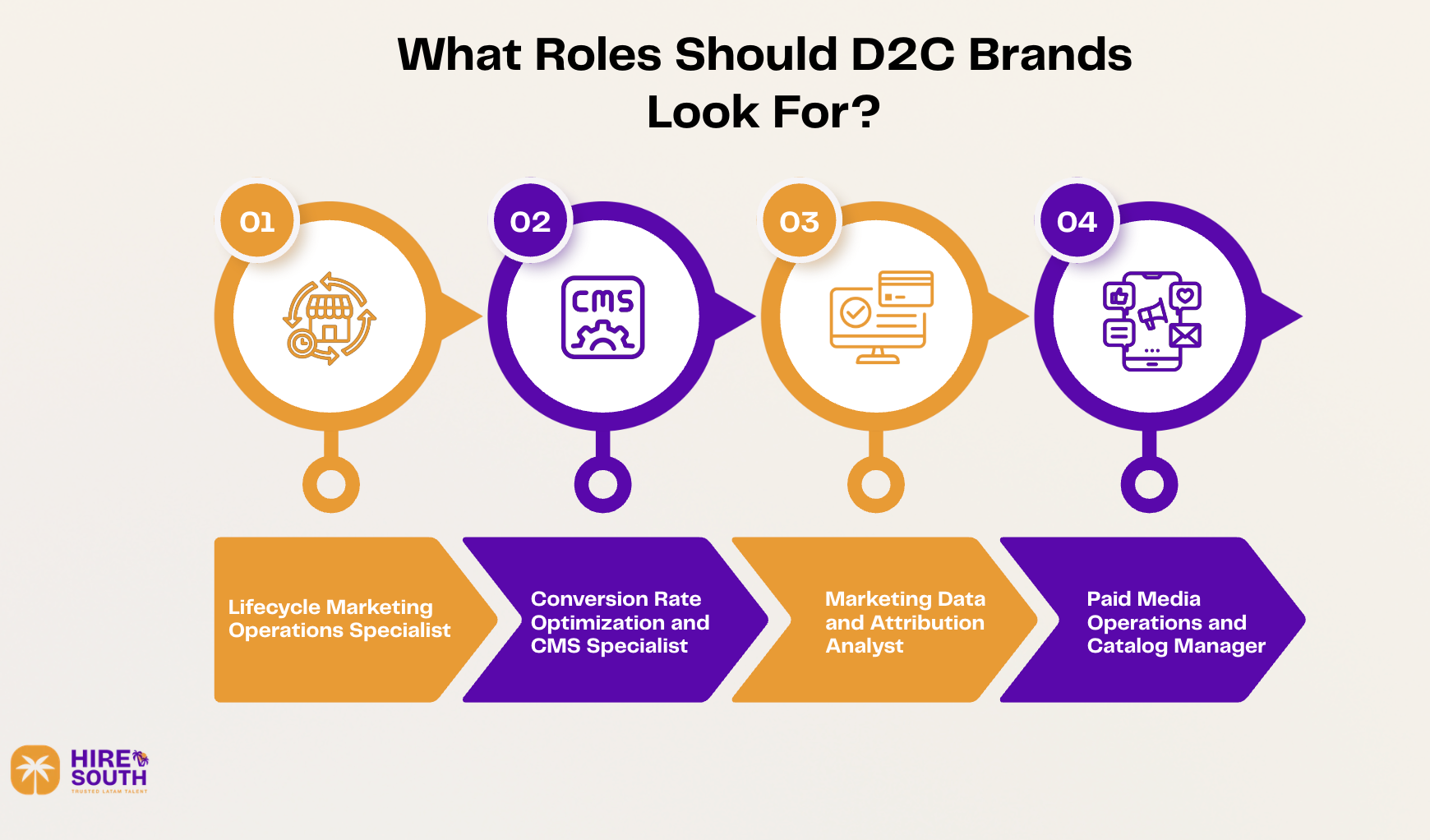
Prioritizing headcount in a direct-to-consumer operations division requires balancing immediate revenue execution with backend stability. Hiring the wrong positions first leads to messy campaign tracking, fragmented tech tools, and lost revenue opportunities.
Focusing on specialized operational hires allows your creative team and media buyers to run far more efficiently.
1. Lifecycle Marketing Operations Specialist
Retention fuels sustainable consumer revenue growth. A lifecycle ops specialist builds, tests, and maintains every automated interaction after a shopper discovers your store.
This professional owns campaign flows within platforms like Attentive. They set up welcome series, abandoned cart triggers, win-back flows, and VIP loyalty segments. Expect them to run systematic A/B tests on deliverability, send times, and dynamic product recommendations.
2. Conversion Rate Optimization and CMS Specialist
Driving paid traffic yields poor results when your storefront displays slow load times or broken checkout elements. A conversion rate optimization specialist monitors onsite user behavior to remove purchase friction.
This role builds custom landing pages in Shopify, manages app integrations, and executes split tests on product detail pages. They analyze heatmaps and cart abandonment rates, ensuring that incoming traffic converts into completed transactions smoothly.
3. Marketing Data and Attribution Analyst
Modern media buying fails without unified data tracking across marketing platforms. An attribution analyst ensures every ad dollar spent maps accurately back to actual sales.
This position configures server-side tracking, sets up Conversion APIs, and manages third-party attribution platforms like Triple Whale or Northbeam. They build custom dashboards, giving your executive team real-time visibility into customer acquisition costs, blended return on ad spend, and contribution margin.
4. Paid Media Operations and Catalog Manager
Launching ad variations across Meta, Google, and TikTok requires ongoing operational upkeep. A paid media ops manager handles technical ad deployment so your buyers can focus on budget management.
This hire builds tracking URL structures, audits tracking pixels, and updates dynamic product catalog feeds. They QA offer codes before major promotional events, eliminating the human errors that burn through advertising budgets.
Best Practices When You Hire LATAM Marketing Ops Teams
Successfully building an international operations arm requires a strategic approach to recruitment, classification, and communication. Treating Latin American talent as an integrated extension of your core organization, rather than a transactional vendor, protects your technical workflows and maximizes return on investment.
1. Localized Sourcing and Engagement Frameworks
Broad job postings across the entire region yield mismatched candidate pools. Effective recruitment targets specific talent density hubs based on your technical needs. For instance, Argentina and Uruguay offer exceptional English proficiency alongside strong analytical talent, whereas Mexico and Colombia feature massive tech talent pools with extensive experience managing high-volume ecommerce storefronts.
You must also establish the right legal engagement model early in the recruiting process. Choosing between independent contractors, Employer of Record (EOR) services, or direct local entities dictates how you handle taxes, benefits, and statutory compliance. Distributed teams increasingly lean on EOR infrastructure to hire compliantly. In fact, 41 percent of distributed companies rely on EOR platforms, while an additional 49 percent plan to adopt them to manage cross-border employment risk, according to Athyna.
2. Technical Vetting and Scenario-Based Skill Assessments
Resume reviews rarely reveal whether an operations specialist can handle high-stakes campaign launches. Your interview pipeline needs practical, scenario-based testing tailored to your tech stack.
When testing data pipelines, ask candidates to map out a fix for broken pixel tracking or resolve server-side attribution gaps between Shopify and Meta Ads Manager. For automation audits, present a mock Klaviyo flow and have the applicant identify logic errors, improper audience exclusions, or deliverability risks. During live problem-solving sessions, evaluate how candidates handle sudden promotional changes, payment gateway outages, or app integration errors under tight deadlines. Standardizing these practical assessments reveals operational fluency far better than traditional Q&A sessions.
3. Seamless Technical Onboarding and Documentation Access
Bringing nearshore team members into your ecosystem requires structured access management and clear process documentation. Delays in system permissions create friction and stall execution from day one.
Set up password managers, enterprise single sign-on, and role-based permissions in tools like Google Analytics and ad accounts before your new hire starts. Provide immediate access to your internal standard operating procedures. Detailed guides for naming conventions, UTM parameters, promotional QA checklists, and tag management keep execution consistent across your entire department.
4. Fostering Inclusive Communication and Synchronous Workflows
Working across shared time zones gives you a massive operational advantage, but maintaining alignment requires intentional daily habits.
Run brief 15-minute morning check-ins via Slack or video calls to align on daily priorities and clear technical blockers. Centralize every project, task, and deadline in platforms like Monday to maintain total visibility over campaign readiness. Finally, include your LATAM team members in broader company updates, quarterly planning, and performance recognition programs.
Teams operating with daily time zone overlap achieve up to 32 percent higher project success rates compared to teams working entirely asynchronously, according to research from MIT Sloan. Treating nearshore hires as true peers builds long-term loyalty and minimizes turnover across your division.
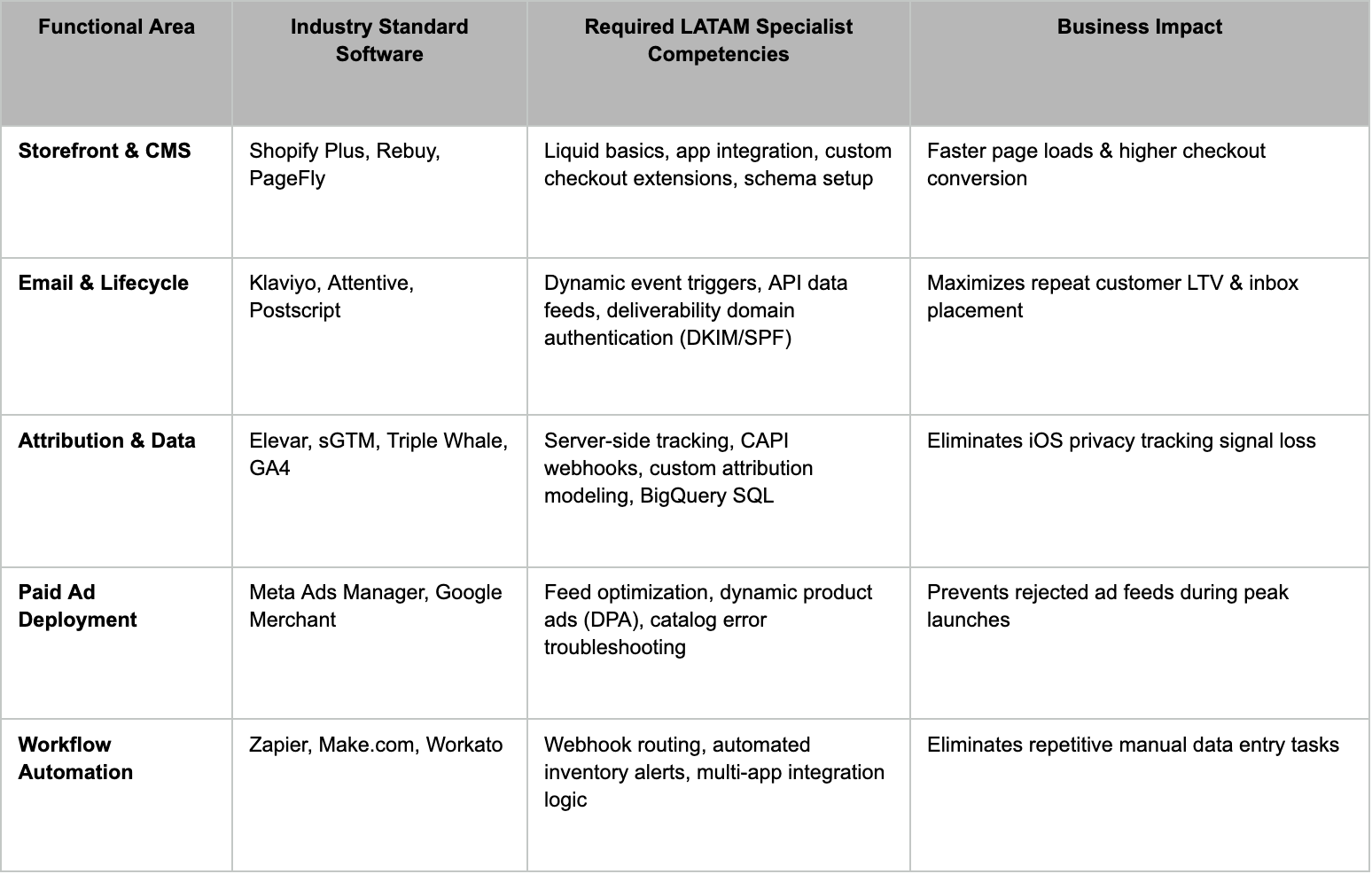
Tool Stack Mapping: Technical Proficiency of LATAM Ops Specialists
A major advantage of hiring nearshore marketing operations specialists in Latin America is their immediate familiarity with modern North American e-commerce tech stacks. Because LATAM specialists work extensively with leading US agencies and venture-backed D2C brands, they require zero ramp-up time on core tools.
Nearshore Tech Stack & Competency Mapping Matrix
How to Vet LATAM Marketing Ops Talent: Scenario-Based Testing
Resume reviews fail to predict whether a candidate can handle high-stakes promotional launches under pressure. At HireSouth, we utilize a 3-Stage Scenario-Based Technical Audit during candidate screening.
Scenario Test 1: The Broken Attribution Audit
- The Prompt: "Shopify shows 150 sales for yesterday's campaign, but Meta Ads Manager only records 82 conversions. Walk us through how you diagnose whether the gap is caused by client-side browser blocking, broken CAPI webhooks, or UTM parameters."
- What a Senior Hire Answers: The candidate systematically inspects sGTM container logs, verifies Event ID deduplication between browser pixel and server events, checks Meta Events Manager match quality scores, and validates UTM parameters via Chrome DevTools.
Scenario Test 2: The Klaviyo Flow & Deliverability Breakdown
- The Prompt: "Our open rates on the 4-step Abandoned Checkout flow dropped from 48% to 19% overnight following a domain migration. How do you audit deliverability and flow logic?"
- What a Senior Hire Answers: The candidate isolates domain authentication records (DKIM, SPF, DMARC), checks dedicated IP reputation, audits recipient engagement exclusions (e.g., excluding profiles who received an email in the last 16 hours), and verifies dynamic tag rendering.
Scenario Test 3: High-Volume Sale Event QA
- The Prompt: "We are launching a 'Buy 2, Get 1 Free' tier discount across 50 SKUs during Cyber Monday, paired with a custom Shopify discount code. How do you QA the storefront before ad spend goes live?"
- What a Senior Hire Answers: The candidate builds a sandbox test environment, verifies app script conflict order, tests checkout stack behavior across desktop and mobile viewports, verifies inventory reservation thresholds, and confirms that cart webhooks fire correctly into Klaviyo.
Frequently Asked Questions About Hiring LATAM Marketing Ops Teams
Why should D2C brands hire marketing ops teams in Latin America instead of Asia?
Direct-to-consumer ecommerce brands require real-time collaboration to troubleshoot tracking pixels, launch daily ad creative, and manage promotional campaigns. LATAM marketing ops teams share up to 8 hours of direct workday overlap with US time zones (EST/CST/PST) and possess native C1 English fluency, whereas Asian offshore setups introduce 10-to-12-hour delays that stall campaign execution.
What are the most critical marketing ops roles to hire first for an ecommerce brand?
The two most critical initial marketing ops hires for a growing D2C brand are a Lifecycle Marketing Operations Specialist (to own Klaviyo/Attentive retention revenue) and a Marketing Data & Attribution Analyst (to manage server-side tracking, GA4, and CAPI attribution accuracy).
How much can a D2C brand save by hiring nearshore LATAM marketing ops talent?
A D2C brand typically cuts payroll and operational overhead by 50% to 70% when hiring nearshore LATAM talent compared to localized US hires. For example, a senior Klaviyo Lifecycle Specialist in LATAM costs between $42,000 and $58,000 annually, compared to $95,000 to $125,000 in the US.
How does HireSouth guarantee the quality of LATAM marketing ops talent?
HireSouth subjects all candidates to a rigorous 4-stage vetting framework that includes hard skill software audits (Klaviyo, Shopify, sGTM), live scenario-based problem-solving tests, C1/C2 English communication evaluations, and strict US timezone matching, backed by a 90-day risk-free replacement guarantee.
Scale Your D2C Marketing Operations Engine with Hire South
Building a high-performing operations engine is the fastest way to protect your profit margins and scale your ecommerce business predictably. Shifting your hiring strategy to Latin America gives you access to pre-vetted, bilingual talent with direct workday overlap, cutting your staffing costs by up to 40 percent compared to domestic hires.
At Hire South, we streamline the entire nearshore hiring pipeline so you can skip the guesswork. Our founder-led team matches your direct-to-consumer brand with top-tier LATAM marketing ops, paid media, and analytics specialists in as little as 10 days. We manage sourcing, technical vetting, transparent salary negotiation, and onboarding paperwork, allowing you to focus on high-level growth while we build your remote department. Ready to scale your operations without increasing overhead? Schedule a brief discovery call with Hire South today to receive your shortlist of pre-vetted candidates.