


Finding the right candidate for a distributed team often feels like searching for a needle in a global haystack. If you only start looking for talent when an open position becomes critical, you are already playing catch-up. The modern, distributed market moves too fast for reactive hiring. You need a proactive strategy to keep your company ahead.
Building a robust pipeline ensures a steady stream of pre-screened, engaged candidates ready to step in the moment you need them. The proof is in the data. According to Glassdoor, fully remote job postings attract an average of 4.7 times more applications per listing than equivalent on-site roles, giving flexible companies a massive recruiting velocity advantage. However, managing that flood of interest without losing top-tier talent requires intentional structure.
This guide breaks down exactly how to build and maintain a high-performing remote talent pipeline. You will learn how to identify global talent hubs, automate candidate engagement, and utilize modern tools to keep your talent pools warm. Let's look at how you can transform your hiring from a stressful scramble into a predictable, scalable asset.
Why a Remote Talent Pipeline Strategy is Essential in 2026
The hiring landscape has fundamentally changed, shifting from the erratic post-pandemic scramble to a highly structured, competitive equilibrium. Waiting until a critical role opens up to begin your candidate search is an expensive liability. In 2026, the companies winning the best global talent are those that treat recruitment as a continuous, proactive pipeline rather than a reactive fix.
The Realities of Market Competition.
The narrative that remote opportunities are disappearing is flatly contradicted by data. According to extensive research tracking remote-capable roles by Gallup, 27 percent of remote-capable U.S. workers remain fully remote, while an additional 53 percent operate in a hybrid structure. Because these figures have completely stabilized, job seekers have permanent expectations around flexibility.
If you do not have an active talent pipeline constantly engaging these professionals, your competitors do. Top tier candidates are rarely browsing job boards when you happen to post a listing. They are already embedded in corporate talent communities, subtly nurtured until the right role becomes available.
The Compounding Costs of Vacancy.
Leaving a specialized remote position open for months destroys team momentum and strains your existing workforce. In highly specialized sectors like cloud engineering, cybersecurity, or advanced data analytics, the time to fill a vacancy can skyrocket when you limit yourself to active applicants. According to placement data from KORE1, job requisitions that are strictly tied to full-time, on-site mandates take an average of 41 percent longer to fill than flexible arrangements.
Even if you offer remote options, running a traditional, reactive search process still introduces weeks of friction. A pre-vetted talent pipeline eliminates this lag, dropping your time to fill from months to days because the foundational screening, compliance checks, and initial conversations are already complete.
Accessing Global Cost Efficiencies Without Sacrificing Quality.
Building a continuous pipeline allows your organization to map out compensation strategies across diverse geographic hubs systematically. White-collar professionals put a massive financial premium on the ability to work from anywhere. According to Stanford University’s WFH Research project, workers value a hybrid or remote arrangement at the equivalent of an 8 percent raise, with elite tech professionals willing to trade up to 25 percent of their total compensation to avoid a five-day office commute.
A well-managed talent pipeline lets you leverage these preferences on a global scale. Instead of fighting localized salary wars in hyper-expensive tech capitals, you can identify, track, and build relationships with exceptional talent in emerging markets well ahead of your actual hiring deadlines.
Key Elements For a Successful Talent Pipeline
Building a framework that consistently attracts and warms high-caliber professionals requires moving past old resume databases. A modern pipeline relies on active relationship management and data tracking. If you want to insulate your business from sudden talent shortages, certain core components must be built directly into your recruitment infrastructure.
1. Continuous Sourcing and Automated Engagement
A pipeline is only as good as the fresh talent entering it. Sourcing cannot be treated as a project with a defined start and stop date. Instead, your acquisition team must continuously identify potential talent, even when your headcount is completely full.
Maintaining touchpoints manually with hundreds of passive leads is impossible. According to data from Aptitude Research, 65 percent of talent acquisition leaders expect their technology budgets to increase, prioritizing tools that automate candidate nurturing without sacrificing a personal touch. By utilizing automated messaging sequences, you keep your employer brand top of mind. When a role inevitably opens up, you are reaching out to a warm contact rather than a cold lead.
2. Structured Candidate Profiles Matched to Long-Term Business Goals
Do not collect resumes aimlessly. A successful pipeline requires clear candidate personas built around the exact skills your company will need over the next twelve to eighteen months. This means sitting down with department heads to map out future project roadmaps before sourcing begins.
Core competencies, time zone availability, and technical expertise should categorize every profile in your talent pool. When you align your sourcing targets directly with upcoming business objectives, you stop collecting arbitrary applications. You begin cultivating a highly specialized, accessible workforce extension.
3. Predictable Cost and Efficiency Benchmarking
To prove your pipeline is functioning efficiently, you must track the financial impact of your sourcing efforts. Relying entirely on reactive job board postings drives up acquisition costs significantly over time. According to the Society for Human Resource Management 2026 Recruiting Benchmarking Report, the median cost per hire for non-executive positions has risen to $1,300, while executive hires have climbed sharply to a median of $15,000.
A healthy pipeline acts as a direct counterweight to these rising marketplace expenses. By cultivating an internal database of pre-vetted professionals, you decrease your dependence on expensive third-party agencies and premium job board promotions. You can measure pipeline success by watching your cost per hire drop and observing a parallel contraction in your overall time to fill.
How to Build a Talent Pipeline
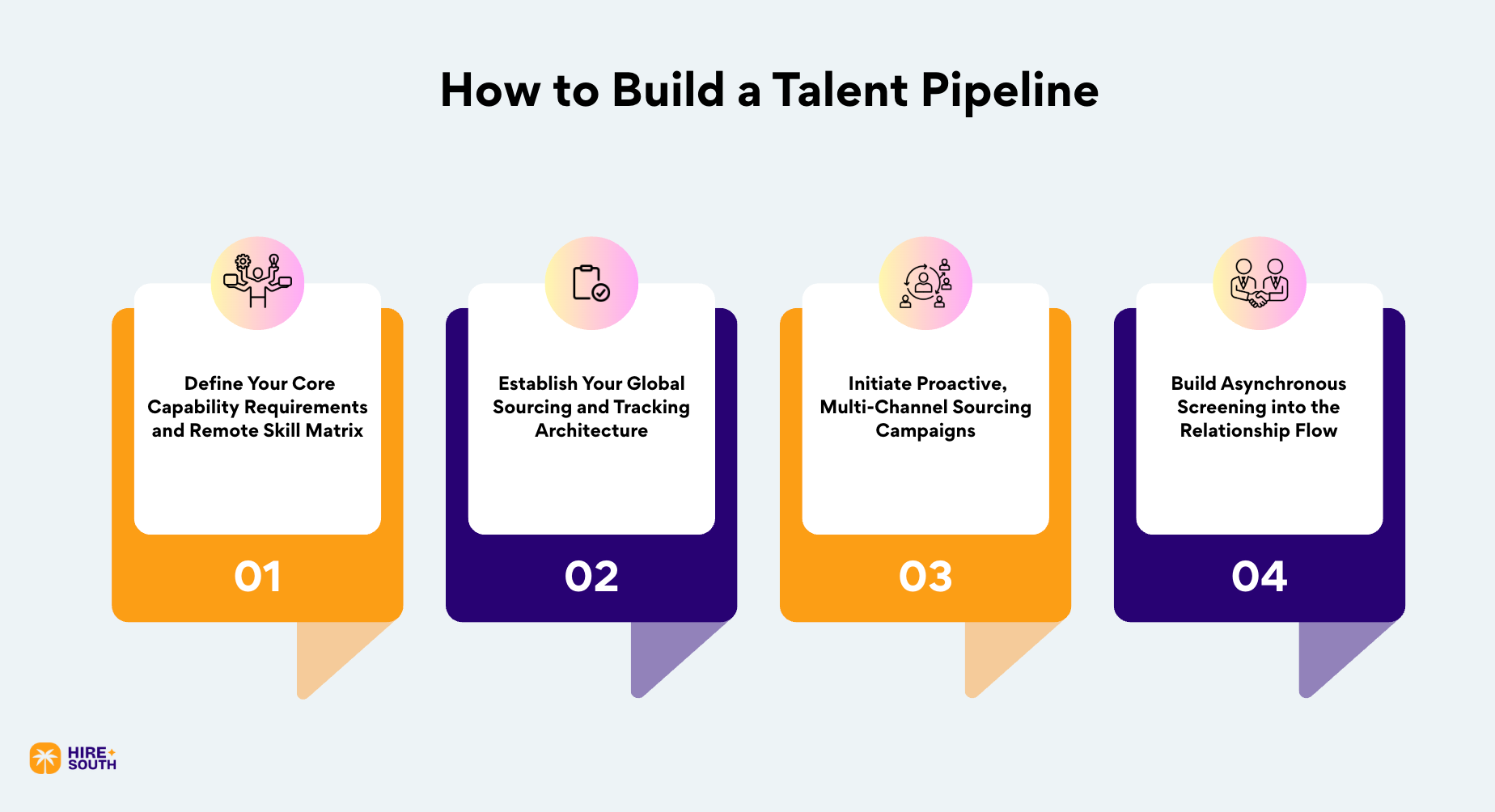
Transitioning from reactive job postings to a self-sustaining talent engine requires a deliberate operational shift. You cannot build a functional candidate network overnight. By breaking the pipeline creation process down into distinct tactical phases, you can systematically cultivate a reliable community of pre-vetted professionals.
Phase 1: Define Your Core Capability Requirements and Remote Skill Matrix
Before reaching out to a single candidate, you must establish the exact operational profiles your company will require over the coming year. Do not look for generalists. Instead, map out specialized remote skill sets, such as asynchronous communication proficiency, cross-border compliance knowledge, or specific technical certifications.
Every department head should contribute to this ideal candidate profile. According to data from the Curriculo ATS 2026 hiring benchmarks report, the national average time-to-fill a vacant corporate position has reached approximately 45 days. Defining your targeted capabilities early minimizes this timeline by ensuring your sourcing teams are not wasting cycles on mismatched profiles.
Phase 2: Establish Your Global Sourcing and Tracking Architecture
Once you know who you are looking for, you need a centralized digital infrastructure to house your talent leads. A standard spreadsheet will quickly fall apart under the weight of hundreds of international profiles. You must implement a dedicated Candidate Relationship Management platform or an advanced Applicant Tracking System.
Your tracking framework must categorize candidates by their geographic location, time zone availability, and specific operational strengths. This structure allows your recruiting team to search internal databases instantly. When a vacancy occurs, you can bypass public job boards entirely.
Phase 3: Initiate Proactive, Multi-Channel Sourcing Campaigns
With your tracking tools in place, your sourcing team can begin identifying passive talent. Look beyond mainstream professional networks. Explore specialized digital communities, open-source repositories, and region-specific remote employment platforms.
Your initial outreach should never look like a hard sales pitch. Focus on sharing high-value industry insights, company engineering challenges, or organizational culture highlights. According to recruiting data from National University, 31 percent of modern candidates decline job offers, frequently pointing to poor communication during the initial touchpoints as their primary reason. Building a foundation of transparent, early communication mitigates this drop-off rate later.
Phase 4: Build Asynchronous Screening into the Relationship Flow
A pipeline is only valuable if the candidates within it are genuinely qualified. You must introduce lightweight, non-intrusive screening mechanisms early in the nurturing process. Use brief technical challenges, short video updates, or structured behavioral questionnaires that candidates can complete on their own schedules.
Integrating these asynchronous touchpoints respects the candidate's time while subtly validating their remote communication capabilities. This continuous screening ensures that when an internal hiring manager asks for candidates, you are delivering a curated list of verified professionals.
Phase 5: Maintain Continuous Database Engagement Over Time
The greatest point of failure in pipeline development is candidate stagnation. If you source an exceptional professional but ignore them for six months, that lead goes completely cold. You must establish a consistent cadence of automated yet personalized interactions.
Send quarterly company updates, invite your talent pool to internal webinars, or check in regarding their current career progression. Keeping your candidate database warm guarantees a high response rate. When a critical position opens, your brand remains at the top of their mind.
Key Metrics for Pipeline Optimization
Investing time and resources into pipeline development is only half the battle. You must actively audit the health of your candidate pool to ensure your sourcing strategy actually works. Tracking the right data highlights functional bottlenecks, validates your hiring choices, and proves the financial return on your relationship-building efforts.
Pipeline Conversion Rate:
Your pipeline conversion rate measures the exact percentage of nurtured, passive leads who successfully transition into active job applicants or formal hires when a matching vacancy opens. A low conversion rate typically points to a disconnect in your messaging or poor initial candidate targeting.
Sourced and nurtured professionals consistently outperform cold applicants across this metric. According to data from the Gem Recruiting Benchmarks report, proactively sourced candidates are five times more likely to be hired than inbound applicants who apply through traditional job boards. Tracking this conversion delta allows you to justify shifting recruiter hours away from reviewing public applications and toward direct outbound sourcing.
Channel Sourcing Efficiency and Source of Hire:
You need to know exactly which digital communities, professional platforms, or regional talent hubs yield your highest-performing remote team members. Monitoring your source of hire prevents your acquisition team from spreading their efforts too thin across underperforming platforms.
Relying purely on mass job boards frequently results in administrative fatigue rather than quality placements. Job boards deliver 49 percent of total application volume but account for only 24.6 percent of actual hires. By identifying the specific niche networks or remote-first databases that generate your final hires, you can confidently reallocate your recruitment budget to the channels that produce the highest density of elite talent.
Cost Per Hire Reductions:
A healthy talent network should steadily lower your overall recruitment expenses over time. Calculate your cost per hire by combining your internal recruitment costs, external agency fees, and software expenditures, then dividing that total by the number of hires made within a specific timeframe.
Building a warm talent network acts as a direct shield against inflation in the recruiting market. According to the 2026 Recruiting Executives Benchmarking data from the Society for Human Resource Management, the average cost per hire for a non-executive position stands at $4,700, while executive hires have sharply escalated to a median of $15,000. When you pull pre-vetted professionals directly from an existing, internal pipeline, you eliminate premium job board fees and third-party placement costs, significantly lowering your baseline acquisition expenses.
Time to Fill for Pipeline Hires vs. Cold Hires:
Time to fill tracks the total number of calendar days required to identify, interview, and secure an offer acceptance for an open role. To prove the operational value of your network, you must contrast the time to fill of pipeline-sourced candidates against traditional, reactive candidates.
Traditional hiring timelines continue to lengthen globally due to increased process friction and extensive interview stages. According to benchmark data from the Society for Human Resource Management, the typical U.S. time to fill has climbed to an average of 44 days, marking a notable 33 percent increase from previous baseline cycles. Maintaining a continuous pipeline completely alters this dynamic. Because initial screening and relationship-building occur long before the role opens, you can frequently drop your time to fill down to under two weeks, keeping your internal teams fully staffed and productive.
Ready to Hire Remote Talent in Latin America?
Shifting your recruitment model from a reactive scramble to a structured, continuous pipeline is the most reliable way to secure top-tier talent without inflating your operational costs. When you build a proactive community of pre-vetted professionals, you insulate your company from sudden talent shortages and drastically reduce your overall time to fill.
At Hire South, we specialize in helping growing organizations bypass the friction of traditional international hiring. We connect you directly with elite, bilingual professionals across Latin America who operate within your exact time zone. Our nearshore solutions allow you to scale your engineering, sales, marketing, and customer support operations seamlessly, delivering up to 40% savings compared to standard domestic hires.
We take care of the entire lifecycle, including sourcing, extensive vetting, payroll, and cross-border compliance, so your team can focus exclusively on strategic growth. Because we stand confidently behind our vetting process, there are zero upfront costs, and we provide a complete replacement guarantee. Contact us today to schedule a consultation and view a curated shortlist of remote professionals ready to move your business forward!