


Scaling your software without breaking your release schedule is a massive operational headache. Traditional quality assurance struggles to keep up with rapid deployment demands, making artificial intelligence testing a necessity rather than a luxury.
To bridge this gap, modern tech companies are increasingly looking south. Latin America produces over 220,000 new STEM graduates every year, according to Athyna, giving you immediate access to a deep pool of skilled engineers.
This guide explores why nearshoring your AI QA testing to Latin America delivers real-time collaboration, smooth integration, and massive cost efficiency. Here is how you can tap into the region's top tech hubs to build a faster, more reliable testing pipeline.
The Growing Necessity of AI QA Testing in Modern Software
Modern Software Complexity Has Broken Traditional Quality Assurance:
Legacy testing frameworks were built for predictable, slow software updates. Modern development environments move at a pace that renders manual checks and simple, script-based automation obsolete.
When your engineering team pushes code changes multiple times a day, traditional scripts constantly break due to minor user interface updates or minor backend changes. Your team spends more time updating broken test scripts than actually catching critical bugs.
Artificial intelligence changes this dynamic completely by introducing self-healing test automation, dynamic test case creation, and autonomous bug triage.
High Financial and Reputation Costs of Late Bug Detection:
Catching software defects in production is extraordinarily expensive. The cost of fixing a bug increases exponentially as software moves through the development lifecycle, from initial design all the way to deployment. Fixing a defect found during production can cost up to 100 times more than addressing that same issue during the design stage.
Beyond direct development costs, releasing buggy software destroys user trust. Releasing buggy software leads to immediate customer churn, negative public reviews, and severe loss of brand equity.
How Artificial Intelligence Accelerates the Testing Lifecycle:
Integrating artificial intelligence into your QA strategy shifts bug detection to the left, allowing your development team to catch defects early in the build pipeline.
Machine learning models identify element changes in application code and automatically update test selectors, eliminating broken pipelines. Generative models analyze application user flows, automatically drafting thousands of realistic test scenarios in minutes. Algorithms analyze past commits and system logs to flag high-risk areas of the codebase, directing human attention where it matters most.
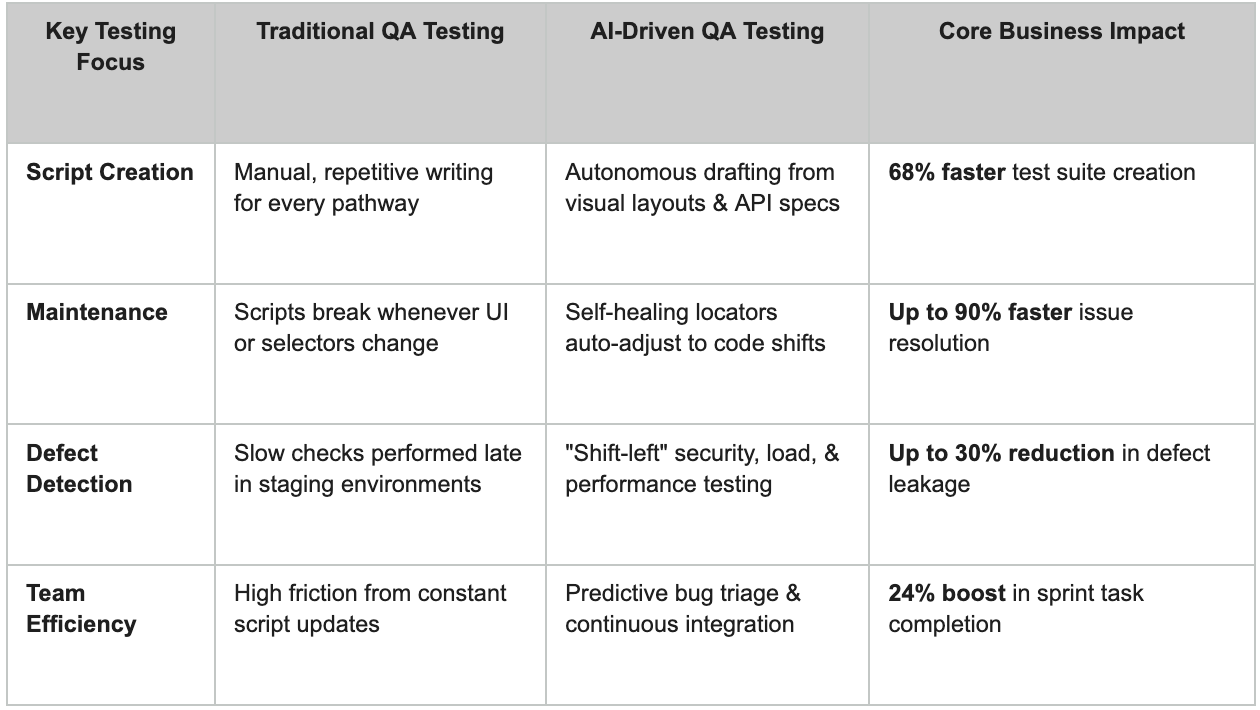
Adopting AI-based QA platforms allows teams to achieve up to 68% faster test suite creation, according to a report by Mordor Intelligence. Additionally, AI-driven testing tools reduce defect leakage by up to 30% and cut issue detection times by up to 90%.
The Expanding Market for Autonomous QA Solutions:
The shift toward AI-enabled quality assurance is no longer an optional experiment for forward-thinking companies. It has become a foundational baseline for competing in the modern software economy.
The global AI-enabled testing market is projected to reach 1.21 billion dollars in 2026, according to Fortune Business Insights, with continuous expansion projected toward 4.64 billion dollars by 2034 as cloud platforms adopt autonomous testing architectures.
Deploying AI QA testing provides an undeniable competitive advantage, giving your organization the operational resilience needed to release cleaner code, maintain lightning-fast deployment cycles, and retain user confidence.
How Artificial Intelligence Accelerates the Testing Lifecycle
1. Real-Time Autonomous Test Generation
Writing manual test scripts for every potential user pathway creates severe bottlenecks in agile development cycles. Generative machine learning platforms address this delay by reading code updates, API specifications, and visual layout changes to construct fully functional test scripts autonomously.
These systems analyze real user interaction patterns in staging environments to automatically mirror high-volume traffic scenarios. Instead of QA engineers spending hours drafting repetitive assertions, automated tools generate comprehensive regression suites in seconds, expanding overall test coverage while freeing human engineers to focus on high-risk edge cases and strategic exploratory testing.
2. Elimination of Test Maintenance via Self-Healing Locators
The single largest time drain for modern quality assurance teams is repairing brittle, broken test scripts caused by minor UI shifts or updated DOM elements.
AI-augmented testing frameworks utilize dynamic visual models and element attribute mapping to resolve selector changes autonomously on the fly. When a button ID or location shifts, the self-healing algorithm recognizes the element's functional context, updates the target locator dynamically, and proceeds with the run.
This automation capability drastically reduces pipeline failures, allowing testing suites to run continuously without constant manual intervention.
3. Shift-Left Vulnerability and Performance Detection
Waiting until staging or pre-production to test non-functional requirements guarantees costly delayed releases. Artificial intelligence embeds security scanning, performance monitoring, and load simulation directly into early development stages.
- Machine learning algorithms scan pull requests before code merges, identifying memory leaks, API vulnerabilities, and concurrency flaws immediately.
- AI agents run micro-load tests against individual microservices during initial build steps, predicting performance degradation well before full-system integration.
- Automated systems generate synthetic, privacy-compliant test datasets, allowing developers to safely test complex data pipelines without risking exposure of real user PII.
4. Operational Productivity Gains Driven by AI Testing
The adoption of artificial intelligence tools converts quality assurance from a slow, reactive gatekeeper into a fast driver of software deployment speed.
The global AI-powered software testing and QA market reached 11.99 billion dollars in 2026 and is projected to expand to 39.43 billion dollars by 2031, according to Mordor Intelligence. Engineering teams leveraging continuous testing automation experience a 24% boost in task completion speed when managing complex regression cycles, according to research published by Lead with AI.
These productivity gains allow technology organizations to maintain rapid deployment cadences without compromising code stability or user experience.
Advancing AI QA Testing Capabilities With Nearshore Teams
Real-Time Collaboration Accelerates Continuous Delivery:
Offshore QA models often introduce frustrating 12-hour communication lags that stall deployment pipelines. Nearshore engineering teams operating in Latin America work within American time zones, providing six to eight hours of direct daily overlap with your core product management and development teams.
This synchronization allows nearshore testers to join your morning standups, participate in sprint planning, and execute immediate root-cause analysis when automated test suites fail during live continuous integration pipelines. Bugs identified during morning builds get triaged, assigned, and re-tested within the same workday.
Rapid Upskilling in Generative AI and Machine Learning:
Latin America has become a massive engine for artificial intelligence talent acquisition. Professional upskilling in artificial intelligence technologies has surged across key regional tech hubs, with regional enrollment in generative AI training programs jumping 425% year-over-year, according to the Coursera Job Skills Report.
This educational momentum means nearshore QA professionals do not merely run legacy manual test scripts. They enter your organization equipped to train computer vision models, evaluate large language model outputs for hallucination rates, and integrate machine learning frameworks directly into enterprise automation pipelines.
Seamless Cultural Alignment and Communication High Standards:
Effective software testing requires clear communication, analytical pushback, and nuanced understanding of business logic. Nearshore professionals bring high levels of English proficiency alongside a direct communication style that integrates naturally into North American engineering cultures.
Tech leaders report an 87% satisfaction rate when operating with Latin American outsourcing teams, compared to just 53% for teams based in Asia, according to joint research conducted by Auxis and SSON Research. This strong operational alignment reduces friction in pull request reviews, improves test scenario documentation, and ensures external testers challenge flawed product requirements constructively before code hits staging environments.
High Retention Rates Protect Institutional Knowledge:
High churn rates in distant offshore destinations frequently wipe out institutional knowledge, forcing engineering managers to repeatedly spend months re-onboarding replacement testers. Latin American tech centers offer vastly improved retention metrics due to stable career development pathways and competitive local tech ecosystems.
Maintaining a stable nearshore QA team preserves domain knowledge regarding your codebase architecture, edge-case quirks, and legacy microservices. Long-term team continuity directly improves the accuracy of automated test suites, limits duplicate bug reports, and ensures your testing strategy matures smoothly alongside your primary product ecosystem.
Conclusion
Integrating artificial intelligence into your QA workflows requires skilled engineers who can build self-healing automation, run continuous testing pipelines, and collaborate in real time with your dev team. Modern tech leaders cannot afford broken deployment pipelines or long communication delays, making regional proximity a major operational advantage.
That is where we come in. At Hire South, we connect you directly with top-tier, pre-vetted LATAM talent specializing in AI QA testing, software development, and modern automation. We manage the entire candidate search, rigorous technical vetting, compliance, and payroll so you can onboard senior-level engineers operating within your exact time zone in weeks. Companies partnering with us slash payroll expenses by up to 40% compared to local hiring without compromising technical quality.
Ready to scale your quality assurance operations faster and more efficiently? Schedule a free discovery call with Us today to access the region's best engineering professionals.