


Leading a remote engineering unit requires more than just assigning tickets. It demands a clear strategy for communication, culture, and performance management. The stakes are high. If you are struggling to keep your distributed talent aligned, you are certainly not alone. Actually, 72 percent of organizations outsource part of their software development, according to the Deloitte Global Outsourcing Survey.
This guide walks you through the entire lifecycle of a distributed engineering unit. You will learn exactly how to build a high-performing group. Discover the best ways to source top-tier talent, and see how to seamlessly integrate external contractors into your daily operations.
At the end of this article, you’ll leave with actionable strategies for overcoming common roadblocks and scaling your operations. Prepare to rethink your approach to distributed leadership!
What’s Behind a Great Nearshore Team Leader
What exactly makes a successful nearshore team leader? Top managers bridge geographical gaps by mastering cultural intelligence, outcome-based performance, and asynchronous empathy. They create environments where remote software engineers thrive without constant surveillance.
1. Prioritizing Asynchronous Empathy
Great leaders do not expect instant replies. They know that even with overlapping time zones, constant pinging disrupts deep work. You must build a system where information flows smoothly without requiring everyone to be online at the exact same moment.
Teams utilizing asynchronous workflows report a 43 percent increase in overall productivity, according to a 2022 survey by GitLab. You can achieve this by documenting decisions thoroughly. Leave clear instructions in your project management tools. Give your developers the context they need to execute tasks independently.
2. Cultivating Contextual Intelligence
Working with nearshore talent means blending different professional norms. A high-performing leader understands these subtle cultural differences. For instance, developers in certain regions often value relationship building before diving into technical requirements.
You need to adapt your communication style. Take five minutes at the start of a meeting to ask about their week. Building that basic human connection prevents misunderstandings later when project deadlines get tight.
3. Managing by Outcomes Rather Than Hours
Tracking keystrokes is a fast track to destroying trust. The best managers evaluate their nearshore software development team based on deliverables. Your focus should be on sprint completion rates and code quality.
Employees subjected to micromanagement are 68 percent more likely to experience severe burnout, according to a 2021 study by the American Psychological Association. Set clear criteria for success. Let your engineers figure out the best way to reach the finish line.
4. Fostering Cross-Border Psychological Safety
Remote engineers must feel safe pointing out architectural flaws. If they fear reprimand, they will stay quiet while technical debt accumulates. A great leader actively asks for pushback and values constructive criticism.
You can build this safety by reacting positively to bad news. Celebrate developers who catch critical bugs before deployment. When you reward transparency, you build a highly resilient and innovative nearshore team.
Best Practices to Lead Your Nearshore Software Development Team
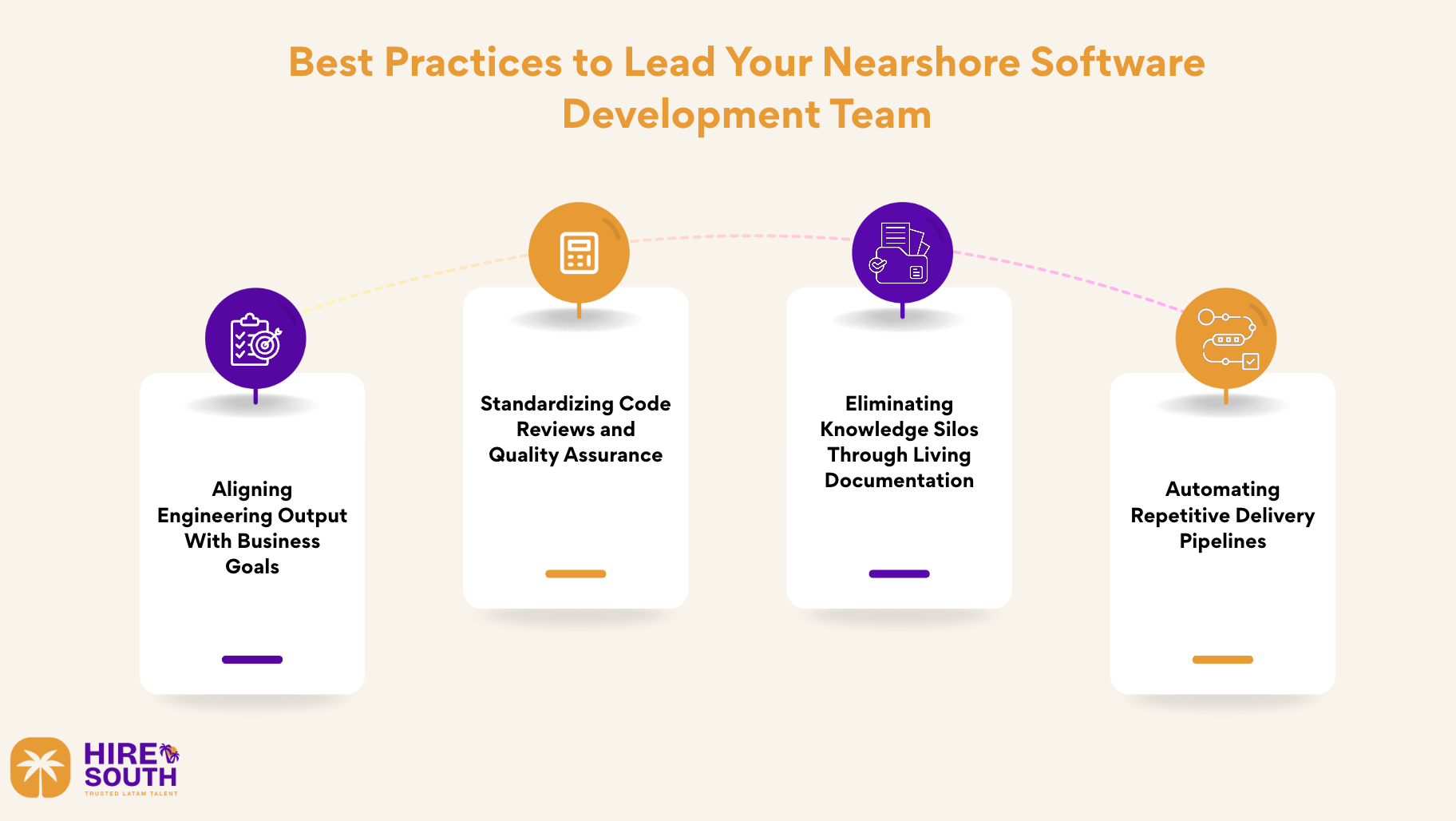
1. Aligning Engineering Output With Business Goals
Developers build better software when they understand the underlying business problem. Stop handing down lists of isolated features. Explain exactly how the code impacts the end user and drives revenue.
This context prevents engineers from wasting time on low-priority technical tasks. Organizations with highly aligned projects report 71 percent higher success rates, according to the Project Management Institute. You can easily achieve this alignment by inviting your lead engineers to product roadmap meetings. Give them a seat at the table so they see the bigger picture.
2. Standardizing Code Reviews and Quality Assurance
Consistent peer reviews act as your primary defense against technical debt. Do not treat quality assurance as an afterthought or a bottleneck. Make thorough code reviews a mandatory step before any pull request gets merged.
This practice ensures that no single developer becomes a hidden point of failure. Peer code reviews catch up to 60 percent of software defects, according to the Software Engineering Institute at Carnegie Mellon University. Keep the feedback strictly objective. Direct the review toward logic and architecture rather than personal coding styles.
3. Eliminating Knowledge Silos Through Living Documentation
Relying on oral tradition to explain your software architecture is a massive risk. If your lead architect leaves tomorrow, your development progress should not grind to a halt. You need living documentation to support your nearshore operations.
Treat your internal wikis like actual software products. Knowledge workers spend an average of 1.8 hours every day simply searching for internal information, according to a workplace report by McKinsey. Reclaim that lost time by requiring engineers to update system documentation alongside every major feature release. Make active knowledge sharing a core responsibility.
4. Automating Repetitive Delivery Pipelines
Manual software deployments destroy engineering momentum. Leading a modern dev team requires a relentless focus on automation. You must implement continuous integration and continuous delivery practices across your entire technology stack.
Let the machines handle testing, code formatting, and routine deployment tasks. High-performing engineering teams that utilize continuous delivery spend 22 percent less time on unplanned work and rework, according to the Accelerate State of DevOps Report. Free your remote developers from tedious manual configurations. Direct their creative energy toward solving complex user problems instead.
How to Optimize Communication in Your Nearshore Software Development Team
Establishing Clear Response Time Agreements:
Remote collaboration easily devolves into a chaotic mess of constant notifications. You must establish communication protocols to prevent notification fatigue. Define exactly how quickly team members need to reply across your different platforms.
Direct messaging might require a response within two hours, while project board tags could carry a twenty four hour expectation. Setting these explicit boundaries reduces anxiety. Workers switch between different workplace applications nearly 1,200 times a day, according to a 2022 study published in the Harvard Business Review. Stop this context switching by making it explicitly clear that immediate replies are rarely necessary.
Creating a Centralized Technical Glossary:
Language differences often cause subtle but expensive delays. Even if your external developers speak fluent English, technical jargon varies wildly across regions and companies.
Build a centralized glossary for your specific project. Define your unique acronyms, architecture terms, and variable naming conventions in one place. This single source of truth eliminates translation bottlenecks. When everyone uses the exact same vocabulary, debugging sessions run significantly faster and code deployment accelerates.
Running Highly Structured Agile Ceremonies:
Do not let your daily check-ins mutate into lengthy status reports. Keep these meetings incredibly tight and strictly focused on blockers.
A daily standup should never exceed fifteen minutes. If a specific architectural issue requires a deep discussion, move it to a separate parking lot meeting with only the relevant engineers. Reducing scheduled meetings by 40 percent actually increases employee productivity by 71 percent, according to a 2022 study by MIT Sloan Management Review. Protect the calendars of your nearshore software development team fiercely so they have actual time to write code.
Leveraging Visual Feedback Tools:
Explaining a complex user interface bug over text is frustrating. Visual communication bridges geographical divides almost instantly.
Encourage your engineers and quality assurance testers to use screen recording software. Annotated screenshots also work exceptionally well when reporting visual defects. A quick two-minute video demonstrating a broken login flow conveys much more than three paragraphs of written text. This straightforward habit prevents endless back-and-forth clarification threads in your messaging apps.
Scaling Your Successful Nearshore Team for the Future
1. Evolving From Individual Contributors to Autonomous Squads
Once your initial remote hires prove their value, it is time to shift your operational model. Stop plugging individual external developers into your internal departments. Build cross-functional, autonomous product squads instead.
Give these squads their own product managers, designers, and quality assurance testers. This independent structure allows them to own entire features from conception to deployment. Highly aligned and autonomous teams are twice as likely to meet their business goals, according to a 2023 report by the Harvard Business Review. You eliminate bottlenecks when a unit does not have to wait for your headquarters to approve every minor design change.
2. Integrating Artificial Intelligence Coding Assistants
Scaling output does not always mean doubling your headcount. You can multiply the productivity of your existing team by adopting advanced development tools.
Equip your team with AI-driven code completion software and automated testing generators. Software engineers using AI coding assistants complete tasks up to 55 percent faster, according to a controlled study by GitHub. Introduce these tools gradually. Set clear security guidelines regarding what internal code can be shared with third-party language models, ensuring your intellectual property remains secure as your velocity increases.
3. Building Leadership Pipelines Across Borders
Your future technical directors should emerge from your current nearshore talent pool. Promote from within to retain institutional knowledge as your operation expands.
Identify senior engineers who show strong mentorship skills. Give them small groups to manage, and provide management training specifically tailored to remote environments. Companies that actively promote internal mobility retain their employees for an average of 5.4 years, compared to just 3.2 years for companies that do not, according to workplace research published by LinkedIn. Investing in their career progression turns temporary contractors into fiercely loyal company leaders.
4. Standardizing Security Protocols for Larger Workforces
Growth introduces new vulnerabilities. A security setup that worked for five contractors will not protect a distributed workforce of fifty. You must tighten your data access controls as you add more personnel.
Implement zero trust network architectures. Require multi-factor authentication for every code repository and internal database. Limit access privileges so that developers only interact with the data strictly necessary for their current sprint. This proactive approach prevents accidental breaches while keeping your expanding remote footprint compliant with international privacy laws.
Ready to Hire and Lead a Nearshore Software Development Team?
Leading a distributed engineering unit gives you a clear advantage when local talent is scarce. The demand for regional developers is growing rapidly. In fact, 80 percent of North American businesses are actively considering nearshore outsourcing, according to market data from Statista.
At Hire South, we supply the technical talent you need to hit your product deadlines. We match your business with senior software engineers located in your own time zone. Our developers step right into your workflow. They adapt to your communication style and push your projects forward. You keep full control over your engineering roadmap and daily operations. We handle the difficult work of recruiting, technical vetting, and international compliance. Contact us now and let us help you scale a reliable, high performing team that consistently delivers excellent software.