


These days, many U.S. companies are looking to Latin America to source top talent, build their teams, and stretch their budgets without sacrificing quality. In fact, U.S. companies save 30% to 70% on salary costs when hiring nearshore talent in Latin America.
Now, are you wondering if you should hire an independent contractor or a full-time employee? This article breaks down everything you need to know about the LATAM staffing landscape. We will cover the core differences between the two models, explore the legal risks of misclassification, and compare the true costs of both options. You'll learn how the laws change from Brazil to Mexico, and how to stay perfectly compliant no matter where you hire.
Whether you're looking to bring on a single freelance designer or build a full software engineering pod, making the right structural choice early is critical. Read on to see how you can safely and effectively build your nearshore team!
The LATAM Independent Contractor Model
At its core, a LATAM independent contractor is self-employed. They operate as their own distinct business entity, rather than integrating fully into your corporate structure. This means you’re essentially entering a business-to-business (B2B) relationship.
This structure offers immense flexibility. You bring in specialized talent for specific deliverables without committing to a long-term, full-time headcount. In this model, you don't dictate their daily schedule, provide their equipment, or manage their local taxes. The contractor is responsible for their own compliance, healthcare, and pension contributions in their home country.
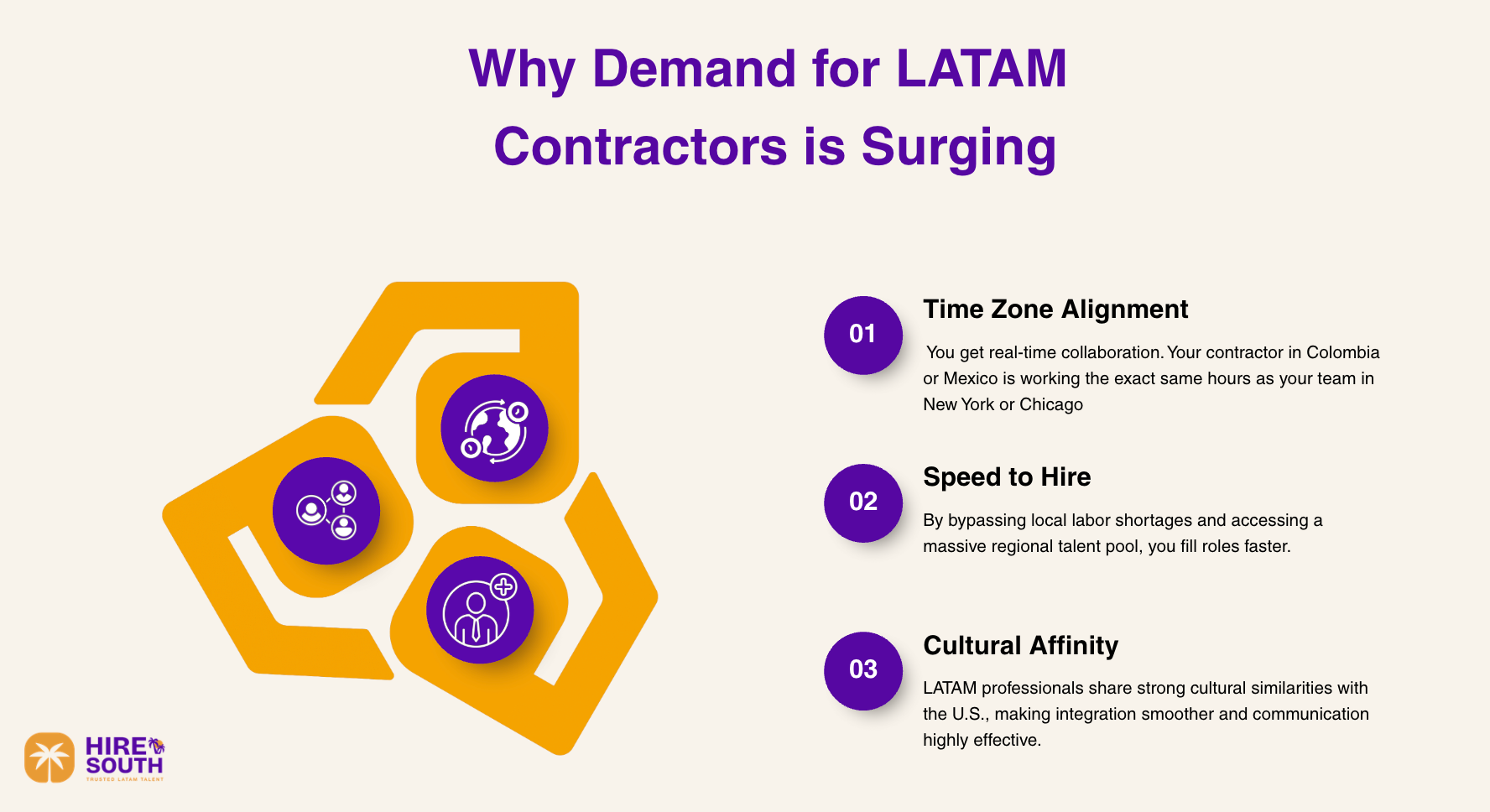
Why Demand for LATAM Contractors is Surging:
The shift toward Latin American talent isn't just a cost-saving measure anymore; it’s a strategic growth play. According to Hire With Near’s 2026 State of LatAm Hiring Report, demand for engineering talent in the region grew 250% year over year. U.S. leaders are utilizing this model because it works.
Here are the primary drivers fueling this expansion:
The Drawbacks: What You Give Up for Flexibility
While the financial and operational benefits are clear, the contractor model isn't perfect for every situation. You trade control for flexibility.
Because a contractor is independent, you cannot mandate their exact working hours or micromanage their daily processes. They are paid for the output, not the hours spent at a desk. If you need someone fully integrated into daily stand-ups who uses company-provided equipment and follows strict internal procedures, the contractor model might expose you to misclassification risks.
Additionally, contractors inherently have less long-term loyalty than full-time employees. They manage their own client roster and can leave for a better opportunity with shorter notice. This turnover can disrupt project continuity and force you to restart the hiring process.
Managing Cross-Border Payments:
Handling payments is a logistical hurdle you must prepare for. You can't just run an international contractor through your standard domestic payroll system.
You will need to utilize specialized cross-border payment platforms to manage currency conversion, track invoices, and ensure compliance. While these platforms simplify the process, they often involve transfer fees and minor delays. Thirty to 45-day payment terms are common, and platform escrows can add a few extra days after you approve the work.
The Full-Time Employee Route in Latin America
Characteristics of a Traditional LATAM Employee.
Unlike independent contractors, full-time employees are fully integrated into your company. You have the legal right to dictate their daily schedule, mandate attendance at internal meetings, and require the use of specific company-provided equipment. They work exclusively for your organization and follow your internal procedures and management directives.
Because you control how, when, and where the work is performed, local governments classify these workers as your dependents. This classification triggers a wide array of mandatory employer obligations that do not exist in the U.S.
Statutory Benefits Add Heavy Employer Burdens.
U.S. employers are often shocked by the true cost of a LATAM employee. The base salary is just the starting point. Local labor laws mandate extensive statutory benefits that can increase your total payroll costs by 27% to over 50%, depending on the country.
The most notable regional requirement is the mandatory 13th-month salary, often called the Aguinaldo. This is not a discretionary performance bonus; it is a legally required extra month of pay. In Brazil and Argentina, this is typically paid in two installments (usually June and December). In Mexico, employers must pay at least 15 days of wages by December 20th.
Furthermore, you must budget for mandatory vacation premiums. For example, in Brazil, employees receive 30 days of vacation plus a one-third salary bonus. In Mexico, a 25% vacation premium is legally mandated.
Understanding Employer Tax Obligations.
Hiring locally requires you to register with national tax authorities, manage monthly payroll deductions, and remit employer-side contributions to social security, healthcare, and pension systems.
In Argentina, employer social security contributions run about 27% to 28% of the employee's gross salary. In Brazil, employers must deposit 8% of the employee's salary monthly into a government severance fund (FGTS). These are not optional perks; failing to remit these taxes on time results in severe penalties and employee claims.
You must also navigate strict pay cadences. In Mexico, manual laborers must be paid weekly, while corporate roles are typically paid bi-weekly. In Brazil, monthly pay is due by the 5th business day.
High Severance and Termination Risks.
At-will employment does not exist in Latin America. Terminating an employee without just cause is incredibly expensive.
In Argentina, termination without cause requires paying roughly one month's highest salary per year of service, plus notice and pro-rated bonuses. In Brazil, dismissing someone without cause triggers a massive 40% fine on the total accumulated balance of their FGTS severance fund. In Mexico, an unjustified dismissal legally triggers three months' salary plus 20 days per year of service. These liabilities must be factored into your financial modeling from day one.
Utilizing an Employer of Record (EOR).
Given the extreme complexity of setting up a local entity, registering for taxes, and managing ongoing compliance in multiple countries, most U.S. companies utilize an Employer of Record (EOR).
An EOR already has a legal entity in the target country. They act as the legal employer on paper, handling the local employment contracts, processing the monthly payroll, remitting the correct taxes, and managing the statutory benefits. You maintain day-to-day management of the employee's actual work.
This service typically costs a flat management fee per employee, per month, generally ranging from $400 to $699. While this adds to the overall headcount cost, it eliminates the need to spend $15,000 to $50,000 establishing your own foreign entity and shields you from the direct administrative burden of managing LATAM labor law.
Cost Comparison: Upfront Savings vs Long-Term Liability
The True Cost of a LATAM Independent Contractor:
On paper, the independent contractor model looks incredibly inexpensive. You avoid payroll taxes, healthcare contributions, and statutory bonuses. However, managing international contractors carries administrative overhead that you must factor into your budget.
While you aren't paying traditional employer taxes, you are still paying for compliance and payment infrastructure. Cross-border payment platforms charge transaction fees, currency conversion markups, and monthly software subscription costs. Furthermore, robust contractor agreements require specialized legal counsel to ensure the contracts hold up in the contractor's home country. Relying on generic, downloaded templates is a major risk when dealing with cross-border intellectual property rights.
Therefore, the "true cost" of a contractor is their hourly rate plus the software, transfer fees, and legal counsel required to manage them compliantly.
Hidden Expenses of Employee Administration:
When you choose the employee route, the financial commitment shifts from legal defense to structural administration. If you choose to set up your own foreign legal entity, you face upfront incorporation costs that can easily range from $15,000 to $50,000, depending on the country. You must then maintain local accountants, HR personnel, and legal representatives to run the local payroll and manage statutory benefits.
This is why most companies opt for an Employer of Record (EOR). An EOR absorbs the legal liability and manages the local payroll on your behalf. Standard EOR service fees typically range from $199 to $699 per employee, per month, in 2026. While this avoids the massive upfront cost of entity creation, it adds a continuous operational expense to your monthly budget that does not exist in the contractor model.
Weighing Legal Fees and Potential Fines:
The biggest financial variable in nearshore hiring is the risk of misclassification. If local LATAM authorities determine your contractor is actually functioning as an employee, the financial penalties are severe and retroactive.
The scope of this risk is massive. In 2024 alone, Latin American governments collected an estimated $2.3 billion in misclassification-related penalties. In Colombia, for example, fines for misclassification can reach up to roughly $2.3 million USD. In Mexico, a single incident can result in fines nearing $350,000.
Beyond the government fines, you are also liable for all unpaid statutory benefits retroactive to the start of the working relationship. In Brazil, this means paying back years of mandatory vacation premiums, 13th-month bonuses, and severance fund contributions in a single lump sum. A single successful labor dispute can instantly wipe out years of perceived savings from hiring a contractor.
Strategic Budgeting for Regional Expansion:
Your hiring strategy should align with your company’s risk tolerance and growth stage. If you are a startup needing short-term flexibility to launch a specific product, the contractor model, managed through compliant payment platforms, offers necessary agility.
However, if you are building a core engineering team meant to scale with your company over the next five years, the EOR model is financially safer. The $199 to $699 monthly EOR fee acts as an insurance policy against million-dollar misclassification lawsuits. Ultimately, you must decide whether you prefer a fixed monthly administrative cost or the ongoing, unquantifiable risk of an international labor audit.
Which One Is The Right For You?
When to Hire a LATAM Independent Contractor:
The independent contractor model is ideal for companies that prioritize agility, speed, and strict budget control. If you are testing a new market, launching a short-term project, or needing specialized skills for a limited time, a contractor offers the lowest barrier to entry.
This model is best suited for early-stage startups where cash flow is tight and committing to long-term payroll overhead or fixed severance liabilities isn't feasible. It also works perfectly for project-based work. If you need a senior developer to build a specific app feature or a designer for a rebranding campaign, you only pay for the exact deliverables required. Finally, it fits highly autonomous roles where the worker does not need to be deeply integrated into your daily team meetings or use company-provided equipment.
By 2024, global spending on independent contractors reached a staggering $1.9 trillion, proving that businesses are increasingly relying on flexible talent for high-skill needs. If flexibility is your top priority and you can comfortably manage the B2B relationship without exercising direct daily control, the contractor route is a highly effective entry point into the LATAM market.
When to Hire a Full-Time LATAM Employee:
Hiring full-time employees, typically facilitated through an Employer of Record (EOR), is the right choice when you are building a permanent, integrated team. If the role requires daily supervision, the use of company software, and exclusive dedication to your business, the employee model is not just recommended; it is legally required to avoid misclassification.
This model is best suited for core engineering and product teams building intellectual property that requires long-term continuity, high security, and deep alignment with your company culture. It is also the correct path for customer-facing roles, such as account managers and support teams who must follow strict company protocols and represent your brand full-time. Scaling enterprises also benefit from this model, as they have the budget to absorb EOR fees, typically $199 to $699 per employee, per month, in exchange for zero misclassification risk and higher talent retention.
The data supports this shift toward permanence. While early global hiring relied heavily on short-term freelance contracts, U.S. companies are increasingly investing in long-term, full-time remote professionals across LATAM. This transition is driven by the need for better integration, stronger cultural alignment, and the desire to build dedicated regional hubs rather than just renting temporary skills.
The Hybrid Approach: Transitioning Models as You Scale
You don’t have to choose just one model forever. Many successful companies use a hybrid strategy, utilizing both contractors and employees depending on the specific department or project phase.
A common and highly effective strategy is the contract-to-hire pipeline. You might start by bringing on a LATAM professional as an independent contractor for a three-month trial project. This allows you to evaluate their skills, communication, and cultural fit with zero long-term liability. Once they prove their value and the role evolves to require full-time integration, you can formally transition them to a compliant employee contract via an EOR.
This phased approach minimizes your initial financial risk while creating a clear pathway to retain top-tier talent as your company scales.
Ready to Dive Into LATAM Staffing?
Deciding between an independent contractor and a full-time employee depends entirely on your specific growth goals and your risk tolerance. Building a compliant, high-performing nearshore team does not have to be a legal guessing game.
At Hire South, we help you navigate these exact staffing decisions. We find, vet, and embed the top 1% of Latin American talent directly into your workflows. You do not need to choose between massive upfront costs and dangerous misclassification risks. We manage the local compliance, cross-border contracts, and international payroll for you.
Companies save between $30,000 and $100,000 annually per hire when they build their teams with us, according to Hire South placement data. We only place highly vetted, bilingual professionals who align with your time zone and your company culture. Because we prioritize long-term fit over quick placements, we maintain a 94% client retention rate at the 90-day mark, according to our internal performance metrics.
Book a free discovery call with our founders today to discuss your next nearshore hire!