


Finding the right technical leadership for your CRM ecosystem shouldn't mean blowing your budget or settling for fragmented communication. LATAM CRM architects give your company a serious nearshore edge, offering high-level enterprise design along with full daily schedule alignment.
Nearshore hiring in Latin America can slash your overall technical headcount costs by 55% to 70% compared to equivalent U.S. roles, according to industry research.
This guide breaks down everything you need to know about sourcing, evaluating, and onboarding elite Latin American talent. You'll learn how to assess system integration skills, structure competitive remote packages, and seamlessly bring these top architects into your existing workflows.
Why Hiring LATAM CRM Architects is the Ultimate Nearshore Advantage
Real-Time Schedule Alignment That Keeps Systems Moving:
Nearshore collaboration eliminates the delays that slow down traditional offshore dev teams. LATAM CRM architects work in time zones that directly overlap with US operating hours, spanning Eastern to Pacific time.
That means your team can troubleshoot in real time, hold daily standups, and resolve enterprise architecture bottlenecks without waiting overnight for answers.
Time zone proximity directly impacts productivity. A single hour of additional time-zone separation decreases synchronous communication by an average of 11%, according to research published in Organization Science.
When your enterprise Salesforce, HubSpot, or Microsoft Dynamics deployment requires live system architecture adjustments, instant access to your lead technical architect prevents costly project stalls.
High-Level Enterprise Technical Expertise at Reduced Overhead:
Latin America has built a dense, highly specialized talent pool focused on enterprise CRM architecture, data migration, and API integration design. Higher education institutions in the region now graduate over 220,000 STEM students every year, according to industry talent research from DevsData.
These architects manage complex platform integrations, custom data pipelines, and scalable security frameworks for major global organizations.
You gain senior-level technical leadership, deep platform expertise, and strategic architecture oversight while keeping operating expenses lean.
Cultural Proximity and Seamless Team Integration:
Technical skill is only half the equation when designing core enterprise infrastructure. Clear communication, shared work cultures, and fluent English skills are critical for translating complex business requirements into high-performing system designs.
LATAM tech hubs prioritize bilingual proficiency and agile business methodologies that align naturally with US corporate operations.
Your remote CRM architect steps in as a cohesive partner who understands modern corporate priorities, stakeholder expectations, and collaborative system design from day one.
Core Capabilities of Top Remote CRM Architecture Candidates
1. High-Level System Architecture and Scalable Schema Design
Enterprise CRM failures stem directly from poor system design rather than flawed software. In fact, research compiled by Hey DAN reveals that 50% to 55% of CRM implementations fail to deliver their intended value, with system complexity and poor integration listed among the top technical causes.
A skilled remote CRM architect designs robust data models built for rapid corporate growth. They structure multi-tenant environments, custom object relationships, and data governance frameworks that maintain high performance even as record volumes scale into millions.
Your architect must establish clean data pipelines early. Doing so prevents technical debt and avoids expensive, multi-month database overhauls down the road.
2. Masterful Cross-Platform API Integration Logic
Modern enterprise tech stacks rely on dozens of interconnected platforms, from ERPs like SAP and Oracle to custom billing gateways and marketing engines. A top-tier remote CRM candidate designs seamless integration patterns using RESTful APIs, SOAP web services, and middleware like MuleSoft or Zapier.
They possess deep experience in asynchronous processing, event-driven architectures, and real-time data syncs.
Instead of building fragile point-to-point connections, elite architects build scalable API frameworks that guarantee system uptime and data consistency across your entire ecosystem.
3. Advanced Data Migration and Security Governance Expertise
Extracting, transforming, and loading legacy system data into a modern CRM environment remains one of the highest-risk phases of digital transformation. A top LATAM architect brings proven methodologies for mapping complex data, maintaining record lineage, and validating data integrity throughout migration.
Security compliance is equally vital. Your candidate must possess hands-on expertise in role-based access controls (RBAC), field-level encryption, single sign-on (SSO) integrations, and international compliance standards like GDPR and SOC 2.
They ensure your enterprise platform balances frictionless user access with ironclad data privacy controls.
4. Strategic Business Alignment and Technical Leadership
Building great systems requires strong communication. Industry survey data from SF Ben indicates that clear communication ranks as the most valuable skill for CRM architects, outperforming pure hands-on coding.
Senior architects bridge the gap between business executives and technical engineering teams. They translate high-level revenue operations goals into actionable system technical specs.
When your candidate evaluates system design choices, they prioritize long-term business ROI, operational efficiency, and user adoption above unnecessary technical complexity.
How to Source and Attract Elite LATAM CRM Architects
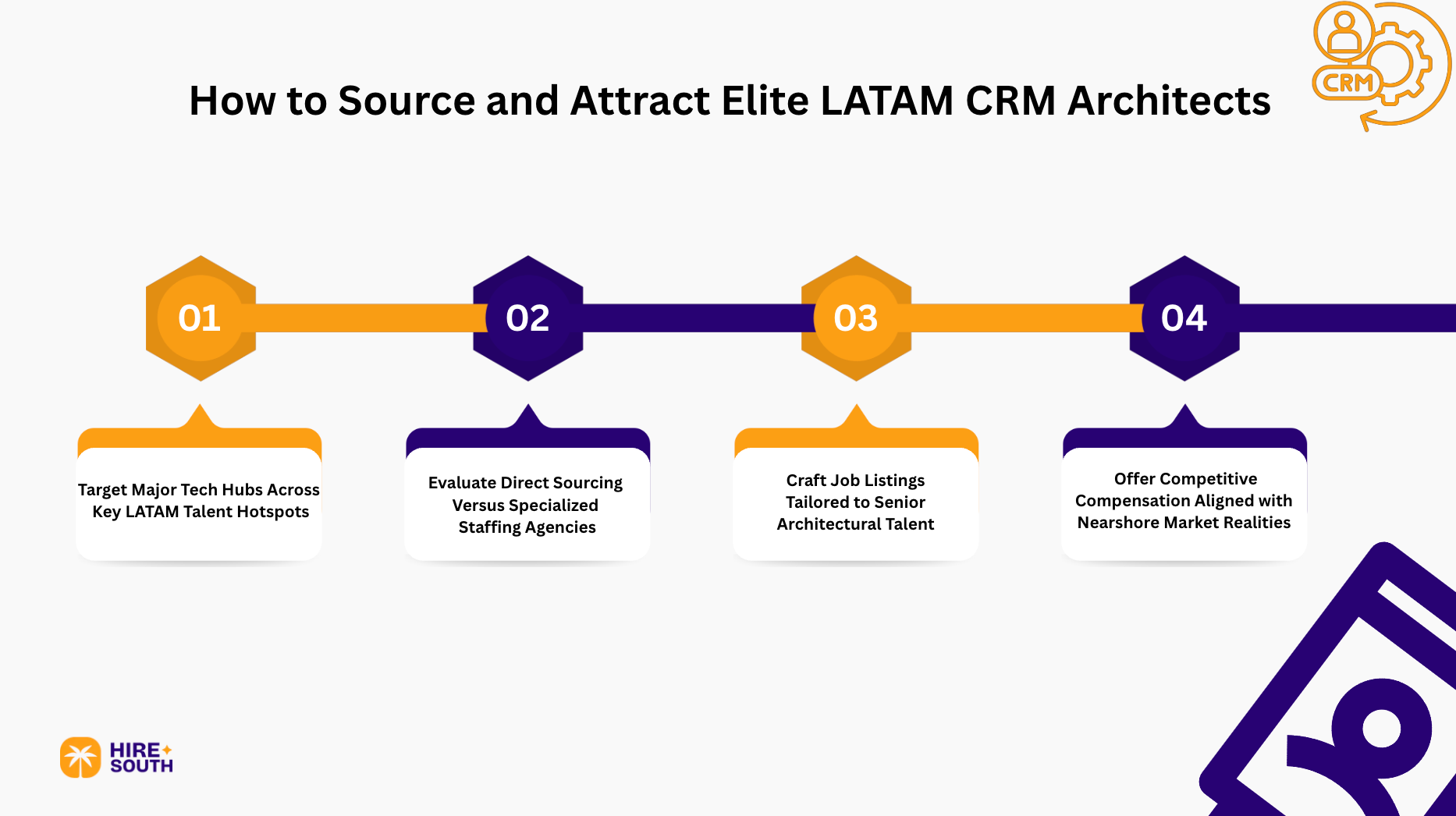
1. Target Major Tech Hubs Across Key LATAM Talent Hotspots
Finding top-tier talent starts with knowing where to look. Latin America boasts over 2 million software developers across several specialized regional tech hubs, according to DEV Community developer data aggregator estimates.
Focusing your recruitment on specific geographic areas helps you locate architects with deep enterprise platform experience.
- Brazil (São Paulo, Florianópolis): Home to over 750,000 developers, making it Latin America's largest software engineering market. Brazilian hubs excel in complex financial systems, large-scale cloud backend infrastructure, and heavy enterprise data architectures.
- Mexico (Guadalajara, Mexico City): Boasts over 560,000 software engineers. Guadalajara, known as the "Silicon Valley of Mexico," produces candidates with strong U.S. nearshore experience, full time-zone alignment, and deep expertise in Salesforce and Microsoft ecosystems.
- Argentina (Buenos Aires, Córdoba): Represents a pool of roughly 160,000 developers renowned for their architectural maturity and product vision. Argentina leads the region in English proficiency, according to the EF English Proficiency Index, making its talent pool ideal for cross-functional leadership roles.
- Colombia (Bogotá, Medellín): Medellín's rapid evolution into an innovation hub has created a pool of over 85,000 developers. Colombian architects offer a strong balance of enterprise platform knowledge and competitive rates.
2. Evaluate Direct Sourcing Versus Specialized Staffing Agencies
You have two main paths when sourcing senior LATAM talent: direct recruitment or partnering with a dedicated employer of record (EOR) and nearshore staffing agency.
Direct recruitment via platforms like LinkedIn Recruiter or localized job boards gives you total control over the candidate pipeline. However, vetting senior candidates across foreign tax systems, legal entities, and regional salary benchmarks requires significant internal HR resources.
Specialized nearshore staffing partners streamline this entire cycle. These agencies maintain pre-vetted networks of senior system architects who are already screened for technical proficiency, English fluency, and remote collaboration readiness.
Working with a staffing partner cuts typical hiring timelines down from months to a few weeks while removing the legal friction of managing cross-border labor contracts.
3. Craft Job Listings Tailored to Senior Architectural Talent
Senior CRM architects rarely apply to generic job postings. To capture the attention of top-tier LATAM candidates, your job descriptions must clearly define technical ownership and strategic scope rather than listing basic coding tasks.
Avoid vague titles like "CRM Developer" when you actually need a technical lead. Highlight specific enterprise platforms, data scaling expectations, and API integration requirements.
Clearly state your remote work structure, time-zone overlap expectations, and compensation models upfront. Transparent listings that showcase technical ownership and long-term career stability build immediate trust with high-performing passive candidates.
4. Offer Competitive Compensation Aligned with Nearshore Market Realities
Attracting elite architects requires offering packages that match local market demands while still providing major savings compared to domestic U.S. hires. Senior talent in LATAM expects competitive USD-based salaries or local currency pegs that guard against inflation.
Beyond base pay, top architects prioritize professional flexibility, continuous learning, and clear career progression.
Providing home office stipends, coverage for technical certifications, flexible paid time off, and continuous learning budgets sets your offer apart from competitors vying for the same senior talent.
Screening, Evaluating, and Technical Testing for CRM Architecture Solutions
Structure Real-World Scenarios Over Generic Coding Puzzles:
Designing an enterprise CRM system requires holistic problem-solving rather than rote memorization. Skip abstract algorithms and focus candidate assessments on actual system challenges your engineering team faces.
Present candidates with a realistic architectural scenario. For instance, ask them to map out a multi-system data sync between a CRM and a legacy ERP, detailing how they handle rate limits, failed API calls, and data deduplication.
This approach reveals an architect's true technical depth. It demonstrates whether they anticipate edge cases, build for fault tolerance, and consider long-term maintainability when designing core digital infrastructure.
Test System Integration and Data Migration Proficiency:
Data migration and third-party integrations carry the highest risk in complex CRM overhauls. A misconfigured pipeline can corrupt core customer records, lead to compliance violations, or cripple sales operations.
Evaluate how candidates manage complex data transformations. According to data published by viva-IT, replacing a senior technical hire who fails in their role can cost a business upwards of $240,000. That figure accounts for lost productivity, delayed deliverables, and recruitment rework.
Ask candidates to detail their strategies for executing zero-downtime data migrations. Have them walk through their experience with middleware tools, asynchronous event processing, and custom API connector builds.
Measure Strategic Business Alignment with Targeted Questions:
Technical expertise alone does not make a successful CRM architect. Elite candidates understand how system decisions impact business operations, revenue attribution, and user adoption.
Use targeted interview questions to gauge how candidates balance technical ideals with practical business needs:
- Platform Trade-offs: How do you determine whether a custom requirement should be met using native declarative features versus custom programmatic code?
- Cost Management: Can you describe a scenario where you redesigned a system architecture specifically to lower platform licensing or API call costs?
- Stakeholder Management: How do you handle non-technical business leaders who demand custom features that threaten long-term system stability?
A strong candidate advocates for solutions that drive clear business value. They explain technical constraints in simple language and keep system designs aligned with company goals.
Conduct Peer-Led Architecture Reviews and Defense:
A practical design session provides the clearest picture of a candidate's real-world skill. Have your team give the candidate a high-level business requirement, granting them 45 minutes to draft a system architecture diagram.
Once complete, have the candidate defend their architecture choices in front of your lead engineers. Encourage your team to question their selection of specific data models, security controls, and integration patterns.
This exercise shows how the candidate handles technical feedback, collaborates under pressure, and defends their technical decisions. It mirrors real daily operations and helps ensure a successful hire.
Hire CRM Architects in Latin America With Hire South
Scale your enterprise tech stack without losing velocity or exceeding your operating budget. A dedicated CRM architect ensures your platform handles complex data migrations, custom API logic, and long-term business goals smoothly.
At Hire South, we connect growing companies with the top 1% of pre-vetted LATAM tech talent. Our team handles end-to-end recruitment, technical evaluations, payroll, and compliance, helping you cut payroll overhead by 30% to 70% compared to domestic hires while ensuring full real-time time zone alignment.