


Tired of midnight status calls and language barriers draining your company’s engineering momentum? You are not alone. More US companies are shifting their attention south to solve tech talent shortages. The Latin American IT services outsourcing market is expected to reach $126.3 billion by 2030, according to Grand View Research.
To hire effectively in South America, you need to understand regional labor laws, source through the right tech hubs, and leverage shared time zones. You get elite LATAM talent, real-time collaboration, and high cultural alignment without the massive price tag of local hiring.
Whether you want to expand an existing development team or build an entire remote R&D hub, this guide covers exactly what you need to succeed. You will discover top South American job markets, compare developer salary benchmarks, and learn step by step how to launch a compliant cross-border strategy.
What is LATAM Nearshore Outsourcing?
Nearshore outsourcing to Latin America, commonly referred to as LATAM nearshoring, is the practice of delegating software development or core business processes to skilled professionals in neighboring South American countries.
Unlike traditional offshore models that shift work to distant locations like India or the Philippines, nearshoring keeps your operational footprint within adjacent geographic boundaries. The strategy pairs US business teams with engineers, data analysts, sales development representatives, marketers, executive assistants, and product specialists in hubs across Colombia, Brazil, Argentina, and Chile.
Proximity acts as the core engine behind this hiring model. Most South American tech hubs operate within Eastern, Central, or Mountain time zones. This provides a critical six-to-eight-hour daily workday overlap with North American teams.
This close alignment eliminates the delayed feedback loops that often derail offshore arrangements. Your in-house staff can run real-time daily standups, review code synchronously, and resolve critical incidents during standard business hours. Research indicates that maintaining at least six hours of daily overlap helps companies complete software projects roughly 23% faster on average compared to traditional offshore models.
The Key Outsourcing Distinctions: Nearshore vs. Offshore vs. Onshore
Understanding how the South American job market compares to other sourcing models helps you select the right operational fit for your recruitment strategy.
Onshore or domestic sourcing means hiring talent within your home country, such as US companies recruiting developers in San Francisco or Austin. It provides maximum alignment but carries premium compensation costs and intense local talent competition.
Offshore sourcing involves partnering with regions across 9 to 13 time zone differences. It delivers low hourly rates but frequently creates communication friction, 24-hour turnaround delays, and noticeable cultural misalignment.
Nearshore sourcing in Latin America involves partnering directly with South American talent. It balances competitive labor rates with real-time collaboration, cultural alignment, and manageable travel distances for conducting face-to-face team integrations.
Direct Business Impact: Why Companies Hire in South America
Adopting a LATAM nearshore strategy delivers immediate operational advantages. Specialized nearshore recruitment partners frequently place fully vetted candidates in two to three weeks, compared to the 60-plus days required in tight domestic markets.
South American developers share direct familiarity with North American product design principles, Agile methodologies, and workplace etiquette. The key urban tech hubs prioritize bilingual education, ensuring clear written and spoken communication across all team channels.
Modern LATAM nearshore contracts operate under standard international intellectual property frameworks. This reduces legal risk for proprietary software and ensures your codebase remains protected from day one.
Benefits and Challenges of Nearshore Outsourcing
1. Solving the Domestic Tech Talent Deficit
Unfilled engineering roles stall product roadmaps and drive up domestic recruiting costs. The global technology, media, and telecommunications sector faces a projected deficit of 4.3 million skilled workers by 2030, according to Korn Ferry. Expanding your search and choosing to hire in South America grants immediate access to millions of qualified professionals. You bypass regional hiring bottlenecks in North America, filling senior-level engineering slots in weeks rather than months.
2. Real-Time Collaboration and Increased Velocity
Working across identical or adjacent time zones transforms day-to-day team dynamics. South American tech hubs share significant working hours with North American business centers, allowing your engineering staff to collaborate live. Your team can host morning standups, conduct pair programming, and deploy updates during standard office hours. Quick feedback loops prevent blockers from sitting unattended overnight, keeping your release schedules moving forward efficiently.
3. Shared Cultural Dynamics and Business Etiquette
Cultural compatibility directly impacts team cohesion, interview processes, and product execution. Developers across South America frequently work with North American startups, making them well-versed in modern dev stack tools and direct communication styles. High English proficiency in primary tech hubs like Buenos Aires, São Paulo, and Bogotá enables clear, daily technical conversations. Team members share familiar workplace expectations, problem-solving styles, and an appreciation for strong interpersonal relationships.
4. Navigating Local Labor Laws, Visas, and Compliance
Operating across international borders introduces legal and tax complexity. Each South American nation maintains distinct labor codes, such as mandatory 13th-month bonuses (Aguinaldo), statutory vacation days, and local payroll regulations. If you plan to relocate foreign nationals, understanding specific work permits and visa requirements is also critical. Misclassifying full-time contractors or failing to follow local termination procedures can lead to heavy financial penalties. Many organizations solve this by partnering with Employer of Record (EOR) platforms to manage tax withholdings and local compliance smoothly.
5. Managing Turnover, Recruitment Strategies, and Talent Retention
Top tech talent in Latin America remains in high demand. Successful recruitment strategies in South America go beyond posting on generic online job portals. Implementing rigorous technical interviews, live coding assessments, and evaluating cultural fit are essential steps. Keeping high-performing engineers on your team requires more than competitive base compensation. Providing clear career progression, access to modern technology stacks, equity options, and an inclusive company culture helps maintain long-term retention.
6. Establishing Intellectual Property and Data Safeguards
Protecting proprietary software code and consumer data is essential when extending operations overseas. International legal enforcement varies by jurisdiction, requiring clear contractual protections before onboarding begins. You can safeguard corporate assets by using cross-border master service agreements with explicit IP assignment clauses. Standard security practices like enforcing multi-factor authentication, issuing managed hardware, and restricting repository permissions keep your codebase secure.
Top LATAM Tech Hubs: Where to Hire in South America
1. Brazil: Scale and AI-First Engineering Capacity
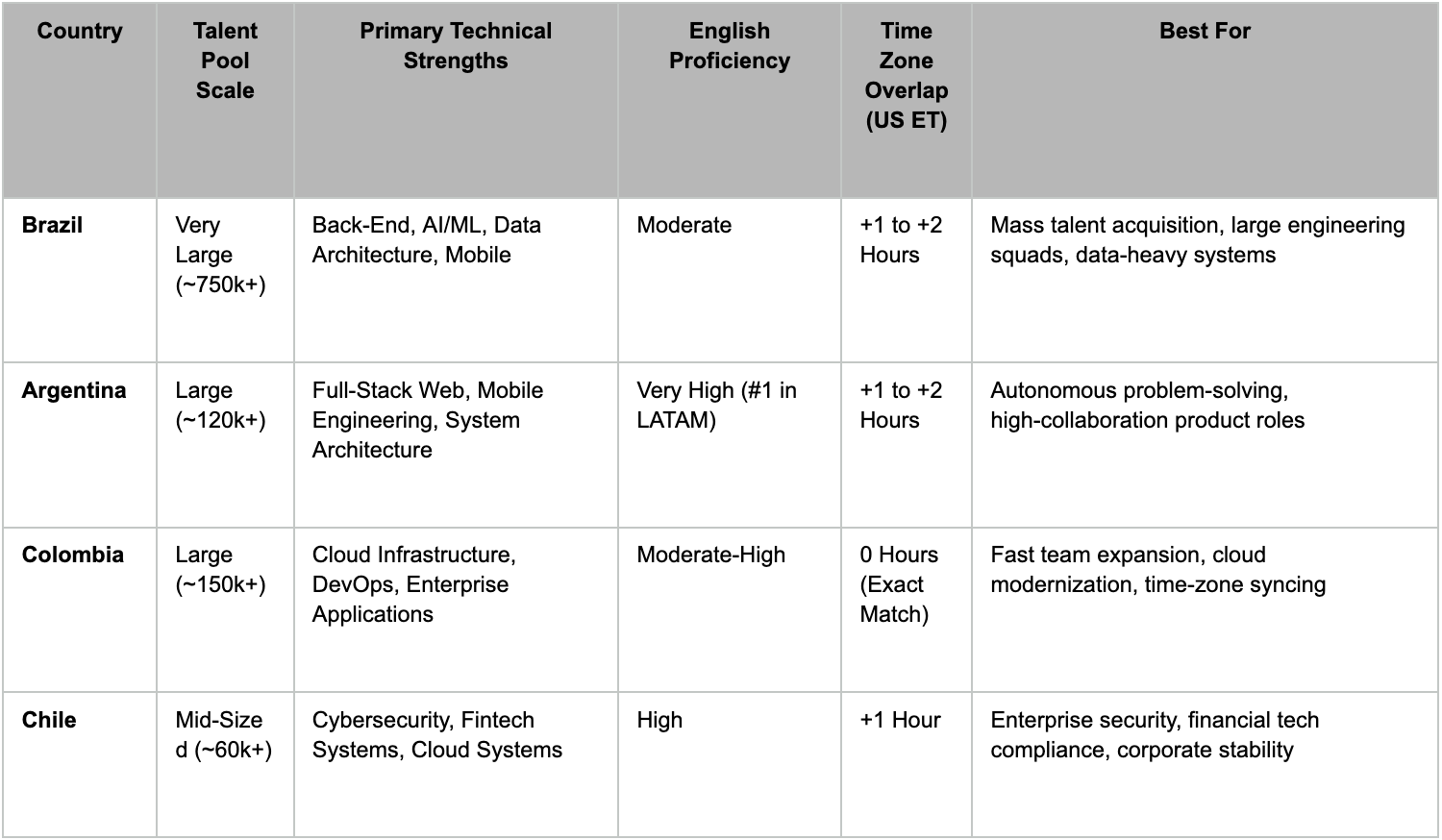
Brazil stands as Latin America’s largest technology market, boasting over 500,000 active software developers. Major urban tech epicenters like São Paulo, Florianópolis, and Belo Horizonte serve as mature R&D headquarters for international enterprises and high-growth startups alike. The country's university ecosystem produces a steady flow of computer science graduates skilled in complex back-end architectures, data science, and artificial intelligence. When your organization needs to build out large engineering squads or staff data-heavy initiatives quickly, Brazil delivers unmatched recruitment volume and technical depth.
2. Argentina: High Technical Literacy and Advanced English Fluency
Argentina consistently ranks at the top of Latin America for adult English proficiency, according to the EF English Proficiency Index. Its talent pool excels in full-stack web engineering, mobile development, and modern product design. Buenos Aires acts as the primary focal point, supported by vibrant secondary tech hubs in Córdoba and Mendoza. Argentine software engineers bring strong product-minded execution to remote environments, making them a natural fit for teams requiring autonomous problem-solving and clear cross-border communication.
3. Colombia: Rapidly Expanding Tech Infrastructure and Innovation
Colombia has transformed into one of the fastest-growing engineering destinations in the Americas. Medellín, recognized globally as an innovation ecosystem, works alongside Bogotá to train thousands of bilingual software professionals every year. Local government initiatives heavily subsidize STEM education, digital literacy, and cloud infrastructure projects. As a result, Colombian talent offers extensive experience in cloud architecture, DevOps, enterprise app development, and agile team setups.
4. Chile: Economic Stability and Specialized Cloud Engineering
Chile pairs robust data privacy frameworks and economic stability with a highly specialized developer base. Santiago, often called "Chilecon Valley," attracts global venture capital alongside corporate technology hubs. While total developer headcounts are smaller than in neighboring Brazil, Chilean tech talent offers deep capabilities in cybersecurity, financial technology systems, and complex cloud deployments. The local workforce operates under corporate standards that align closely with US business practices.
The Financial Impact of Choosing to Hire in South America
Direct Wage Savings vs. Domestic Engineering Costs:
Software development compensation in major North American tech hubs continues to command premium budgets. According to the US Bureau of Labor Statistics, the national median annual wage for software developers reached $135,980, with senior roles in primary metros frequently exceeding $180,000 in base salary alone. Nearshoring to Latin America shifts those baseline unit economics significantly. Senior software developers based in primary South American tech hubs typically command annual salaries ranging between $50,000 and $85,000. This direct wage variance allows companies to lower total baseline labor expenses by 40% to 60% per engineering role without sacrificing technical seniority or delivery speed.
Indirect Overhead and Employee Maintenance Reductions:
Base salary savings represent only a fraction of total financial optimization. Onboarding a domestic employee carries heavy administrative, insurance, tax, and infrastructure overhead that inflates the total cost of ownership (TCO). Partnering with nearshore staff augmentation firms or Employer of Record (EOR) platforms consolidates local health benefits, mandatory country pension contributions, severance provisions, and hardware deployment into a predictable flat monthly fee. You cut out corporate real estate expansions, lower HR administrative spend, and eliminate heavy local payroll tax liabilities.
Capital Efficiency and Extended Runway for High-Growth Teams:
For growth-stage technology ventures and enterprise innovation labs, payroll remains the single largest operational expense. Optimizing engineering spend directly extends corporate financial runway. A fixed $1.5 million annual product development budget supports a modest core team domestically. Sourcing that same workforce in South America enables leadership to build out cross-functional engineering squads, double feature delivery velocity, and extend cash runway substantially.
Reducing Cost-per-Hire and Accelerated Sourcing Timelines:
Sourcing engineering talent domestically incurs heavy recruitment agency costs, lengthy internal interview cycles, and lost product momentum. The average time-to-hire for specialized tech talent in North America sits between 45 and 60 days. Nearshore hiring pipelines collapse those timelines down to two or three weeks. Specialized nearshore recruitment networks maintain active talent databases, reducing candidate acquisition costs by up to 50% while getting income-producing features to market faster.
Minimizing Attrition Expenses and Technical Debt:
Developer turnover carries massive hidden costs, including lost institutional knowledge, code refactoring delays, and repeated onboarding cycles. High domestic demand creates intense poaching environments, where developer tenure often averages under two years. South American engineering talent exhibits higher retention rates when paired with competitive cross-border compensation packages. Lower developer churn maintains codebase continuity, reduces long-term technical debt, and prevents costly project restarts.
Hire in South and Central America With The Hire South Team!
Nearshore outsourcing to South America offers the speed, time zone alignment, and high-caliber talent required to scale modern engineering operations efficiently. With a regional talent pool exceeding 2.8 million tech professionals and potential labor cost savings of up to 60%, expanding south provides a clear competitive edge for growing businesses.
At Hire South, we streamline the entire cross-border recruitment process so you can build high-performing teams without administrative friction. Our team sources, screens, and presents pre-vetted, bilingual software engineers within two weeks, ensuring full alignment with your company culture, technical stack, and working hours. We manage legal compliance, international payroll, statutory benefits, and local onboarding on your behalf. This gives you access to elite regional talent with transparent pricing and zero upfront risk.