


Tapping into Latin America’s booming tech scene is a no-brainer for scaling startups. The real challenge? Deciding how to bring that talent on board without tripping over international labor laws or burning through your runway.
Should you use an Employer of Record (EOR) to launch fast, or establish a direct local entity for long-term control? According to Deel, 73% of companies expanding internationally choose EOR solutions to bypass initial entity capital expenses and convert hefty upfront setup costs into predictable monthly fees.
This article breaks down the financial, legal, and operational trade-offs of both options. You will get a clear look at local compliance risks, mandatory statutory benefits, and total cost of ownership across primary LATAM markets. By the end, you will have a practical decision framework to choose the best hiring model for your startup’s exact funding stage and growth goals.
EOR for Startups: Speed, Flexibility, and Rapid Expansion
1. Accelerated Time-to-Hire Across Latin American Tech Hubs
Speed is everything when you are scaling a remote engineering or product team. Traditional cross-border expansion requires establishing a foreign legal entity, opening local bank accounts, and registering with municipal tax authorities.
According to market expansion data from RemotePass, establishing a local legal entity typically takes anywhere from 3 to 9 months depending on the jurisdiction. In contrast, hiring through an Employer of Record reduces your setup timeline to just 3 to 15 business days.
Using an EOR lets you issue locally compliant employment contracts almost immediately. You bypass months of regulatory red tape in complex markets like Brazil or Mexico, allowing your startup to capture top talent before competing offers land.
2. Operational Flexibility and Risk-Free Market Testing
Testing a new geographic market for talent brings operational uncertainty. If your product direction pivots or a specific market underperforms, unwinding a direct legal entity can take over a year and incur substantial legal fees.
According to Slasify, 88% of top-funded startups expand into multiple countries within 18 months of their first international hire, relying primarily on EOR infrastructure to navigate rapid growth.
An EOR model provides complete operational flexibility. You can scale your team up in Colombia or down in Argentina without leaving behind lingering corporate tax liabilities, physical office commitments, or liquidation costs.
3. Mitigating Local Payroll, Tax, and Labor Law Liabilities
Latin American labor frameworks heavily favor the employee, featuring strict mandates around mandatory bonuses, statutory vacation pay, and rigid termination protocols. Managing these complex requirements without localized expertise exposes startups to steep non-compliance penalties and misclassification fines.
According to Slasify, regulatory misclassification enforcement can trigger losses up to $26,253 per worker, making contractor-first strategies increasingly risky for core roles.
Partnering with an EOR transfers the core employment liability to the provider. The EOR handles statutory benefits administration, accurately calculates local payroll withholdings, and ensures every contract aligns with shifting regional employment legislation.
4. When EOR Benefits Early-Stage Scaling Most
An EOR is not a permanent solution for every stage of business, but it is the optimal model during specific growth inflection points.
- Seed to Series A stages: Your focus is product-market fit, and internal HR or legal resources are minimal.
- Small team deployments: You are hiring fewer than 10 to 15 employees within a single country.
- Distributed talent strategies: You want to hire individual specialists scattered across multiple LATAM countries rather than building a single centralized hub.
- Rapid headcount surges: You need to deploy capital quickly after a funding round to meet aggressive product roadmap deadlines.
Direct Hiring for Startups: Long-Term Equity, Control, and Infrastructure
1. Establishing Local Legal Entities in Key Target Countries
Setting up a direct local legal entity in countries like Brazil, Mexico, or Colombia transforms your company from a foreign employer into a permanent fixture in the local market. This approach requires establishing a local corporate structure, such as a Limitada, Sociedad Anónima, or S.A.S., and opening local corporate bank accounts to process local currency transactions.
While establishing an entity provides ultimate control, the financial and operational barrier to entry is high. According to legal analysis from Alcor, establishing a direct local entity in a primary Latin American tech hub typically costs between $15,000 and $20,000 in upfront legal processing fees, excluding the required minimum capital deposits or ongoing corporate accounting overhead.
Setting up a local entity makes the most sense when you plan to build a major hub rather than a distributed footprint. Market analysis from Globental shows that direct entity creation becomes financially viable once you cross 10 to 15 hires within a single LATAM country. At that point, fixed corporate maintenance costs break even against recurring EOR markups.
2. Managing Equity Grants, Stock Options, and Direct Benefits
Offering incentive stock options, stock appreciation rights, or equity-based compensation across borders becomes significantly cleaner when candidates sign contracts directly with your corporate group rather than a third-party intermediary.
While EOR models can handle equity grants, navigating cross-border tax treatment for third-party workers often triggers complex reporting requirements or double-taxation issues for the employee. Direct employment eliminates the legal buffer, ensuring that your equity plans function natively without requiring custom Phantom Stock or synthetic option workarounds.
Direct hiring allows you to structure custom localized benefit packages that go beyond statutory minimums. You gain the freedom to offer tailored healthcare extensions, wellness stipends, and hardware allowances directly, strengthening overall offer competitiveness for senior talent.
3. Fostering Strong Employer Branding and Cultural Retention in LATAM
Top engineering and product leaders in Latin America often prefer direct employment over agency or EOR relationships. Working directly for the parent entity provides a stronger sense of job security, clearer career progression, and closer alignment with the company’s core mission.
Direct hiring removes the psychological distance created by third-party paper employers. Your HR team manages performance reviews, internal promotions, and company culture touchpoints natively, driving long-term retention.
Data from Howdy shows that international engineering teams offering direct organizational alignment and partial equity ownership experience measurably higher retention and employee engagement. This equity-driven alignment becomes especially critical when competing against local tech giants in hubs like São Paulo, Mexico City, and Buenos Aires.
Determining the Best Hiring Model for Startups
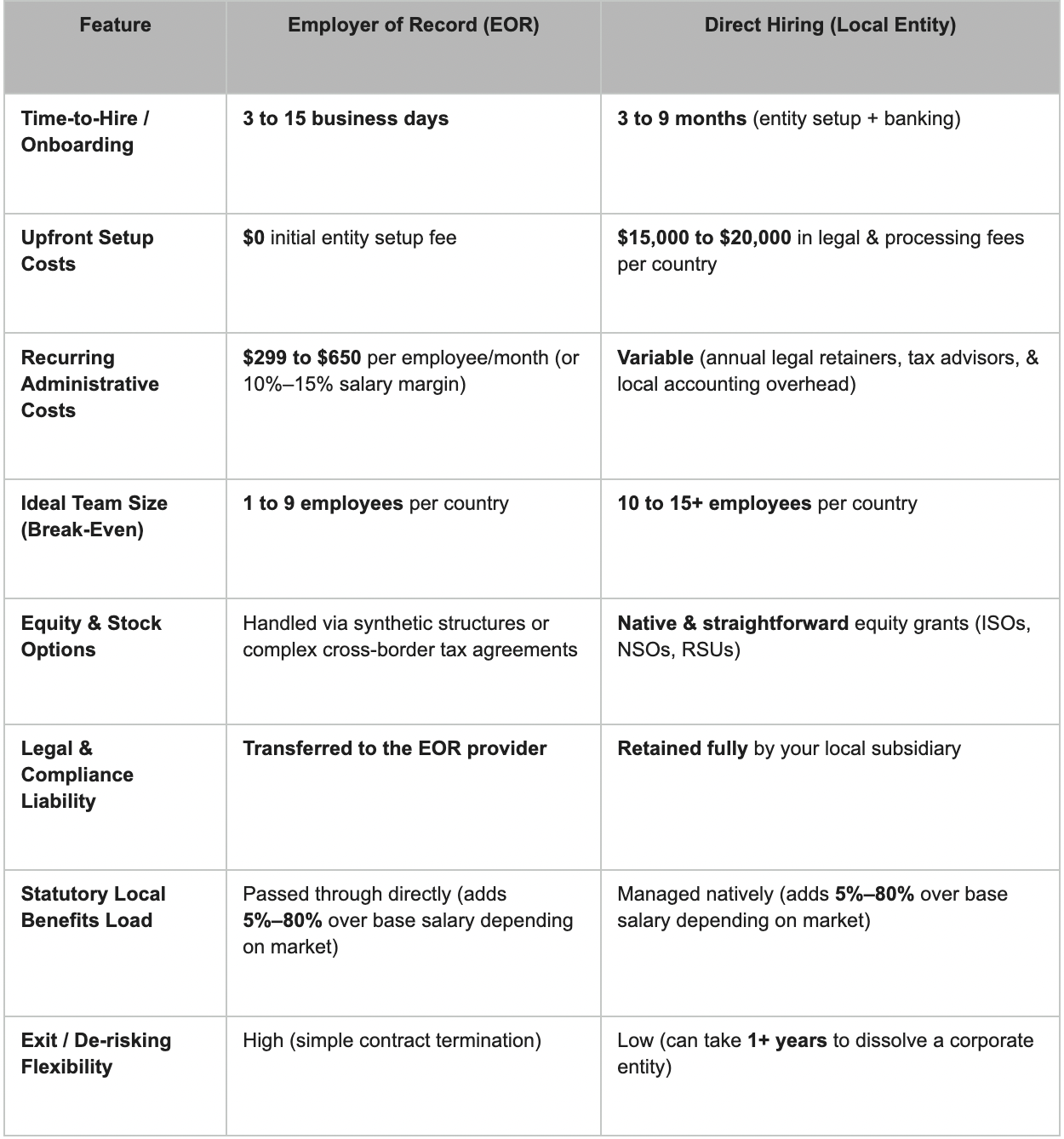
Upfront Entity Setup Fees vs. Recurring EOR Margins:
Choosing a hiring strategy comes down to trade-offs between initial capital outlay and recurring operating expenses. An Employer of Record removes upfront investments, replacing them with fixed monthly service fees.
According to global pricing data from Second Talent, typical EOR services in Latin America range from $299 to $650 per employee each month, or a 10% to 15% margin on gross salary. These pricing structures mean initial expansion costs remain low, helping you preserve runway during early growth phases.
Building a direct entity requires significant capital before making your first local hire. Establishing a legal business entity, securing local legal counsel, and setting up compliant corporate banking in markets like Mexico or Brazil generally requires $15,000 to $20,000 in upfront setup costs.
For a startup making one or two hires, an EOR keeps capital efficient. Once your headcount expands within a single country, those recurring monthly EOR fees compound, making a direct entity the more cost-effective choice long-term.
Calculating Statutory Benefits and Tax Obligations in LATAM:
Base salary is only part of the real cost of hiring in Latin America. Employers must budget for strict mandatory statutory benefits, payroll taxes, and social security contributions that vary by country.
According to 2026 Latin America hiring benchmarks from Howdy, local statutory cost multipliers added on top of base salary break down as follows:
- Chile: Adds 5% to 9% over base salary, making it the most predictable market in the region.
- Mexico: Multiplies base salary by 1.36x to 1.44x to cover social security, profit sharing (PTU), and the mandatory 13th-month bonus.
- Colombia: Multiplies base salary by 1.35x to 1.40x due to mandatory severance accruals, health contributions, and statutory bonuses.
- Brazil: Features the highest statutory load, multiplying base salary by 1.65x to 1.80x once FGTS severance fund obligations, social security, and vacation bonuses are included.
Whether you run payroll through an EOR or your own entity, these statutory loads are mandatory. An EOR passes these exact local tax and benefit costs directly to you on your monthly invoice.
Evaluating Total Cost of Ownership (TCO) and Break-Even Points:
Determining the right hiring model requires evaluating your Total Cost of Ownership (TCO) over a multi-year horizon. TCO includes initial corporate setup, monthly platform management fees, statutory tax multipliers, and ongoing accounting overhead.
According to industry data from Deel, 73% of companies expanding internationally rely on EOR solutions to bypass initial capital expenses, using predictable monthly fees to protect short-term cash flow.
The financial break-even point typically arrives when a company reaches 10 to 15 employees within a single LATAM country. Below 10 employees, recurring EOR fees remain cheaper than maintaining an entity, local tax advisors, and local HR software.
Beyond 15 employees, the cumulative monthly EOR fees exceed the $15,000 to $20,000 entity setup investment and annual legal maintenance costs, making direct hiring the more economical long-term strategy.
Essential Questions Founders Must Answer Before Deciding
1. Target Headcount and Regional Distribution
Your team size across Latin America dictates which hiring path makes sense. If you are bringing on 1 to 9 employees distributed across multiple countries, like two developers in Colombia, one product manager in Argentina, and a designer in Mexico, setting up local entities in each jurisdiction creates massive unnecessary overhead.
Opening a legal entity in a foreign market generally costs $15,000 to $20,000 upfront per country. Below 10 employees in a single country, using an EOR is almost always the more economical choice. Once your headcount reaches 10 to 15 people in a single country, the recurring monthly EOR fees surpass annual entity maintenance costs, making direct local incorporation the smarter long-term investment.
2. Speed-to-Market Expectations
How fast do you need boots on the ground? Building an engineering team to meet an aggressive product deadline requires rapid execution that direct entity formation cannot support.
Setting up a local business entity in Latin America takes 3 to 9 months, depending on government processing times, bank account approvals, and tax registrations. Onboarding workers through an Employer of Record reduces that timeline to 3 to 15 business days, allowing you to hire and issue contracts almost immediately.
3. Equity Offerings and Long-Term Incentives
Granting equity to international hires introduces significant cross-border tax and legal complexities. You need to consider how critical stock options, restricted stock units, or phantom equity are to your recruitment offer.
When hiring directly through your own local entity or parent corporation, issuing equity is straightforward and aligns natively with localized tax laws. Providing equity through a third-party EOR can trigger double taxation risks or require complex synthetic option structures. If equity is the primary lever in your compensation package for executive talent, direct legal employment offers a cleaner operational framework.
4. Capital Availability and Expansion Budget
Your available capital and funding stage dictate how much upfront exposure your balance sheet can handle. Opening local entities requires immediate capital reserves for incorporation fees, legal retainer agreements, minimum share capital deposits, and local accounting services.
An EOR converts large upfront capital expenditures into predictable, per-employee operating expenses. According to global pricing data from CRMside, leading EOR platforms cost $299 to $699 per worker per month. Early-stage startups can preserve runway by using EOR platforms to hire talent without tying up cash in corporate infrastructure.
5. Long-Term Market Commitment vs. Market Testing
Are you testing Latin America as a temporary talent pool, or building a permanent hub for your company's core operations?
An EOR lets you test talent markets without long-term commitments. Unwinding an EOR arrangement requires simple contract terminations. Dissolving a direct local entity, however, can take over a year of regulatory filings and liquidation procedures. Startups should use EORs to validate candidate quality, cultural fit, and regional dynamics before committing the resources required for direct corporate setup.
Hire in LATAM With Our Nearshore Outsourcing Services
Choosing the right growth model in Latin America comes down to balancing speed against operational control. While establishing a direct entity works well for centralized hubs, leveraging an Employer of Record eliminates upfront entity setup costs and reduces your time-to-hire from months to a few business days.
At Hire South, we streamline your expansion into Latin America by handling the entire talent acquisition and employment lifecycle. Whether you are looking to source pre-vetted nearshore talent or require a complete Employer of Record infrastructure, our services enable you to onboard, pay, and manage remote teams compliantly while saving up to 40% on total payroll expenses compared to US-based hiring. We manage local contracts, statutory benefit contributions, and tax withholdings so you can focus directly on building product and driving business growth. Book a free discovery call today to hire in LATAM within 15 days!