


Building a high-performing nearshore team isn't just about cutting costs. It is about speed, alignment, and grabbing top-tier talent before your competitors do. If you want to scale effectively in Latin America without overpaying or stalling your hiring pipeline, you need the right benchmarks. Navigating local regulations, salary expectations, and time-to-hire across different tech hubs isn't always straightforward.
In this guide, you will get a complete breakdown of what it actually takes to hire in the region. We cover time-to-hire metrics for key technical roles, real-time salary benchmarks broken down by country and seniority, and the statutory overhead costs you must plan for. You will also discover actionable strategies to speed up your interview process, navigate English proficiency premiums, and secure top candidates before they accept another offer.
Here is everything you need to execute a competitive, compliant LATAM hiring strategy.
Why US Companies Are Prioritizing a LATAM Salary Benchmark Strategy
An accurate LATAM salary benchmark strategy turns remote hiring from an unpredictable variable into a reliable system. Companies that build structured compensation matrices hire faster, protect runway, and keep top engineers from jumping ship.
Market Transparency Eliminates Offer Rejections:
Unrealistic offer letters break hiring pipelines. When you benchmark salaries using regional data, you stop losing candidate offers to misaligned compensation.
Top engineers in Latin America know their exact worth in the international remote market. According to compensation data from Nexton, senior software engineers in LATAM save US employers approximately 60% compared to domestic hires, while tech lead and leadership positions can deliver savings up to 78%.
If your team makes an offer based on local inflation instead of USD-denominated remote benchmarks, top candidates walk away. Having precise benchmarks lets you make competitive offers on day one.
Budgeting Strategy Shifts From Base Pay to Total Cost:
Looking at base salary alone creates hidden expenses. A robust LATAM salary benchmark framework accounts for local employment mechanics, statutory bonuses, and taxes before you draft a contract.
Engaging direct contractors requires zero local payroll taxes, though candidates often expect a premium to cover their own health coverage and accounting expenses. Conversely, hiring through a full Employer of Record protects your business from misclassification risks, but local compliance adds structural costs. Regional statutory overheads vary widely across Latin America, ranging from roughly 15% in contractor-friendly structures to over 70% under strict labor laws like Brazil's CLT framework.
Companies using an established benchmarking strategy factor in these total operational costs early. That keeps finance teams aligned with engineering leadership from the start.
Benchmark Data Accelerates Technical Pipeline Velocity:
Clear salary bands cut time-to-hire. When engineering managers know their precise salary ceiling before kicking off sourcing, technical screeners don't waste time interviewing candidates out of budget.
According to market research from ParallelStaff, total first-year employment costs for a senior LATAM engineer average between $65,000 and $130,000, including platform fees, compared to over $200,000 for equivalent US roles.
Companies using real-time salary benchmarks fill technical roles in two to four weeks instead of four to six months. Speed wins in nearshore recruiting. Getting your salary parameters locked in allows your team to move top talent through the technical pipeline without stopping to renegotiate rates mid-funnel.
How LATAM Hiring Velocity Solves Tech Shortages
Building a software product with a depleted engineering team drains resources, delays product roadmaps, and burns out remaining staff. When domestic tech markets stall out due to candidate scarcity, expanding into Latin America provides an immediate reset to your talent pipeline.
1. Expansive Talent Pools Eradicate Local Sourcing Bottlenecks
Relying solely on local hiring markets limits your reach to a tiny, highly contested pool of engineers. Expanding your search radius across Latin America instantly unlocks a massive ecosystem of experienced software professionals.
Latin America is home to an estimated 2 million software developers. Heavy domestic investment in STEM education ensures this number grows every year. According to market data from DEV Community, educational institutions in Mexico and Brazil produce over 260,000 new IT graduates annually.
This continuous influx of skilled talent means your talent acquisition team won't run into the supply dry spells common in US tech hubs. When hundreds of qualified applicants enter the market every month, open requisitions get filled much faster.
2. Synchronous Collaboration Accelerates Interview Cycles
Offshore hiring in distant regions often introduces severe time zone friction. Communication lag slows down technical screenings, drags out decision-making, and lengthens overall time-to-hire.
Nearshore hiring in Latin America operates on a completely different model. Most major tech hubs across Mexico, Colombia, Argentina, and Brazil share near-total working hour alignment with US time zones.
- Real-time evaluations: You can schedule live technical interviews without asking hiring managers to log on early or stay up late.
- Instant offer acceptance: Candidates respond to feedback and offer letters within hours, not days.
- Rapid onboarding: New hires join daily standups and sprint planning sessions from day one without schedule disruption.
Eliminating communication delays cuts week-long interview scheduling back-and-forth down to a single day. That administrative speed directly increases your overall recruitment velocity.
3. High Technical Rigor Reduces Sourcing Waste
Hiring quickly only works if candidate quality remains consistently high. Sifting through hundreds of unqualified resumes wastes engineering resources and destroys hiring momentum.
LATAM developers receive training grounded in rigorous computer science fundamentals. According to Coursera's Global Skills Index, countries like Argentina and Brazil consistently rank among the top performers globally for technology and data science competencies.
Because nearshore candidates routinely hold advanced degrees and possess extensive experience with modern cloud, AI, and full-stack frameworks, your technical screeners reject fewer applicants during initial assessments. Higher candidate pass rates mean fewer interview loops per successful hire, allowing your team to fill critical engineering roles in weeks instead of months.
LATAM Key Salary Benchmarks by Role for 2026
Software Engineering and Architecture Pay Bands.
Base compensation for core development roles scales predictably with hands-on experience and system ownership.
According to placement data from Nexton, backend developers in LATAM command a median annual salary of roughly $84,000, while engineering managers sit between $90,000 and $100,000.
- Junior Engineers (0–2 years): Annual compensation ranges from $18,000 to $35,000. These professionals handle routine execution under direct team supervision.
- Mid-Level Engineers (2–5 years): Expectations move to $35,000 through $65,000. Developers at this level manage end-to-end features and independent workflows.
- Senior Engineers (5–8+ years): Salaries average between $70,000 and $95,000. Hires in this tier own complex system design, cross-functional architecture, and core delivery.
- Tech Leads and Architects (8+ years): Top engineering leadership commands $80,000 to $110,000. They oversee multi-team architecture, technical strategy, and organizational growth.
AI, Machine Learning, and Data Science Premiums.
Specialized technical skill sets command a distinct wage premium due to global candidate scarcity.
According to cross-border hiring statistics from Lemon.io, AI and machine learning specialists earn a global rate premium around 20% to 30% higher than generalist full-stack developers. Data from Nearshore Business Solutions further shows senior machine learning engineers in primary markets like Mexico and Brazil earning between $80,000 and $109,000 annually.
Mid-level data engineers and data scientists hover in the $40,000 to $55,000 range. Entry-level data analysts present a far lower financial baseline, often starting under $35,000.
Cloud, Infrastructure, and DevOps Compensation.
As companies move mission-critical systems into hybrid cloud environments, experienced DevOps and site reliability engineers remain high-demand targets.
According to multi-country salary metrics from Uvik Software, mid-level DevOps engineers across Brazil, Mexico, and Argentina average between $37,000 and $48,000 per year. Senior DevOps specialists overseeing complex CI/CD infrastructure, Kubernetes clusters, and cloud security frameworks frequently reach annual base salaries of $75,000 to $90,000.
Product Management and UX Design Baselines.
Product and design roles require strong English fluency and tight cross-functional alignment with US executive leadership.
According to internal compensation benchmarks, product management roles across LATAM span a typical range of $35,000 to $70,000 depending on seniority and scope. Junior UX/UI designers start near $20,000, while senior product designers leading design systems for complex digital platforms cap out around $55,000 to $65,000.
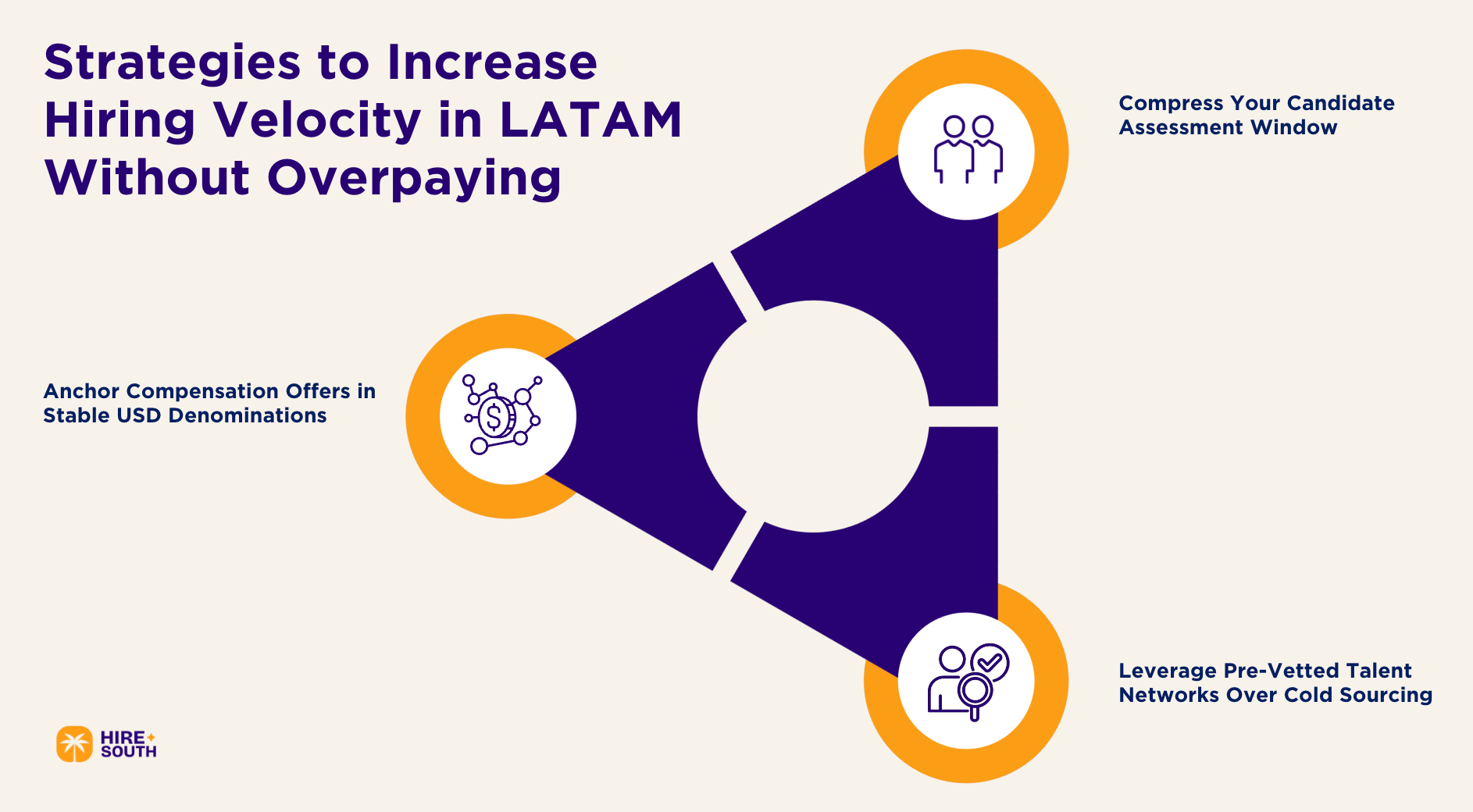
Strategies to Increase Hiring Velocity in LATAM Without Overpaying
t
To increase your hiring velocity in Latin America without inflating offer values, you need to eliminate friction in your recruitment process while maintaining strict alignment on market compensation.
1. Compress Your Candidate Assessment Window
Protracted evaluation stages kill candidate momentum and drive up acquisition costs. When software engineers sit in multi-week interview pipelines, they shop competing offers, driving up the final rate you must pay to land them.
According to recruitment analytics from SHRM, standard North American corporate hiring processes average 44 days, stretching past 60 days for specialized technical roles. Meanwhile, candidate experience research from Robert Half demonstrates that top-tier remote candidates are often off the market within 10 business days, with 57% losing interest if the process moves too slowly.
- Limit evaluation steps: Keep your pipeline to three main interactions: an initial screening call, a single live technical session, and a final leadership culture fit.
- Consolidate technical vetting: Replace time-consuming multi-day take-home coding assignments with single 60-minute practical pair-programming sessions.
- Accelerate decision windows: Align key internal decision-makers ahead of time so you can extend formal offers within 24 to 48 hours of final candidate calls.
Streamlining these steps lowers candidate drop-off and secures top engineers at standard market rates before bidding wars start.
2. Anchor Compensation Offers in Stable USD Denominations
Inflationary trends and local currency volatility across Latin America create uncertainty for local tech professionals. Offering USD-denominated or USD-pegged compensation packages gives candidates financial stability, making your offers significantly more attractive without overstepping your base budget.
According to market research from Glassdoor, clear salary transparency and currency stability directly reduce candidate drop-off during final offer negotiations.
Engineers frequently choose a lower, guaranteed base salary paid in USD or stablecoins over a slightly higher local currency that is vulnerable to devaluation. Leveraging currency stability gives your organization a distinct competitive edge without inflating your overall compensation bands.
3. Leverage Pre-Vetted Talent Networks Over Cold Sourcing
Starting a search from scratch using cold outreach on professional platforms wastes valuable weeks and strains internal sourcing resources. According to recruiting time-tracking data published by SHRM, internal talent teams can spend up to 23 hours simply reviewing initial resume submissions for a single open technical requisition.
Partnering with specialized nearshore talent platforms grants immediate access to pre-screened talent pools. According to operational metrics from Athyna, leveraging pre-vetted talent networks delivers qualified shortlists in under two weeks, enabling engineering organizations to complete full hires within three to five weeks total.
Skipping the initial top-of-funnel noise allows your technical team to focus exclusively on final-stage interviews, preserving momentum, reducing time-to-hire, and maintaining budget parameters.
Hire in South and Central America With Our LATAM Hiring Services
Mastering your nearshore strategy requires balancing competitive salary parameters with a streamlined evaluation process to capture top talent. When you combine precise market intelligence with real-time hiring velocity, expanding into Latin America becomes a high-ROI growth engine for your engineering pipeline.
At Hire South, we handle the end-to-end heavy lifting so you can scale your team without the administrative drag. From precision candidate sourcing to seamless cross-border compliance, we connect North American companies with the top 1% of vetted LATAM talent. By matching your technical requirements with English-fluent professionals in your time zone, we help you reduce staffing costs by up to 50% while accelerating your time-to-hire down to just two weeks.
Ready to optimize your hiring velocity and secure world-class nearshore talent? Book a discovery consultation with Us today!