


We get it: You need sharp insights and clean data to steer your business, but the local talent war is making your budget sweat. Finding data analysts within your usual talent pool has become a costly, uphill battle.
The good news is that the LATAM region has shifted from a budget alternative to a premier global powerhouse for data intelligence. When you hire Latam data analysts, you aren't just saving money; you are tapping into a massive pool of STEM graduates who work in your time zone. In fact, the software and data services market in Latin America is projected to reach a staggering $111 billion by 2026, according to Statista.
This guide breaks down exactly how to navigate this landscape. You will discover which countries hold the top specialists, how to benchmark salaries, and the best ways to vet technical skills from afar. It’s time to stop overpaying for local scarcity and start leveraging regional excellence.
Why Companies Should Hire Latam Data Analysts in 2026
The hunt for high-tier data talent has moved past local borders. If you are struggling to fill specialized roles, you are likely feeling the squeeze of a domestic market where demand for data expertise outpaces supply by a wide margin. In 2026, the strategic pivot isn't just about saving money; it is about accessing a sophisticated, rapidly maturing ecosystem that mirrors your own operational standards.
Data Talent Density and Market Maturity.
Latin America is no longer an "emerging" market, it has arrived. The regional data analytics industry hit a valuation of $3 billion in 2026 and is currently sustaining a massive 37.5% compound annual growth rate (CAGR), according to Best Masters. This explosion is fueled by a massive surge in STEM graduates, with over 220,000 new professionals entering the workforce annually, according to Committed Staff.
When you hire Latam data analysts, you are tapping into a workforce that isn't just learning the ropes; they are leading. Roughly 50% of tech professionals in the region are currently pursuing advanced AI and Machine Learning training, which is the highest specialization rate globally, according to more info from Committed Staff. This means you get access to "future-proof" skills like predictive modeling and decision automation without the bidding wars typical of Silicon Valley or New York.
The Power of Synchronous Collaboration.
One of the biggest friction points in global hiring is the "lag" of 10-hour time differences. If you've ever waited an entire day for a SQL query fix from an offshore team, you know the frustration. Latam solves this through near-perfect time zone alignment. Most major hubs in Mexico, Colombia, and Argentina sit within 0 to 3 hours of North American time zones.
This alignment isn't just a convenience; it is a productivity multiplier. Companies with at least six hours of workday overlap complete projects 23% faster on average, according to McKinsey & Company. By operating in real-time, your data analysts can join your morning stand-ups, respond to Slack pings instantly, and iterate on dashboards while your stakeholders are still in the office.
High-Value Expertise Without the Overhead.
Budgeting in 2026 requires a lean approach, but you cannot afford to sacrifice quality in your data pipeline. Hiring in Latin America allows you to maintain, or even raise, your hiring bar while reducing costs by 50% to 60% compared to equivalent US talent, according to Committed Staff.
These savings allow you to build a more robust team. Instead of hiring one local analyst, you can often fund a three-person squad comprising a data engineer, a visualization specialist, and a junior analyst for the same total investment.
Cultural Synergy and Communication.
Effective data analysis requires more than just coding; it requires the ability to translate complex numbers into business stories. Latin American professionals are known for strong cultural alignment with North American business values, emphasizing transparency, direct communication, and creative problem-solving.
English proficiency in the tech sector is particularly high. In countries like Argentina, which consistently ranks as a regional leader in English skills, analysts are accustomed to working in English-first environments for global enterprises. This reduces the "translation tax" and ensures that your data insights aren't lost in a sea of cultural misunderstandings.
Essential Skills to Evaluate When You Hire Latam Data Analysts
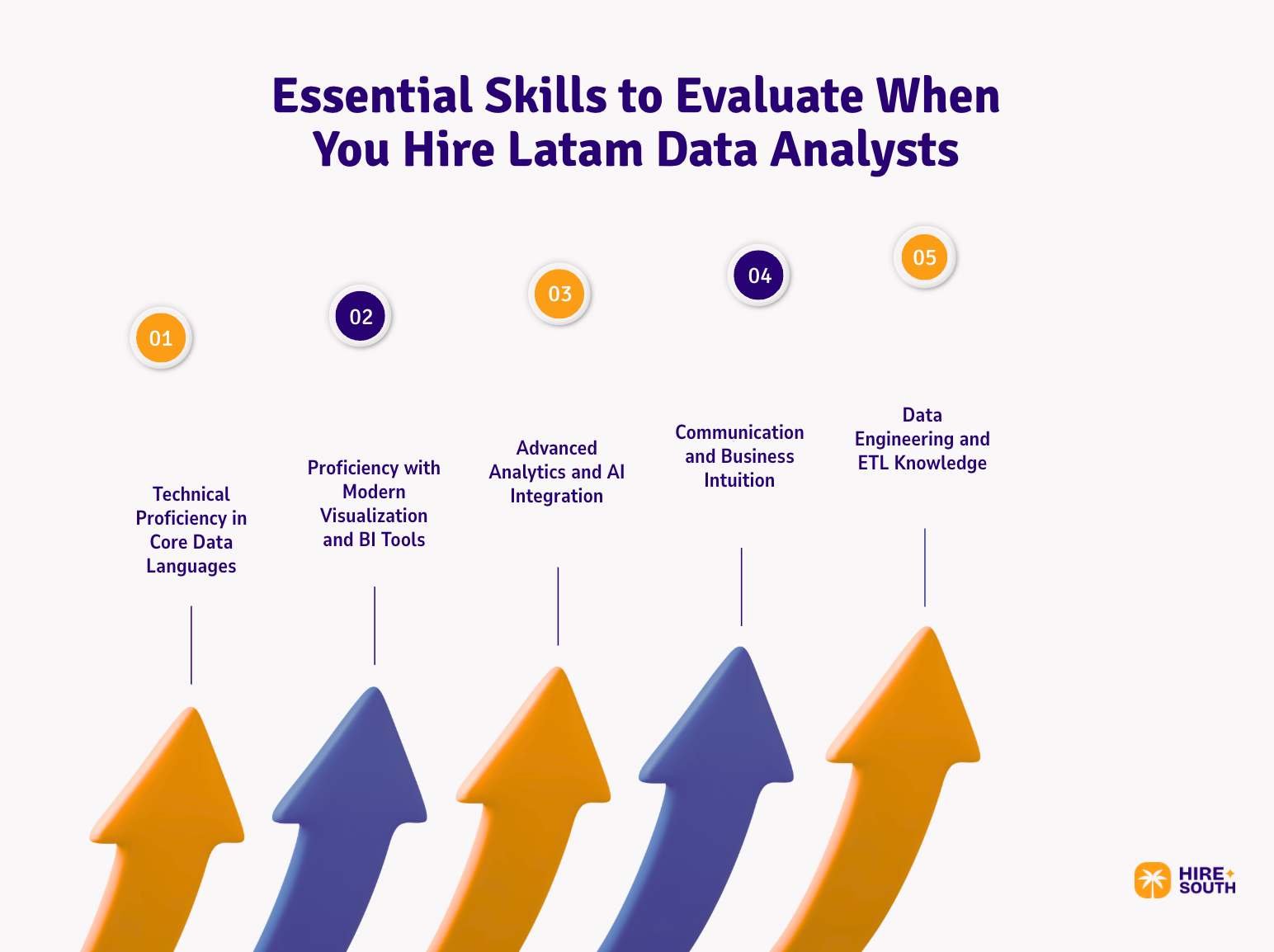
Screening for technical depth in a different market requires a specific lens. You aren't just looking for someone who can code; you need a professional who understands how data drives your specific business goals. In 2026, the baseline for "qualified" has shifted toward automation and advanced modeling.
1. Technical Proficiency in Core Data Languages
Top-tier analysts in hubs like Medellín or São Paulo should demonstrate absolute mastery of Python and SQL. These aren't just "bonus" skills; they are the bedrock of the role. You should look for candidates who can handle complex joins, window functions, and database optimization without breaking a sweat.
While Python remains the gold standard for data manipulation, R is still highly prevalent in academic and research-heavy sectors in Argentina and Chile. If your work involves heavy statistical modeling or bioinformatics, prioritizing R-literacy is a smart move. According to Coursera's Global Skills Report, Latin America consistently shows high proficiency scores in data science, with several countries outperforming global averages in statistical programming.
2. Proficiency with Modern Visualization and BI Tools
Data is useless if your stakeholders can’t understand it. When you hire Latam data analysts, evaluate their ability to build intuitive, high-impact dashboards in Tableau, Power BI, or Looker. They should be able to explain why they chose a specific chart type to represent a specific KPI.
Business intelligence in the region is booming. The Latam BI market is expected to grow at a 10.1% CAGR through 2026, according to Mordor Intelligence. This growth means the talent pool is increasingly familiar with enterprise-grade reporting requirements and the "storytelling" aspect of data.
3. Advanced Analytics and AI Integration
In today’s landscape, a standard analyst who only looks at the past is a liability. You need someone comfortable with predictive analytics and machine learning (ML) frameworks. Evaluate their experience with libraries like Scikit-learn, TensorFlow, or PyTorch.
Regional talent is leaning heavily into these "future-ready" skills. This local drive for self-improvement means you can find analysts who can build churn models or demand forecasts rather than just static monthly reports.
4. Communication and Business Intuition
Communication is often the "hidden" technical skill. You need an analyst who can join a Zoom call and explain a data anomaly to a non-technical marketing manager without using jargon.
English proficiency is a key metric here. Argentina, for example, ranks #1 in Latin America and high globally on the EF English Proficiency Index, according to EF Education First. When interviewing, look for "active listening" and the ability to link data findings to ROI. If they can’t tell you how their analysis will save you money or find new revenue, they aren't the right fit.
5. Data Engineering and ETL Knowledge
The lines between data analysis and data engineering are blurring. You’ll get more value from your hire if they understand the "plumbing" of data. Ask about their experience with ETL (Extract, Transform, Load) processes and cloud environments like AWS, Google Cloud, or Azure.
A candidate who understands how to clean and structure messy data before analyzing it will save your senior engineers hours of headache. Many Latam analysts have a "full-stack" mindset due to the lean nature of regional startups, making them incredibly versatile in a growing North American company.
How Much Does a LATAM Data Analyst Cost?
Budgeting for data talent in 2026 requires a balance between cost efficiency and competitive edge. If you are looking to scale your department without the six-figure overhead of a US-based hire, Latin America offers a compelling middle ground. You aren't just saving on base pay; you are reducing the "fully loaded" costs that typically bloat a domestic payroll.
Comparing US vs. Latam Annual Salary Benchmarks:
In the United States, the midpoint salary for a mid-level data analyst has climbed to approximately $117,250, according to Robert Half. When you shift your search to Latin America, the numbers change drastically. You can typically find high-caliber data analysts for an annual range of $35,000 to $60,000, according to RemotelyTalents.
This disparity doesn't represent a gap in skill, but rather a reflection of local costs of living and market dynamics. For many companies, this means the ability to hire two or three specialized analysts in Latam for the price of a single hire in a major US tech hub.
Significant Reductions in "Fully Loaded" Employee Costs:
The sticker price of a salary is only part of the story. When you hire domestically, you are on the hook for heavy payroll taxes, premium health insurance, 401(k) matching, and office overhead. These "hidden" costs can add 30% to 40% on top of the base salary.
By using an Employer of Record (EOR) or a contractor model in Latam, you bypass many of these traditional burdens. Companies frequently see an average savings of 58% to 64% on total employment costs compared to US-equivalent positions, according to Hire With Near. These savings are often redirected into growth initiatives or more advanced data infrastructure.
Regional Salary Tiers and Country Variations:
Not every country in Latin America shares the same price point. The market is generally divided into tiers based on economic stability and talent demand. Understanding these tiers helps you prioritize your search based on your specific budget.
- Tier 1 (Premium Markets): Countries like Mexico, Brazil, and Chile command higher rates due to their massive tech ecosystems and proximity to US business hours. A senior analyst here might earn $65,000 to $75,000.
- Tier 2 (High Value): Colombia and Argentina offer an incredible balance of top-tier expertise and affordability. Mid-level roles in Colombia often range between $48,000 and $72,000 for total monthly cost, including platform fees, according to Teilur Talent.
- Tier 3 (Emerging Hubs): Countries like Peru often provide the most significant savings, though the talent pool for hyper-specialized AI roles may be smaller.
The Impact of USD-Based Compensation:
In 2026, many top-tier Latam analysts prefer, or even require, their compensation to be pegged to the US Dollar. This is especially true in countries with high inflation, such as Argentina.
Paying in USD isn't just a courtesy; it is a retention strategy. It protects your team’s purchasing power and makes your offer significantly more attractive than local firms paying in volatile local currency. According to RemotelyTalents, USD-based pay has become the standard for international remote roles to ensure long-term stability and loyalty.
Tips for Screening Good Data Analysts
1. Implement a "Live" Technical Challenge
Skip the generic take-home assignments that can be easily outsourced to an AI. Instead, opt for a live, 30-minute coding session. Ask the candidate to perform a complex SQL join or a Python data cleaning task while sharing their screen.
This isn't just about the code; it’s about watching their thought process in real-time. Do they check for null values? Do they comment on their logic? According to the 2026 Hiring Insights Report, fraudulent or AI-augmented candidates have emerged as the #1 threat to recruitment accuracy, cited by nearly 90% of companies as a primary concern, according to GoodTime.io. A live session is your best defense against "ghost" expertise.
2. Verify the "Factor Sorpresa" (Surprise Factor)
In Latin American recruitment, the "Factor Sorpresa" refers to the tendency of some candidates to embellish their experience or educational credentials. Statistics show that over 10% of applicants in the region falsify academic backgrounds, and 22% misrepresent their work history, according to First Advantage.
You can mitigate this risk by making employment verification your highest priority. Don't just call the references provided on a PDF. Use a specialized background screening provider with local knowledge of Latin American labor laws to confirm previous titles and tenure.
3. Assess Language and "Business Translation" Skills
Technical brilliance is wasted if an analyst cannot explain their findings to your stakeholders. During the interview, ask the candidate to describe a previous project as if they were speaking to a non-technical Marketing Director.
Pay close attention to their English fluency and their ability to link data to ROI. While countries like Costa Rica and Argentina are noted for very high English proficiency, individual variation is high. According to Floowi, testing both written and spoken English in a business context is critical for ensuring smooth integration into U.S.-based teams.
4. Evaluate "Remote Readiness" and Autonomy
Hiring a nearshore analyst means you won't be looking over their shoulder. You need to screen for discipline and self-management. Ask probing questions about their previous remote work environments:
- "How do you manage your schedule when working across multiple time zones?"
- "Describe a time you encountered a data blocker and solved it without immediate supervision."
Candidates who have previously worked for international firms often have a higher "remote maturity." According to Recruitee, asking why a candidate specifically wants to work remotely can reveal their true motivations and help you gauge if they are prepared for the isolation and accountability of a distributed team.
5. Use Scenario-Based Case Studies
Instead of asking "What is a p-value?", give them a scenario: "Our churn rate increased by 5% last month in the Brazil market. Walk me through the steps you would take to identify the cause."
This approach tests their business intuition and their ability to handle real-world datasets. Top-performing analysts will discuss data segmentation, checking for external market factors, and looking at user behavior patterns rather than just reciting statistical definitions. According to Lupa Hire, evaluating the approach to a problem is often more indicative of long-term success than a perfect technical score.
Looking to Hire Data Analysts in Latin America? We Can Help!
The era of struggling with localized talent scarcity and inflated overhead is over. By shifting your focus toward Latin America, you gain a competitive edge through elite technical skills, real-time collaboration, and a specialized workforce that is projected to drive a $111 billion tech market by 2026, according to Statista.
Building a high-performing data department shouldn’t feel like a gamble. At Hire South, we eliminate the complexity of international recruitment by connecting you with the top vetted tech talent across the region. We handle the rigorous technical screening, cultural alignment checks, and compliance hurdles so you can focus on scaling your insights. Whether you need a single SQL expert or a full-scale data engineering squad, our team ensures you secure the right talent at a fraction of the traditional cost. Reach out to us today to start building your nearshore data powerhouse!