


Running a business is hard enough without your phone continually ringing off the hook. You want to focus on strategy and growth, but endless customer inquiries keep pulling your team away from their core tasks. It is a frustrating bottleneck. In fact, 59% of businesses cite cost cutting as their primary reason for outsourcing, according to Deloitte. But handing over your support operations actually does much more than just protect your bottom line.
It fundamentally changes how you operate. When you leverage call center outsourcing services, you unlock a highly scalable support system. You gain immediate access to global talent, cutting-edge AI, and 24/7 support.
This guide explains why switching makes sense for your company. You will discover the core financial advantages of an outsourced call center, explore how specialized teams enhance the customer experience, and learn the exact steps to find the perfect partner. Read on to find out how you can elevate your customer service without the traditional operational headaches.
What Does It Mean to Outsource Your Call Center?
Outsourcing means you hire an external vendor to manage your customer communications. You effectively rent a fully operational support department rather than building one from scratch. This arrangement shifts the heavy lifting of recruiting, training, and daily management to a specialized agency. You provide your brand guidelines, and the partner handles the actual customer interactions.
Moving Beyond Basic Phone Support:
Many professionals still picture a noisy room full of ringing phones when they think of outsourcing. Modern contact centers actually operate as omnichannel communication hubs. Your external partner handles emails, live website chats, text messages, and social media inquiries right alongside traditional voice calls. They act as the primary voice of your brand across all digital touchpoints.
Trusting Specialized Industry Experts:
You are not simply handing off busywork to untrained temporary workers. Top business process outsourcing companies focus heavily on specific industry niches. They train their agents to understand complex software troubleshooting, strict financial regulations, or sensitive healthcare protocols. In fact, nearly 78% of telecommunications companies have outsourced some form of customer service, according to Gartner. High-level industries rely on these partners because the agencies dedicate their entire business model to mastering customer care.
Leveraging Turnkey Technology Infrastructure:
Building a secure communication network requires significant capital. You must buy software licenses, configure servers, and implement strict data privacy safeguards. Outsourcing eliminates these technical barriers. Your vendor already operates with advanced software, artificial intelligence routing, and robust data encryption. You gain immediate access to enterprise-grade technology without buying the systems yourself.
Matching Staffing Levels to Seasonal Demand:
Call volumes naturally fluctuate throughout the business year. A retailer might see a massive spike in customer questions during the winter holidays. Outsourcing gives you the flexibility to increase your active agent count quickly when traffic surges. Once the busy season ends, you scale your coverage back down. You avoid paying idle internal staff during slow periods while ensuring customers get fast answers during peak months.
What You Are Missing If You Do Not Outsource Your Call Center
1. Losing Valuable Time for Strategic Growth
When you keep customer support in-house, your leadership team spends countless hours putting out operational fires. You miss the opportunity to focus entirely on product development and market expansion. Instead of innovating, managers get bogged down dealing with staffing shortages, scheduling conflicts, and everyday administrative tasks. Companies that delegate non-core functions see a 20% increase in overall productivity, according to a recent Harvard Business Review study. By holding onto support tasks, you actively steal time from the strategic initiatives that actually drive revenue.
2. Risking Catastrophic Service Interruptions
A localized power outage, severe weather, or a sudden internet failure can instantly blindside an in-house contact center. If you rely on a single physical location, your customers are left stranded the moment a regional disruption strikes. Outsourcing providers build their entire business models around strict redundancy. They operate multiple facilities across different geographic zones to ensure zero downtime. Over 40% of businesses fail to reopen after a major disaster, according to the Federal Emergency Management Agency. Relying strictly on internal infrastructure means you are missing out on enterprise-grade business continuity plans that keep your operations running during a crisis.
3. Missing Out on Deep Customer Analytics
You might think you know your buyers well. However, running a small internal team often means you lack the bandwidth to thoroughly analyze every single conversation. Large outsourcing firms utilize dedicated data analysts who monitor call patterns, sentiment shifts, and recurring complaints at an incredible scale. They map the entire customer journey to spot friction points you likely overlook. Organizations that leverage customer behavioral insights outperform peers by 85% in sales growth, according to Gallup. Without an external partner digging into this granular data, you leave critical market intelligence on the table.
4. Falling Behind on Campaign Agility
Launching a new product requires immediate and robust customer support. Building that capacity internally takes months of planning, hiring, and system testing. If you handle operations yourself, you lose the ability to deploy campaigns rapidly. External vendors maintain bench strength, meaning they keep a reserve of trained agents ready to jump in at a moment's notice. You can launch a massive marketing initiative on a Monday and have a fully staffed support team answering inquiries by Tuesday. Skipping this partnership means you forfeit the rapid speed necessary to outmaneuver your competitors.
Why You Should Leverage Call Center Outsourcing for Growth
1. Expanding Into Global Markets Faster
Entering new territories usually requires a massive operational overhaul. You have to navigate foreign labor laws, lease new office space, and hire bilingual staff. An outsourced partner removes these hurdles completely. You gain instant access to agents who already speak the local language and understand regional cultural nuances.
76% of consumers prefer purchasing products with information in their native language, according to CSA Research. This instant localization allows you to capture international market share months faster than building an internal team from the ground up.
2. Maximizing Customer Lifetime Value
Sustainable growth relies heavily on keeping the buyers you already have. Your support team acts as the primary driver of customer loyalty. Dedicated outsourcing agencies train agents specifically on retention strategies, de-escalation techniques, and proactive problem-solving.
When customers receive fast, competent help, they stick around longer and buy more often. A simple 5% increase in customer retention produces more than a 25% increase in profit, according to Bain & Company. By upgrading your support quality through a specialized partner, you directly increase the long-term revenue generated by every single buyer.
3. Capturing After-Hours Revenue Opportunities
Modern commerce never sleeps. If a potential buyer has a question at two in the morning, they expect an immediate answer. If your internal team clocks out at five, you are actively losing sales to competitors who stay open. Outsourcing gives you true round-the-clock coverage without the headache of managing night shifts.
78% of customers buy from the company that responds to their inquiry first, according to Lead Connect. Having professional agents ready to capture leads and process orders at any hour turns your support channel into a continuous growth engine.
4. Reinvesting Capital Back Into Core Products
Growing a business demands steady cash flow. Running a proprietary contact center drains capital through software licenses, hardware upgrades, and middle management salaries. When you shift to a variable pricing model with an external vendor, you immediately free up a significant portion of your budget.
You can then redirect those funds directly into new marketing campaigns, product research, or aggressive sales initiatives. The money you save on operational overhead becomes the exact fuel you need to accelerate your market penetration.
Steps to Successfully Outsource Your Call Center
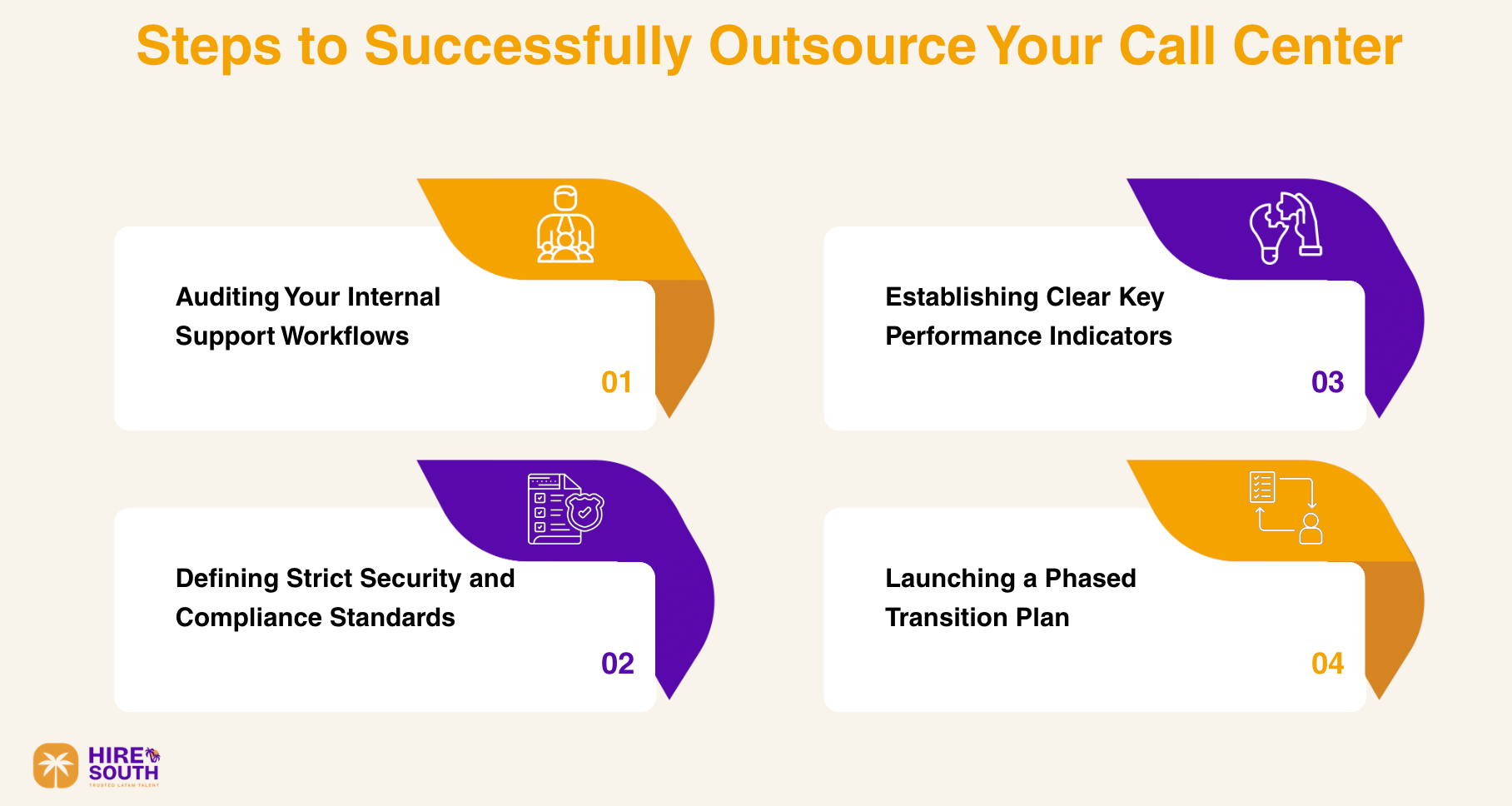
1. Auditing Your Internal Support Workflows
You cannot fix what you do not fully understand. Start by analyzing your current ticket volumes, peak calling hours, and the most frequent customer complaints. You need to know exactly which processes are draining your team's energy. Scalability is the leading reason organizations outsource, cited by 53% of companies, according to Whitelane Research. Knowing your baseline metrics ensures you only outsource the specific tasks that limit your scalability, rather than handing over processes your internal team already manages perfectly.
2. Defining Strict Security and Compliance Standards
When you hand over customer data to a third party, you also hand over massive liability. You must establish rigid data protection requirements before signing any vendor contract. The average cost of a data breach in the United States recently reached $10.22 million, according to the IBM Cost of a Data Breach 2025 Report. Protect your business by requiring potential partners to prove compliance with frameworks like SOC 2, HIPAA, or GDPR. You should also demand explicit protocols for encrypted cloud storage and multi-factor authentication.
3. Establishing Clear Key Performance Indicators
A vendor partnership only works if both sides understand what success looks like. You need to draft a comprehensive service level agreement that outlines exact performance metrics. Focus on tracking average handle time, first contact resolution, and customer satisfaction scores. Surprisingly, 20% to 25% of all outsourcing relationships fail within two years, according to Deloitte. You can avoid becoming part of that statistic by setting crystal-clear expectations and tying vendor compensation directly to these measurable quality metrics.
4. Launching a Phased Transition Plan
Do not flip a switch and move your entire support operation overnight. You should run a 60- to 90-day pilot program with a small, dedicated team of external agents. This gives you time to calibrate communication channels, refine training materials, and ensure cultural alignment. A phased rollout allows you to spot knowledge gaps early and correct them without impacting your entire customer base. Once the pilot proves successful, you can confidently scale the operation across all of your communication channels.
Need Affordable Call Center Outsourcing Services? We Can Help!
Shifting your customer communications to a specialized partner is no longer just a strategy for reducing overhead. It is a mandatory step for scaling your daily operations without sacrificing response times. Companies that actively invest in high-quality customer service yield revenue growth 4% to 8% above their market peers, according to Bain & Company.
At Hire South, we help you capture that growth by connecting your business with premium nearshore talent. We source, train, and deploy dedicated bilingual agents who seamlessly adopt your brand voice and internal workflows. If you are ready to upgrade your support infrastructure and protect your bottom line, our team is ready to build your customized outsourcing plan. Schedule a free consultation today!