


If you are still relying on offshore call centers to handle customer support, you are likely feeling the strain of timezone lags, misaligned communication, and frustrating language barriers. Managing overseas vendors sounds great for cheap hourly rates, but the hidden costs can quickly drain your team's energy and damage your customer loyalty. You need an alternative that protects your budget without sacrificing quality.
That is where nearshoring comes in. According to a report by Grand View Research, the global nearshore business process outsourcing market reached over $61 billion in revenue, driven by companies seeking closer, more agile support teams. In this article, you will discover why modern brands are ditching traditional offshore setups, how nearshore hubs compare operationally, and how to execute a seamless transition without disrupting your daily operations.
Why Companies Are Leaving Offshore Call Centers Behind
Managing offshore call centers used to be the default choice for cutting operational overhead. However, the long-term reality rarely matches the initial financial projections. Business leaders are increasingly realizing that low hourly rates often conceal operational friction that directly erodes customer trust and brand equity.
The Cost of Communication Friction and Time Zone Delays:
Operating across a 10 to 12 hour time gap severely limits real-time collaboration between your core team and your customer support reps. When urgent updates, product changes, or crisis situations occur, offshore teams often lag behind by an entire business day.
According to research from the Deloitte Customer Service Excellence report, 42% of businesses experienced noticeable drops in overall customer satisfaction after moving operations offshore, driven largely by language barriers, cultural misalignment, and delayed issue resolution.
This delay creates severe friction for the end user:
- Repeat contacts for straightforward customer requests
- Extended average handle times and prolonged queue lengths
- Misaligned brand messaging during critical updates
- Frustrated customers escalating simple interactions into high-tier complaints
When your internal teams cannot jump on a quick call with call center managers during normal operating hours, operational agility suffers.
Turnover and Retraining Costs Destroy Offshore Margins:
High attrition is one of the highest, uncalculated costs of traditional offshore centers. High stress, poor training alignment, and distant management structures often create a revolving-door environment for call center agents.
According to workforce data from Insignia Resources, annual turnover rates in offshore call center regions like India reach between 46% and 56%. In addition, overall call center first-year agent attrition sits at 69% to 73%, meaning nearly two-thirds of newly hired agents leave within 12 months.
Every time an agent leaves, your business absorbs the cost of recruiting, onboarding, and training a replacement. More importantly, constant agent turnover leaves your customers continuously interacting with inexperienced reps who lack deep domain knowledge about your product or services.
Quality Erosion and Customer Churn Overpower Labor Savings:
Saving money on hourly wages loses its value if those savings directly drive away your highest-paying clients. Today's consumers expect rapid, empathetic, and context-aware support. When offshore agents rely strictly on rigid scripts because they lack deep cultural context, customer satisfaction plummets.
According to research published by Insignia Resources, replacing a single call center agent costs between $10,000 and $20,000 in direct expenses, while the total impact from lost productivity and quality degradation reaches up to $46,000 per agent.
When you factor in lost customer lifetime value caused by poor service interactions, the apparent cost savings of traditional offshore call centers quickly evaporate. Forward-thinking companies are shifting away from distant overseas setups, choosing models that prioritize geographic proximity, shared working hours, and higher service standards.
What is The Nearshore Advantage
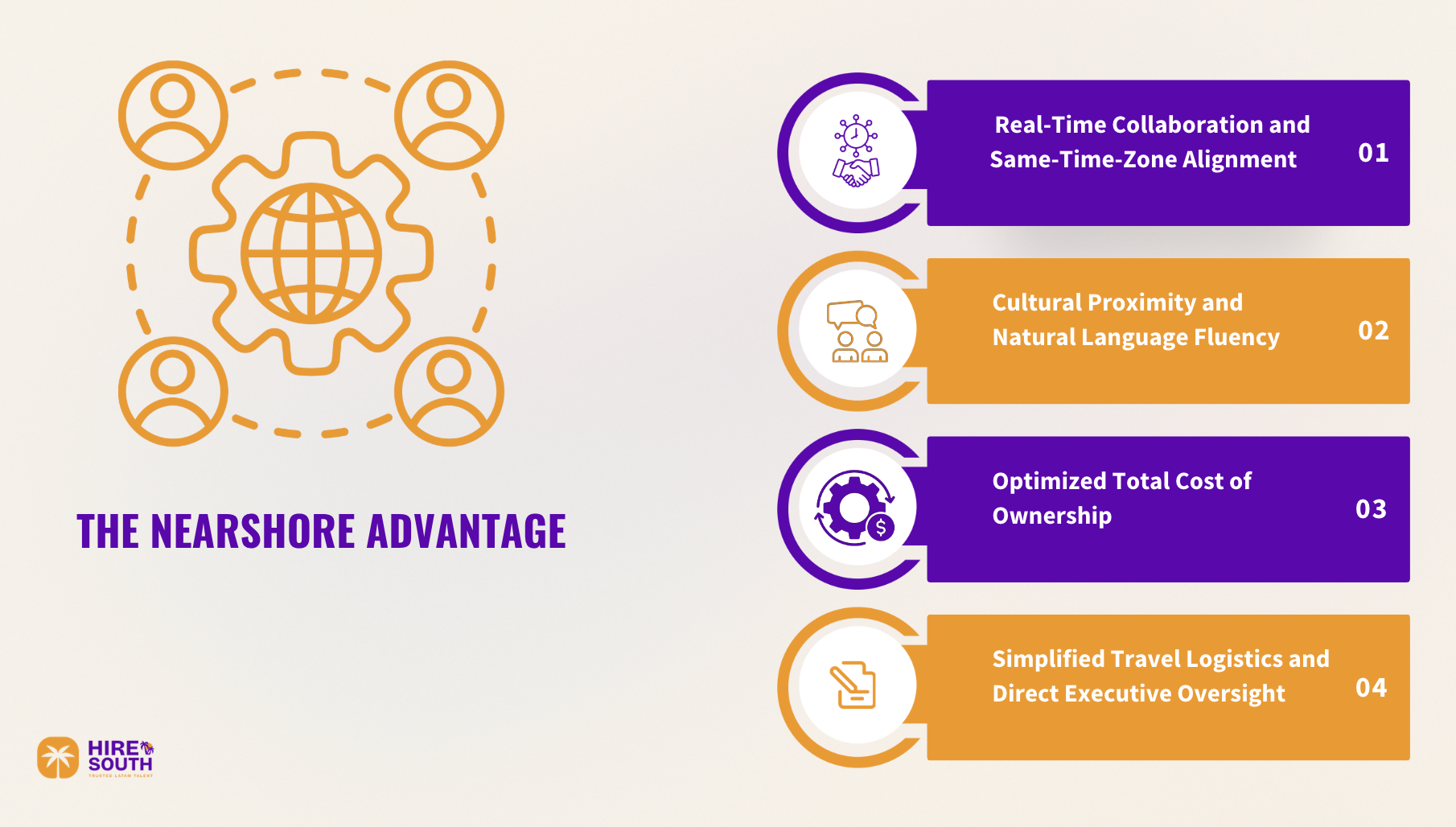
The nearshore advantage refers to the strategic practice of outsourcing business operations, such as contact centers and IT support, to neighboring countries located within similar time zones and geographic proximity. For North American companies, this typically means partnering with organizations across Latin America, including hubs in Mexico, Colombia, and Costa Rica.
This operational shift bridges the gap between costly domestic staffing and distant overseas vendors. By keeping your customer operations close to home, you achieve substantial labor savings while drastically cutting down the communication barriers, cultural gaps, and management complexity typical of traditional offshore setups.
1. Real-Time Collaboration and Same-Time-Zone Alignment
One of the most immediate benefits of nearshoring is operational synchronization. When your support partner operates within the same working hours, your internal leaders can conduct live standups, resolve escalations instantly, and deploy real-time training updates without waiting overnight for email responses.
According to data published by Grand View Research, the global nearshore business process outsourcing market reached $61.57 billion in 2025, expanding at an 8.8% compound annual growth rate. Much of this expansion is driven by organizations prioritizing real-time operational control over static hourly wage discounts.
2. Cultural Proximity and Natural Language Fluency
Nearshore agents grow up consuming similar media, social context, and consumer trends as your target customer base. This shared cultural grounding allows agents to grasp nuanced conversations, subtle humor, and regional idioms naturally, reducing awkward, scripted interactions that alienate callers.
Key linguistic advantages include:
- High English proficiency coupled with native Spanish fluency for complete bilingual coverage.
- Reduced accent barriers, making voice interactions smoother and faster.
- Intuitive empathy during high-stress customer support situations.
- Faster training times when launching new products or complex policy adjustments.
According to a Deloitte Customer Service Excellence study, 42% of companies that moved operations offshore noted visible declines in customer satisfaction, primarily due to language barriers and cultural gaps. Nearshoring eliminates those friction points while keeping your customer experience authentic.
3. Optimized Total Cost of Ownership
While offshore centers often boast the lowest raw hourly rates, the total cost of ownership tells a different story once you factor in management overhead, high customer churn, and low agent productivity. Nearshore centers provide a middle ground that balances direct labor savings with high-touch support.
According to industry pricing benchmarks, nearshore customer support typically costs between $13 and $19 per hour. Compared to domestic US rates averaging $28 to $42 per hour, this delivers a direct 40% to 52% reduction in labor expenses without sacrificing service quality.
4. Simplified Travel Logistics and Direct Executive Oversight
Maintaining quality standards requires hands-on management, occasional site visits, and face-to-face team building. Flying to a distant overseas center requires 20+ hours of travel, severe jet lag, and significant corporate travel expense.
Nearshore hubs require a quick 2-to-5-hour direct flight from major domestic airports. Your operational leaders can visit a facility in Mexico, Colombia, or Central America, perform quality audits, train staff in person, and return home in the same week, keeping leadership tightly connected to customer-facing reps.
Transitioning from Offshore to Nearshore: Step-by-Step
Transitioning your contact center operations away from an established overseas vendor requires deliberate execution. A rushed migration risks service interruptions, lost customer context, and inflated transitional expenses.
Moving your support operations closer to home demands a structured methodology. By breaking the transition into controlled phases, you can safeguard your baseline metrics, maintain continuity, and align your new nearshore team with internal performance expectations.
Phase 1: Conducting an Audit of Existing Offshore Operations
Before engaging new partners, map out every workflow currently managed by your incumbent vendor. You cannot optimize what you have not explicitly documented.
Your audit must focus on extracting historical call volume patterns, handle times, and seasonal spikes. You need to review script repositories, knowledge base articles, and escalation paths while identifying recurring customer friction points caused by current vendor limitations. Finally, pinpoint every technical integration, including CCaaS platforms, CRM custom fields, and security protocols.
According to research from McKinsey, enterprise organizations that complete thorough operational and technical audits prior to platform or vendor migrations reduce post-launch integration delays by up to 35%. Establishing clear baseline data ensures you evaluate prospective nearshore partners against precise operational requirements rather than generic sales promises.
Phase 2: Partner Selection and Cultural Alignment Audits
Selecting a nearshore partner goes beyond evaluating hourly billing rates. You need a partner whose operational culture, talent recruitment pipeline, and infrastructure mirror your internal standards.
When evaluating potential providers, inspect local labor markets, regional English proficiency indexes, and transport infrastructure surrounding vendor facilities. You should verify PCI-DSS, SOC 2 Type II, or HIPAA certifications directly rather than relying on vendor self-reporting. It is equally critical to review the vendor's internal agent retention rates, compensation structures, and career pathing programs.
Industry benchmark data from Customer Contact Week indicates that agent attrition directly impacts first-contact resolution. Selecting a partner with proven retention strategies protects your training investment and stabilizes long-term service quality.
Phase 3: Technical Integration and Knowledge Transfer
With a nearshore partner selected, focus shifts to system integration and training execution. Your technical teams must establish secure, low-latency connectivity while your operational leads translate core business logic into actionable training modules.
Prioritize establishing dedicated VPN tunnels or secure cloud environments for agent access alongside role-based access controls to protect sensitive customer records. Your team should conduct train-the-trainer workshops with nearshore instruction leads and rebuild training modules to replace rigid scripts with scenario-based learning frameworks.
Modern nearshore migrations leverage cloud contact center platforms, enabling seamless telephony routing changes without hardware installation.
Phase 4: Running a Parallel Pilot Program
Never execute a hard cutover from an incumbent vendor without validating operational readiness in a live environment. A parallel pilot program isolates risk, allowing your nearshore team to handle a controlled slice of live traffic while your offshore team maintains primary operations.
Start by routing a fixed percentage, typically 15% to 25% of total volume, to the nearshore team. Monitor real-time interaction quality, average handle times, and first-contact resolution rates daily while conducting side-by-side coaching sessions to correct misalignments immediately. This allows you to compare performance benchmarks directly against your incumbent offshore team in real time.
According to contact center migration studies by BETSOL, running a controlled, phased pilot for 2 to 4 weeks reduces critical go-live escalations by over 60% compared to direct cutover strategies.
Phase 5: Executing the Full Cutover and Offboarding
Once your nearshore team consistently matches or exceeds target performance metrics across the pilot volume, execute the final phase of migration. Ramp volume up in increments of 50%, 75%, and finally 100% over a two-week window rather than flipping all traffic simultaneously.
Once full volume stabilizes at the new nearshore center, formally notify your legacy offshore vendor according to contract termination clauses. Immediately revoke legacy vendor system credentials, API tokens, and network access points. Finish by conducting a final audit of all customer data assets to confirm complete data deletion at the legacy site, then transition operational meetings into a standard cadence of weekly performance reviews and monthly strategic syncs with your new partner.
Executing these steps systematically transforms a complex vendor migration into a predictable, low-risk operational upgrade.
Ready to Hire Nearshore Talent in Latin America?
Moving away from offshore call centers is no longer just about cutting costs; it is about protecting your brand equity, improving customer satisfaction, and building a responsive support engine. When your customer support team operates in real time, speaks with natural fluency, and aligns with your company culture, every customer interaction becomes a long-term retention tool.
At Hire South, we connect growing businesses with the top 1% of pre-vetted customer support talent across Latin America. By delivering direct access to bilingual, highly skilled professionals working in your exact time zone, we help you reduce labor costs by 50% to 70% compared to domestic hires, all while elevating your service quality. From sourcing and rigorous screening to compliance, payroll, and ongoing success management, our team handles the entire process so you can build a high-performing nearshore team without the operational headache. Contact us to get started today!


.jpg)