


If you are still treating nearshoring as a generic cost-cutting exercise, you are missing the biggest shift in modern engineering when you hire LATAM developers. The days of hunting for any remote-native professional who can write code are over. Today, building a high-velocity team requires a deliberate approach to mapping out specific tech hubs based on the exact engineering stacks you need.
A clear telltale of this is that Latin America is no longer just a backup option for North American tech companies. It’s evolved into a proper powerhouse. The regional active developer pool has surged past 2.8 million tech specialists, according to a 2026 software outsourcing data report by AgileEngine. Because of this massive growth, different cities have developed highly specialized technical identities. This makes it easier than ever to hire tech talent in Latin America.
At Hire South, we want to give you the ultimate blueprint for navigating these specialized clusters. We will break down the regional macroeconomic trends, map frontend and full-stack dominance in cities like Guadalajara and Santiago, and locate the heavyweight enterprise backend powerhouses. You will also discover where the top AI, data science, and Web3 talent is hiding, while learning how to match your specific budget and time zone requirements to the right local ecosystem. Keep reading to learn more!
What Defines a Specialized Technology Hub in Latin America?
You cannot define a specialized tech hub simply by its geographic size or the number of developers living there. True specialization happens when a city moves past general IT support and builds a critical mass of talent around specific programming languages, architectures, or industries. It requires a dense concentration of highly skilled software engineers, targeted university programs, and localized corporate investment, all pulling in the same direction.
When you look at Latin America's specialized tech hubs, you see distinct technical personalities. One city might evolve into an enterprise backend powerhouse running Java and cloud infrastructure, while another becomes a magnet for advanced machine learning and data science. This deep concentration of niche expertise is what transforms a standard offshore destination into a specialized engineering node.
1. Technical Density and Talent Clustering
Specialization thrives on talent density. It is about how many developers within a specific metropolitan area actually master a particular engineering stack. For instance, when a city has a disproportionately high percentage of engineers skilled in Python, Kubernetes, or React compared to the regional average, it achieves a specialized status.
This clustering creates a powerful network effect. As more companies set up operations to hire LATAM talent to tap into a specific talent pool, local engineers naturally upskill in those exact technologies to stay competitive. According to an emerging markets talent analysis, tech hubs with high vertical density see a 40 percent faster local knowledge-sharing rate through dev communities and user groups compared to diversified cities. This concentration makes it much easier for you to scale a team with deep, domain-specific expertise rather than relying on generalists who need months of retraining.
2. Alignment of Academic and Corporate Ecosystems
A true specialized hub requires a direct pipeline from local classrooms to commercial engineering teams. This happens when regional universities align their STEM resumes with the specific needs of global tech companies and local tech champions.
If local universities heavily emphasize data engineering and distributed systems, the local talent pool will naturally reflect that expertise. According to an international education impact study by UNESCO, regions where tech firms actively co-develop university IT resumes see a 35 percent increase in immediate, job-ready engineering specializations upon graduation. This alignment ensures the hub constantly replenishes its specialized talent pool, giving your business a sustainable pipeline of fresh, highly targeted engineering talent.
3. Infrastructure and Local Tech Policy Support
The final piece of the puzzle is the regional framework supporting the ecosystem that allows US companies to hire LATAM developers with ease. Specialized hubs do not emerge by accident, they are built through deliberate local policies, reliable tech infrastructure, and tech-friendly tax incentives.
Municipalities that invest heavily in high-speed fiber connectivity, reliable power grids, and dedicated tech districts naturally attract the specific types of companies that fuel specialized growth. According to a digital infrastructure readiness index by the Inter-American Development Bank, Latin American cities that establish dedicated technology enterprise zones experience a 50 percent higher rate of foreign tech investment over five years compared to unassisted municipalities. These structural advantages give engineers the stability they need to build complex platforms, ultimately securing the hub's reputation as a reliable destination for high-tier engineering stacks.
How Regional Specialization Impacts Software Development Velocity
When you drop a software engineer into an unfamiliar engineering stack, your development pipeline hits a wall. True delivery speed is not just about typing code quickly; it is about minimizing friction. Choosing a team from a highly specialized tech hub directly injects momentum into your sprint cycles.
By hiring remote developers from a region that naturally aligns with your core architecture, you eliminate the learning curves that traditionally drag down new projects. Your features move from the backlog to production faster because the team speaks your technical language from day one. This structural alignment alters the entire economic and operational trajectory of your software releases.
Drastic Reduction in Engineering Onboarding Time:
Bringing a new developer up to full speed is historically a slow, expensive process. In a standard, non-specialized hiring environment, it often takes three to nine months for an engineer to achieve full productivity, according to a technical workforce study by TechClass. This lag creates a massive drag on your organizational capacity.
Specialized tech hubs completely break this bottleneck when you hire LATAM developers. When you hire from an ecosystem dense with your specific framework, engineers do not waste weeks struggling with environment setups or basic architectural patterns. They already master the nuances of the stack. According to an onboarding efficiency analysis by TeamCubation, organizations with highly targeted, role-specific engineering alignment see a 50 percent improvement in immediate team productivity. You save months of downtime and start seeing valuable code commits almost instantly.
Higher Sprint Predictability and Lower Error Rates:
Velocity is nothing without stability. A development team that rushes features out the door only to spend the next sprint firefighting bugs is not actually moving fast. True velocity relies heavily on predictability.
Engineers rooted in a specialized regional hub possess deep, contextual knowledge of the tools they use. They understand how your specific backend handles scale, where database bottlenecks form, and how to write clean, maintainable tests. According to an agile execution study published in the Journal of Software Engineering, structured velocity tracking and stack mastery improve estimation accuracy by roughly 40 percent. This expertise directly translates to a lower change failure rate, meaning your team spends less time fixing broken code and more time building new revenue-generating features.
Streamlined Code Reviews and Seamless Team Collaboration:
When your entire cross-border team shares an identical technical foundation, internal friction evaporates. Code reviews become constructive architectural discussions rather than frustrating syntax corrections.
This shared expertise streamlines your continuous integration and continuous deployment pipelines. Experienced developers in specialized nodes catch edge cases early in the review process, long before the code ever reaches a production environment. According to an engineering effectiveness benchmark by DX, optimizing workflow mechanics and reducing technical friction can cut pull request cycle times by 43 percent. By eliminating these minor, daily delays, you create a compounding efficiency loop that keeps your entire product roadmap moving forward on schedule.
Engineering Stacks-Tech Hubs Mapping
To build an efficient cross-border engineering team, you must move away from country-level hiring and start looking at city-level specialization. Mapping specific architectures to specialized regional hubs ensures that you source talent with deep ecosystem familiarity rather than generic skills.
Different metropolitan areas across the region have evolved unique technical identities tailored to specific corporate landscapes. By aligning your required technology stack with these localized clusters, you maximize development velocity and optimize operational budgets.
Direct Correlation: Specialized Programming Frameworks and Local Nodes
When you map the regional landscape, clear software patterns emerge across major metropolitan areas. For instance, Brazil boasts the largest absolute talent pool with over 759,000 active technology specialists, according to a 2026 workforce report by Revelo. This massive workforce is heavily concentrated around enterprise backend languages, making cities like São Paulo the premier destination for complex Java, Spring Boot, and cloud infrastructure architectures.
Conversely, if your development pipeline requires immense scale in frontend frameworks or mobile application ecosystems, the map shifts toward Mexico and Colombia. Mexico alone supports a technical workforce of more than 560,000 developers, according to data from Revelo, with a massive concentration of full-stack JavaScript and TypeScript expertise localized in Guadalajara and Mexico City. By pinpointing these nodes, you ensure your open positions are marketed directly to communities where those specific skills are already the default standard.
Market-Driven Engineering Premiums Across the Region:
The financial realities of engineering stacks-tech hubs mapping vary wildly depending on the scarcity of the underlying technology. While general full-stack engineering roles command a predictable baseline, highly niche specializations carry distinct market premiums that affect your overall budget.
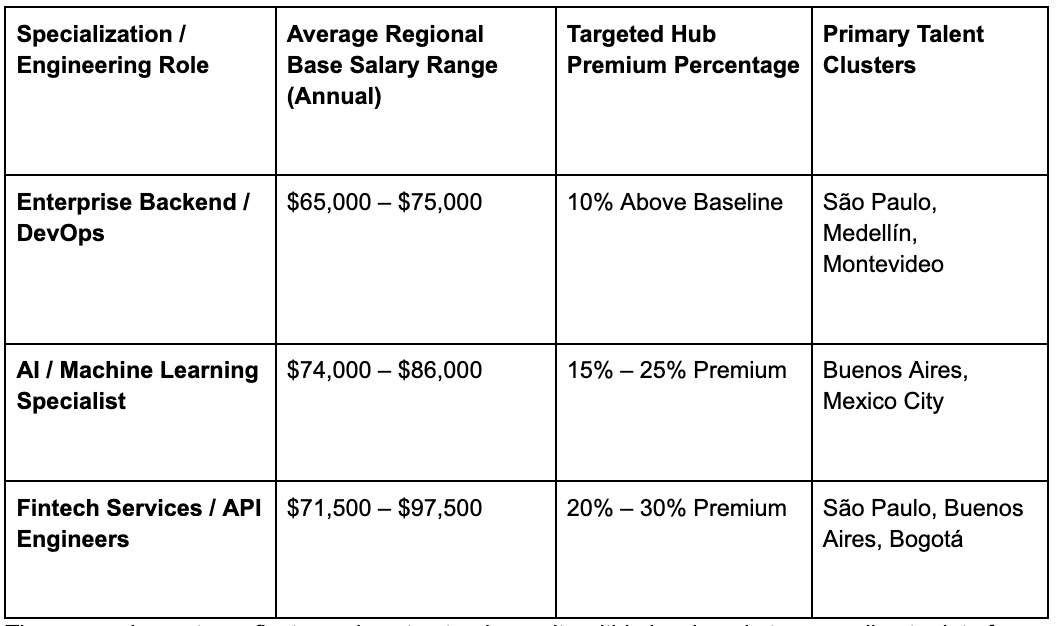
These premium rates reflect genuine structural scarcity within local markets, according to data from an international salary benchmark study by Howdy. Understanding these local compensation variations prevents you from underpricing your job offers in highly competitive tech sectors.
Temporal and Regulatory Factors in Hub Selection:
Mapping your engineering stack to a specific geographic node involves more than counting available resumes; it requires careful consideration of operational workflows. Time zone alignment represents a significant strategic variable for real-time, synchronous code collaboration. For example, teams relying on real-time pull request reviews report a 40 percent faster time to market compared to asynchronous offshore models with minimal daylight overlap, according to engineering efficiency data by Revelo.
Choosing between a Central Standard Time node like Guadalajara or an Eastern Standard Time alternative like Bogotá dictates how your daily standups operate. Furthermore, you must account for localized compliance structures. Navigating the difference between a contractor-heavy ecosystem in Argentina and the stricter local labor codes in Brazil allows you to scale your engineering footprint while keeping legal and operational risks fully managed.
How To Correlate Your Project Needs to the Right LATAM Tech Hubs
Matching your technical roadmap to the geographical map of Latin America is the key to minimizing project friction. You cannot treat the region as a single, uniform talent source. If your engineering team relies on real-time peer reviews and synchronous deployment loops, dropping a project into a node without the proper structural alignment will cause immediate delays.
Instead, you must systematically evaluate local developer concentrations against your core project parameters. Evaluating target budgets, velocity goals, and language needs allows you to build a highly stable cross-border engineering footprint.
1. Finding the Ideal Balance Between Tech Stack Mastery, Target Budget, and Hiring Speed
Every software engineering project operates under a unique set of constraints, forcing you to prioritize either immediate availability, niche framework expertise, or raw cost efficiency. If you are building an enterprise platform requiring heavy microservices architecture, you will find a massive volume of senior backend talent in São Paulo, Brazil. However, because over 60 percent of businesses actively prioritize specialized industry experience when choosing a development partner, according to a tech sourcing study by Clutch, these enterprise-ready nodes command higher compensation rates.
When your primary project driver is rapid team scaling on a restricted budget, you must shift your focus toward rising technical ecosystems. For instance, scaling a mid-level full-stack team in Bogotá, Colombia, allows you to tap into a growing workforce while keeping baseline compensation optimized. According to a nearshore pricing analysis by nCube, building a development team through a structured Latin American hub can yield an overall cost savings of 50 to 70 percent compared to hiring equivalent engineering talent within North America. Striking this balance early prevents you from getting bogged down in localized talent wars.
2. Navigating Time Zone Overlaps to Establish Synchronous Engineering Operations
True development velocity suffers when a developer has to wait twelve hours for a simple pull request review or architectural clarification. This hidden cost of asynchronous communication is why modern engineering teams prioritize direct, real-time collaboration. Aligning your daily operations with the proper geographic longitude completely changes your team dynamics.
Choosing a tech hub that mirrors your local operating hours drastically improves your delivery timelines. Organizations that shift from traditional, distant offshore models to nearshore teams experience a 35 percent reduction in overall project delivery cycle times, according to industry data. If your core management operates out of California, utilizing Central Standard Time nodes like Guadalajara keeps your standups perfectly synced. For East Coast operations, Eastern Standard Time nodes like Bogotá offer seamless daylight integration, ensuring your distributed squads function as a singular, cohesive unit.
3. Mitigating English Proficiency Gaps Across Varied Spanish and Portuguese Tech Hubs
A software engineer can write flawless code, but if they cannot articulate technical trade-offs during a live system architecture emergency, your project velocity will stall. English fluency varies heavily across individual municipal hubs, requiring you to look closely at local education trends rather than national averages.
If your project requires engineers to actively participate in client-facing product strategy sessions, targeting elite communication hubs is critical. Software developers in Argentina consistently demonstrate the highest baseline of English fluency across the region, according to an international language proficiency report by Next Idea Tech. Conversely, while massive hubs like São Paulo or Mexico City offer incredible sheer talent volume, their broader populations sit at a moderate proficiency tier on the EF English Proficiency Index. This structural variance means you must build explicit, communication-focused vetting pipelines into your local sourcing strategy to ensure deep technical comprehension.
Ready to Hire LATAM Developers in Latin America’s Specialized Tech Hubs?
Building a high-velocity development team requires moving past generic nearshoring and embracing a data-driven approach to mapping localized talent pools. When you align your core engineering stacks with the regional nodes that naturally specialize in those frameworks, you systematically eliminate technical friction, lower your change failure rates, and maximize your product delivery speed.
Navigating this vast regional landscape alone can easily stall your growth, but you do not have to build your cross-border strategy in isolation. At Hire South, we specialize in bridging this exact gap by connecting growing North American companies with the top 1% of vetted, bilingual engineering and operational talent across Latin America.
Our dedicated cross-border recruitment infrastructure accelerates your organizational momentum, allowing you to build elite, time-zone-aligned remote teams in 14 days or less. Book a FREE discovery call today to map out your custom engineering pipeline!