


Finding the right technical talent locally is getting much tougher, and many companies are feeling the squeeze of high salaries and endless recruitment cycles. That’s why so many business leaders are looking south for a better way to scale. According to Gitnux, 72% of US companies outsource software development to cut costs and access specialized talent. When you want lower costs while maintaining top quality, nearshore software development really hits the sweet spot.
Why? Well, you secure the financial benefits of outsourcing without the massive time zone headaches of traditional offshoring. This guide breaks down exactly what nearshore software development looks like right now. You will learn the core differences between nearshoring and offshoring. You will also uncover the immediate benefits it brings to your budget, hiring speed, and team agility. Read on to future-proof your IT staffing strategy!
First, What Is Nearshore Software Development?
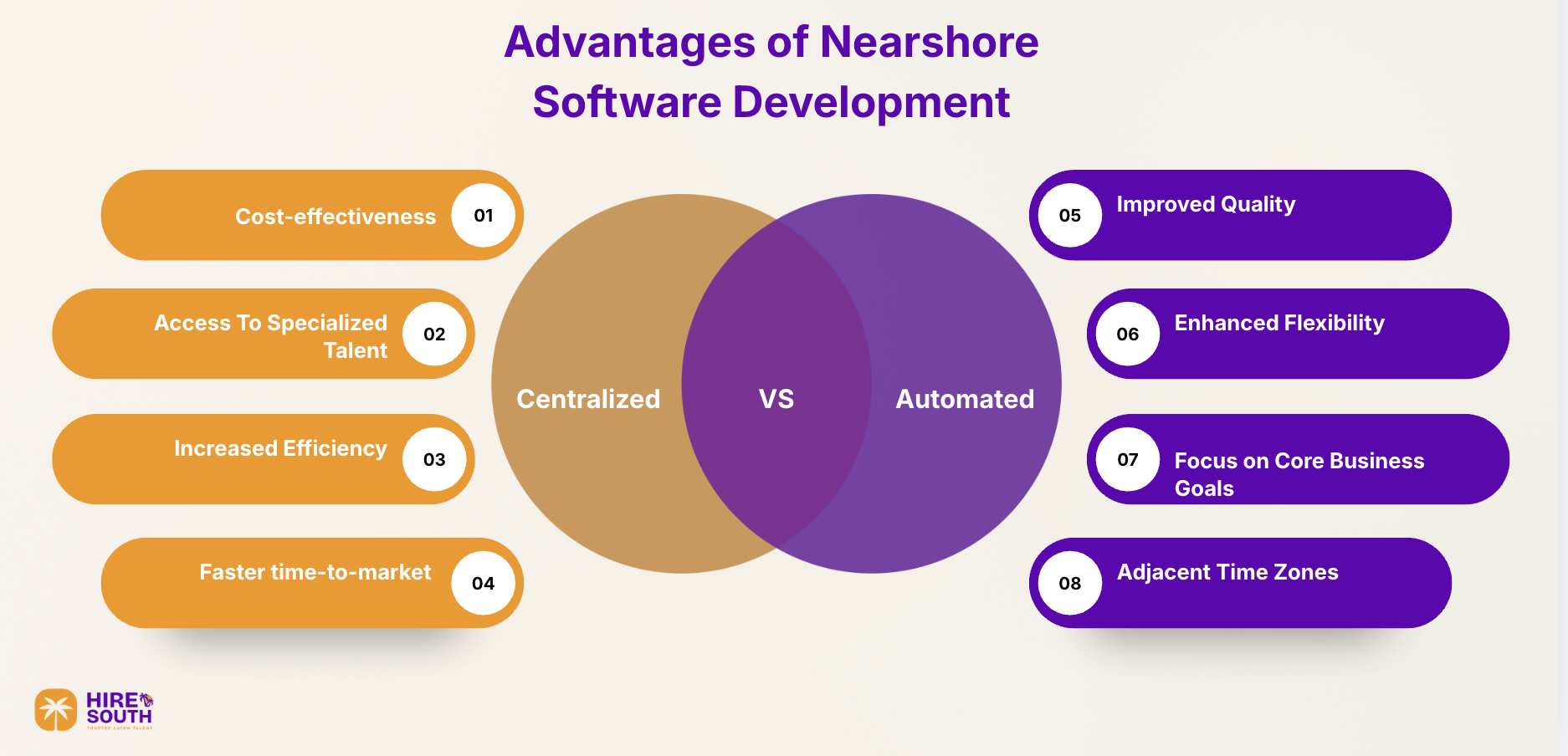
Nearshore software development is the strategic practice of building remote engineering teams in neighboring countries. You extend your internal workforce across a nearby border to access specialized outsourced tech talent. You partner with professionals who share similar schedules rather than dealing with massive geographical divides.
This operational model offers a highly practical middle ground. You bypass the high costs of local recruiting without taking on the logistical headaches of working with distant offshore vendors. Keeping your external developers geographically close allows you to maintain tight control over daily workflows while rapidly scaling your technical capacity.
The Operational Advantage of Adjacent Time Zones:
Geographic proximity drives the success of any nearshore setup. For North American companies, nearshoring to Latin American countries provides six to nine hours of daily time zone overlap with the US East Coast, according to JumpGrowth. This significant overlap fundamentally changes your software development cycles.
Your internal product managers and external developers are online together. You can run morning standups, conduct live code reviews, and resolve immediate deployment bugs on the same calendar day. This alignment eliminates the classic offshoring bottleneck where a simple clarification question takes an entire day to answer.
Accelerating Digital Product Delivery:
Execution speed is a major differentiator for this staffing model. Companies that adopt nearshore software development reduce delivery timelines by up to 30% compared to traditional offshore counterparts, according to McKinsey Digital. Faster, real-time problem-solving translates directly into a quicker time-to-market for your software products.
Agile frameworks require continuous communication and rapid iteration to function properly. When your extended team operates in your neighborhood, you integrate them directly into your daily sprint rhythms. They actively participate in your strategy sessions and adapt quickly to shifting project scopes, rather than just writing code in isolation.
Predictable IT Staffing Budgets:
Finding top-tier talent is a priority, but controlling operational costs remains a necessary factor in any technical staffing decision. The global nearshore software development services market is expanding rapidly, projected to hit $85 billion by 2035 at a compound annual growth rate of 5.2%, according to WiseGuyReports. This heavy enterprise investment is largely driven by the financial predictability the nearshore model provides.
You pay for dedicated engineering pods that scale exactly when your workload demands it. This structure protects your budget from the high overhead costs of traditional hiring, such as benefits, local office space, and prolonged recruitment cycles. You capture the financial advantages of outsourcing while keeping the smooth operational cadence of an in-house tech department.
How Software Development Nearshoring Differs from Offshoring
You often hear these two terms used interchangeably, but they represent entirely different operational strategies. Offshoring pushes your development work to distant continents, prioritizing massive cost reductions and access to the largest possible talent pools. Software development nearshoring keeps your external teams in neighboring countries, balancing budget efficiency with strict operational alignment.
Understanding the difference helps you avoid costly missteps when scaling your tech capabilities. You must evaluate these models based on real-time collaboration, true cost of ownership, and communication styles.
1. Asynchronous Versus Synchronous Workflows
The most glaring difference lies in how your team actually gets work done. Offshore teams operate in entirely different time zones, which forces you to rely on highly structured, asynchronous workflows. Offshore teams require detailed documentation and an acceptance of 24-hour response cycles, according to StepTo. If a developer in Asia hits a roadblock while you sleep, they must wait until your morning to get clarification.
Nearshore partners work synchronously with your internal staff. You share a substantial portion of the working day, allowing your engineers to jump on quick video calls or chat instantly on messaging apps. This real-time collaboration fits perfectly into modern Agile frameworks, where requirements shift rapidly, and same-day decisions are necessary to keep sprints on track.
2. The Total Cost of Ownership Comparison
When you look purely at hourly rate cards, offshoring always wins on paper. Offshore outsourcing in regions like the Philippines or India is typically 20 to 40 percent cheaper in base rates than nearshore options in Latin America or Eastern Europe, according to Cloud Employee. However, those initial savings can quickly vanish if you factor in the total cost of ownership.
Nearshoring often delivers a better return on investment for complex projects. Your nearshore teams typically complete tasks with fewer revision cycles because they communicate with you in real time. You spend less money fixing misunderstood requirements, and your project managers spend less time acting as communication buffers.
3. Navigating Cultural Alignment and Business Practices
Cultural differences significantly impact software quality and project momentum. Offshore destinations often have hierarchical corporate cultures where developers might hesitate to push back on flawed technical requirements. This can lead to your external team building exactly what you asked for, even when a better technical solution exists.
Nearshore teams tend to share stronger cultural and business compatibility with your home market. Your extended engineers act as proactive consultants rather than passive order takers. They are much more likely to challenge assumptions, suggest architectural improvements, and flag potential issues before they become expensive mistakes.
4. Choosing Between Commodity Skills and Specialized Agility
Your choice ultimately depends on the specific nature of your project. Offshoring provides access to millions of developers, making it ideal if you need a large team quickly for routine maintenance or well-documented legacy system updates. The massive offshore talent pool easily supports commodity technologies.
Software development nearshoring is the better choice when your product requires constant innovation and specialized agility. If you are building a new application from scratch, navigating shifting market demands, or requiring tight integration with your in-house product designers, geographic proximity becomes your biggest asset.
Why Nearshore Software Development is a Game Changer in 2027
The technology landscape is moving incredibly fast this year. You face mounting pressure to deliver better software while simultaneously managing tighter operational budgets. Expanding your workforce across borders is no longer just a basic cost-saving measure. It has evolved into a strategic necessity for staying competitive in a rapidly shifting market.
Relying solely on local hiring puts your product roadmap at serious risk. You need immediate access to specialized engineers who can integrate seamlessly into your current workflows.
Mitigating the Critical Tech Talent Shortage.
Finding qualified tech professionals locally is becoming nearly impossible. Over 90% of global enterprises will face critical skills shortages by 2026, according to an IDC report. You cannot afford to let your digital initiatives stall simply because you cannot fill empty seats in your local office.
Nearshore partnerships provide an immediate release valve for this intense hiring pressure. You tap into a massive, highly educated talent pool that shares your work hours. This immediate access to senior developers and specialized architects keeps your projects moving forward without the friction of a six-month local recruitment cycle.
Artificial Intelligence Integration in Modern IT Staffing.
Artificial intelligence is fundamentally changing how software gets built. A full 93% of development professionals are already using AI in their product or software development today, according to Vention. You need external teams that are already fluent in these modern acceleration tools.
Top-tier nearshore engineers are heavily utilizing AI copilots for code generation, automated testing, and rapid prototyping. They bring this cutting-edge efficiency directly to your internal projects. You benefit from significantly faster development speeds and cleaner codebases without having to train your existing staff on brand-new AI workflows from scratch.
Increased Agility for Shifting Business Priorities.
Modern business requires extreme operational flexibility. Market demands change weekly, and your engineering capacity must adapt just as quickly. Traditional hiring locks you into fixed overhead costs and rigid team structures that are difficult to unwind when your priorities inevitably pivot.
A nearshore strategy gives you the agility to scale your tech resources up or down on demand. You can bring on a dedicated pod of full-stack developers for a rapid four-month sprint, and then seamlessly scale back down once the core product launches. You only pay for the exact engineering capacity you need, exactly when you need it.
Overcoming IT Staffing Challenges with a Nearshore Strategy
1. Slashing Your Average Time to Hire
The local hiring process is painfully slow and often ends in an expensive bidding war. According to Ashby's 2026 benchmarks, hiring a senior software engineer takes a median of 71 days from the moment the job opens. That leaves your product roadmaps stalled for over two months just waiting for a single capable contributor to start.
Nearshoring sidesteps this massive delay completely. You bypass the traditional resume sorting, endless interview rounds, and typical two-week notice periods. Partnering with an established nearshore firm gives you instant access to a pre-vetted talent bench. You can evaluate qualified candidates in a matter of days and have a senior developer actively writing code in your environment by next week.
2. Retaining Vital Project Domain Knowledge
Freelancers and short-term contractors often leave just when they finally understand your tech stack. Constant turnover forces your lead engineers to waste hundreds of hours explaining basic architecture to new faces. This revolving door of talent destroys your overall momentum and increases the likelihood of critical bugs slipping into production.
A strong nearshore strategy emphasizes dedicated team integration over transactional gig work. You get engineers who stick with your product through multiple iteration cycles. They learn the quirks of your codebase, understand your specific business logic, and act as stable pillars for your ongoing digital initiatives.
3. Scaling Engineering Pods Without Overhead Friction
Business demands fluctuate wildly, yet local hiring forces you into rigid commitments. Scaling up an in-house team requires purchasing expensive hardware and absorbing massive benefits packages. If a major project gets canceled suddenly, you are stuck with an inflated payroll overhead.
Nearshore teams provide the exact flexibility you need to survive unpredictable market conditions. You can rapidly spin up an entire pod of QA automation engineers for a six-month deployment push. Once the software launches and stabilizes, you smoothly transition back to a leaner maintenance crew. You pay only for the exact technical output you need, eliminating the heavy financial friction of traditional staffing models.
Ready to Get Started With Nearshore Software Development?
Building a robust engineering team no longer requires draining your local budget or navigating challenging 12-hour time zone differences. With 69% of U.S. employers reporting difficulty filling critical technical roles in 2026, expanding your search across borders is now a strategic necessity.
This is exactly where our team at Hire South steps in. As a specialized LATAM recruiting partner, we connect you directly with elite, pre-vetted nearshore professionals who perfectly overlap with your daily working hours. Our white-glove IT staffing process handles everything from deep technical sourcing to local compliance. This allows you to bypass lengthy local hiring cycles and onboard senior developers in a matter of weeks rather than months.
Whether you are looking to augment your current staff with a specific specialist or build a dedicated remote engineering pod from scratch, we have the regional network to make it happen. Hire South provides the agile talent infrastructure you need to accelerate your software delivery, retain vital project knowledge, and scale your digital initiatives efficiently. Book a free strategy call today!