


Thinking about scaling your team without draining your bank account? You aren't alone. As North American labor markets tighten and salaries for specialized roles skyrocket, smart leaders are looking south to Latin America.
It isn't just about finding cheaper labor; it's about finding world-class talent that actually works in your time zone. You can expect to save between 50% and 80% on labor costs when hiring from the region compared to local U.S. hires, according to Mismo.
This article breaks down exactly how those savings materialize. You’ll explore a detailed comparison of annual salaries, the hidden costs of "cheap" offshore alternatives, and a country-by-country guide to the best talent hubs in 2026. Whether you are a startup founder or a seasoned VP, this is your roadmap to building a leaner, faster team.
The Financial Blueprint: Realizing LATAM Talent Cost Savings
Building a high-performing team shouldn't force you to choose between quality and your bottom line. When you analyze your budget, you'll find that the "sticker price" of a North American hire is only the beginning of your expenses. Hiring in Latin America allows you to bypass the bidding wars of Silicon Valley or New York while securing the same caliber of expertise.
Direct Salary Comparisons by Role.
The most immediate impact on your balance sheet is the base salary. You can typically secure senior-level engineering talent in Latin America for roughly $60,000 to $90,000, whereas the same role in a major U.S. tech hub often starts at $160,000, according to Mismo. This isn't a reflection of lower skill, but rather a result of the vastly different cost of living in cities like Medellín or Buenos Aires compared to San Francisco.
Eliminating the Burden of Payroll Taxes and Social Security.
Domestic hiring comes with a heavy tail of "invisible" costs. For every dollar you pay a U.S. employee, you often pay an additional 25% to 40% in taxes, insurance, and mandatory contributions. When you hire talent from Latin America via an international contract or an Employer of Record (EOR), you often see a 30% reduction in these specific administrative overhead costs, according to Hiresouth.
Reducing Infrastructure and Equipment Overhead.
The remote-first nature of LATAM hiring means you aren't paying for expensive square footage in premium zip codes. Beyond rent, you save on utilities, office furniture, and on-site perks. Companies transitioning to a LATAM-heavy remote model report saving an average of $11,000 per employee annually on office-related expenses, according to Global Workplace Analytics.
Avoiding the High Cost of Recruitment Cycles.
The U.S. tech market is notoriously fickle, with high turnover and even higher "cost-to-fill" metrics. It takes an average of 42 days and costs over $4,000 to hire a new employee in the States, according to SHRM. In contrast, the LATAM market is less saturated. You'll find that retention rates are often higher when you provide a competitive USD-based salary that places your hire in the top tier of their local economy.
Why Time Zone Parity Saves You More Than Money.
Offshoring to Eastern Europe or Asia often incurs "hidden" productivity taxes. When your team has to wait 12 hours for a pull request review, your project timeline stretches. Since most of Latin America shares time zones with the U.S., your "synced" work hours eliminate the need for costly late-night shifts or management redundancies. Real-time collaboration prevents the $20,000 to $50,000 in lost productivity typically caused by communication lag in traditional offshore models, according to Accelerance.
Strategic Guide: How to Hire in Latin America Efficiently
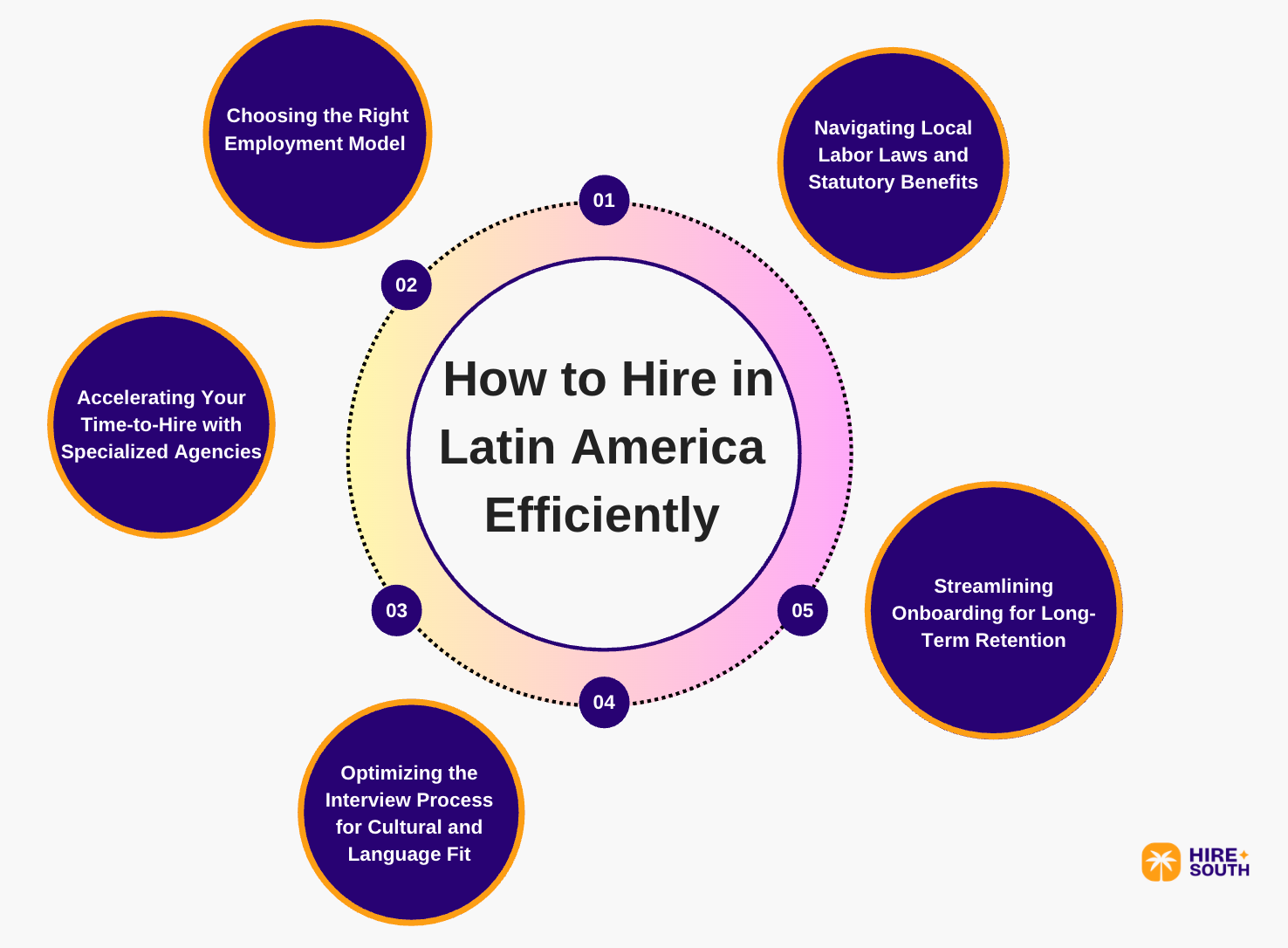
To hire in Latin America effectively, you need a strategy that balances speed with legal airtightness. The region offers an incredible talent density, but navigating the local nuances requires more than just a Zoom link and a job offer. If you want to maximize your ROI, you have to move beyond "job board surfing" and embrace a structured approach.
1. Choosing the Right Employment Model: EOR vs. Contractor
Your first decision is how you will legally engage your new team members. Many companies start with independent contractors for project-based work. However, if you are looking for long-term, core team members, an Employer of Record (EOR) is often the safer bet.
Using an EOR allows you to hire talent from Latin America without setting up a local legal entity in each country. This service typically costs between $300 and $1,000 per employee per month, according to SelectSoftware Reviews. While this adds a flat fee, it shields you from the massive legal risks of misclassification, which can lead to fines exceeding $100,000 per violation in countries like Mexico, according to Ogletree Deakins.
2. Navigating Local Labor Laws and Statutory Benefits
Latin American labor laws are generally more employee-friendly than those in North America. You must account for mandatory benefits that go beyond the base salary. For example, many countries require a "13th-month salary," a mandatory bonus typically paid in December.
In Brazil, you also need to factor in a 40% penalty on the total social security deposits if you terminate an employee without cause, according to RemoFirst. Factoring these "loaded costs" into your initial budget, usually an additional 25% to 30% of the base salary, ensures there are no surprises when the first payroll cycle hits.
3. Accelerating Your Time-to-Hire with Specialized Agencies
The domestic U.S. hiring cycle for a software engineer currently averages 42 days, according to SHRM. By shifting your search to LATAM and partnering with a specialized nearshore agency, you can often cut that time in half.
Top-tier sales and engineering roles in the region are frequently filled in just 28 days when using a pre-vetted talent pool, according to HirewithNear. Because these agencies handle the initial technical screening and English proficiency testing, you only spend time interviewing the top 3% of candidates who are already culturally and technically aligned with your needs.
4. Optimizing the Interview Process for Cultural and Language Fit
Technical skills are only half the battle. To hire in Latin America successfully, you should prioritize "soft skills" and communication clarity. While English proficiency is high, with Argentina scoring "High" on the global EF EPI index, you still need to verify that a candidate can navigate the specific nuances of your company culture.
About 45% of remote hiring failures in the region are attributed to cultural misunderstandings rather than technical incompetence, according to Auxis. You can mitigate this by including a "culture fit" interview stage that specifically tests for proactive communication and experience working with North American management styles.
5. Streamlining Onboarding for Long-Term Retention
Retention is the ultimate cost-saver. LATAM professionals tend to stay longer at companies that invest in their professional growth. Providing a structured onboarding process can increase remote employee engagement by 50%, according to Pitch'n Hire.
Ensure your onboarding includes:
- Hardware Logistics: Using a local provider to ship laptops avoids the 30%+ import duties often found in Brazil or Argentina.
- Synchronous Training: Leverage the time zone overlap to conduct live training sessions rather than relying solely on recorded videos.
- Local Context: Acknowledging local holidays or regional traditions builds a sense of belonging that prevents "mercenary" behavior and keeps your talent loyal.
Tips To Maximize Your LATAM Talent Costs Savings
Simply hiring in Latin America is a great first step toward a healthier runway, but leaving the details to chance can erode your margins. To truly capitalize on the region’s potential, you need to be strategic about where you hire and how you structure your offers. High-growth companies that optimize their nearshore strategy can save $35,000 to $64,000 per hire on average, according to HirewithNear.
1. Prioritize Countries with Favorable Tax and Benefit Structures
Not all LATAM markets are created equal when it comes to "fully loaded" costs. While a base salary might look identical in two countries, the statutory benefits can vary wildly. For instance, hiring in Brazil under the CLT framework can add a 60% to 80% multiplier to the base salary due to complex social security and labor taxes, according to Revelo.
If your goal is maximum efficiency, look toward markets like Argentina or Peru. These regions often utilize contractor models that bring the cost multiplier down to 1.2x or 1.3x, according to Revelo. This allows you to offer a higher take-home pay to the talent while keeping your total expenditure lower than in more regulated markets like Brazil or Mexico.
2. Leverage Currency Fluctuations and USD-Denominated Offers
One of the most effective ways to secure top-tier talent at a discount is by offering salaries in U.S. Dollars. In countries with high inflation, such as Argentina, a USD-pegged salary is a massive competitive advantage. Professionals in these regions often prefer the stability of a "hard currency" over higher local-currency amounts.
By offering a salary that is elite by local standards but modest by U.S. benchmarks, you can reduce your turnover. Replacing a developer in the U.S. can cost up to 150% of their annual salary in lost productivity and recruitment fees, according to Gallup. Stabilizing your team with USD offers in LATAM effectively eliminates these recurring "attrition taxes."
3. Strategically Target Emerging Tech Hubs Over Capital Cities
Just as hiring in San Francisco is more expensive than in Austin, hiring in São Paulo or Mexico City comes with a premium. To maximize savings, look toward secondary tech hubs like Medellín (Colombia), Guadalajara (Mexico), or Córdoba (Argentina).
These cities have a high density of STEM graduates but lower local competition than the major capitals. You can often find senior developers in these emerging hubs for $5,000 to $10,000 less per year than their counterparts in the region's largest cities, according to Howdy.
4. Use Managed Service Providers to Avoid Indirect Costs
Managing international payroll, hardware logistics, and local compliance yourself can quickly become a full-time job for your HR department. The "hidden" cost of internal administration often eats into your savings.
Using a specialized nearshore partner or an Employer of Record (EOR) typically costs a flat monthly fee, but it prevents the $100,000+ legal fines associated with misclassification in countries like Mexico, according to Ogletree Deakins. Streamlining your operations through a single partner allows your internal team to focus on core business growth rather than navigating the 2026 global regulatory patchwork.
5. Align Roles with Regional Strengths
Maximize your ROI by matching your specific project needs to the "specialty" of a country's talent pool. According to Floowi Talent:
- Creative and Design: Argentina and Colombia have deeply established design cultures.
- Fintech and Enterprise Scale: Brazil’s massive internal banking market has bred engineers who excel at high-availability systems.
- AI and Cloud Infrastructure: Mexico is currently seeing the highest growth in AI-ready talent due to its 38+ tech clusters, according to Revelo.
Ready to Hire LATAM Talent?
Scaling your operations shouldn't feel like a compromise between your growth targets and your financial health. By tapping into the Latin American market, you gain access to a talent pool of over 1.9 million developers who operate in your time zone and align with your corporate culture, according to IDC.
At Hire South, we simplify this transition by removing the traditional friction of international hiring. Whether you are looking to save 60% on specialized technical roles or need to scale a support team in under 30 days, our expertise in local labor compliance and precision vetting ensures your expansion is both low-risk and high-impact. Reach out to us today to book a free strategy call!