


Finding specialized medical technology talent locally isn't getting any easier or cheaper. That is why so many US business leaders are looking south to build out their technical capacity.
Companies hiring senior software engineers in Latin America save roughly 60% compared to equivalent US hires, according to compensation data from Nexton. Beyond the clear financial benefits, nearshore teams offer real-time timezone overlap and exceptional technical expertise.
This guide breaks down everything you need to know about expanding your engineering footprint into LATAM. You will discover the top regional talent hubs, key technical roles to target, and the step-by-step process for sourcing and vetting specialists. You will also learn how to navigate local compliance, protect your intellectual property, and seamlessly integrate nearshore teams into your product lifecycle.
Considerations Before Hiring MedTech Teams in Latin America
Aligning Engineering Practices with IEC 62304 Standards:
Medical device software development leaves zero room for casual coding. Any nearshore engineer you hire must understand IEC 62304, the mandatory international benchmark for medical software lifecycle processes. This standard governs everything from architecture design to risk management and code traceability.
You must verify that candidate developers know how to write software compliant with specific safety classifications. Class A software carries no risk of injury, while Class C failures can result in serious harm or death. A developer might write excellent general software, but without direct experience in Class B or C environments, your team risks severe regulatory friction during FDA audits.
Evaluating Technical English and Regulatory Literacy:
Communication gaps present a real project risk, especially when technical specs interact with complex FDA regulations. You cannot rely solely on basic conversational English when screening candidate engineers.
Technical English proficiency varies across regional markets. Argentina leads Latin America on the EF English Proficiency Index with a score of 575, placing it in the high-proficiency bracket globally, according to research from EF Education First. Costa Rica and Uruguay also rank strongly. During technical interviews, test candidate developers on their ability to explain complex engineering trade-offs, write clear commit messages, and document requirements in English.
Navigating Cross-Border Intellectual Property Laws:
Protecting your core algorithms and device architecture requires deliberate legal structuring before onboarding remote developers. Simply pasting US non-disclosure agreements into a LATAM contract does not provide full enforcement power in foreign courts.
You must structure agreements using local legal entities or Employer of Record platforms that natively handle IP assignment laws within each country. Ensure that every contract explicitly includes dynamic IP assignment clauses, defining work-for-hire provisions under local labor codes so that all code belongs to your firm from the exact moment of creation.
Validating Quality Management System Integration:
Nearshore teams must plug directly into your company’s existing Quality Management System (QMS), typically built around ISO 13485 guidelines. Remote engineers need to follow strict change control protocols, continuous integration workflows, and detailed design documentation.
Assess whether candidates have experience working under formal pull-request policies, automated unit testing, and rigorous code reviews. If your LATAM hires skip these documentation steps to speed up delivery, your quality team will spend double the effort fixing compliance issues later.
Balancing Speed of Hiring Against Regulatory Rigor:
Moving too fast during the hiring stage often backfires in regulated industries. While standard tech startups might prioritize raw coding speed, MedTech platforms require patience, precision, and thorough background checks.
Vetting candidates for technical skills, security awareness, and regulatory experience takes time. Plan for a 4 to 6 week sourcing timeline per specialized role. Rushing through vetting cycles often leads to high team turnover and costly product rework down the line.
Key Roles to Target When Building LATAM MedTech Teams
1. Software Engineers specializing in SaMD (Software as a Medical Device)
Standalone medical applications require full-stack developers who write clean, modular code following strict design controls. SaMD roles demand deep familiarity with RESTful APIs, cloud architecture on AWS or Azure, and cross-platform mobile frameworks like Flutter or React Native.
Your SaMD engineering hires must write unit tests and automated integration tests as part of their standard pull request process. Prioritize software developers who have built cloud environments handling real-time data streams, clinical algorithms, or diagnostic image processing.
2. Regulatory Affairs and Quality Assurance (RA/QA) Consultants
Engineers build the product, but regulatory professionals make sure you can legally sell it. Nearshore RA/QA specialists review design history files (DHF), draft device master records (DMR), and maintain risk management files under ISO 14971 standards.
Building a team in LATAM allows you to hire bilingual QA analysts and regulatory project managers who understand both local regulatory bodies, like ANVISA in Brazil or COFEPRIS in Mexico, and international FDA 21 CFR Part 820 requirements. Having team members who maintain compliant technical documentation during active sprint cycles prevents massive backlog delays when preparing 510(k) or CE mark submissions.
3. HealthTech Data Scientists and Machine Learning Engineers
Building predictive diagnostics or automated image interpretation requires algorithms trained on complex medical datasets. LATAM has grown into a major hub for data science talent, with the regional IT service market projected to reach $27.5 billion.
Seek out data specialists proficient in Python, PyTorch, and TensorFlow who have specific experience handling DICOM medical images or continuous EHR stream data. Crucially, these engineers must understand de-identification protocols to clean dataset inputs without violating data protection laws.
4. Cybersecurity and Health Data Compliance Specialists
Medical devices are high-value targets for ransomware and data breaches. Cybersecurity experts in your LATAM operational hub focus on hardening firmware, securing end-to-end telemetry encryption, and patching vulnerabilities across connected hospital networks.
Screen candidates for hands-on experience building systems that comply with HIPAA, GDPR, and SOC 2 Type II guidelines. A qualified remote security analyst should know how to run threat modeling exercises, execute penetration testing on device interfaces, and establish secure boot pipelines for hardware devices.
5. HealthTech Product Managers and Clinical Systems Analysts
A HealthTech product manager translates complex clinical workflows into clear engineering requirements. They sit directly between your clinical advisory board, regulatory experts, and software developers.
Hire product managers who have a background in health informatics or biomedical engineering. They need to understand HL7 and FHIR interoperability standards, so your platform seamlessly syncs with hospital electronic health record systems. Their ability to manage sprint backlogs while maintaining trace matrices keeps your software pipeline moving without breaking regulatory compliance.
Common Challenges When Hiring LATAM MedTech Teams
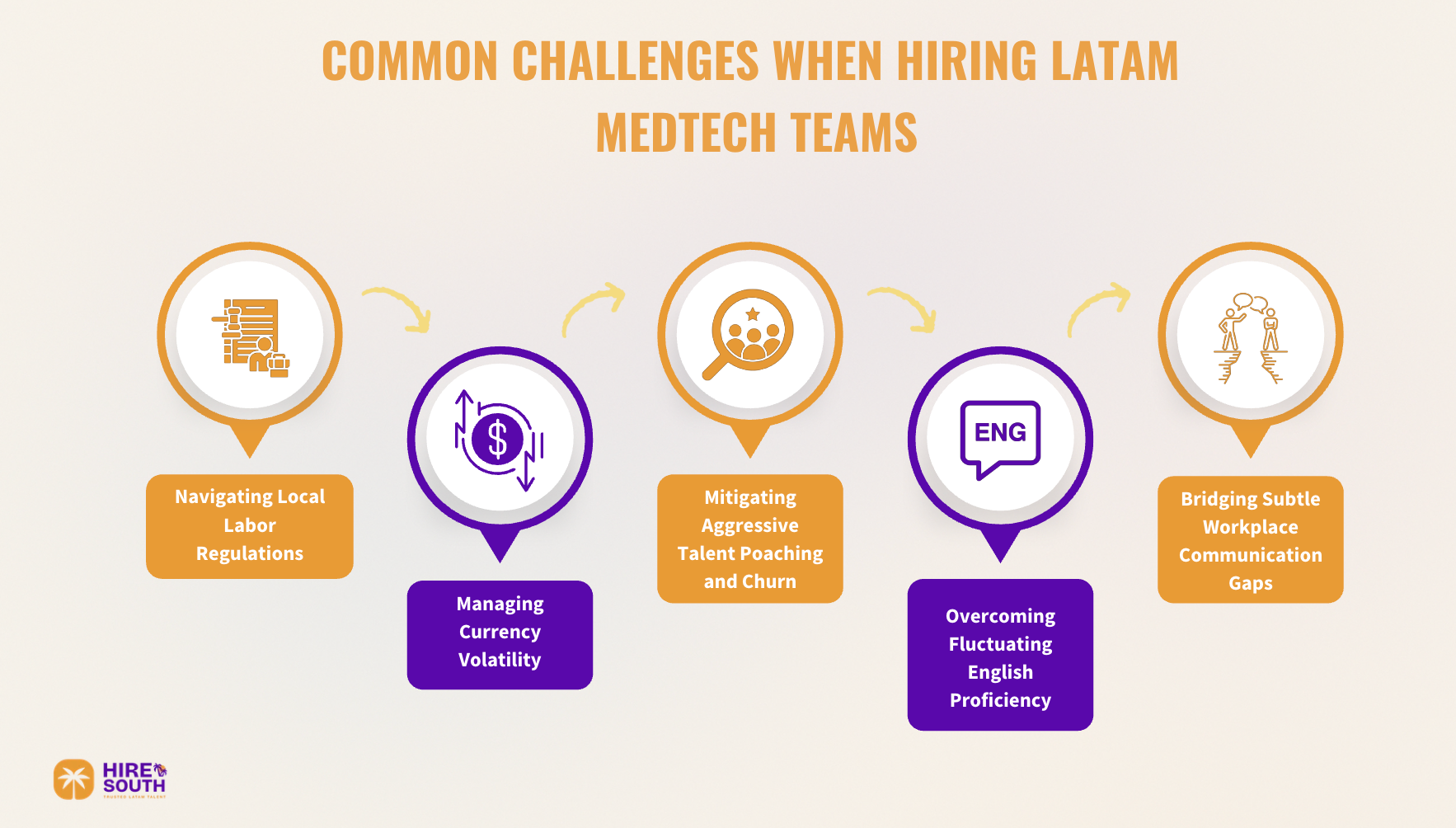
Navigating Local Labor Regulations and Statutory Benefit Mandates:
Employment legislation across Latin America heavily protects local workers, making basic US employment models risky if copied directly. National labor codes mandate explicit statutory benefits, including an extra 13th-month annual bonus paid every December, mandatory inflation-adjusted pay reviews, and generous statutory paid leave policies.
Termination laws carry stiff financial consequences if handled incorrectly. In markets like Brazil and Argentina, letting an employee go without cause requires paying significant severance packages calculated based on years of service. Partnering with an Employer of Record (EOR) or working alongside local legal counsel insulates your organization from wrongful termination lawsuits and unexpected operational liabilities.
Managing Currency Volatility and USD Salary Expectations:
Inflation levels and currency stability vary widely throughout Latin American markets. Engineers operating in high-inflation environments, like Argentina, often request compensation tied directly to US dollars or stablecoins to protect their local purchasing power.
However, paying remote developers directly in foreign currency can inadvertently trigger banking compliance audits or currency conversion penalties from central authorities in nations like Colombia or Brazil. Building clear payroll mechanisms that accommodate inflation adjustments while staying fully aligned with national banking frameworks keeps your salary offerings competitive without running afoul of tax laws.
Mitigating Aggressive Talent Poaching and Churn:
The battle for skilled MedTech engineers across LATAM is intense. Tech industry voluntary turnover in the US holds at roughly 13%, according to research from Mercer, but nearshore hubs face even sharper retention pressures as global software companies compete for identical talent pools.
Senior developers regularly receive competing job offers featuring higher base pay from North American firms. Keeping your core engineering talent intact requires providing structured technical growth paths, retention incentives, continuous learning opportunities, and funding for specialized medical software certifications. Competitive pay alone won't prevent turnover; clear career progression and strong team integration are vital for maintaining long-term software teams.
Overcoming Fluctuating English Proficiency Across Engineering Hubs:
While technical skill across LATAM is abundant, English language fluency drops off outside primary metropolitan centers and core innovation hubs. Research from EF Education First shows Argentina scoring high in regional rankings, whereas major tech markets like Brazil score 482 and Mexico scores 440, placing them in lower proficiency tiers.
Gauging language skills during brief informal screening calls rarely reveals the full picture. Drafting regulatory design documents, defining system requirements, and leading agile standups require real verbal and written precision. Implementing formal, standardized communication assessments early in your hiring pipeline prevents operational disconnects when developers start creating critical regulatory documentation.
Bridging Subtle Workplace Communication Gaps:
Working across borders introduces distinct cultural nuances in communication styles and decision-making dynamics. Workplace cultures in Latin America often prioritize indirect communication and team harmony, which can lead developers to agree to tight release deadlines even when underlying technical hurdles exist.
US technical leaders generally expect immediate, direct feedback when project timelines slip. Building genuine psychological safety inside your remote teams encourages nearshore engineers to speak up about technical risks early. Training engineering managers to proactively ask for feedback, run structured retrospectives, and normalize raising blockers ensures your product roadmap stays on schedule without surprise delays.
Looking to Hire a Remote MedTech Team in Latin America?
Building a compliant, high-performing MedTech team in Latin America requires navigating complex regulatory frameworks, local employment laws, and specialized technical sourcing. While the cost savings and time zone alignment present a major operational advantage, setting up these systems internally can slow down your product roadmap.
At Hire South, we streamline the entire nearshore hiring pipeline so your leadership team can focus on product innovation. Sourcing talent from a network of over 120,000 regional professionals, we connect US firms with the top 1% of pre-vetted Latin American tech, data, and healthtech talent. Our team manages the end-to-end recruitment process and delivers 3 to 5 hand-picked finalists in under two weeks. We also handle all local legal contracts, payroll logistics, and international employment compliance across every jurisdiction. Partnering with us allows you to scale high-caliber MedTech teams up to 70% more cost-effectively than US-based hiring, without taking on legal risk or operational friction. Schedule a free discovery call to learn more!


.jpg)