


Scaling an engineering team in today’s market feels like a constant battle against your own runway. US developer pay continues to climb, and local talent wars are burning through capital faster than ever. According to the U.S. Bureau of Labor Statistics, the national median annual salary for software developers sits at $133,080, with senior roles in major tech hubs pushing total compensation well past $200,000. You do not need to cut back on top-tier engineering talent just to protect your margins.
There is a way out of the domestic compensation trap. Nearshore hiring lets you build high-performing teams without the financial drag or timezone headaches of traditional models.
This guide breaks down why US tech salaries have spiked, how nearshore talent in Latin America stacks up against domestic hires, and how you can tap into LATAM markets to cut employment costs by up to 60% without sacrificing speed or code quality.
The Growing Impact of High US Salaries on Tech Scaling
How US Salaries Evolution Has Redefined Tech Hiring Budgets.
The financial mechanics of building a product team have shifted dramatically over the past five years. Domestic software engineering compensation has surged past historic baselines, forcing tech leaders to rethink their workforce strategies.
According to the U.S. Bureau of Labor Statistics, the national median annual salary for software developers sits at $133,080. However, that baseline barely reflects what companies actually pay to secure senior talent in competitive markets. Data from real-time placement benchmarks, such as KORE1's software engineering compensation reports, reveals that senior product engineers in growth-stage SaaS companies consistently command base salaries between $170,000 and $215,000. When you factor in specialized skill sets like AI infrastructure or cloud engineering, senior base rates routinely clear $220,000 before bonuses or equity enter the picture.
This steady upward trend directly impacts your operational efficiency. High base pay means engineering takes up a larger piece of your operating budget, leaving less capital for marketing, customer acquisition, and product development. Venture-backed startups and growth-stage companies burn through funding rounds significantly faster, forcing founders to raise capital earlier or accept down rounds. At the same time, competition for domestic talent inflates recruiting agency fees, signing bonuses, and retention packages, driving up your total cost per hire.
Why Tech Salaries in the US Keep Reaching Historic Highs.
Understanding why domestic compensation remains high requires looking at structural supply constraints rather than temporary market spikes. While general tech hiring has normalized after pandemic-era peaks, the price tag for experienced, self-directed engineers continues to climb.
Tier-one tech firms and well-funded AI labs continue to set baseline expectations. Data from Levels.fyi highlights that total compensation packages for mid-to-senior engineers at enterprise tech giants regularly range from $250,000 to over $400,000. This creates an artificially high floor for mid-market and growth-stage companies trying to hire locally.
Generalist roles have flattened, but specialized roles have surged. Industry compensation research from Payscale shows that specialized domains like AI, machine learning, and cloud architecture command substantial salary premiums over standard stack engineering. Furthermore, while entry-level developer markets have saturated, senior engineers who can architect systems independently, lead teams, and ship clean code remain scarce. You are not just paying for syntax knowledge, you are paying for risk mitigation and technical leadership.
The True Cost of Local Engineering Beyond Base Pay.
Relying solely on base salary numbers leads to major miscalculations when projecting annual engineering expenditure. The total cost of employment for a domestic software engineer adds significant financial overhead to your payroll.
When you hire a senior US developer at a $175,000 base salary, the actual cost to your business looks substantially different once overhead hits. Employer-side FICA taxes, state unemployment insurance, and workers' compensation add roughly 9% to 12% directly on top of base earnings.
Competitive US benefit packages, including health, dental, vision, and 401(k) matching, cost companies an average of $15,000 to $25,000 per employee annually. According to tech hiring benchmarks from Beon.tech, filling a senior engineering role locally in the US takes an average of 45 to 60 days. That gap translates directly into lost feature velocity and unbilled revenue opportunities.
On top of those figures, enterprise software seats, hardware refreshes, workstation stipends, and administrative overhead add another $5,000 to $10,000 annually per developer. Factoring in these fully loaded expenses, a single senior developer in the US easily costs your company $225,000 to $250,000 per year. For scaling startups and mid-market engineering organizations, relying entirely on domestic hires makes building product roadmaps unsustainable over the long run.
Protecting Your Bottom Line: The Power of Nearshore Hiring
What is Nearshore Hiring and How Does It Protect Margins?
Nearshore hiring is the strategic practice of sourcing, hiring, and integrating technical talent from neighboring countries located in similar time zones. For North American organizations, this primarily means expanding engineering capacity into Latin American tech markets like Mexico, Colombia, Argentina, and Brazil.
Unlike traditional offshore models that prioritize lowest-cost labor in drastically different time zones, nearshoring focuses on operational parity. You secure senior-level technical execution at a fraction of domestic costs, protecting your company's financial health while maintaining product momentum.
By shifting software development to nearshore regions, businesses reduce total payroll expenditure without cutting headcount or lowering engineering standards. This preserves cash runway, protects venture capital investments, and provides the financial flexibility required to pivot or scale aggressively.
Direct Compensation Savings: LATAM vs US Software Engineers:
The primary engine driving nearshore adoption is the substantial gap in total compensation between US software engineers and their Latin American counterparts.
According to compensation data from the Nearshore Business Solutions Developer Salary Guide, senior LATAM software developers earn between $50,000 and $75,000 annually. In contrast, the median annual salary for a senior US developer routinely ranges between $155,000 and $210,000 before fully loaded overhead.
This base differential creates a guaranteed savings floor of 60% to 65% per technical hire. For specialized roles like machine learning engineers or cloud architects, domestic packages often exceed $220,000, while LATAM specialists command between $68,000 and $109,000.
Slashing Fully Loaded Employment Overhead:
Base salary metrics only tell half the story. The hidden costs of domestic hiring create an even larger financial strain on operating budgets.
When you hire software developers in the United States, employer-side payroll taxes, medical benefits, 401(k) contributions, equipment, and local compliance add 20% to 30% on top of base compensation. A domestic engineer with a $175,000 base salary actually costs your company upwards of $225,000 per year.
Nearshore hiring models eliminate much of this statutory friction. Partnering with an Employer of Record (EOR) or a dedicated nearshore staffing agency allows you to pay a single, transparent fee that covers international payroll, local benefits, tax compliance, and local administrative management. According to Nearshore Business Solutions, fully loaded senior engineering costs in Latin America average approximately $65,000 annually, compared to $160,000 or more in the US.
Operational Advantages of Shared Time Zones and Cultural Alignment:
Cost reductions mean very little if poor communication slows down your product releases. Traditional offshore hiring in locations like Asia often introduces an 8 to 12 hour time difference. This creates delayed feedback loops, where a simple code review or pull request can take 24 hours to resolve.
Nearshore talent operates within the same working hours as your core team. Major Latin American technology hubs share significant time zone overlap with US Eastern, Central, and Pacific time zones, typically varying by only 0 to 2 hours. This provides 6 to 8 hours of synchronous daily overlap and eliminates asynchronous feedback delays.
This real-time alignment allows your domestic product managers and nearshore engineers to conduct daily standups, pair program, and resolve system-critical bugs instantly during normal business hours.
Furthermore, nearshore regions boast strong cultural alignment with North American business practices. Data from the EF English Proficiency Index ranks countries like Argentina, Costa Rica, and Uruguay among the top locations in Latin America for business English fluency, ensuring clear documentation and fluid communication during technical design reviews.
Acceleration of Time-to-Fill for Senior Engineering Roles:
Vacant engineering seats represent hidden revenue loss. The longer a technical role sits open, the slower your team ships features, fixes bugs, or processes technical debt.
According to recruitment benchmarks published by Navero, filling a specialized software engineering position locally in the technology sector takes an average of 63 to 95 days. The intense local competition for senior developers stalls recruitment pipelines and exhausts internal hiring resources.
Nearshore talent platforms compress this timeline dramatically. By tapping into vast developer pools across Latin America, such as Brazil's 750,000+ developer workforce or Mexico's 110,000 annual engineering graduates, companies routinely source, vet, and contract senior engineers in 2 to 4 weeks. Accelerating your time-to-hire by over 50% protects feature velocity and ensures your product roadmap stays on schedule.
LATAM Salaries vs US Salaries: A Direct Cost Comparison
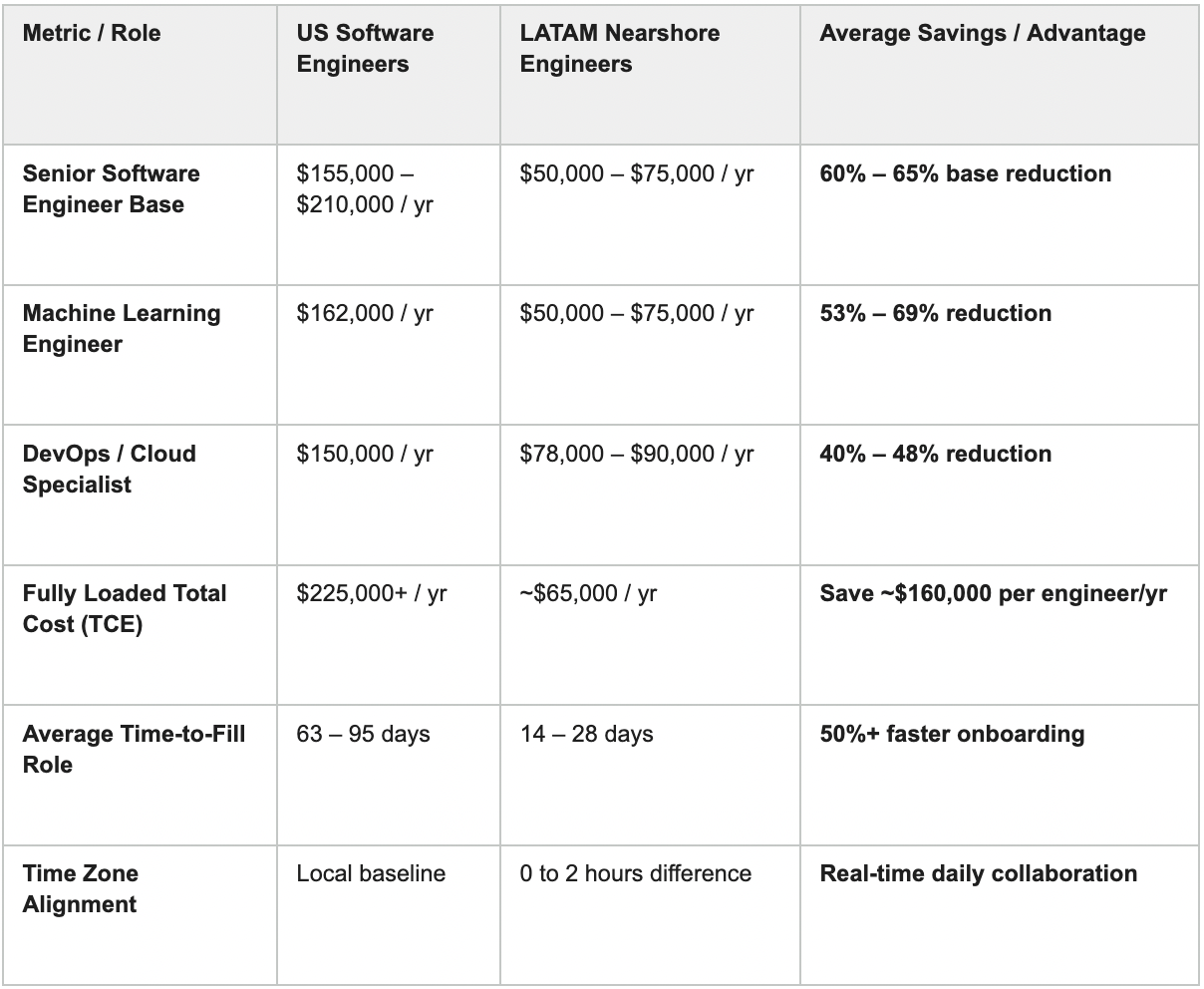
Evaluating the financial spread between domestic and nearshore engineering teams requires looking at direct compensation benchmarks across key engineering tiers. The cost advantage of nearshore hiring is not a temporary dip, it represents a structural difference in global living costs and labor market dynamics.
Senior Software Engineer Pay: LATAM Salaries vs US Salaries
The baseline gap between domestic and Latin American engineering compensation remains substantial across every major technical discipline. According to payroll data from Howdy, software developers in Latin America earn between $53,000 and $63,000 annually on average, while equivalent senior engineers in the United States command an average base of $180,000.
When looking at upper-tier talent, the spread holds firm. According to the Nearshore Business Solutions Developer Salary Guide, senior LATAM developers earn between $50,000 and $75,000 annually, whereas senior US developers routinely secure between $155,000 and $210,000 before bonuses. This creates an immediate base salary reduction of 60% to 65% per technical hire without compromising engineering standards.
Even in higher-income Latin American markets, the numbers favor nearshoring. Senior developers in Chile command top market rates of $70,000 to $100,000, while senior talent in Argentina starts around $42,000 to $72,000 annually. Both ranges remain far below standard US baselines for experienced tech talent.
Detailed Role-by-Role Compensation Benchmarks Across Regions
Salary variance becomes even clearer when breaking down specific technical roles and specialized stacks. Advanced domains like cloud infrastructure, machine learning, and mobile architecture carry heavy premiums in the domestic market, but remain accessible across Latin America.
According to compensation benchmarks published by Nearshore Business Solutions:
- Machine Learning Engineers earn an average of $162,000 in the US, compared to $50,000 to $75,000 in LATAM.
- DevOps Engineers average $150,000 in the US, compared to $78,000 to $90,000 in LATAM.
- Senior Front-End Developers command $139,000 in the US, compared to $50,000 to $70,000 in LATAM.
Leadership roles demonstrate similar percentage reductions. According to Nexton's LATAM Tech Salary and Benefits Report, senior Engineering Managers in the US command roughly $350,000 in total compensation, whereas equivalent vetted LATAM hires average between $90,000 and $100,000 annually. That difference represents a 70% reduction in leadership overhead.
Total Cost of Employment: Payroll Taxes, Benefits, and Overhead Savings
Base salary numbers only capture part of your annual expenditure. The total cost of employment includes mandatory payroll taxes, health benefits, equipment, and administrative overhead.
Domestic employment adds significant statutory strain to your bottom line. According to Nearshore Business Solutions, a US developer with a $137,000 base salary costs approximately $160,000 in total employer expenses once benefits and mandatory taxes are applied. Higher senior base rates of $175,000 easily push that fully loaded total past $225,000 per year.
Nearshore engagement models streamline these operational expenses. According to the same Nearshore Business Solutions data, the average fully loaded total cost for a senior LATAM developer sits at approximately $65,000 per year. Partnering with international payroll platforms or Employers of Record consolidates health insurance, local compliance, and tax management into a flat rate. You eliminate unexpected overhead spikes while keeping your engineering spend predictable.
According to ROI calculations from Howdy payroll benchmarks, nearshoring a single senior engineering position yields over $88,000 in direct first-year savings. For an organization scaling a team of five senior developers, shifting to nearshore talent frees up over $400,000 in annual capital, directly extending your operational runway.
Leverage Nearshore Hiring Today to Find LATAM Talent
As domestic engineering compensation climbs past historical norms, nearshore talent expansion offers a practical way to manage payroll growth without slowing down technical execution. Sourcing senior developers from Latin America gives companies access to experienced engineering teams, same-time-zone collaboration, and significantly lower fully loaded payroll costs.
At Hire South, we help North American companies build, scale, and integrate high-performing LATAM teams without the operational friction of traditional cross-border recruiting. We match you with bilingual, pre-vetted senior software engineers in two weeks or less, handling everything from talent acquisition to international payroll, local benefits, and legal compliance so your team can focus on shipping products. Contact us for a discovery call to help you hire more efficiently!