


Building an elite team doesn't have to break your budget. The old playbook of fighting over overpriced local talent is dead. You need a smarter way to scale, and nearshore staffing might be just what you need. According to the Inter-American Development Bank, nearshoring investments are projected to add $78 billion to Latin America's export economy in the coming years. Today, executives are quickly realizing their most strategic hires might just be a time zone away.
This guide breaks down exactly how to capitalize on nearshore staffing in Latin America. You will explore the real financial impact of the modern staff augmentation model compared to legacy offshore outsourcing, review accurate salary benchmarks, learn how to navigate cross-border compliance safely, and see exactly how generative AI is rapidly accelerating nearshore developer velocity. Keep reading to learn all about nearshoring!
The Fundamentals of LATAM Nearshoring
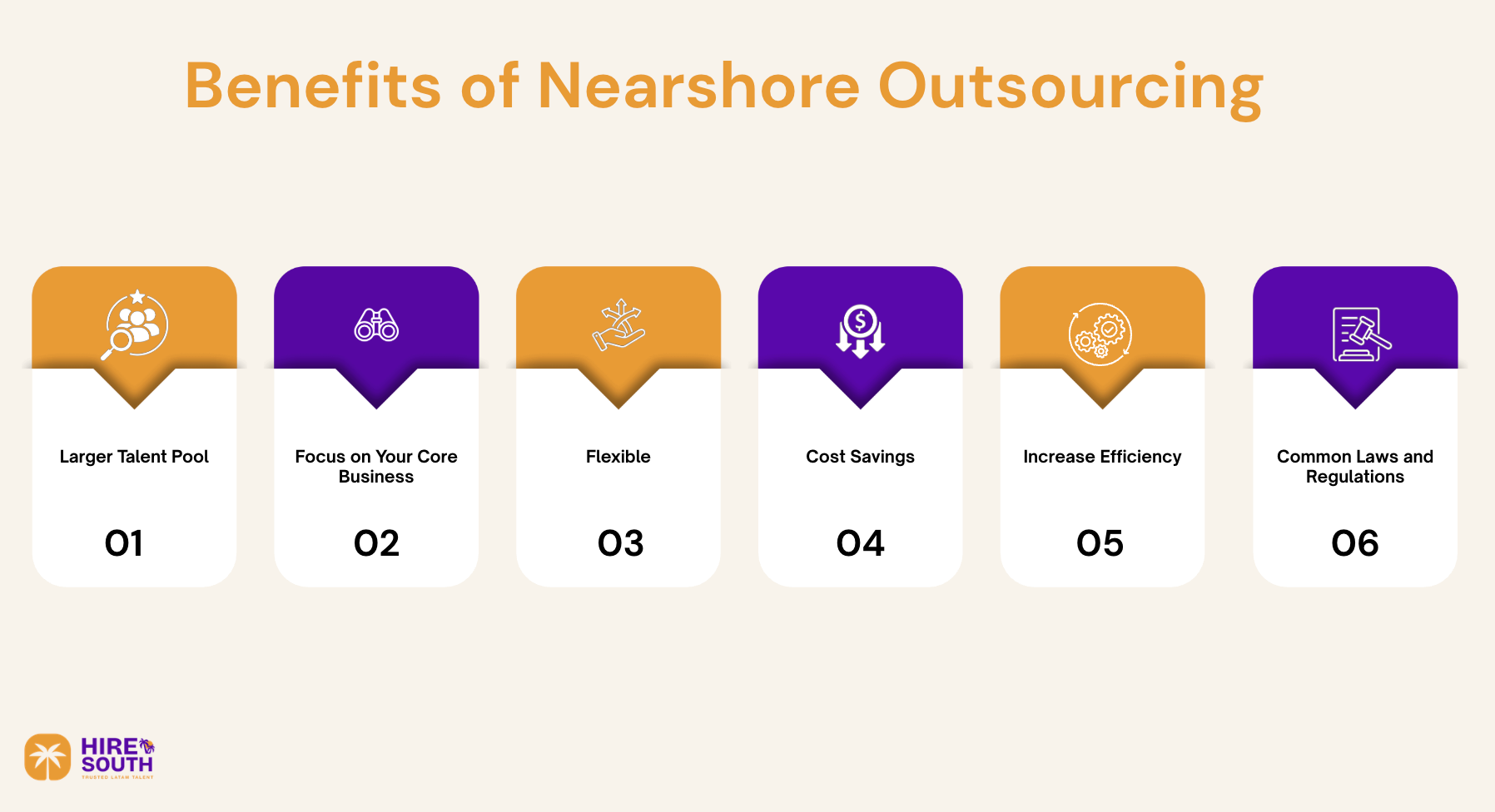
LATAM nearshoring is the procurement of talent, teams, or managed services from Latin American countries to execute specific business functions. Unlike offshore outsourcing (which targets distant regions), nearshoring leverages geographic proximity and shared time zones to enable real-time, synchronous collaboration.
Instead of sending isolated projects "over the wall" to a vendor, modern B2B staffing integrates Latin American professionals directly into your internal Slack channels, daily standups, and enterprise workflows. Whether you utilize Nearshore Staff Augmentation (embedding specialists into your existing teams) or an Employer of Record (EOR) to handle compliance, the goal is to treat LATAM hires as full-time extensions of your core U.S. operations.
Top Enterprise Functions to Staff in Latin America
U.S. enterprises primarily staff high-skill, knowledge-based services in Latin America. The most mature talent pools in 2026 are Software Development & IT, Corporate Finance & Accounting, Growth Marketing, and Revenue Operations (RevOps).
Functions with clear deliverables, standardized software, and recurring workloads are ideal for nearshore execution.
1. Software Development & IT
LATAM is home to over 1.5 million software developers. The region’s universities emphasize full-stack development, making it a premium destination for engineering teams needing specialized capacity.
- Top Roles: Full-Stack Engineers (React, Node.js, Python), Cloud Architects (AWS, Azure), QA Automation Engineers, and Cybersecurity Analysts.
2. Corporate Finance & Accounting
LATAM finance professionals are rigorously trained, with many possessing deep familiarity with US GAAP, NetSuite, QuickBooks, and U.S. tax compliance standards.
- Top Roles: FP&A Analysts, Senior Accountants, Controllers, AP/AR Specialists, and Bookkeepers.
3. Growth Marketing & Creative Production
Instead of paying premium U.S. agency retainers, companies are building internal growth pods using bilingual creatives who deeply understand North American consumer culture.
- Top Roles: SEO Managers, Performance Marketers (PPC), Graphic Designers, Video Editors, and B2B Copywriters.
4. Revenue Operations & Administration
Administrative delegation has moved past simple data entry. Today, U.S. executives rely on sophisticated operators to manage CRMs, streamline logistics, and handle complex calendaring.
- Top Roles: Executive Assistants (EAs), RevOps Specialists, Supply Chain Coordinators, and HR/Recruiting Coordinators.
Core Drivers Behind the LATAM Hiring Boom
Enterprise leaders prioritize Latin America because it resolves the classic global hiring trilemma: balancing cost, quality, and speed. LATAM provides top-tier technical and bilingual talent at 40-60% reduced costs, operating during the exact same working hours as U.S. headquarters.
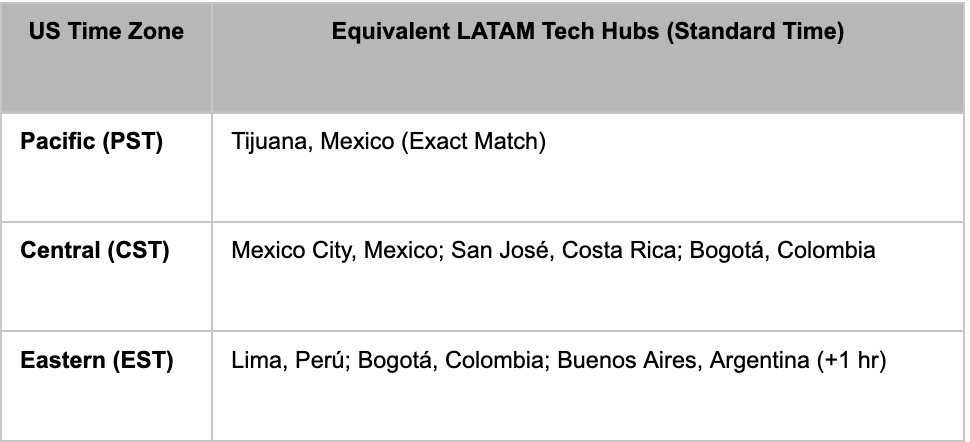
Synchronous Collaboration (Time-Zone Parity)
Delegating to Asia requires early morning or late-night meetings, leading to rapid burnout and 24-hour feedback loops. LATAM’s alignment with U.S. time zones allows for synchronous Agile sprints, immediate incident resolution, and fluid communication.
Enterprise-Grade English & Cultural Alignment
Modern LATAM professionals consume U.S. media, utilize the same tech stacks, and are natively familiar with Western corporate communication styles (direct, proactive, and outcome-oriented). Countries like Argentina consistently rank "High" or "Very High" on the EF English Proficiency Index.
LATAM Salary Expectations & Financial Impact
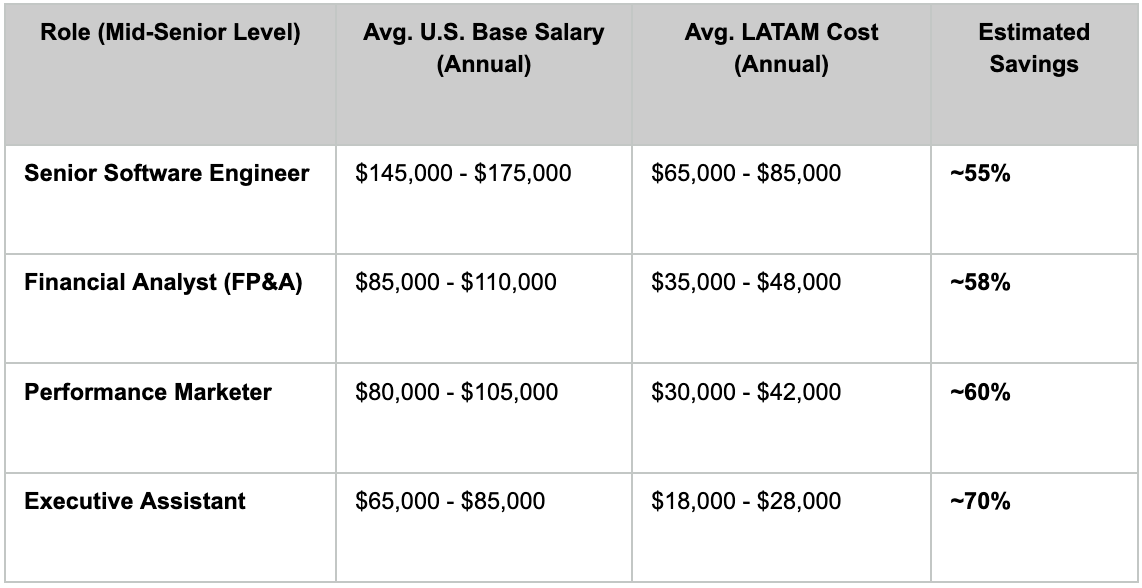
In 2026, securing a mid-to-senior-level professional in Latin America costs between $3,000 and $7,000 per month, depending on the role, technical requirements, and the specific country. This represents an average gross saving of $50,000 to $90,000+ per headcount annually compared to U.S. hiring markets.
When evaluating nearshore talent, compensation must be benchmarked accurately. Below is a realistic 2026 comparative salary scale (inclusive of base salary and standard burdens):
Use Hire South’s Free 2026 US vs. LATAM Salary Calculator to run custom compensation models for your exact open roles. Get instant, data-backed salary ranges for IT, Finance, and Marketing talent across Latin America.
Decoding Global Hiring Frameworks (Staff Augmentation vs. EOR)
Companies can engage LATAM talent through three primary frameworks: Project-Based Delivery (BPO), Nearshore Staff Augmentation, and Direct Remote Hiring (via an Employer of Record). The right framework depends on whether you want to delegate a specific outcome or permanently expand your internal team's bandwidth.
- Nearshore Staff Augmentation: The fastest-growing enterprise model. You hire a vetted LATAM professional who embeds completely into your company. They use your email domain, report to your managers, and follow your processes. The staffing partner (like Hire South) handles local payroll, compliance, and HR overhead.
- Employer of Record (EOR) / Direct Hire: Similar to staff augmentation, but you take over the legal employment responsibilities through a third-party EOR platform. Best for companies building massive localized hubs.
- Traditional BPO / Project-Based: You hire an external agency to deliver a specific, scoped project (e.g., "Build an iOS app" or "Handle 10,000 customer tickets"). You manage the vendor relationship, not the individual talent.
The Top-Tier Nearshore Markets in 2026
The premier nearshore destinations in 2026 are Argentina, Colombia, and Mexico. These countries dominate due to their heavy investments in STEM education, robust IT infrastructure, and deep pools of bilingual corporate talent.
- Argentina: The undisputed king of complex engineering and software architecture. Favorable exchange rates make Argentina highly cost-effective for elite IT talent, Data Scientists, and Senior Web Developers. English proficiency is the highest in Latin America.
- Colombia: The premier hub for Customer Success, Finance, and Operations. Cities like Bogotá and Medellín share Eastern/Central time zones, and the workforce is highly service-oriented, bilingual, and culturally aligned with North American corporate standards.
- Mexico: Best for large-scale enterprise IT and B2B Sales. Proximity to the U.S. (allowing for easy executive travel) and a massive population make Mexico ideal for staffing large development squads and technical support teams.
- Costa Rica & Uruguay: Niche, premium markets. Both offer incredible political stability, elite education, and specialized IT skills, but generally command 15-20% higher salaries than Colombia or Argentina.
Nearshore (LATAM) vs. Offshore: The Synchronous Advantage
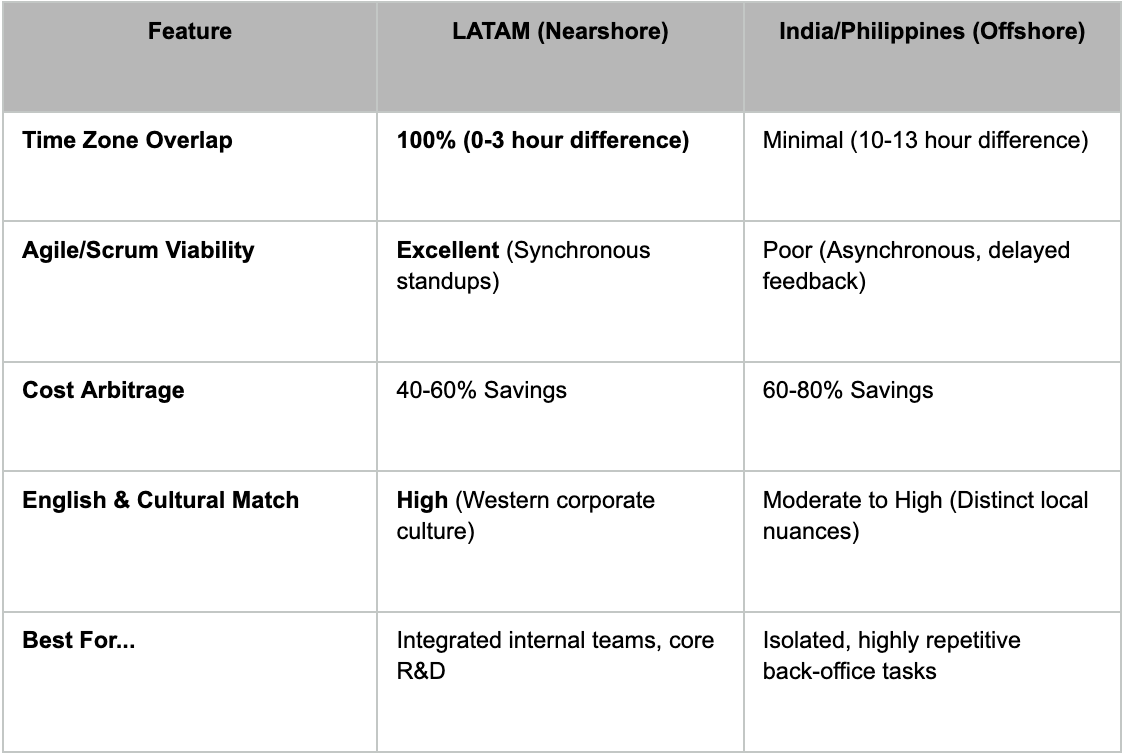
While offshore routing to regions like India or the Philippines provides the lowest baseline cost, LATAM nearshoring offers vastly superior operational efficiency for agile teams. LATAM provides shared time zones, faster problem resolution, and closer cultural alignment, eliminating the friction of asynchronous workframes.
Navigating Cross-Border Compliance and Security Risks
The primary risks of building a global workforce involve worker misclassification, complex cross-border compliance, and IP/Data security vulnerabilities. U.S. companies must utilize proper legal frameworks, like hiring through a compliant B2B staffing agency, to shield themselves from foreign labor disputes and tax liabilities.
Compliance & Misclassification:
Paying a LATAM worker directly as a 1099 contractor can trigger severe penalties under local labor laws (which heavily favor employees). Solution: Partner with an agency that acts as the legal employer of record, indemnifying your business.
Intellectual Property (IP) & Data Security:
Different countries have varying standards for IP assignment. Solution: Ensure your staffing partner executes bulletproof, U.S.-governed NDAs and IP assignment contracts before onboarding. Mandate the use of secure VPNs and company-issued hardware.
Equipment Procurement:
Shipping laptops to LATAM via FedEx is notoriously difficult due to customs blocks. Solution: Work with an agency that handles local hardware procurement, securing Apple or Dell enterprise gear locally within the talent’s country.
What to Look for in a LATAM Staffing Agency
A premium LATAM staffing agency should offer a stringent vetting process, transparent pricing, robust legal compliance, and dedicated post-hire HR support. Avoid vendor "marketplaces" that simply pass along raw resumes without validating technical or linguistic competence.
When auditing a nearshore partner, ask:
- What is your vetting acceptance rate? (Elite agencies accept the top 1-3% of candidates).
- Do you handle local payroll, benefits, and compliance?
- What is your talent replacement guarantee if a hire doesn’t work out?
- How do you test for behavioral and cultural fit?
Defeating the Global Churn Crisis: Retention Strategies for LATAM Teams:
The traditional offshore outsourcing industry has long been plagued by staggering employee turnover, with some distant hubs averaging over forty percent annual churn. Enterprise leaders are recognizing that constantly recruiting, onboarding, and retraining remote workers annihilates the initial cost savings of global hiring. In 2026, the most successful companies outsourcing to Latin America have abandoned the disposable contractor mindset entirely. Instead, they are achieving retention rates that rival or beat their domestic U.S. offices by deploying structured career pathing and deep cultural integration for their nearshore talent.
When Latin American professionals are embedded directly into your organizational chart, they expect the exact same professional development opportunities as your core team in New York or San Francisco. Forward-thinking executives are implementing unified performance reviews, continuous learning stipends, and performance-based bonuses that align nearshore squads with overarching corporate revenue goals. By treating a Colombian financial analyst or an Argentine software engineer as a long-term investment rather than a temporary staffing fix, organizations build fiercely loyal teams. This approach locks in compounding institutional knowledge over years, ensuring your operations scale smoothly without the constant friction of replacing vital personnel.
Leveraging Geopolitical Stability and Cross-Border Trade Incentives:
Global business volatility is forcing corporate boards to heavily scrutinize the systemic risks associated with their international footprint. Moving critical intellectual property and operational data halfway across the world exposes companies to unpredictable regulatory shifts, massive time-zone communication breakdowns, and severe geopolitical friction. Latin America offers a uniquely stabilized alternative backed by robust international trade frameworks. Agreements like the United States-Mexico-Canada Agreement and various bilateral digital trade treaties across the region have established highly secure, business-friendly corridors specifically designed to protect North American enterprise interests.
These modernized trade agreements enforce strict intellectual property protections, streamline cross-border data flows, and provide clear legal recourse that is often ambiguous or completely unenforceable in distant offshore jurisdictions. Furthermore, as nearshoring becomes a dominant macroeconomic policy championed across the Americas, local governments are actively incentivizing tech sector growth through infrastructure investments, tax advantages, and STEM education grants. Aligning your hiring strategy with these geopolitical realities ensures your company benefits from a compliant, legally protected environment built to sustain long-term enterprise growth without the looming threat of sudden regulatory lockouts.
Step-by-Step: Onboarding Your First Nearshore Hire
Launching your LATAM hiring strategy requires auditing your current organizational bottlenecks, defining specific job descriptions, aligning on budget, and partnering with a specialized nearshore agency to execute the search.
- Audit the Bottleneck: Identify roles that are fully remote-compatible, clearly documented, and currently suffering from high U.S. wage inflation.
- Run the Numbers: Use our 2026 US vs. LATAM Salary Calculator to map out exactly what your budget can acquire in the nearshore market.
- Align with a Partner: Schedule a discovery call to outline your technical requirements, tech stack, and ideal candidate profile.
- Interview and Integrate: Review a curated shortlist of 3-5 elite candidates. Hire your favorite, and let your agency handle the HR, payroll, and compliance onboarding.
High-Intent FAQs on LATAM Staffing
1. Do professionals in Latin America speak fluent English?
Yes. Hire South strictly vets for B2 (Upper Intermediate) to C2 (Native/Bilingual) English proficiency. We conduct multi-stage live behavioral interviews to ensure candidates communicate clearly, proactively, and effectively in a Western corporate setting.
2. How do U.S. holidays and LATAM public holidays align?
While LATAM countries have their own national holidays, professionals hired through staff augmentation models generally align their schedules with the U.S. corporate calendar. Hire South helps structure agreements so your nearshore team is available during your critical business days.
3. What happens if a hired LATAM professional isn’t a good fit?
Elite staffing agencies mitigate hiring risk through replacement guarantees. If a professional does not meet your performance expectations, Hire South steps in to rapidly source and replace the talent at no additional recruiting cost to your business.
4. How do I legally compensate my nearshore team?
You do not pay the worker directly, which avoids currency exchange fees, international tax liabilities, and misclassification risks. Instead, you pay Hire South a simple, flat monthly invoice in USD, and we handle the complex localized payroll, taxes, and mandatory benefits for the talent.
Ready to Build Your Nearshore Team?
Scaling your business shouldn't mean drowning in overhead or managing complex cross-border employment laws. The talent you need to drive growth is already operating in your time zone, speaking your language, and ready to execute. You just need the right partner to connect the dots.
At Hire South, we do exactly that. We don't just pass along a stack of unvetted resumes. Our founder-led team leverages deep regional roots to connect U.S. enterprises with the top 1% of synchronous, bilingual professionals across Latin America. From conducting rigorous technical vetting to handling local compliance, payroll, and hardware procurement, we eliminate the friction of global hiring so you can focus entirely on your revenue. Stop overpaying for local talent and stop settling for disconnected offshore vendors. Book a free discovery call to learn more about nearshore staffing!