
.jpg)

Hiring skilled software engineers in the US is getting tougher and more expensive by the day. According to Capgemini, 56% of large organizations have turned to nearshoring to plug critical talent gaps, with Latin America leading the charge. One of these tactics has historically been the staffing of LATAM developers.
Connecting with regional talent is easy. The real challenge comes when you try to blend offshore team members into your existing engineering workflows without causing miscommunication or delays.
This guide gives you the exact playbook to make that transition smooth. You will discover practical strategies for navigating cultural nuance, setting up security protocols, and structuring a seamless onboarding process. Here is everything you need to know to build a high-performing, cross-border development team.
Why It Is Key To Fully Integrate Your LATAM Developers Before Joining Your Team
Treating nearshore engineers as an external add-on rather than a core part of your team is one of the fastest ways to derail a software project. When software developers feel isolated, communication breaks down, code quality drops, and project timelines start slipping. Full integration before official day-one production work ensures your remote talent hits the ground running without friction.
1. Reducing Time-to-Productivity and Eliminating Ramp-Up Drag
Dropping new talent straight into active sprints without proper structural preparation creates immediate bottlenecks. Engineers end up hunting for documentation, requesting missing repo permissions, or re-learning internal tools on the fly.
According to flair HR, new hires typically operate at only 25% productivity during their first month. However, organizations that deploy structured onboarding frameworks boost overall new-hire productivity by 70% while improving retention rates by 82%. Proper pre-integration resolves environment setup and architecture reviews upfront, giving developers direct access to tools, clear ticket expectations, and immediate momentum.
2. Preventing Silent Context Switching and Communication Gaps
When developers lack context on product strategy or team dynamics, they spend excess time second-guessing requirements. This leads to constant back-and-forth messaging, delayed code reviews, and fragmented workflows across time zones.
According to a GitLab developer productivity survey, 58% of developers state that context switching negatively impacts their daily productivity. Pre-integrating your LATAM software development talent establishes explicit communication norms early. Aligning asynchronous channels, Jira workflows, and code review standards ahead of time keeps developers focused on shipping features instead of chasing down operational clarity.
3. Protecting Codebase Quality Through Early Architecture Alignment
Every engineering team maintains unique coding patterns, testing protocols, and CI/CD pipelines. Pushing remote engineers into active codebases without prior alignment results in PR rejections, technical debt, and team frustration.
Front-loading architectural guidelines, security policies, and pull request rules during the pre-integration phase helps engineers understand your coding standards before submitting their first commit. Your team avoids painful refactoring cycles, maintains strict data compliance, and ensures seamless software delivery across all distributed environments.
4. Building Long-Term Loyalty and Retention Across Cross-Border Teams
Engineers who feel connected to company goals, leadership, and product vision stay engaged longer. Treating nearshore talent as disposable contractors leads to higher turnover rates, which directly drives up recruitment and retraining costs.
According to flair HR, employees who experience a highly effective onboarding process are 18 times more likely to demonstrate high commitment to their organization. Integrating your LATAM developers into team rituals, architecture discussions, and feedback loops early builds strong psychological safety. You cultivate a dedicated, high-performing extension of your engineering organization that delivers long-term value.
Pre-Integration Preparation: Setting the Stage to Integrate LATAM Developers
Bringing remote software talent into your company requires deliberate setup before day one. Treating integration as an active, pre-hire phase ensures your engineering pipeline runs smoothly without costly onboarding delays. Proper preparation bridges operational gaps, clarifies technical expectations, and sets your distributed team up for immediate output.
Establishing Overlapping Hours for Synchronous Workflows:
Time zone alignment is a primary reason US companies hire in Latin America, but you still need clear operational boundaries. Establishing mandatory synchronous working hours prevents scheduling friction across your distributed team.
Target a consistent four- to six-hour window each day where US and nearshore engineers are active at the same time. Use this dedicated time for high-value collaboration like pair programming, sprint planning, and daily standups. Outside this window, allow developers to work uninterrupted on deep coding tasks, creating a balanced rhythm between real-time communication and focus time.
Auditing Documentation and Asynchronous Communication Channels:
Remote developers rely heavily on written context to build features accurately. Outdated repository guides, missing API schemas, or ambiguous user stories force engineers to stop working and ask for help, slowing down release schedules.
Audit your internal documentation standards before adding new engineers to your repository. Ensure your architecture decision records (ADRs) are up to date and your Jira tickets contain clear acceptance criteria. According to the GitLab Global DevSecOps survey, organizations using standardized platforms and clear asynchronous workflows onboard new developers in under four weeks at a rate 1.07 times higher than those with fragmented tools. Clean documentation gives nearshore talent direct autonomy from day one.
Assessing Technical Stacks and English Proficiency Levels of LATAM Developers:
Evaluating core skills before onboarding ensures developers match your engineering benchmarks and team dynamics. Assessing both code quality and communication style prevents early friction during code reviews and design sessions.
Conduct practical code reviews and scenario-based technical interviews to verify how engineers solve real-world problems. Simultaneously, evaluate functional English proficiency in professional settings. According to N-iX industry data, Latin America offers a tech pool of nearly 2 million software developers, with key hubs like Argentina leading in regional English proficiency. Prioritizing engineers who explain technical concepts clearly keeps cross-border discussions productive.
Setting Up Security Protocols and Zero-Trust Access Rules:
Granting cross-border access to proprietary codebases requires strict security controls to safeguard intellectual property. Setting up permissions before onboarding avoids last-minute access blocks and protects sensitive customer data.
Implement role-based access control (RBAC) and single sign-on (SSO) credentials through a Zero-Trust Network Architecture. Restrict database access to staging environments and mandate hardware security keys or multi-factor authentication for all remote endpoints. Securing your infrastructure upfront allows new hires to run local builds safely without compromising corporate data compliance.
Essential LATAM Developers Integration Steps for Smooth Onboarding
Bringing cross-border engineers into your tech organization requires an active execution plan. Skipping basic operational steps leads to disoriented hires, delayed sprints, and high early turnover. According to Gallup, only 12% of employees strongly agree that their organization does a great job with onboarding. Following a structured framework gives your LATAM talent immediate direction while keeping your internal engineering velocity steady.
Step 1: Provisioning Security Access, Hardware, and Dev Environments
Handing developers a list of empty account credentials on day one kills momentum. New hires should spend their first morning running builds, not filling out IT helpdesk tickets or waiting for repository access.
Set up single sign-on (SSO) credentials, role-based code access, and cloud sandbox environments well before your hire's official start date. Configure dev containers or infrastructure-as-code scripts so engineers can spin up a local workspace with a single terminal command. If you provide physical devices, ship laptops through reliable regional logistics providers at least two weeks early to account for local customs clearance across Latin American borders.
Step 2: Implementing a Peer-Buddy Pairing Model for the First Month
Throwing a remote developer into a massive codebase without a dedicated contact point causes unnecessary isolation. Expecting an entire engineering team to share onboarding duties creates conflicting directions and constant Slack distractions.
Assign each nearshore hire a dedicated US-based peer buddy for their first 30 days. This peer answers daily tactical questions, explains unwritten repository norms, and assists with early code reviews. According to an Enboarder HR survey, 30.3% of new hires who leave in their first 90 days cite a misalignment between job expectations and reality as their main reason for quitting. Pairing developers directly with an established peer grounds expectations and creates immediate social connection.
Step 3: Running Structured Technical and Domain Orientation Sprints
Expecting nearshore talent to understand your core business logic and complex domain rules through standard documentation reading is unrealistic. Developers absorb context best by shipping code directly to production environments.
Design a light, low-risk onboarding sprint during week one. Assign your new engineer a small, well-scoped bug fix or an internal tool improvement that touches your core deployment pipeline. Guide them through your team's pull request process, automated testing suite, and release rituals. Shipping real code within the first few days builds instant developer confidence, validates environment setups, and gives leadership a clear baseline for future output.
Long-Term Strategies to Integrate LATAM Developers into Company Culture
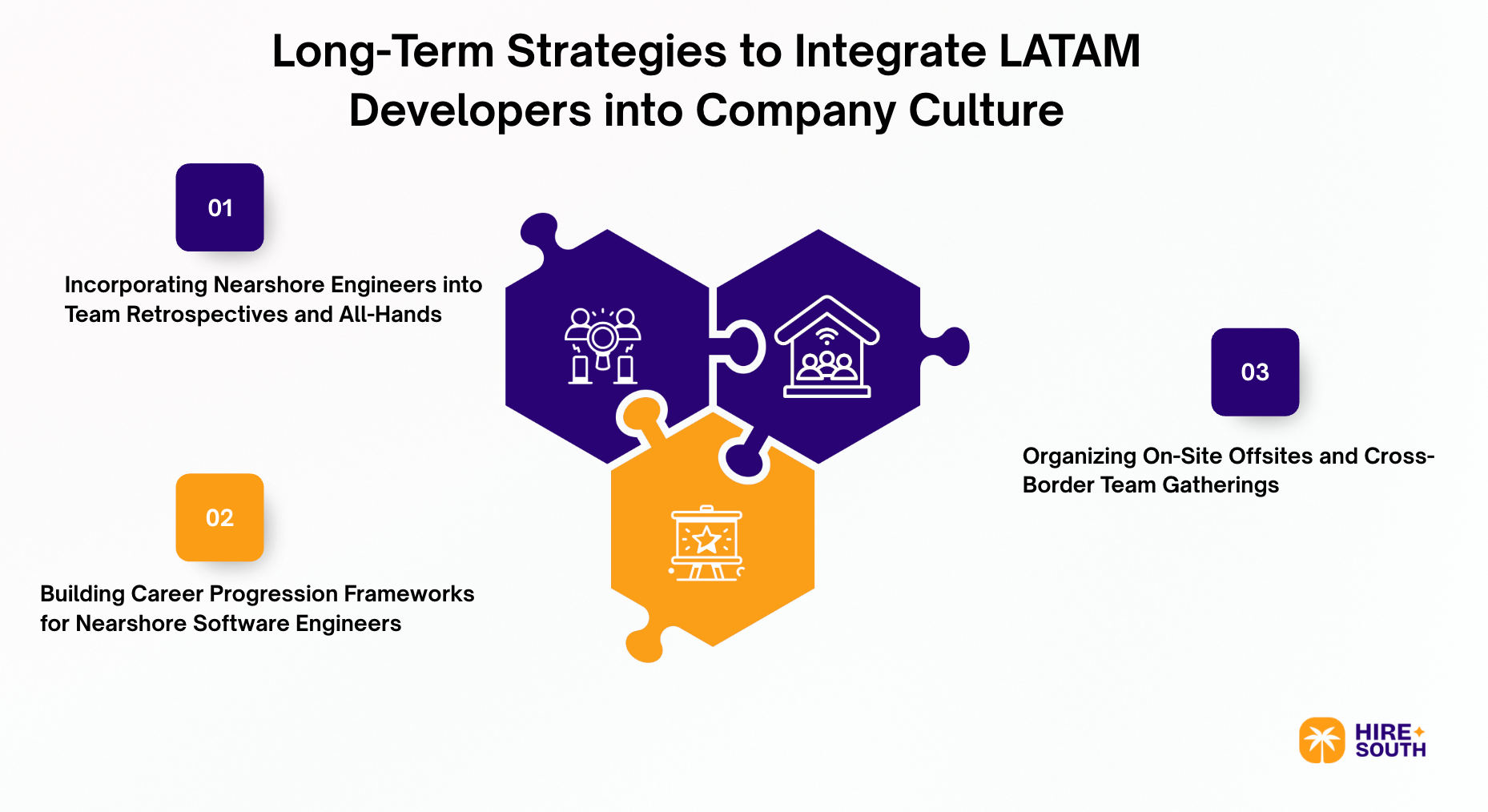
1. Incorporating Nearshore Engineers into Team Retrospectives and All-Hands
Isolating LATAM software engineers from high-level strategic meetings makes them feel like transactional contract labor. Full cultural alignment means giving your remote developers an equal voice in shaping your engineering roadmap and company direction.
Invite nearshore team members to product design discussions, architecture guilds, and bi-weekly retrospectives. Encourage open feedback during sprint post-mortems so developers can highlight process bottlenecks without hesitation. Including your Latin American team in company-wide all-hands meetings builds shared purpose and aligns everyone around key business objectives.
2. Building Career Progression Frameworks for Nearshore Software Engineers
Talented software developers leave organizations that offer no clear path for professional growth. Providing nearshore talent with concrete promotion milestones directly impacts retention and daily engineering performance.
According to a survey by GitLab, 34% of remote workers worry about career progression due to a lack of visibility. Structure clear engineering ladders that map out expectations for junior, mid-level, senior, and staff roles. Offer continuous learning stipends, cloud certification coverage, and mentorship opportunities. Showing nearshore developers a defined trajectory within your technical organization drives long-term commitment.
3. Organizing On-Site Offsites and Cross-Border Team Gatherings
Digital messaging and video calls establish basic workflows, but face-to-face interaction creates deep trust. In-person team gatherings bridge regional gaps faster than months of virtual standups.
Budget for annual or semi-annual team offsites to bring your US and Latin American engineers together in one location. Use this time for high-level technical brainstorming, hackathons, and casual social activities rather than routine sprint execution. Flying nearshore developers to your US office or hosting regional gatherings in hubs like Buenos Aires or Mexico City reinforces team unity and solidifies long-term loyalty.
Looking to Hire LATAM Developers? We Can Help!
Integrating cross-border engineering talent doesn't have to feel like a high-stakes gamble with your team's software velocity. When you establish clear pre-integration steps, align communication standards, and build long-term retention frameworks, nearshore developers quickly become one of your highest-performing assets.
That is where we, at Hire South, step in to simplify every step of your expansion. We connect growing US tech companies with top-tier, pre-vetted Latin American developers who work directly in your time zone. Our nearshore staffing solutions deliver senior-level engineering talent at up to 40% less than domestic hiring costs, while taking care of local legal compliance, international payroll, and employee benefits so you can keep 100% of your focus on shipping great product. Contact us when you are ready to find your next hire!