


Looks solid.Finding the right software engineers is tough. Hiring them locally can drain your budget before the product even launches. That is why so many tech leaders are looking south.
South America has quietly become a massive hub for top-tier developers. The talent pool is incredibly deep. The time zones align perfectly with North American hours, making daily collaboration easy. Plus, the financial upside is hard to ignore. According to Howdy, U.S. companies save roughly 60 to 65 percent by hiring equivalent talent in Latin America.
This article walks you through exactly how IT staffing works in the region. It breaks down how to define your requirements, navigate the hiring process, and pick the right engagement model. You will also discover the top countries for specific tech stacks and learn proven strategies to manage your new remote team effectively. Read on to build a smarter hiring strategy.
South America IT Staffing: An Overview
Market Growth and Talent Availability.
The technology sector south of the border is expanding rapidly. The Latin American IT services market is projected to grow by roughly $58.78 billion between 2025 and 2030. Cloud migration and artificial intelligence adoption drive much of this momentum.
This expansion translates directly into a larger, more specialized workforce. You gain access to an enormous pool of vetted professionals. Brazil alone boasts over 500,000 tech specialists, while countries like Colombia and Argentina continue to produce thousands of top-tier graduates annually. You no longer have to compromise on quality when hiring abroad.
Time Zone Alignment and Real-Time Collaboration.
Working with overseas teams traditionally meant dealing with massive delivery delays. You would send a request at the end of your day and wait until the next morning for a response. South America eliminates this friction.
Countries like Colombia share the exact same working hours as the U.S. Eastern timezone. Other major hubs like Brazil sit just one to four hours ahead. Your developers can troubleshoot bugs, deploy code, and participate in sprint planning alongside your domestic staff.
Cost Efficiency Without Quality Sacrifices.
Budget constraints often force difficult decisions. The global IT skills shortage could cost organizations up to $5.5 trillion by 2026. Navigating this environment requires a smarter hiring approach.
You can secure senior-level talent at a fraction of the domestic cost. This financial flexibility allows you to expand your team faster. You get seasoned engineers who understand complex enterprise systems without breaking your annual budget.
IT Staffing Requirements
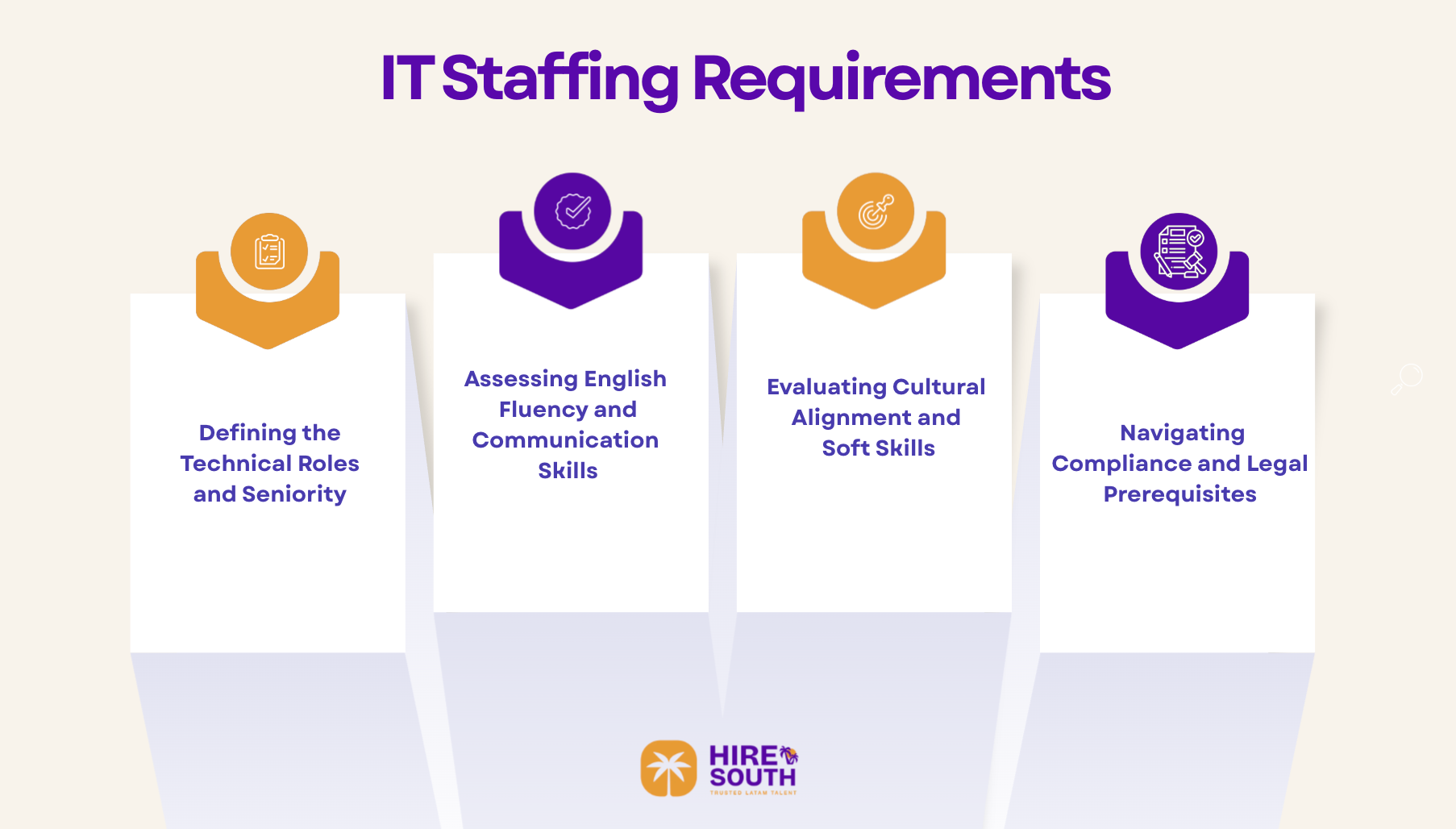
Pinpointing exactly what your project needs makes or breaks a remote engineering pod. Skipping this prep work leads directly to mismatched skills and wasted budget. You must map out the specific capabilities your project demands before interviewing a single candidate.
1. Defining the Technical Roles and Seniority
Start by identifying the exact technology stack. Outline whether you need a React front-end specialist or a Python data engineer. Beyond programming languages, seniority often dictates project success. Most U.S. companies hunt for seasoned professionals to tackle complex architecture.
The regional talent pool aligns perfectly with this demand. Data shows that 56 percent of full-stack and back-end developers in Latin America possess three or more years of experience. This depth of expertise makes filling senior-level roles much easier.
Tool familiarity also matters. More than 80 percent of developers now utilize AI coding tools. Including AI fluency as a baseline requirement keeps your delivery cycles highly competitive.
2. Assessing English Fluency and Communication Skills
Writing clean code is only half the job. Your engineers must communicate architectural decisions during daily standups. Solid communication skills are a non-negotiable requirement for seamless integration.
Language capabilities across the region remain incredibly strong. Argentina currently boasts an EF English Proficiency Index score of 575, classifying the nation in the high proficiency band.
You should establish a minimum B2 English proficiency requirement for all technical hires. Setting this standard ensures everyone can write clear documentation and participate actively in sprint planning. It removes the language barriers that often derail international projects.
3. Evaluating Cultural Alignment and Soft Skills
Technical tests only measure hard skills. Cultural alignment determines long-term retention and overall team cohesion. Your remote developers should share your company's work ethic and problem-solving mentality.
Look for candidates who ask questions and take ownership of their deliverables. Latin American developers are widely recognized for a collaborative and innovative mindset. Building a team that meshes well with your domestic staff prevents the isolation that frequently ruins traditional offshore initiatives.
4. Navigating Compliance and Legal Prerequisites
Hiring across international borders introduces legal complexities. You cannot simply pay a foreign developer through your standard domestic payroll system. You need a solid framework for intellectual property protection, data privacy, and local tax compliance.
Modern staffing providers are increasingly implementing formal information security programs and data privacy practices aligned with local regulations. Establishing these legal requirements upfront protects your proprietary code. Handling the legal paperwork correctly from day one lets your management team focus strictly on product development.
The Step-by-Step IT Staffing Process
Hiring internationally requires a tight operational framework. Without a structured workflow, the recruitment cycle drags on indefinitely. You end up losing great candidates to faster competitors. Here is the exact sequence required to build a reliable remote engineering pod.
1. Initial Needs Assessment and Strategy
Every successful placement starts with a clear role definition. You must align your technical leads and hiring managers on the precise requirements before opening a requisition.
Unclear role definitions can add two to four weeks to your search process, according to HR Oasis. You should define the tech stack, the required seniority level, and the English proficiency threshold on day one. Establishing a structured decision-making process upfront prevents internal bottlenecks later.
2. Sourcing and Talent Acquisition
Finding active candidates requires tapping into local tech communities. Recruiters look far beyond generic job boards. They access regional networks, university alumni groups, and specialized developer platforms.
Speed matters heavily during this phase. Top-tier nearshore agencies can present a vetted shortlist of IT candidates in just three business days, according to Nearshore Business Solutions. Moving fast ensures you capture the attention of high-demand developers before they accept competing offers.
3. Live Coding and Technical Vetting
Resume screening only scratches the surface. You must evaluate practical engineering skills through rigorous technical assessments to guarantee competence.
These evaluations typically include system design reviews, live coding challenges, and infrastructure walkthroughs. You also need to verify communication skills. Conducting a live B2-level English interview guarantees the candidate can articulate complex architectural concepts during your daily syncs. Give candidates clear next steps within 48 hours of an interview to maintain engagement, according to HR Oasis.
4. Offer Negotiation and Onboarding
Making the offer requires an understanding of regional compensation expectations and local labor laws. Standard notice periods across Latin America typically run two to four weeks, according to HR Oasis. You must factor this buffer into your project timelines.
Hiring a software developer in Latin America takes between three and eight weeks from first outreach to accepted offer, according to HR Oasis. By comparison, the average time to fill for senior engineering roles in major Canadian and U.S. markets often exceeds 90 days, according to DevEngine.
Once the candidate signs, the onboarding phase begins immediately. You set up equipment access, configure Jira boards, and integrate the new hire seamlessly into your agile workflows.
Premier IT Staffing Solutions in the Region
Choosing the right operational model determines how well remote engineers integrate with your core business. You have multiple ways to engage talent across Latin America depending on your immediate technical needs. Understanding these pathways ensures you do not overcommit resources or delay critical product launches.
Staff Augmentation vs Direct Hire:
Staff augmentation embeds outside technology professionals directly into your existing workforce on a contract basis. They use your internal tools, join daily standups, and follow your management processes. This approach works incredibly well when you need niche skills fast. Approximately 71% of enterprises utilize augmentation specifically to support time-sensitive development tasks and cloud modernization initiatives.
Direct hiring places permanent employees onto your payroll. You handle everything from long-term retention to benefits administration. This model makes the most sense when the role sits at the absolute core of your business and will last for several years.
Dedicated Nearshore Software Development Teams:
Sometimes you lack the internal management capacity to oversee individual contractors. Building a dedicated nearshore team solves this problem entirely. You hire an entire autonomous squad comprising front-end developers, quality assurance testers, and a dedicated product manager.
These cross-functional units take full ownership of a specific product stream. They operate independently but align their deliverables with your broader company roadmap. It is a highly effective strategy for accelerating enterprise software development without straining your internal technical leads.
Contract-to-Hire Flexibility:
Economic shifts continue to push many organizations toward contract-to-hire arrangements. This model lets you evaluate a developer's real-world performance before extending a permanent offer.
You typically run a 60- to 90-day trial period. If the engineer ships quality code and meshes well with your team culture, you convert them to a permanent seat. It acts as a functional safety net that drastically reduces the financial risk of making a bad hire.
Project-Based Tech Talent Deployment:
Certain initiatives have strict deadlines and heavily defined technical scopes. Project outsourcing hands the entire delivery process over to a vendor. You agree on a fixed price or specific milestones before any code gets written.
The staffing partner manages the developers and guarantees the outcome. You step completely away from daily oversight. This solution perfectly suits legacy system migrations or isolated app development where you simply want the finished product delivered on time.
Ready to Start IT Staffing in South America?
Scaling your engineering capacity does not have to mean choosing between domestic budget drain and offshore communication delays. South America offers the perfect middle ground for securing highly skilled, timezone-aligned developers.
At Hire South, we built our nearshore staffing model specifically to connect U.S. enterprises with the top 1% of Latin American technical professionals. We have successfully placed over 200 hires across the region, maintaining an average time-to-hire of just 10 days. By eliminating traditional U.S. office overhead and localized recruitment markups, our clients consistently achieve a 40% to 50% net cost reduction without sacrificing engineering quality.
We handle the rigorous human-led vetting, international legal compliance, and ongoing payroll administration so your leadership can focus strictly on product development. Whether you need a single senior full-stack developer or a fully managed agile pod, we operate with zero upfront fees and complete pricing transparency. If you are ready to expand your technical capabilities, book a call now! Our team will help you seamlessly integrate vetted, bilingual experts who work the same hours you do.