
.jpg)

Finding the right tech talent locally can feel like an endless waiting game, especially when your product roadmap is screaming for velocity. Traditional hiring in the US often drags out between 45 and 90 days just to fill a single senior engineering role. When you are trying to scale a business or launch a critical software feature, that kind of timeline is a luxury you simply do not have.
That is exactly why nearshore outsourcing has shifted from a backup plan to a core growth strategy for forward-thinking companies. By tapping talent pools across overlapping time zones, you get the speed your business demands without the communication bottlenecks of traditional offshore setups. According to data published by Mismo, leveraging an established nearshore talent network can cut your time to hire down drastically, often yielding qualified shortlists in 3 to 5 days and closing hires in just 2 to 4 weeks.
But how does this process actually work from start to finish? To get those results, you need a clear grasp of the mechanics behind the momentum. Here is a breakdown of a typical nearshore hiring cycle, mapping out exactly what to expect from initial role definition to cross-border onboarding.
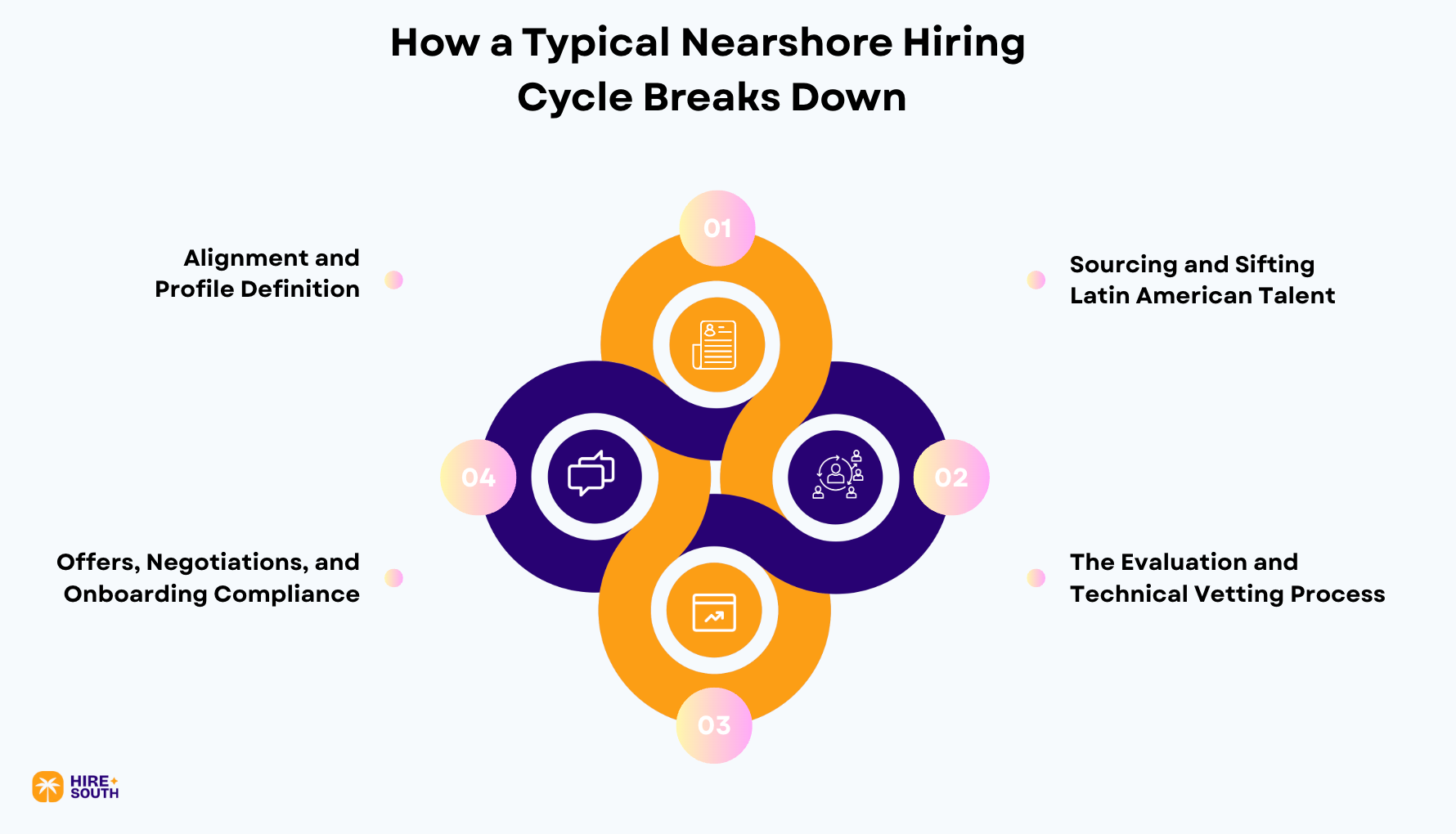
Stage 1: Alignment and Profile Definition
The foundational step of any successful nearshore hiring cycle happens before a single resume enters your pipeline. If your internal team is not completely aligned on the exact technical benchmarks, communication requirements, and operational parameters of the role, the entire cross-border sourcing engine stalls. Taking the time to build a razor-sharp profile prevents downstream bottlenecks and keeps your time-to-hire exceptionally lean.
Defining Roles Within Your Nearshore Hiring Strategy:
A common misstep when expanding your talent search internationally is simply copy-pasting a domestic job description and hoping for identical results. Nearshore product design, software engineering, and customer success ecosystems operate with their own unique regional titles, seniority definitions, and educational frameworks. To attract elite talent, you must translate your core requirements into a scorecard that resonates with candidates in your target nearshore markets.
Start by clearly separating your absolute non-negotiables from your preferred bonus skills. If you try to source a candidate who must possess five years of rare cloud architecture experience, complete bilingual fluency, and immediate availability, you will dramatically extend your sourcing timeline. According to a global talent report by McKinsey, roughly 43% of technology leaders currently struggle to fill critical, specialized roles due to an industry-wide skills shortage. When building your target profile, prioritizing core problem-solving capability over an exhaustive list of secondary tools will drastically shorten your initial sourcing phase.
Aligning Time Zones and Cultural Requirements:
The primary catalyst behind the massive growth of nearshore outsourcing is the elimination of the severe communication lags that plague traditional offshore models. Real-time, synchronous collaboration is no longer a soft luxury, it is a non-negotiable standard for modern agile businesses. However, capitalizing on this benefit requires planning during the initial profile definition stage.
When mapping out your target talent zones, you need to establish explicit expectations for overlapping working hours. Latin American tech hubs generally operate within a comfortable zero to three-hour offset from major United States time zones, providing a built-in advantage for live collaboration. According to corporate communication research published in Organization Science by academic experts from Rice University and Harvard, just a single hour of increased temporal distance between team members shrinks synchronous, live communication by a notable 11%. By defining your required daily meeting windows early on, you can screen specifically for candidates who can seamlessly participate in your morning agile standups or live troubleshooting sessions without forcing unsociable night shifts.
Mapping Technical Skills and Language Proficiency:
The final piece of the alignment phase involves calibrating your assessment filters for both technical capabilities and language fluency. A candidate might be an absolute master of a specific programming language, but if they cannot confidently articulate their architectural decisions during a rapid live product sprint, the integration will fail.
Your initial role definition must outline the exact baseline for English proficiency required for day-to-day operations. For highly collaborative, client-facing roles, a near-native fluency level is essential. For heads-down development tasks, technical literacy and clear text communication may be entirely sufficient. Clearly defining these liquid benchmarks upfront prevents your recruiting team from wasting valuable hours interviewing brilliant technical minds who do not quite meet your team's real-world communication needs.
Stage 2: Sourcing and Sifting Latin American Talent
Sifting Through the Sourcing Pipeline:
Navigating candidate pipelines across Latin America is entirely a game of scale and refinement. The regional talent pool is substantial, with a total tech workforce exceeding 2.8 million specialists across the territory, according to research published by Revelo. However, a massive applicant pool can easily paralyze an internal HR department if you do not filter it properly.
A high volume of resumes does not automatically mean high-velocity hiring. Inexperienced technical recruiters often waste valuable days reviewing unqualified applicants who lack the precise architectural experience your product requires. To optimize this phase, your sourcing engine must focus aggressively on passive candidate engagement rather than relying entirely on inbound job boards. Top-tier software talent across Latin America is rarely actively looking for work, which means your outreach strategy must highlight your technical stack and operational maturity to get noticed.
Overcoming Regional Sourcing Bottlenecks:
Every geographic market contains specific regional friction points that can easily stall an international hiring timeline. In Latin America, the most prominent operational bottleneck centers around localized communication preferences and platform usage. Relying entirely on standard email or traditional domestic corporate job portals will dramatically slow down candidate response times.
Elite tech talent across the region relies heavily on direct, mobile-first communication channels like WhatsApp for professional networking and recruitment outreach. Sourcing teams that fail to adapt their initial touchpoints to these localized habits experience prolonged lag times during early outreach. Furthermore, the massive volume of international companies competing for the exact same talent pool means you must present clear, transparent job details regarding remote structures, equity options, and contract terms during the very first message to maintain candidate momentum.
Identifying Top Tech Hubs for Nearshore Outsourcing:
Maximizing search efficiency requires focusing your recruitment efforts on specific urban tech clusters that are already optimized for international business collaboration. Latin America features several mature tech cities, each possessing distinct operational advantages, technical specializations, and salary baselines.
Brazil serves as the absolute heavyweight for enterprise scale, drawing from a massive nationwide pool of over 759,000 developers, according to data from Revelo, with major hubs centered around São Paulo and southern technical corridors. Mexico provides another exceptionally deep talent ecosystem with over 560,000 engineering specialists, according to the same market data from Revelo. This hub is highly prized for its complete geographic and cultural proximity to the United States market, especially through focal cities like Guadalajara and Monterrey.
Further south, Buenos Aires, Argentina, is highly regarded for complex algorithmic development and exceptional language capabilities. According to the global EF English Proficiency Index, Argentina consistently secures the top ranking for English fluency across the entire Latin American region. Meanwhile, Colombia represents a rapidly expanding technical market supported by substantial municipal investments in Bogotá and Medellín, pulling from a growing national pool of over 62,000 active tech professionals.
Automated vs. Manual Screening in the Nearshoring Cycle:
Striking the right balance between automated sorting algorithms and manual human review is what separates high-velocity talent acquisition from fractured hiring workflows. Relying too heavily on keyword-matching software often filters out exceptionally brilliant self-taught engineers or candidates with non-traditional educational backgrounds who are highly prominent across emerging markets.
Conversely, relying purely on manual screening slows down your pipeline velocity, allowing agile competitors to secure top candidates first. The ideal approach uses automated tools strictly for initial baseline verification, such as confirming time-zone availability and basic technical alignment. Once those baselines are established, human technical sourcers must immediately step in to review code repositories and conduct brief introductory conversations, ensuring you capture elite creative talent without sacrificing structural speed.
Stage 3: The Evaluation and Technical Vetting Process
Designing a Lean Interview Process for Nearshore Candidates:
The total duration of your interview pipeline directly influences your final offer acceptance rates. When top-tier engineers enter the job market, they do not remain available for long. According to recruitment data published in a 2026 hiring report by Pin, the interview stage alone accounts for a massive 32% of all candidate drop-off across modern hiring funnels. This makes the interview phase the single largest leak in the talent acquisition pipeline, outpacing initial application abandonment and scheduling friction combined.
Every unnecessary conversation or repetitive panel interview you add increases the likelihood that a candidate will exit your pipeline to accept a faster offer elsewhere. According to historical tracking analytics from SkillSauce, each additional day introduced into an active evaluation process increases overall candidate drop-off by roughly 5% to 10%. To maintain velocity, structure your funnel with an absolute maximum of three primary touchpoints. A streamlined sequence consisting of a brief initial screening, a single focused technical review, and a final cultural alignment conversation provides more than enough data to make an informed hiring decision while keeping candidates fully engaged.
Assessing Soft Skills and English Fluency Under Time Constraints:
Evaluating communication compatibility requires a structured approach that moves past casual conversation. While technical skills can be verified through clean code output, assessing a candidate's ability to collaborate in a live synchronous remote environment requires observing real-time problem-solving behaviors. This step is critical because a developer who struggles to clearly articulate their architectural choices during a rapid sprint will quickly create delivery bottlenecks.
Instead of relying on unstructured behavioral conversations, utilize situational scenarios that mirror your team's day-to-day operations. Ask candidates to walk through how they navigate a sudden production outage, or how they handle a direct disagreement with a product manager regarding a feature's scope. This approach allows you to evaluate spontaneous language clarity, active listening skills, and cross-cultural professional alignment in a single conversational setting, eliminating the need for separate communication screens.
Standardizing Technical Assessments to Accelerate Hiring:
Implementing exhaustive, multi-hour take-home coding assignments frequently backfires when targeting highly experienced software engineers. Elite developers often view lengthy, uncompensated homework tasks as a significant red flag, leading to immediate drop-outs during the middle of your funnel. According to recruitment insights published by daily.dev, up to 60% of technical job seekers will completely abandon an active application process if the assessment phase feels excessively long, complex, or detached from real-world workflows.
To preserve pipeline velocity, replace abstract homework projects with standardized live technical sessions. A one-hour collaborative code review or a highly practical pair-programming exercise provides deep visibility into how a candidate actually thinks, writes, and debugs under real-world conditions. This interactive approach yields immediate, objective engineering insights while respecting the candidate's time, drastically compressing your evaluation timeline.
Red Flags to Watch for During Nearshore Evaluation:
During cross-border technical assessments, certain behavioral patterns require careful attention to protect the integrity of your pipeline. The most critical technical red flag to watch for is a sharp discrepancy between a candidate's written profile and their actual performance during live coding exercises. A sudden inability to explain the underlying logic of a basic algorithm, or an over-reliance on external copy-paste solutions during a live pairing session, indicates that the initial application may not accurately reflect their practical capabilities.
Operational red flags during early conversations are equally telling. Frequent last-minute interview rescheduling requests, persistent connectivity or audio issues that cannot be resolved, or a distinct lack of transparency regarding current employment notice periods all serve as early indicators of future remote reliability problems. Identifying these behavioral patterns during the initial assessment phases allows you to confidently remove mismatched applicants early, keeping your internal resources focused exclusively on reliable, high-performing professionals.
Stage 4: Offers, Negotiations, and Onboarding Compliance
Formulating Competitive Offers for Nearshore Outsourcing Professionals:
The final offer stage requires localized market data rather than a generic compensation formula. Tech professionals across Latin America are fully aware of their global market value, meaning a low baseline offer will quickly stall your pipeline momentum. According to international payroll data published in the State of Global Hiring Report by Deel, Latin American tech positions experienced some of the fastest global salary growth, with specific operational and specialized engineering roles commanding substantial premium increases to adjust for local tech inflation.
To secure an immediate acceptance, your package must address regional economic realities directly. In volatile economic markets or countries experiencing high localized inflation, top-tier engineering talent actively practices currency hopping. According to the same global hiring analysis by Deel, contractors in volatile regional economies frequently prioritize contracts denominated in United States Dollars or stablecoins over their local currency to protect their baseline purchasing power. Providing a stable, dollar-denominated offer instantly positions your company as a preferred employer, helping you outpace domestic regional competitors.
Managing Contract Signatures Across Borders:
The actual administrative mechanics of executing international agreements can become an unexpected bottleneck if your team relies on outdated, manual onboarding protocols. Sending dense, unlocalized document files back and forth via email drags out your hiring timeline and opens your organization up to cross-border intellectual property vulnerabilities.
To maintain velocity, utilize localized, pre-vetted digital contract templates that are already compliant with the candidate's local municipal laws. Ensuring your contracts explicitly state United States intellectual property ownership and standard cross-border data protection clauses protects your underlying source code while complying with regional data privacy laws, such as Brazil's LGPD or Argentina's PDP Law. Automating this document execution layer allows you to securely collect verified electronic signatures within hours rather than days, maintaining candidate momentum.
Streamlining the Onboarding Phase of Your Nearshore Hiring Cycle
An exceptional candidate experience during the final offer stage must transition into a highly structured, day-one remote onboarding workflow. The initial two weeks of a nearshore professional's tenure dictate their long-term retention and time-to-productivity metrics. If a new hire spends their first week waiting for access to local repositories, cloud environments, or basic communication channels, your operational momentum stalls.
When structuring your remote onboarding framework, plan for localized hardware logistics and payroll processing frequencies. According to global operational standards published by Deel, running a single global payroll calendar frequently triggers wage law compliance violations. While monthly payroll runs are completely standard across Europe, bi-weekly payroll distributions are legally mandated or culturally expected for professional roles throughout Mexico and parts of Central America. Aligning your payroll frequencies and shipping hardware well ahead of the official start date ensures your nearshore talent is fully equipped and legally compliant to contribute to your codebase from day one.
Ready to Hire LATAM Talent?
Navigating a cross-border talent acquisition pipeline requires an intentional blend of structural velocity, localized economic insight, and strict regulatory adherence. When you compress the time-to-hire window and eliminate geographic friction, you convert a standard operational workflow into an aggressive competitive advantage. Managing the complexity of international contract structures, fluctuating local labor benchmarks, and regional compliance standards, however, demands dedicated infrastructure.
At Hire South, we engineer this entire operational framework on your behalf, eliminating the traditional friction points of international talent acquisition. By leveraging an expansive, vetted network of professional Latin American talent, we accelerate your sourcing phase to present highly qualified, bilingual shortlists in under two weeks. Our end-to-end model assumes the entire administrative burden of localized compliance, cross-border payroll, and statutory benefits coordination, allowing your internal teams to remain focused exclusively on product delivery and strategic scale. Contact us to get started today!