


Finding brilliant developers across the globe has never been easier, but it has also never been more dangerous. When you hire remotely, you are not just welcoming a new team member, you are opening a digital door to your company's most sensitive data.
How well do you really know the person behind the Zoom screen? The stakes are incredibly high, and traditional gut-feeling hiring simply does not cut it anymore. In fact, according to a 2025 survey by Checkr, 31% of hiring managers have interviewed a candidate who was later revealed to be using a completely fake identity.
This guide breaks down exactly how to protect your business. You will learn how to design a watertight talent background check, spot sophisticated digital impersonators, and run compliant remote work background checks without slowing down your onboarding. Let’s make sure your next remote hire is a source of growth, not a major security breach.
Why Security Has Become Crucial In the Remote Work Industry
Historically, securing a corporate network meant protecting a single, physical building. You had a firewall at the door, on-site IT staff, and employees working on company-owned computers behind a unified network. The transition to distributed teams has completely dismantled this traditional perimeter, turning security from a back-office IT checklist into a core business survival strategy.
1. The Radically Expanded Digital Attack Surface
When your team operates globally, your company's network security is only as strong as your employees' home routers. Cybercriminals are highly aware of this vulnerability. According to a remote work security study by ElectroIQ, 38% of all modern cyberattacks specifically target remote infrastructure, such as home routers, virtual private networks (VPNs), and other remote-access pathways.
If you hire a developer who accesses your codebase from a residential connection without strict endpoint protocols, you are essentially trusting their home security habits with your proprietary intellectual property. A single compromised device can grant lateral access to your entire cloud environment.
2. The Drastic Financial Impact of Distributed Data Breaches
A security failure in a remote environment is significantly harder to detect, isolate, and remediate. This delay directly translates into massive financial losses. According to the IBM Cost of a Data Breach Report, the remote work factor alone adds an average of $173,074 to the total cost of a corporate data breach.
Because distributed teams rely on asynchronous communication and lack physical proximity, identifying a compromised user account can take weeks. By the time your team notices anomalous behavior, sensitive customer databases or proprietary algorithms may already have been exfiltrated.
3. The Rising Vulnerability of Unsecured Personal Hardware
Allowing remote talent to use personal laptops is one of the most common mistakes a growing business can make. According to data published by ElectroIQ, unsecured personal devices are responsible for 22% of all exploited endpoint weaknesses in remote work settings.
Without central management, you cannot guarantee that your remote contractors are running updated operating systems, utilizing active firewalls, or keeping their systems free of malware. This lack of visibility makes background checks and continuous device monitoring a non-negotiable step in the onboarding process.
4. The Growing Threat of Exploited Remote Access Credentials
Traditional passwords are no longer enough to protect your cloud architecture. Cybercriminals actively use credential stuffing and social engineering to target remote employees. According to security data from ElectroIQ, 62% of security breaches in remote settings were caused directly by the use of poor or stolen remote access credentials.
This reality highlights why verifying a candidate’s identity during the screening phase is just as important as securing their connection with multi-factor authentication once they are hired. If you cannot guarantee the true identity of the person logging into your systems, even the most advanced security tools will fail.
How a Modern Remote Talent Security Check Should Be
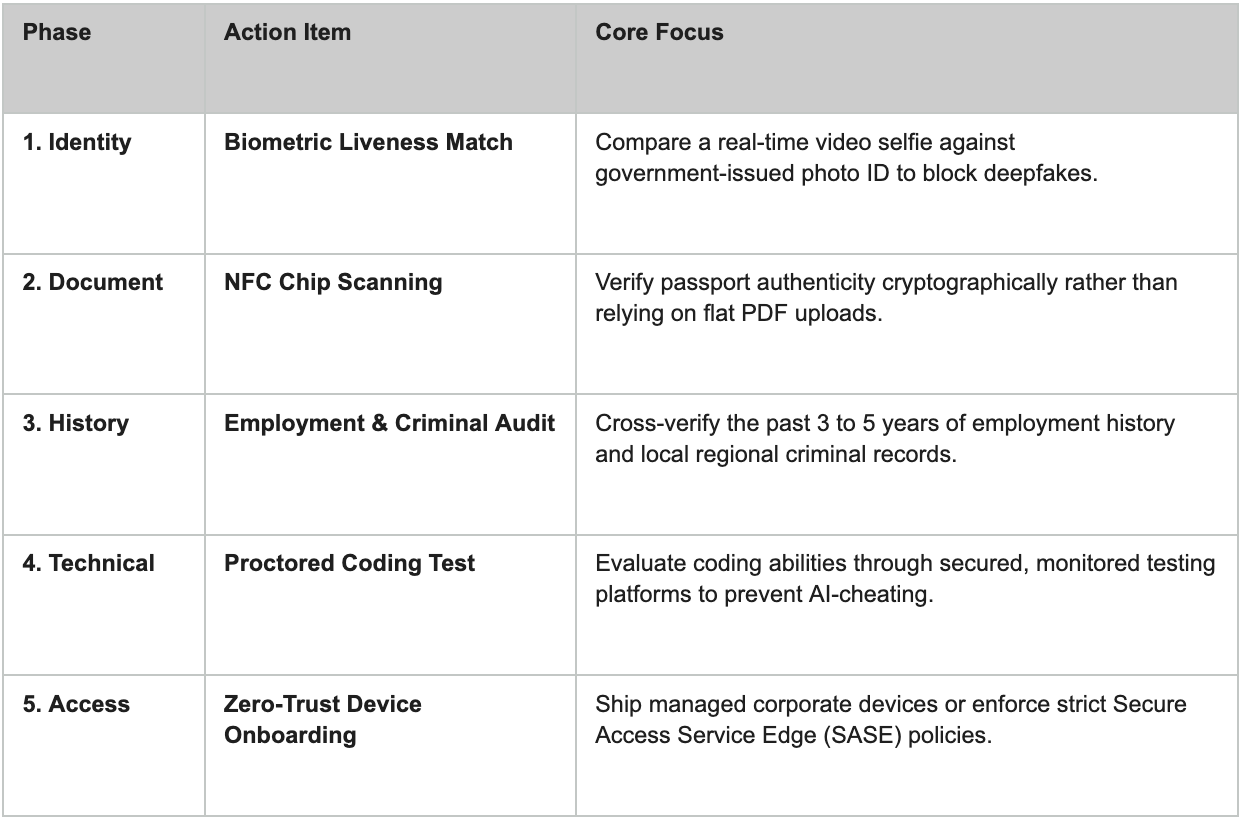
The days of relying on a simple, localized database search to vet your workforce are gone. A modern talent background check must be dynamic, continuous, and built specifically for a borderless digital environment. Setting up a secure remote team requires an approach that goes far beyond verifying a candidate's past, focusing heavily on securing their present identity and future access.
1. Prioritizing Identity-First Verification over Resume Reviews
In a remote-first world, you cannot afford to assume that the person coding on your project is the same person who passed your technical interview. According to the 2026 Global Workforce Trends Report by First Advantage, 45% of hiring professionals have encountered candidate identity misrepresentation during the recruitment process.
A modern screening process must begin with identity-first verification before any traditional background checks are run. This means using touchless digital identification and biometric matching during the initial application phase.
2. Upgrading from Visual Scans to Cryptographic NFC Chip Verification
Relying on a candidate uploading a flat photo of their driver's license or passport is no longer secure. Advanced generative AI and high-quality deepfakes make it easy for bad actors to bypass simple optical character recognition (OCR) software.
Your screening protocol should utilize Near Field Communication (NFC) verification. According to 2026 identity data published by Zyphe, approximately 62% of digital identity verifications now utilize NFC chip reads where the physical document supports it. By having a candidate scan the embedded chip in their passport with their smartphone, your system cryptographically verifies the document’s authenticity directly with the issuing government authority, completely neutralizing visual document tampering and deepfake ID attempts.
3. Transitioning from Point-in-Time Vetting to Continuous Monitoring
A traditional background check is a static snapshot of a candidate’s history at a specific moment in time. If an employee commits a serious security violation or legal offense six months after onboarding, a pre-hire check will not protect your company.
To mitigate ongoing insider threats, organizations are shifting toward continuous post-hire monitoring programs. By integrating automated, real-time data feeds across judicial, financial, and professional registries, your compliance team can receive proactive risk signals throughout the entire employee lifecycle. This ongoing visibility is especially critical for remote developers who hold administrative access to your live production environments and proprietary code databases.
4. Automating the Adjudication Process for Enhanced Onboarding Speed
Security should never act as a bottleneck for securing top-tier global tech talent. High-performing developers are often off the market within days, making fast turnaround times a critical competitive advantage for your HR department.
Modern screening platforms leverage machine learning and automated rules-based adjudication engines to parse background data. Rather than forcing a human compliance officer to manually review every minor, irrelevant discrepancy, automated systems quickly flag actual risk factors while instantly clearing low-risk profiles. This intelligent automation dramatically slashes your average time-to-hire, allowing you to secure top-tier candidates before your competitors do.
Choosing the Right Partner for Remote Work Background Checks
When you scale a distributed tech team, you cannot manage the legal, logistical, and technical weight of global screenings internally. Your HR department needs a specialized background check partner. However, choosing the wrong screening vendor can expose your organization to severe data privacy lawsuits or cause you to lose top-tier tech talent due to sluggish onboarding times.
To make an informed decision, you must evaluate potential vendors against modern, remote-first security standards.
Prioritizing Global Compliance and Local Data Privacy Expertise:
A vendor that excels at domestic screenings in your home country might completely fail when navigating international labor laws. Every region has highly specific regulations regarding what employer-requested data can be collected, stored, and processed.
For example, in many European jurisdictions, running a criminal record check is legally restricted to high-sensitivity roles, such as positions with direct access to financial assets or vulnerable populations.
Furthermore, you must ensure your screening partner complies with strict international frameworks like the European Union's General Data Protection Regulation (GDPR). According to an industry market analysis by Mordor Intelligence, rising regulatory mandates and global privacy enforcement have significantly raised the compliance costs and security requirements for screening platforms.
Your chosen vendor must possess localized legal expertise to protect your company from crippling regulatory fines. In the United States alone, the Federal Trade Commission issued 23 consent decrees for Fair Credit Reporting Act (FCRA) non-compliance during 2025, which doubled the prior two-year period and drove average settlement values to nearly $5 million, according to data published by Mordor Intelligence.
Insisting on Direct ATS Integrations to Minimize Time-to-Hire:
Top-tier software developers and system architects do not stay on the job market for long. If your background check process takes weeks of manual back-and-forth communication, your candidate will likely accept another offer.
The right partner must offer pre-built integrations with your Applicant Tracking System (ATS). According to industry data from Mordor Intelligence, widespread HR technology consolidation has led major ATS platforms to rapidly double their rosters of pre-integrated screening providers to offer unified recruiting, payroll, and onboarding workflows.
Integrating your screening platform directly with your ATS allows you to initiate a background check with a single click. This integration also automates candidate data entry, which reduces human error and slashes days off your average time-to-hire.
Evaluating International Turnaround Times and Transparency:
Global screening timelines vary wildly depending on the target country and the depth of the check. While simple international database scans or global sanctions lists can be cleared in one to two business days, verifying international employment histories or academic credentials can take up to 15 business days, according to platform data from Remote.
A high-quality vendor does not hide these discrepancies behind generic timeline estimates. They should provide your hiring team with a real-time tracking dashboard showing the exact status of each component of the background check.
Avoid vendors that keep you in the dark while a crucial hire hangs in the balance. Transparent communication allows your team to manage candidate expectations and adjust project timelines accordingly.
Assessing Candidate Experience and Support Infrastructure:
The screening process is often a candidate's first major interaction with your company's operational style. If your vendor utilizes a clunky, non-mobile-responsive portal or demands redundant paper forms, it reflects poorly on your corporate brand.
According to the 2025 Global Trends Report by First Advantage, organizations are increasingly leveraging modern software and digital identity solutions to streamline the candidate experience while maintaining rigorous risk mitigation.
Choose a vendor that provides candidates with a secure, highly intuitive digital portal where they can easily upload documents and sign consent forms.
Additionally, ensure the vendor provides dedicated customer support to assist candidates who encounter technical hurdles or local document submission issues. A smooth, supportive screening experience keeps candidates engaged and excited to join your team.
Hire Remote Tech Talent with the Right Global Partner
Building a highly secure, distributed organization is a continuous journey that begins before a candidate ever signs an employment contract. As the digital attack surface continues to expand, relying on antiquated vetting methods is no longer a viable option for forward-thinking organizations.
We at Hire South are here to ensure that your business expands securely and efficiently without sacrificing your peace of mind. We specialize in connecting growing businesses with highly skilled, pre-vetted nearshore professionals across Latin America who work in your exact time zone and integrate seamlessly into your engineering and operations teams. Because we understand that safety is just as critical as skill, we handle the intensive sourcing, technical vetting, and comprehensive identity screenings on our end. This thorough process allows you to onboard top-tier talent while remaining completely compliant with global labor laws.