


Trying to scale your engineering team domestically is a fast way to drain your runway. High salary demands, endless bidding wars, and sudden turnover make software development incredibly painful to budget for. If you feel like your product roadmap is stalled because you cannot afford local talent, you are not alone.
Fortunately, a massive shift in tech sourcing lets you stretch your capital further. By expanding your search globally, you can literally add three engineers to your payroll for the price of a single local hire. Senior developers in the United States command an average annual salary of 175,559 dollars, according to Glassdoor’s 2026 compensation data, which means a single domestic salary can easily fund an entire, high-performing engineering squad nearshore.
But how do you pull this off without sacrificing code quality or dealing with massive communication blockers?
This guide maps out the exact process. You will learn the core differences between hiring individual freelancers versus a dedicated development team, how to run secure cross-border coding tests, and the best ways to handle international payroll compliance. Let's look at how to scale your development capacity without blowing up your budget.
The Real Costs of Hiring Software Developers
Calculating your true engineering overhead requires looking past base salary figures. When you plan a tech expansion, looking only at the numbers on a job offer leads to major budgeting shortfalls down the road. True organizational scale requires an honest audit of fully burdened employment costs, administrative overhead, and productivity variables.
Base Salaries Form Only a Fraction of Domestic Engineering Overhead.
Focusing entirely on a candidate's base pay gives an inaccurate picture of your actual financial commitment. In major United States tech centers, a junior developer’s starting salary ranges from 90,000 dollars to 120,000 dollars annually, according to Perimattic's 2026 Software Developer Cost Snapshot, while senior engineers regularly command between 140,000 dollars and 200,000 dollars per year.
The baseline salary is just the initial layer of your investment. Mandatory state and federal payroll taxes, corporate healthcare coverage, retirement matching, and local benefits packages routinely add 30 to 50 percent more to your actual financial outlay. For a senior resource, a 160,000-dollar salary easily translates into a 220,000-dollar annual burden on your business capital.
Sourcing and Recruitment Channels Burn Core Technical Bandwidth.
Attracting elite technical talent demands significant time and resources from your existing team. Whether you pay direct agency placement fees or rely on internal recruiters, finding qualified engineers comes with major upfront costs. High-end tech recruiting agencies frequently charge between 20 and 25 percent of the hired developer’s first-year base salary, according to data from Mismo’s 2026 Developer Hiring Guide.
There are also massive internal resource drains to consider. Your senior engineers and product managers must pause their roadmap tasks to audit resumes, manage technical assessments, and conduct multi-tiered live code reviews. This engineering downtime slows feature development and impacts your overall time-to-market.
Infrastructure and Tool Stacks Multiply Daily Operational Costs.
Equipping an enterprise engineer to write production-grade code safely requires an extensive, paid operational footprint. You cannot simply hand over a basic laptop and expect fast, secure output. Modern development teams require premium hardware setups alongside continuous software licensing costs that scale with every seat you add.
Enterprise-tier accounts for code repositories, project tracking software, cloud sandboxes, and automated testing tools pile up quickly. Additionally, engineering teams heavily leverage modern AI-assisted development tools like GitHub Copilot and Cursor AI, which slash development timelines by 20 to 40 percent, according to Perimattic’s 2026 trend analysis. While these smart assistants offer an exceptional return on investment, the cumulative licensing cost of an advanced, multi-tool development stack adds thousands of dollars per seat to your annual budget.
High Technical Attrition Rates Spark Expensive Code Base Disruptions.
The financial damage caused by software developer turnover goes far beyond recruitment fees. When an engineer leaves your organization, they take critical, undocumented knowledge of your proprietary system architecture with them. This introduces severe productivity gaps while your remaining team scrambles to decipher old logic.
Replacing a technical asset typically costs a business 1.5 to 2 times the employee’s annual salary when factoring in lost momentum and ramp-up time, according to general Society for Human Resource Management benchmarks. The remaining engineers must pivot away from building new features to onboard the replacement, slowing down product releases for months. Managing retention risks through stable, vendor-backed teams protects your core code consistency and shields you from sudden, expensive engineering churn.
The Step-by-Step Process to Hire Developers Safely
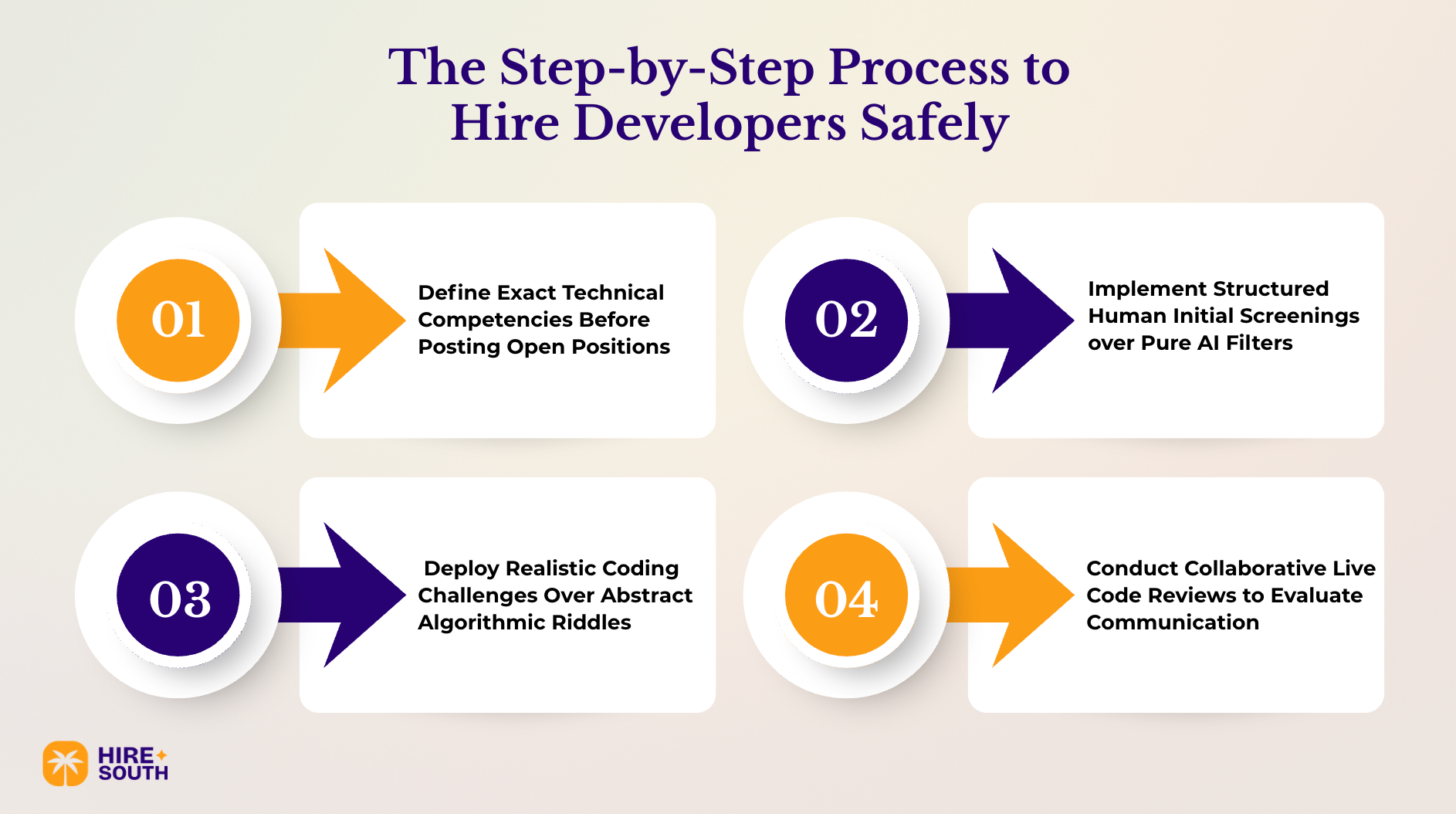
Mitigating risk during a technical team expansion requires a highly methodical, repeatable evaluation sequence. Allowing unstructured conversations or unverified resumes to dictate your hiring decisions invariably leads to project delays and broken codebases. To build a highly reliable engineering branch, you must implement an objective screening system that separates top-tier talent from smooth talkers.
1. Define Exact Technical Competencies Before Posting Open Positions
Launching a software candidate search without concrete architectural requirements guarantees a flooded, unmanageable application pipeline. You must explicitly isolate the exact languages, frameworks, and database dependencies your project relies on daily. Documenting whether your team needs a specialized system architect or a product-focused frontend engineer prevents your internal screening staff from wasting time on misaligned profiles.
Vague job listings significantly extend your company’s vacancy timelines. The average time required to fill an open corporate position stretches from 63 to 68 days, according to a 2026 workforce planning report by The Resource Company, with technical roles demanding nearly twice as much interview overhead as non-technical corporate business functions. Clearly mapping out your Git workflows, cloud ecosystem needs, and testing expectations before speaking to candidates allows you to compress this hiring window and locate targeted experts faster.
2. Implement Structured Human Initial Screenings over Pure AI Filters
Automated resume-scanning algorithms frequently create false negatives by rejecting highly capable, non-traditional software engineers who lack specific keywords. While initial software filtering can help manage massive applicant volumes, human-led operational screening provides a far more accurate baseline evaluation. A brief, structured 20-minute introductory conversation helps confirm baseline professional communication abilities, remote work readiness, and core alignment with your team's development schedule.
This initial layer serves as an essential qualification filter for the rest of your pipeline. The overall applicant-to-interview conversion rate for modern technical roles sits at a tight 3 percent, according to CareerPlug's 2025 Recruiting Metrics Report, meaning only 3 out of every 100 applicants possess the baseline traits needed for a direct conversation. Utilizing a focused, human-centered initial screen ensures your team saves their deep technical evaluations exclusively for candidates who show genuine promise.
3. Deploy Realistic Coding Challenges Over Abstract Algorithmic Riddles
Forcing candidates to solve highly theoretical brainteasers or complex math puzzles rarely predicts their actual, day-to-day coding performance. Elite software developers frequently abandon recruitment processes entirely when faced with irrelevant algorithmic hurdles that have nothing to do with their actual jobs. Your practical evaluation should feature a localized, time-bound coding exercise designed to mirror the exact bugs, feature requests, or logic issues they will face inside your production repository.
Abstract code tests often mask real-world capability gaps. While automated testing platforms regularly show coding challenge failure rates between 80 and 90 percent, according to 2026 technical interview analytics from Onehour, roughly 78 percent of working developers state that traditional hiring assessments completely fail to align with everyday engineering tasks. Constructing a realistic, hands-on debugging or feature-building test gives your engineering leaders authentic data on how a candidate handles real-world architecture.
4. Conduct Collaborative Live Code Reviews to Evaluate Communication
The final step in a secure technical validation process must focus heavily on team integration and engineering soft skills. Bring your final candidates into a live, interactive video session with your senior developers to walk through their completed coding test. Ask the applicant to explain their architectural choices, justify their framework implementations, and describe how they would scale their code to support high user traffic.
This collaborative session exposes how a developer handles direct technical feedback and constructive criticism. Technical hires now spend an average of 23.3 hours participating in active interview processes before an official offer is extended, according to data from The Resource Company's 2026 hiring metrics. Spending this face-to-face time running code reviews gives you an unfiltered look at their problem-solving mindsets, ensuring you bring on transparent, collaborative professionals who will seamlessly elevate your code quality from day one.
Best Ways to Expand Your Dev Team While Saving
Maximizing your product output without depleting your capital reserves requires a shift toward smart, borderless resource allocation. Traditional local recruiting methods create heavy financial bottlenecks that stall product roadmaps. By utilizing modern geographic and structural hiring strategies, you can scale your codebase velocity while dramatically lowering your engineering expenditures.
1. Prioritize Nearshore Geographies to Secure Perfect Time Zone Overlap
Expanding your tech squad into nearshore markets like Latin America allows you to tap into world-class engineering talent without the severe operational friction of massive time zone gaps. Unlike offshore models that require late-night or early-morning coordination, nearshore professionals share your exact working hours. This real-time alignment means your developers participate seamlessly in daily agile standups, synchronous code reviews, and live debugging sessions.
The financial leverage gained through this regional approach is substantial. Hiring senior software engineers in Latin America costs between 55,000 dollars and 85,000 dollars fully loaded per year, compared to 150,000 dollars to 180,000 dollars domestically, according to ParallelStaff's 2026 Software Development Cost Guide. This deep pricing discrepancy allows you to add multiple high-caliber engineers to your payroll for the exact cost of a single local hire, all while enjoying complete workday overlap.
2. Shift Software Development Models to Pre-Vetted Dedicated Squads
Hiring individual engineers one by one through standard job boards involves heavy recruitment friction and significant ramp-up delays. Partnering with a managed vendor to deploy a dedicated development team offers an immediate shortcut to productivity. These squads arrive with verified technical credentials, established working relationships, and an understanding of modern agile workflows.
Choosing an integrated unit eliminates the lengthy screening phases that drain your internal management bandwidth. A three-engineer nearshore development team running a blended agency rate costs roughly 36,000 dollars to 40,000 dollars per month when factoring in all-inclusive total cost of ownership, according to ParallelStaff's 2026 cost breakdown, compared to 65,000 dollars to 90,000 dollars per month for an equivalent domestic setup. This framework hands you annual operational savings of 300,000 dollars to 500,000 dollars per squad, freeing up capital to invest directly back into your core marketing and product growth.
3. Partner with an Employer of Record to Neutralize Legal Overhead
Navigating international labor laws, cross-border tax compliance, and local benefits administration can easily overwhelm an internal HR department. Trying to set up legal entities in every country where you find a skilled developer introduces massive operational expenses. Utilizing an Employer of Record, or EOR, solves this issue by acting as the legal employer on the ground.
An EOR manages international payroll, localized tax withholdings, statutory health benefits, and regional compliance mandates through a single flat monthly fee. Managing global talent through a unified compliant partner eliminates hidden legal risks and slashes standard corporate administrative overhead by 15 to 20 percent, according to data from Cloud Employee's 2026 Software Development Rates Guide. This protective structural setup guarantees your intellectual property remains fully secure while keeping your expanding remote operation lightweight and highly cost-effective.
Drive Velocity Across Your Codebase with the Right Nearshore Partner
Expanding your engineering footprint through geographic models provides the unique opportunity to scale your feature delivery without burning through your capital reserves. However, vetting independent cross-border talent, navigating international compliance frameworks, and maintaining code consistency across a distributed environment require a significant allocation of internal time and operational focus.
At Hire South, we specialize in bridging the gap between high-growth organizations and elite Latin American engineering professionals. By integrating our nearshore staffing framework into your technical pipeline, you can reliably add top-tier developers to your product workflow while securing an average reduction of 30 to 50 percent in overall engineering labor expenses, according to internal data. We manage the entire lifecycle of regional talent acquisition, from administering localized, real-world coding tests and verbal communication assessments to handling global payroll infrastructure, statutory benefits, and strict intellectual property protection.
Whether you are looking to integrate individual contributors into an existing repository or deploy a fully dedicated development team operating in your exact time zone, we ensure a transparent, friction-free integration. Contact us today to schedule a free operational consultation and build a scalable, highly cost-effective extended tech team!