


Finding amazing professionals in Latin America isn't the challenge anymore. The real headache starts when your pipeline works too well, leaving you with three or four flawless finalists and only one open headcount.
According to industry data, a striking 84% of international hires in Latin America are for mid-level or senior positions. You aren't just comparing entry-level resumes, you are choosing between battle-tested leaders, brilliant software engineers, and sharp operational minds who all look fantastic on paper.
So, how do you make the final call without relying on a coin flip? This guide breaks down the ultimate playbook for navigating LATAM talent selection. You will discover how to build an airtight scorecard to kill hiring bias, read between the lines of regional work cultures, and use paid test projects to see how candidates actually perform. If you are tired of staring at identical final interview notes and want a data-backed framework to choose the absolute best fit for your team, here is how to seal the deal.
Moving From a Massive Talent Pool to Your Shortlist
Sifting through international resumes can quickly become overwhelming. Latin America boasts a massive, rapidly expanding tech ecosystem. According to data from tech recruitment firm Alcor, the region has amassed a talent pool of over 2 million software developers. Countries like Mexico lead the pack with over 800,000 tech experts, while Brazil and Colombia follow closely with 540,000 and 165,000 specialists, respectively.
1. Filtering the Noise in a Hyper-Growth Region
When you open a single remote role to this massive geography, you will likely face a tidal wave of applicants. The challenge isn't finding talent, it is filtering the noise. Turning a mountain of raw applications into a precise, high-caliber shortlist of three to five candidates requires a structured approach. If you rely on manual resume reviews, you will lose weeks to administrative fatigue.
2. Deploying Asynchronous Screens Early
To streamline your LATAM talent selection, you must implement automated top-of-funnel filters before booking a single live conversation. Start by deploying asynchronous technical screens and standardized English evaluations.
3. Separating High-Level Proficiency from Basic Fluency
According to data from international hiring platform HiresLink, roughly 72.6% of vetted tech candidates in the region possess an upper-intermediate B2 level of English proficiency or higher. By utilizing automated language tools right at the application stage, you instantly filter out the remaining percentage who might struggle with real-time collaboration.
4. Narrowing the Funnel by Operational Hubs
Once your language and basic technical bars are met, narrow the group further by assessing timezone alignment and regional operational preferences. By filtering for specific regional hubs that match your exact working hours, you can compress a chaotic pool of thousands down to a highly targeted, elite shortlist within days. This systematic narrowing ensures that you spend your valuable interview hours speaking only with the absolute top tier of available candidates.
How to Choose When Everyone Is Good
When your sourcing pipeline works efficiently, you face a unique challenge. You end up with a final round packed entirely with exceptional professionals. In a highly competitive nearshore market, distinguishing between top-tier profiles requires moving past surface-level impressions.
According to a regional analysis by tech recruitment marketplace Huntly, the tech market in Latin America is projected to maintain a steady compound annual growth rate of 6.5% through 2030. This sustained growth means the finalists you interview are increasingly sophisticated, highly educated, and well-versed in working with international companies.
Moving Beyond Technical Parity to High-Impact Competencies:
When everyone on your shortlist possesses the required coding skills or operational background, traditional technical interviews lose their decisive power. You cannot make an objective decision based on skills that all your finalists share. At this stage, your evaluation must pivot toward high-impact competencies like systems thinking, problem-solving under constraints, and technical communication.
Looking for the Signals of True Seniority:
The distinction between a good candidate and a truly exceptional one lies in how they approach business outcomes. According to a tech workforce study by LatAm Tech, roughly 67% of tech workers in the region operate remotely. Because remote work demands high autonomy, you need to identify who can manage projects independently.
Ask your finalists to break down a past architectural failure or a project that missed its deadline. Listen closely to how they assign accountability. Top talent will focus on the lessons learned and the preventative systems they built afterward, rather than blaming external circumstances or former teammates.
Evaluating the Hidden Value of Contextual Experience:
When technical portfolios look nearly identical, contextual experience becomes your tiebreaker. Look specifically at the scale and operational environment of the companies your candidates have previously served.
A developer who has built features for a fast-growing startup facing rapid user acquisition brings a different mental framework than one who has spent years optimizing legacy systems inside a massive enterprise. Align the specific operational hurdles of your business with the unique environment where your candidate has historically thrived.
Assessing Adaptability for Long-Term Retention:
Choosing the right professional also means considering how their career trajectory aligns with your product roadmap. According to data published by CodersLink, tech team turnover globally hovers around 13% annually, making long-term adaptability a critical financial metric for your business.
Analyze how your finalists have updated their skills over the last two years. The candidate who actively learns adjacent technologies or steps up to mentor junior peers offers significantly higher long-term value than a candidate whose expertise remains static, even if both perform perfectly on a baseline technical test today.
Breaking Ties When Facing Two Equally Qualified Finalists
You have run the technical screens, analyzed the portfolios, and conducted the live interviews. Now, you are stuck with two exceptional Latin American candidates who both look perfect for your open role. Choosing between candidates at this final stage can stall your momentum, but guessing or picking based on a gut feeling is dangerous.
According to research from the Society for Human Resource Management (SHRM), replacing an employee can cost anywhere from 50% to 200% of their annual salary. Because a misstep is so expensive, you need a precise tiebreaker framework to make the right call confidently.
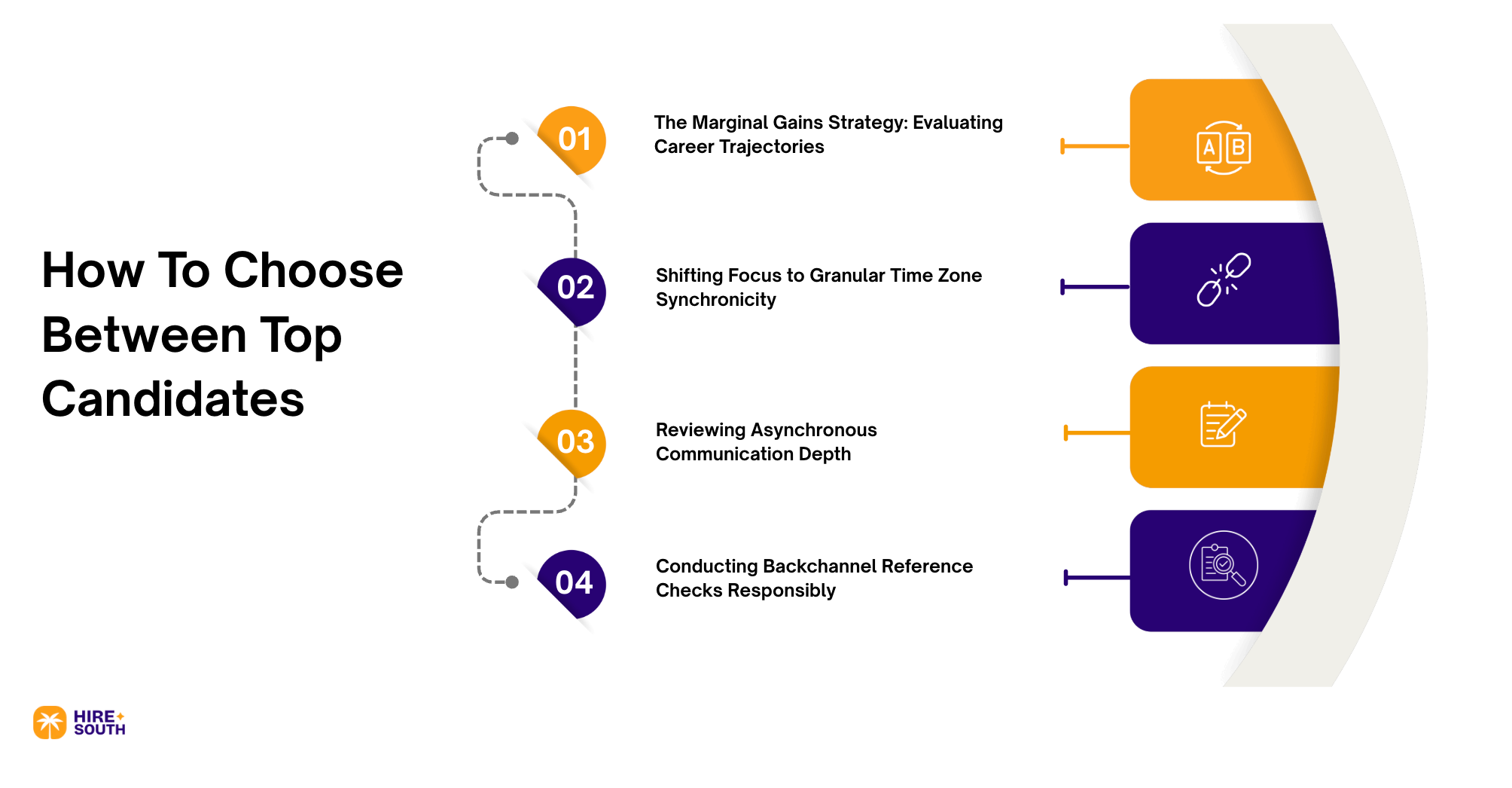
1. The Marginal Gains Strategy: Evaluating Career Trajectories
When core skills are a complete match, stop looking at what the finalists can do today and start looking at where they are headed. You can break the tie by evaluating their trajectory and professional velocity.
Review how each professional has expanded their skill set over the past twelve to eighteen months. One candidate might master a new framework every year, while the other maintains a stable, unchanged toolkit. In a fast-moving business, the person who shows a higher rate of continuous learning will almost always deliver better long-term returns.
2. Shifting Focus to Granular Time Zone Synchronicity
Operating a remote team requires smooth collaboration, making time zones a major asset when hiring in Latin America. While the entire region aligns generally with US business hours, subtle differences matter when breaking a tie.
If your engineering team operates primarily on Pacific Time, a finalist based in Guadalajara, Mexico, offers a distinct operational advantage over an equally qualified candidate located in Buenos Aires, Argentina. According to Remotive's remote work trend analyses, working across highly misaligned time zones causes persistent collaboration friction for 14% of distributed team members. Opting for the candidate who shares your exact core working hours ensures easier synchronous communication and fewer delayed project handoffs.
3. Reviewing Asynchronous Communication Depth
In a distributed environment, clear writing is a core performance metric. Go back and review the text communication your candidates sent throughout the recruitment process.
Look closely at their emails, their responses to scheduling requests, and how they structured their written answers in technical assessments. The professional who writes concisely, structures their thoughts with clear bullet points, and proactively updates you on their availability shows superior asynchronous communication skills. This ability is critical for remote documentation, reducing the need for constant, time-consuming meetings.
4. Conducting Backchannel Reference Checks Responsibly
Traditional references can sometimes feel scripted, but responsible backchannel checks offer a clearer picture. Leverage your professional network on LinkedIn to find mutual connections who have worked with your finalists in the past.
Reach out to former peers or managers in regional tech hubs such as São Paulo or Bogotá to ask about the candidate's work ethic and ability to execute quickly under pressure. This extra layer of verification provides real-world context that helps you see past a polished interview performance, ensuring your choice is grounded in consistent, proven history.
Ready to Hire Top Talent in Latin America?
Making the final call between two or three exceptional LATAM candidates shouldn't come down to guesswork. While technical skills and surface-level qualifications get talent through the door, building an elite nearshore team requires a systematic evaluation of cultural alignment, time zone synergy, and long-term trajectory.
At Hire South, we eliminate the friction and uncertainty of international recruitment by providing end-to-end nearshore staffing solutions. Our deep market expertise across Latin America allows us to source, rigorously screen, and deliver a curated shortlist of top-tier, bilingual professionals who align seamlessly with your operational hours and business objectives.
We handle the heavy lifting, including comprehensive technical assessments, English fluency evaluations, and behavioral interviews, saving you weeks of administrative fatigue. Beyond finding the right fit, we manage all cross-border compliance, HR logistics, local labor laws, and onboarding paperwork so your new hire can deliver value from day one. By utilizing our trusted network, you can scale your operations with senior-level talent while reducing localized staffing costs by up to 40%.
Ready to transform your global hiring strategy and secure the region's top professionals? Let us match you with pre-vetted remote talent tailored to your exact needs. Contact us today to schedule your consultation and build your high-performing nearshore team.