


Hiring nearshore talent solves immediate recruitment bottlenecks, but keeping top performers engaged past the honeymoon phase takes a real strategy. If you rely solely on standard outsourcing playbooks, you risk losing the best remote LATAM talent to the next high bidder. The good news is that long-term loyalty is completely achievable when you build the right foundation.
In this article, you will discover practical ways to structure inflation-proof compensation, leverage overlapping time zones for asynchronous balance, map clear career paths, handle compliant local benefits, and create an inclusive remote culture where your LATAM team thrives for years.
Why Standard Retain LATAM Talent Tactics Fail
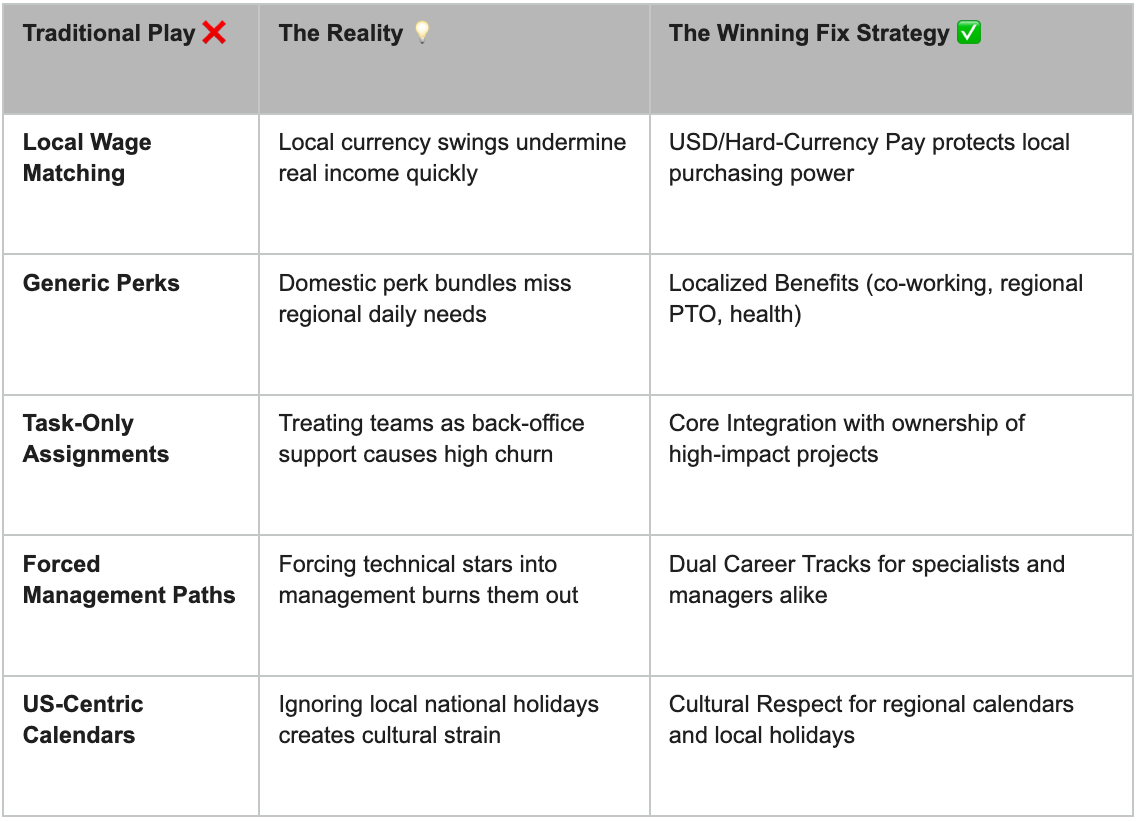
Standard retention tactics like annual bonuses, generic gym perks, and transactional task management fall flat when applied to distributed teams across Latin America. Treating remote LATAM talent like external support staff instead of core team members creates disconnects that push top performers toward competitor offers.
If your strategy relies on copy-pasting domestic HR policies into regional hubs, high churn is practically guaranteed. Traditional approaches miss the cultural nuances, economic factors, and career motives unique to local markets.
Moving Beyond Cost Savings to Build Sustainable Loyalty.
Focusing purely on lower labor costs creates a transactional relationship that damages long-term commitment. When employees feel viewed as a budget line item, they treat their employer as a temporary stopgap.
Companies building stable talent pools shift away from cheap labor optics to offer competitive, long-term career growth. Average U.S. tech turnover sits at roughly 23%, according to LatamCent. Specialized nearshore staffing models retain up to 98% of their teams over two years by offering real integration and stability, according to Howdy.
Understanding the Unique Dynamics of Distributed Workforces Across Latin America.
Latin America is not a single, uniform market. Compensation expectations in high-inflation markets like Argentina look completely different from workforce dynamics in Mexico, Colombia, or Brazil.
Local economic shifts heavily impact what remote LATAM talent values in a contract. Over 40% of the broader regional workforce operates in informal sectors, which creates widespread demand for stable, formal international roles, according to the International Economic Association. Offering legal clarity, stable payouts, and transparent terms helps protect team members from local financial volatility.
Mitigating the Job-Hopping Surge in Global Tech Pools.
Global tech firms aggressively target skilled engineers, product leads, and specialists across regional hubs. Highly qualified talent frequently receives unsolicited outreach with tempting pay bumps in hard currency.
Losing key developers to rival offers happens fast if internal growth paths remain stagnant. Countering constant poaching requires more than reactive salary matching; you need clear skill progression, ownership of high-impact projects, and strong workplace relationships that make leaving a tough decision.
Competitive Compensation and Currency Stability as LATAM Talent Retention Strategies
Compensation remains the primary driver for remote LATAM talent and nearshore high performers. High regional inflation, fluctuating exchange rates, and rising living costs make financial stability a non-negotiable priority for top outsourced hires.
If your pay structures fail to protect local purchasing power, even the most engaged team members will eventually look elsewhere. Integrating stable payouts, aggressive benchmarking, and long-term incentives turns financial strategy into your strongest retention mechanism.
1. Structuring Hard-Currency Compensation to Mitigate Regional Inflation
Local currency volatility creates constant friction for professionals across countries like Argentina, Colombia, and Brazil. Paying remote teams in hard currencies, such as US Dollars or Euros, shields their earnings from sudden local devaluations.
International employers pay Latin American software developers 2.2 times the average local salary rates, according to Arc. Offering USD-denominated payments or indexing local contracts directly to exchange rates gives workers predictable financial security. This simple structural decision immediately lowers flight risk during local economic downturns.
2. Benchmarking Salary Tiers for High-Demand Engineering and Technical Roles
Setting salaries based strictly on local market averages exposes your organization to aggressive headhunting by rival global companies. High-performing tech talent operates in an international marketplace, meaning local wage baselines are quickly becoming obsolete.
Senior developers working remotely for US firms earn a median annual salary of $60,000, compared to $22,350 for domestic employers in Latin America, according to Arc. To stay competitive, you should review compensation bands at least twice a year against global nearshore standards. Keeping pay aligned with international market dynamics ensures your remote LATAM talent stays well above regional averages without pricing your organization out of nearshore advantages.
3. Implementing Equity, RSUs, and Performance-Based Bonuses
Base salary gets talent through the door, but equity and performance incentives keep them committed over the long haul. Many nearshore professionals are traditionally excluded from equity structures, making stock options or Restricted Stock Units (RSUs) a major differentiator.
30% of Latin American workers worry directly about their overall compensation and benefit packages, according to EY. Structuring multi-year vesting schedules for RSUs or offering milestone-based bonuses ties individual career success to overall company performance. When your LATAM team holds a real stake in company outcomes, long-term retention naturally follows.
Building Cultural Alignment and Asynchronous Work Practices to Engage LATAM Talent
Nearshore engagement hinges on how effectively your organization integrates team members into daily workflows. High time zone alignment makes real-time collaboration effortless, but leaning too heavily on synchronous meetings creates exhaustion and stifles focus.
Combining real-time availability with async flexibility builds a modern remote environment where team members feel supported, autonomous, and motivated.
1. Bridging Time Zone Advantages with Asynchronous Communication
Latin America shares up to eight hours of direct working overlap with North American business hubs, according to Tecla. While this proximity enables swift Slack replies and convenient huddles, overusing real-time meetings leads to severe screen fatigue.
62% of remote workers report that time zone compatibility directly improves their daily efficiency, according to Owl Labs. You can maximize this advantage by adopting documentation-first practices. Recording brief video walkthroughs, writing detailed project briefs, and setting clear task handoffs allows your team to maintain deep focus without losing momentum.
2. Fostering Psychological Safety Across Distributed Nearshore Units
Remote professionals often feel hesitant to speak up or challenge decisions if they perceive a cultural gap between headquarters leadership and nearshore nodes. Building psychological safety requires proactive efforts to invite feedback and acknowledge mistakes openly.
65% of an employee's workday is spent collaborating and communicating with colleagues, according to Tecla. Designing structured feedback channels, running regular one-on-ones, and actively soliciting non-US perspectives transforms quiet compliance into genuine initiative and cross-border innovation.
3. Respecting Local Holidays and Regional Cultural Nuances
A major mistake in nearshore management is imposing domestic holiday schedules onto international team members. Latin American countries observe distinct national holidays, labor observances, and cultural traditions that directly affect worker well-being.
For instance, Colombia observes 18 public holidays each year, while Mexico and Brazil feature unique regional observances. Honoring local calendars, encouraging time off for national celebrations, and adjusting sprint deadlines around local holidays signals deep respect for your workforce. This cultural mindfulness builds long-term commitment that monetary compensation alone cannot buy.
Career Mobility and Upskilling: Essential LATAM Talent Retention Practices
1. Career Mobility and Upskilling: Essential LATAM Talent Retention Practices
Ambitious nearshore professionals leave organizations when they hit a ceiling. Providing steady compensation gets your team through onboarding, but long-term talent retention relies heavily on continuous internal growth.
When you offer clear promotion tracks and fund active skill acceleration, your distributed team views your company as a multi-year career partner rather than a short-term freelance contract.
2. Creating Dual Career Tracks for Individual Contributors and Managers
A major structural mistake in remote management is forcing top technical executioners into managerial positions just so they can reach higher salary bands. Not every brilliant software engineer, data scientist, or designer wants to manage people or handle administrative tasks back home. The same goes for remote LATAM talent.
Building parallel progression frameworks allows individual contributors (ICs) to advance into principal, architect, or fellow-level roles with matching pay increases. Simultaneously, employees who excel at cross-functional leadership can pursue traditional management tracks. Offering equal prestige and compensation across both paths eliminates career stagnation and keeps specialist skills sharp within your organization.
3. Offering Learning Stipends, Certifications, and Skill Acceleration
Top nearshore performers actively seek out employers who invest directly in their technical market value. 80% of employers globally recognize that continuous upskilling and reskilling strategies are essential for business success, according to the World Economic Forum.
Providing annual educational stipends for cloud certifications, advanced developer courses, or intensive executive language programs builds immediate operational loyalty. When workers know your organization actively finances their professional evolution, the temptation to jump ship for a slight pay bump drops significantly.
4. Establishing Internal Mobility and Cross-Functional Mentorship Programs
Isolating remote nearshore staff inside single-project silos breeds quiet detachment over time. High performers thrive when given room to solve novel business challenges across different departments and product verticals.
Connecting LATAM professionals with senior executive mentors bridges cross-border communication divides and exposes top talent to broader business logic. Matching individual interests with internal project transfers increases organizational stability; when companies build targeted growth pathways, employee engagement rises by up to 61%, according to Gartner.
Ready to Hire Remote LATAM Talent For a Fraction of The Cost?
Building long-term retention across Latin America comes down to treating your remote workforce as a strategic core asset rather than temporary support. When you align competitive hard-currency compensation with genuine cultural integration and clear career progression, multi-year engagement becomes the natural baseline for your team.
At Hire South, we help growing organizations source, vet, and retain top-tier nearshore talent across engineering, sales, marketing, and operations. By connecting you with bilingual professionals who work in your exact time zone, we streamline your hiring process while cutting operational costs by up to 40% compared to US-based roles. Our end-to-end recruitment framework handles rigorous candidate screening, seamless onboarding, and ongoing payment processing to ensure your LATAM team remains motivated, compliant, and engaged for the long haul.
Ready to scale your business with pre-screened remote talent built to stay? Partner with us today to build your high-performing nearshore team.