


Finding top-tier talent in Latin America is an absolute game-changer for scaling companies, especially with near-perfect time zone alignment and a massive pool of highly skilled professionals. It is a booming market, and US companies have actually increased cross-border hiring in the region by 161% since 2023, according to a recent global talent report by Athyna. But hunting down great candidates is only half the battle.
If your onboarding process feels like a disorganized scramble, your shiny new hires will notice immediately. Navigating international compliance, shipping hardware through complex customs, and managing local payroll cut-offs can get messy fast.
To set your remote team up for long-term success, you need a flawless blueprint. Here is your step-by-step operational guide to nailing the process, protecting your business, and making your new team members feel right at home from day one.
Why a Structured LATAM Onboarding Strategy Matters
When you expand your team into Latin America, hiring great people is only step one. The real test begins the moment they sign the contract. If your internal workflow is a chaotic scramble of missing documents, late laptop deliveries, and radio silence, your new team members will notice. In fact, a study by Paychex found that 74% of employees consider their remote onboarding process to be a total failure.
A weak introduction creates immediate friction, causes early disengagement, and pushes top talent to quietly update their resumes. You cannot treat international hiring like a casual plug-and-play operation. A localized, deeply structured roadmap is what transforms an expensive hiring decision into a highly productive partnership.
Maximizing Early Retention and Minimizing 90-Day Turnover:
The first few weeks dictate exactly how long your new hires will stick around. When professionals feel lost or unsupported during their initial weeks, they start looking for an exit strategy. Data from HiBob indicates that 20% of all new hire turnover happens within the very first 45 days of employment.
When you look at why remote workers leave so quickly, the reasons are incredibly consistent. The vast majority of early departures stem from a massive disconnect between real job expectations and reality, followed closely by a total lack of connection to company culture. A standardized process removes this ambiguity, gives clear direction, and saves you from the massive financial burden of replacing an employee you just spent months sourcing.
Accelerating the Baseline Time-to-Productivity Window:
You aren't just onboarding for compliance, you are onboarding for performance. An unorganized process leaves remote workers waiting for software access, struggling with hardware logistics, and guessing at their core responsibilities. Research from the Brandon Hall Group reveals that organizations with a strong onboarding process improve new hire productivity by over 70%.
When you eliminate systemic bottlenecks, people hit the ground running. They spend less time chasing down administrative approvals and more time focusing on their actual deliverables. Giving your team clear 30-60-90 day benchmarks allows them to understand what success looks like, resulting in a much faster ramp-up period for your business.
Building Deep Cultural Connection in a Disconnected Workspace:
Building a cohesive culture across thousands of miles is notoriously difficult in a fully virtual setup. Without the natural, spontaneous interactions of a physical office, remote hires often feel isolated and excluded. According to a comprehensive employee survey by Enboarder, 42% of fully remote workers report having a truly terrible onboarding experience.
Isolation kills employee engagement. A structured approach intentionally builds the social bridges that software alone cannot fix. By deliberately scheduling virtual team intros, peer buddy systems, and structured context sharing, you create a sense of true alignment. This proactive connection is exactly what transforms a group of scattered independent contractors into a unified global team.
The 10 Key Steps to Onboard LATAM Hires
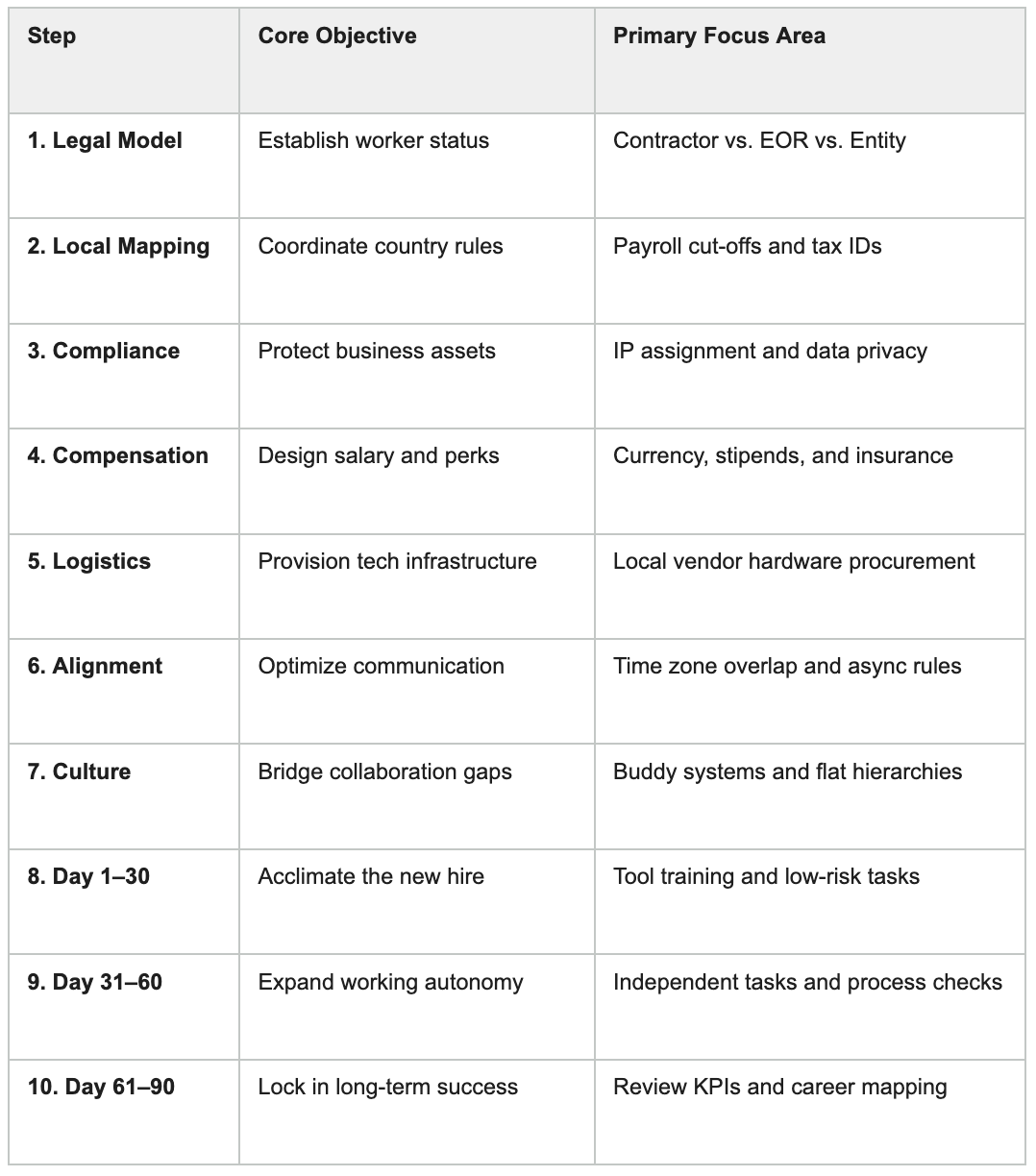
Step 1: Choosing the Right Legal Model for LATAM Talent Onboarding
Before sending out an offer letter, you must establish how this person will legally exist on your payroll. Defaulting to whichever model feels fastest is a recipe for disaster. Governments across the region are actively tightening enforcement on worker status, and misclassification penalties can exceed $100,000 per worker in high-compliance jurisdictions, according to an enterprise recruitment analysis by Athyna. You have to match your corporate structure to your actual risk tolerance.
Hiring international team members as independent contractors offers incredible speed and minimal upfront overhead. However, this path carries severe legal exposure if the role looks, acts, and feels like a permanent job. If a contractor files a claim, you can be forced to retroactively pay years of back-dated benefits, payroll taxes, and statutory fines.
If you want to hire full-time talent without the multi-month headache of setting up a foreign corporate entity, an Employer of Record (EOR) is your safest bet. The EOR acts as the legal employer on the ground, handling localized contracts, complex tax withholdings, and mandatory benefits. It bridges the gap between hiring speed and total regulatory safety.
Step 2: Mapping the Local Onboarding Process Steps by Country
Latin America is not a single, monolithic market. Every country operates on a unique set of labor laws, bureaucratic timelines, and payroll mechanics. Treating a hire in Buenos Aires the exact same way you treat a hire in Mexico City will lead to missed deadlines and immediate compliance violations.
In Brazil, the administrative onboarding tasks must be entirely finalized before strict monthly payroll cut-offs, which usually land between the 13th and 15th of the month. If you miss this window, the local system cannot register the worker in time, delaying their first paycheck.
Furthermore, you need to collect highly specific, government-authorized documentation based on where the worker sits. In Mexico, you must secure their RFC tax ID and CURP identification number. In Brazil, you cannot process payroll without their CPF number. Gathering these exact files during the pre-onboarding phase prevents administrative bottlenecks.
Step 3: Mastering Compliance and Legal Protections for Steps to Onboard LATAM Hires
Protecting your company’s intellectual property and data security requires a proactive approach that extends far beyond your standard domestic onboarding checklists. When data crosses international borders, enforcement mechanisms change completely.
Your standard US proprietary information and inventions agreement holds very little weight in a Latin American courtroom. To truly protect your source code, your contracts must include specific IP assignment clauses that are fully enforceable under the local civil code of the worker's country.
Data privacy enforcement is also expanding rapidly throughout the region. Brazil's LGPD regulations mirror Europe's strict rules, carrying heavy fines for non-compliance that can run up to 2% of a company's Brazilian-segment revenue, according to data privacy guidelines published by Remote People. Your onboarding sequence must train new hires on localized data security and secure file transfer protocols from day one.
Step 4: Structuring Compensation and Benefits for Onboarding LATAM Hires
Attracting and retaining elite talent in Latin America requires a balanced compensation strategy. While the region offers significant cost efficiencies compared to US tech hubs, top-tier professionals expect localized perks that safeguard their purchasing power.
Hiring nearshore professionals allows you to access incredible expertise while optimizing your operational budget. Nearshore software development in Latin America cuts engineering costs by 40% to 65% while giving companies access to millions of skilled professionals.
Basic public healthcare is standard across Latin America, but elite professionals expect private, top-tier medical insurance coverage. If you are hiring contractors, you can differentiate your offers by providing stipends specifically earmarked for private international health insurance policies. For full-time employees managed through an EOR, ensure you select a premium benefits tier that includes comprehensive dental, vision, and wellness coverage.
Step 5: Setting Up Technical Infrastructure and Equipment Logistics
A major operational bottleneck when onboarding Latin American talent is getting physical hardware into the hands of your remote workers. International shipping can quickly become a bureaucratic trap if you do not plan.
Shipping a pre-configured corporate laptop from the US into South America is incredibly risky due to high import tariffs and unpredictable customs delays. This can leave your hardware stuck in a customs warehouse for two to three months. If your new hire spends their first three weeks sitting around waiting for a laptop, your time-to-productivity windows will completely collapse.
The most efficient way to equip your nearshore team is to purchase hardware directly inside their home country through a localized tech vendor. Many modern global EOR platforms provide integrated device management services that procure, image, and ship local hardware within 48 to 72 hours. This strategy ensures the machine clears local regulations smoothly.
Step 6: Executing Communication and Time Zone Alignment Strategies
The single greatest operational advantage of building a team in Latin America is the nearshore time zone alignment. Unlike traditional offshore destinations that require massive overnight schedules, LATAM gives you real-time collaboration during your normal business hours.
Teams operating in places like Bogotá, Mexico City, and Buenos Aires share an incredible 6 to 8 hours of business overlap with US time zones, running projects 40% to 60% faster than setups with a 10-hour timezone gap, according to operational industry data. To make the most of this, explicitly define your core collaboration hours.
While real-time collaboration is incredibly valuable, over-relying on live meetings will quickly drain your team's productivity. You must build a highly disciplined culture around asynchronous documentation. Train your new hires to document project requirements, update shared trackers, and record video walkthroughs for non-urgent updates to protect valuable focused deep-work time.
Step 7: Bridging Cultural Gaps in Latam Talent Onboarding
While professional values line up beautifully across the Americas, subtle differences in communication styles and corporate hierarchies can impact how your new hires engage with the rest of the team. Building an inclusive onboarding experience requires an active effort to understand these regional dynamics.
Many Latin American corporate cultures feature a traditional, top-down hierarchy where employees rarely question management decisions openly. If your US company values a flat structure with highly proactive feedback, you must explicitly state this during onboarding. Actively invite your new hires to share their perspectives and ask questions during all-hands meetings.
Isolation is one of the most common reasons remote workers disengage from their jobs. To build a unified company culture, you must intentionally design social spaces within your digital workspace. Pair your new hire with an experienced peer mentor through a "buddy system" to give the employee a safe space to ask casual questions about team dynamics and internal tools.
Step 8: Designing a Customized 30-Day Onboarding Phase
The first month of employment establishes the foundational tone for your new hire's long-term success. Rather than pushing for immediate, high-pressure output, this initial window must be carefully structured around continuous learning, context building, and tool mastery.
Your core operational objective during the first 30 days is to get your new hire fully acclimated to your corporate tech stack, communication channels, and internal documentation hierarchies. Keep their initial task load intentionally light, focusing primarily on low-risk assignments like reviewing legacy codebases or shadowing senior team members.
To keep a distributed employee aligned without micromanagement, build a highly visual, checklist-driven dashboard for their daily tasks. Document exactly which training videos to watch, which colleagues to meet, and what minor system updates to complete. Tracking these early, asynchronous deliverables gives your remote worker a powerful sense of momentum and clarity from day one.
Step 9: Expanding Autonomy and Core Project Ownership by Day 60
The second month marks a pivotal shift from passive learning to active contribution. By day 60, your nearshore professional should have a solid grasp of your team's workflows and should begin taking direct ownership of meaningful business deliverables. This phase tests their real-world application of the training they received.
Gradually scale up the complexity of their assignments, moving them from collaborative team tracking to independent project ownership. Assign them specific, standalone features or key tasks within larger campaign pipelines. This step allows you to evaluate their natural working rhythm and technical problem-solving capabilities.
Use a midpoint review at day 60 to identify and fix any lingering skill or process gaps. If your new hire is struggling with specific software access, internal acronyms, or cross-departmental handoffs, intervene immediately with targeted training modules. Correcting these minor bottlenecks early prevents operational inefficiencies from settling into their permanent working habits.
Step 10: Conducting the 90-Day Alignment Check and Growth Roadmap
The 90-day mark marks the official conclusion of your core onboarding sequence. At this point, your nearshore professional should operate as a fully integrated, highly autonomous contributor who requires no more administrative hand-holding than a domestic employee.
Execute a comprehensive, two-way performance review that measures their actual output against the initial metrics established in their onboarding plan. Evaluate their technical contributions, communication velocity, and cultural integration. Celebrate their early wins openly, and establish clear, highly measurable key performance indicators (KPIs) for the upcoming quarters.
Onboarding doesn't truly end until your new hire sees a viable career progression path within your organization. Top-tier nearshore talent stays where they see room for long-term professional advancement. Use the 90-day check-in to discuss their long-term career aspirations, identify target areas for continuous upskilling, and map out clear professional growth milestones.
Ready to Hire LATAM Talent?
Executing an international onboarding process requires absolute operational precision, but you do not have to build this complex global HR infrastructure from scratch. Navigating local labor codes, managing hardware logistics, and ensuring cross-border tax compliance can easily drain your internal resources. According to an enterprise recruitment report by Athyna, global compliance errors and misclassification traps can expose your business to legal penalties exceeding $100,000 per worker. Managing these moving parts yourself frequently pulls focus away from your actual core business growth.
At Hire South, we remove the friction from international expansion by serving as your end-to-end nearshore talent partner. We actively manage the entire lifecycle of your remote workforce, from sourcing and vetting to long-term onboarding, compliant payroll management, and local benefit execution. Our specialized regional expertise shields your company from legal exposure while ensuring your new team members receive a flawless first-day experience. Let us handle the operational headaches of cross-border HR so you can focus entirely on scaling your team. Contact us to get started today!