


Scaling a team shouldn't feel like a high-stakes gamble with your company’s culture. If you have been searching for a LATAM partner, you already know the draw: incredible talent, shared time zones, and a massive boost to your bottom line. But as the market matures, the challenge shifts from finding talent to vetting the remote recruitment agency that actually understands your specific needs.
The numbers back the move. According to Deel, Latin America remains the fastest-growing region for hiring globally, with countries like Argentina and Colombia seeing a 20% increase in international hires year-over-year. This surge makes your choice of a remote staffing agency more critical than ever, as the difference between a "paper-pusher" and a strategic partner determines whether your new hires stick for the long haul.
At Hire South, we’ve got years of experience connecting Latin American experts with North American businesses. That’s why this article breaks down exactly how to navigate LATAM staffing without the headaches. By the end, you’ll have a clear roadmap to secure a partnership that doesn’t just fill seats, but actually accelerates your growth.
Why Companies Should Prioritize a Latam Partner for 2026
The landscape of global hiring has shifted from "finding the cheapest labor" to "finding the most compatible talent." In 2026, the rush toward LATAM staffing isn't just a trend; it is a response to the friction of traditional offshore models. If you have ever managed a team across a 12-hour time difference, you know the "delayed communication tax" that kills momentum.
A LATAM staffing partner eliminates this. By hiring in regions like Brazil, Mexico, or Colombia, your remote team operates within the same two-to-three-hour window as your North American headquarters. In fact, this synchronous work environment is why Latin America has seen a 50% increase in hiring for specialized technical roles since 2024. Talk about good time zone management!
Nearshoring Provides Real-Time Operational Agility:
When you work with a remote recruitment agency focused on Latin America, you are buying speed. Agile methodologies require constant feedback loops. Waiting 24 hours for a Pull Request review or a creative asset approval is no longer viable in a high-velocity market.
Proximity breeds better integration. Your developers or project managers can join a Zoom call at 2:00 PM EST without needing to work at midnight. This alignment reduces burnout and increases retention, as your international team feels like a core part of the daily conversation rather than an outsourced afterthought.
High English Proficiency and Cultural Alignment:
The "cultural gap" is often an invisible cost in global hiring. However, many Latin American tech hubs have invested heavily in bilingual education and aligned with Western business practices. According to the EF English Proficiency Index, countries like Argentina consistently rank among the highest in the region, making the transition to a remote staffing agency seamless for English-speaking leadership.
You will find that the work culture in LATAM often mirrors the proactive, problem-solving mindset valued in the US. and Canada. This shared professional etiquette means less time spent managing expectations and more time hitting KPIs.
Access to a Massive, Untapped Tech Talent Pool:
The talent shortage in domestic markets hasn't disappeared; it has simply moved. By 2026, the tech talent deficit in the United States is expected to reach 1.2 million unfulfilled roles, according to the US. Bureau of Labor Statistics.
Tapping into a Latam partner gives you access to over 500,000 software developers in Brazil alone. These are not just entry-level workers; they are senior engineers and specialized architects who have been trained in the same stacks you use, from React and Node.js to advanced AI and machine learning frameworks.
Economic Stability Through Currency Arbitrage:
While the primary driver should be quality, the financial logic is undeniable. You can often hire a senior-level professional in LATAM for the cost of a mid-level hire in a "Tier 1" city like San Francisco or New York.
According to Statista, the average salary for a software engineer in Latin America remains roughly 30% to 50% lower than in the US., even when accounting for the "top-tier" talent premiums. This allows you to reinvest those savings back into R&D or marketing, effectively doubling your operational runway without sacrificing the caliber of your output.
How To Define Your Search Parameters
Before you sign a contract with a LATAM staffing partner, you need to pin down exactly what success looks like for your specific workflow. Vague requirements lead to mismatched candidates and wasted interview hours. To avoid the churn that plagues unoptimized hiring, start by auditing your internal gaps.
According to ManpowerGroup, global talent shortages reached a 17-year high recently, with 75% of employers reporting difficulty filling roles. Defining your search parameters ensures you aren't just looking for "a developer," but rather the specific gear that fits your existing machine.
1. Decide Between Project-Based vs. Long-Term Latam Staffing
Are you building a temporary squad to launch an MVP, or are you looking for a core team member who will stay for five years? This choice dictates whether you need a remote recruitment agency (for direct hires) or a remote staffing agency (for staff augmentation).
Staff augmentation is often faster for scaling. According to Grand View Research, the global IT outsourcing market is expected to expand at a compound annual growth rate (CAGR) of 8.0% through 2030, largely driven by companies seeking this flexible "plug-and-play" talent. If you need someone to start within 14 days, your parameters should lean toward agencies with pre-vetted talent benches.
2. Determine Your Ideal Time Zone Overlap
Not all of Latin America sits in the same time zone. While the region is generally aligned with the US., there are nuances.
- Mexico and Central America: Ideal for Central (CST) and Mountain (MST) time zones.
- Colombia and Peru: Perfect for Eastern Standard Time (EST) alignment.
- Brazil and Argentina: Usually 1-2 hours ahead of EST, which can actually give your team a "head start" on the workday.
If your project requires heavy "pair programming" or constant Slack communication, set a minimum of six hours of daily overlap in your search criteria.
3. Establish Your Language and Cultural Thresholds
Don't just ask for "English speakers." Use the Common European Framework of Reference for Languages (CEFR) to set a standard. Most high-growth companies require a B2 (Upper Intermediate) or C1 (Advanced) level for client-facing or leadership roles.
Cultural fit is harder to quantify but just as vital. Decide if your LATAM staffing needs to prioritize a specific work style, such as "high autonomy" for decentralized startups or "structured hierarchy" for established corporate environments. According to HackerRank, developers in Latin American hubs like Chile and Uruguay score high in problem-solving and technical agility, often matching or exceeding North American benchmarks.
4. Formalize Your Technical Stack and Seniority Requirements
Be ruthless with your "must-haves" versus "nice-to-haves." Searching for a "Full Stack Developer" is too broad for a competitive remote recruitment agency to handle efficiently. Instead, define the specific environment:
- Core Stack: e.g., React, Node.js, AWS.
- Years of Experience: 3-5 years (Mid-level) vs. 8+ years (Senior/Lead).
- Soft Skills: Experience with Agile/Scrum, Jira, or asynchronous documentation.
Setting these technical boundaries early prevents "requirement creep" and helps your LATAM partner filter out 90% of the noise before it ever reaches your inbox.
Proven Strategies to Find a Latam Partner That Fits Your Culture
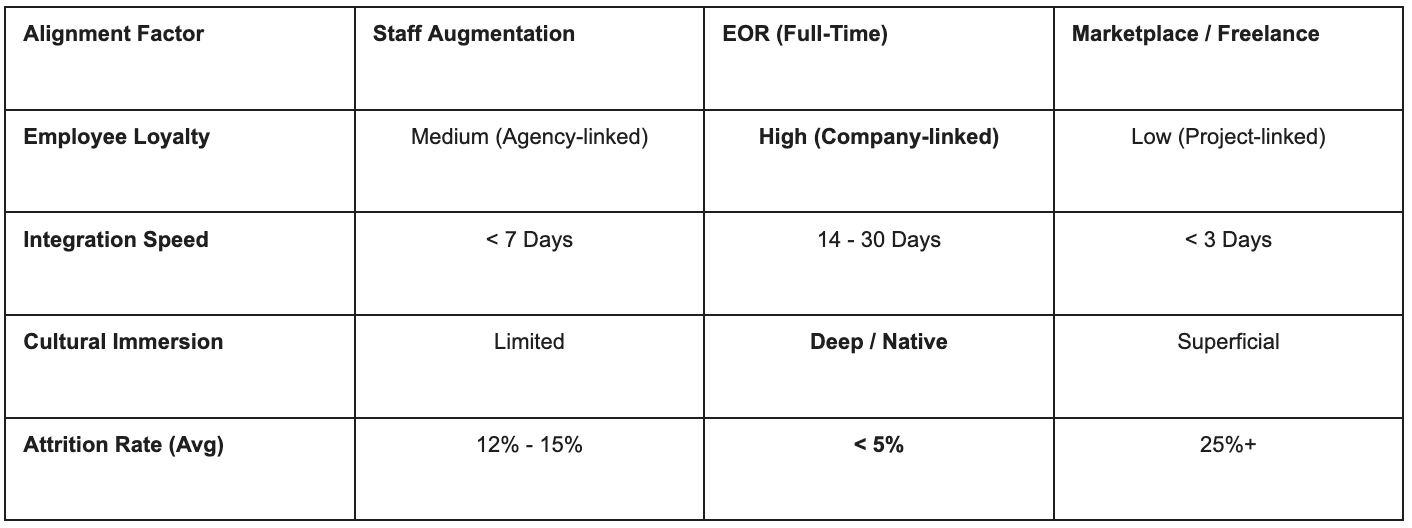
1. Prioritize Relationship-Based Communication Over Transactional Tasks
In many Latin American business hubs, personal rapport is the foundation of professional trust. Unlike the often transactional nature of US business, a Latam partner typically values building a "social landscape" before diving into deep technical execution.
Successful integration often starts with what Harvard Business Review contributors call "fostering connection." This means your remote recruitment agency should help you find talent that values "high-context" communication, where reading between the lines and understanding non-verbal cues is as important as the written ticket. Small gestures, such as dedicating the first five minutes of a Zoom call to personal check-ins, can reduce the "loneliness gap" that affects 25% of fully remote workers, according to Gallup.
2. Assess "Change-Seeking" vs. "Change-Ready" Mindsets
As we move through 2026, being merely "ready" for change isn't enough in an AI-driven market. You need a Latam partner that is "change-seeking." According to the 2025 Global Leadership Development Study by Harvard Business Impact, 40% of senior leaders are now prioritizing cultures that proactively hunt for opportunities and experiment with new tools rather than just reacting to disruption.
When vetting a remote staffing agency, ask how their talent handles "failed pilots" or shifts in strategy. You want a team that feels psychologically safe enough to suggest a better way to use an AI tool or a more efficient workflow, rather than one that waits for top-down instructions.
3. Evaluate Synchronous vs. Asynchronous Work Habits
While the time zone overlap is a major draw for Latam staffing, how a team uses those hours matters most. The region's "polychronic" view of time, where multitasking and relationship-building coexist, can contrast with the "monochronic," punctual approach typical in North American corporate settings.
To find a fit, define your expectations early. Do you need a team that is available for real-time "pair programming," or one that thrives on deep-work blocks with asynchronous updates? According to Mismo, the primary benefit of nearshoring to Latin America is the ability to achieve 6 to 8 hours of daily overlap, which enables the live standups and fast feedback loops that agile teams require.
4. Use "Culture Add" Instead of "Culture Fit"
Avoid the trap of looking for clones of your current team. A great Latam partner brings what many call a "culture add", unique perspectives, and resourceful problem-solving skills born from navigating different economic environments.
According to Virtual Latinos, Latin American professionals are often highly adaptive and creative because necessity has long driven innovation in the region. When you hire through a remote recruitment agency in Mexico or Argentina, you aren't just filling a seat; you are adding a layer of resilience and fresh thinking that can counterbalance a process-heavy domestic team.
Your Roadmap to Secure Latam Staffing
Securing the right LATAM partner requires moving beyond the "post and pray" recruitment method. In 2026, the speed of the market means that if you aren't deliberate with your steps, top-tier talent will be snapped up by competitors within days. According to Mercer, companies that utilize a structured, data-driven onboarding and selection process see 50% higher new-hire retention. You need a repeatable framework that filters for both skill and long-term commitment.
Step 1: Conduct a Localized Salary Benchmark Audit
Don't guess what a Senior Dev in Medellín or a Product Designer in Buenos Aires should earn. Even though LATAM staffing offers significant savings, low-balling the local "top-tier" rate leads to high turnover.
According to PayScale, salary expectations in Latin American tech hubs can fluctuate by 15% to 20% based on US Dollar exchange rate volatility. A professional remote staffing agency will provide you with real-time data on local benefits, such as the "13th-month salary" common in Brazil and Mexico, so your offer is competitive yet cost-effective.
Step 2: Implement a Multi-Stage Technical and Cognitive Shield
Your vetting process must be rigorous enough to filter out "CV padding" but fast enough to maintain candidate interest. Start with an automated technical assessment, followed by a live "whiteboard" session or a brief paid project.
Expertise matters here. According to HackerRank’s 2025 Developer Skills Report, Latin American developers currently rank in the top 10th percentile globally for Python and Java proficiency. Ensure your remote recruitment agency uses peer-to-peer interviewing, where a senior engineer from the agency interviews the candidate to verify they can actually ship code, not just talk about it.
Step 3: Validate Legal Compliance and EOR Infrastructure
The biggest risk in hiring LATAM talent isn't the actual hires, but the paperwork. You must decide if you will hire through a 1099-style contractor agreement or a full Employer of Record (EOR) model.
According to Deloitte, 32% of companies hiring internationally cite "regulatory compliance and tax risk" as their primary concern. To secure your roadmap, verify that your remote staffing agency handles:
- Local tax withholdings and social security contributions.
- Intellectual Property (IP) protection clauses are valid in the candidate's specific country.
- Compliance with local termination laws to avoid "wrongful dismissal" lawsuits.
Step 4: Establish a "Trial Month" Integration Period
Even the best vetting can't simulate the day-to-day reality of your Slack channels and sprint cycles. Set a clear 30-day "Success Roadmap" with your new hire.
This period should include daily syncs and a "buddy system" with a domestic team member. According to Glassdoor, organizations with a strong onboarding process improve new hire productivity by over 70%. If your LATAM partner doesn't support this transition phase with regular check-ins, you are essentially leaving your investment to chance.
Step 5: Finalize Long-Term Growth and Retention Pathways
Talent in Latin America is increasingly looking for "career ladders," not just "gigs." To keep your high-performers, your roadmap must include a plan for professional development.
Whether it is a stipend for English coaching or access to technical certifications, these "soft benefits" are what keep a remote team loyal. According to LinkedIn’s Workforce Learning Report, 94% of employees would stay at a company longer if it invested in their career development. When your remote recruitment agency identifies candidates, ask specifically about their 3-year growth goals to ensure their trajectory matches your company’s evolution.
Ready to Meet Your LATAM Staffing Partner?
Building a distributed team in Latin America is no longer a "hidden gem" strategy; it is a competitive standard for high-growth firms in 2026. The shift toward this region is driven by more than just proximity, as Latin American tech exports have grown by over 15% annually according to Statista, proving that the caliber of work coming out of hubs like Medellín and Buenos Aires matches any global benchmark.
At Hire South, we bridge the gap between ambitious North American companies and the top talent across the LATAM region. We recognize that your biggest hurdle isn't just finding a resume, it's ensuring that your new hire integrates into your workflows without legal friction or cultural silos. Our expertise in LATAM staffing allows you to bypass the typical average time-to-hire and instead secure vetted, high-performing professionals who are ready to contribute on day one. Book a discovery call today to get started!
.jpg)