


Finding skilled engineers to handle complex Tier 2 support is tough, and domestic hiring costs get out of hand quickly. At the same time, offshore setups worldwide often lead to overnight delays, communication breakdowns, and burned-out support leads.
Looking toward Latin America gives you a way around those friction points. According to Revelo, over 2.8 million tech specialists work in LATAM. That massive talent pool lets you build a sharp, synchronous support operations desk that works alongside your core product team without burning through runway.
This guide explains why top tech founders source nearshore Tier 2 engineers. You will learn about real-time timezone alignment, key cost savings, and the specific technical skills LATAM engineers bring to your stack. Keep reading to learn more!
The SaaS Growth Bottleneck: Why Traditional Support Operations Fail
Scaling a B2B SaaS platform requires balancing rapid feature velocity with flawless customer retention. As your active user base expands, the volume and complexity of technical support tickets escalate exponentially.
When an enterprise customer encounters a database synchronization error, an API authentication failure, or a latency spike during peak business hours, a generic Tier 1 customer service representative reading from a pre-written script cannot solve the problem. The issue requires a Tier 2 Technical Support Engineer, a specialist who can read application logs, execute SQL diagnostic queries, trace API endpoints, and reproduce bug environments.
Most early-stage and mid-market SaaS founders make one of two operational mistakes when scaling technical support:
- Forcing Core Tier 3 Engineers onto Support Duty: Pulling senior full-stack developers away from product roadmaps to debug customer tickets destroys sprint momentum, inflates product delivery timelines, and causes severe developer burnout.
- Outsourcing to Traditional Offshore Call Centers: Sourcing offshore support in South Asia or Eastern Europe introduces 10-to-12-hour timezone delays. When an enterprise client hits a critical system bug at 2:00 PM EST, waiting overnight for an offshore team to wake up results in immediate churn.
To solve this dilemma, high-growth SaaS founders are building synchronous, nearshore technical support desks by tapping into the LATAM tech talent pool.
US vs. Nearshore LATAM Compensation Benchmarks for Technical Support
Sourcing Tier 2 technical support engineers within the United States has become financially restrictive. A US-based Tier 2 Support Engineer commands an average annual base salary of $95,000 to $130,000, excluding healthcare, payroll taxes, and benefits overhead.
By building a nearshore support desk through a dedicated LATAM Tech Talent Network, tech founders access experienced software engineers at 50% to 65% lower operational costs.
SaaS Technical Support Salary Comparison (2026 Benchmarks)
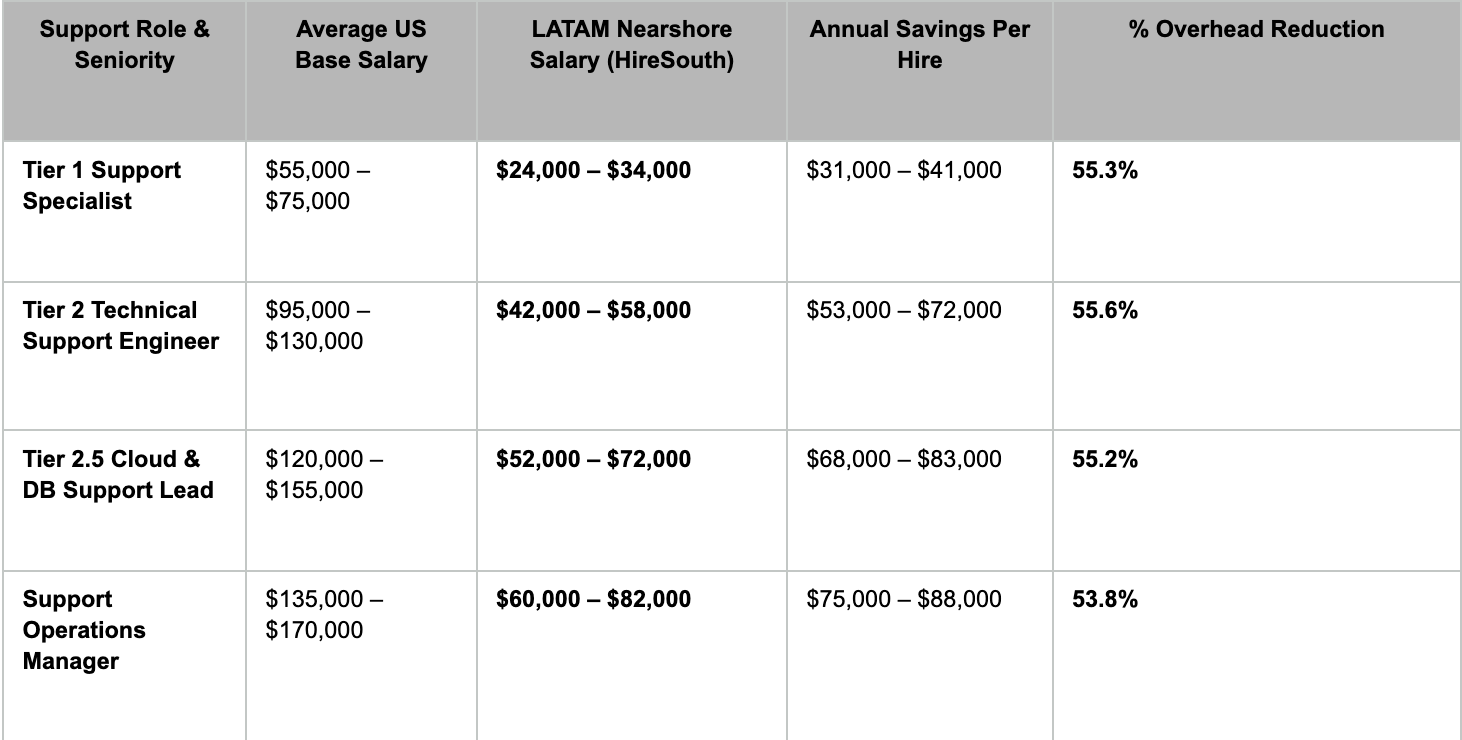
Data sourced directly from Hire South's LATAM Salary Calculator
Why Hire in LATAM for Tier 2 SaaS Support Operations?
1. Delivering Real-Time Customer Resolutions
SaaS platforms live or die by their ability to maintain operational uptime and resolve critical software issues instantly. When a complex bug hits a high-tier client during business hours, waiting a half day for an offshore tech team in an opposing time zone to wake up simply does not work.
Hiring nearshore engineers in Latin America gives your support team direct access to real-time collaboration. Working across identical or adjacent time zones enables Tier 2 agents to join troubleshooting calls on short notice, replicate code failures alongside domestic product managers, and push rapid hotfixes before your customers' workday ends.
Teams maintaining at least four hours of daily working overlap experience 40 percent faster time to market and 19 percent higher overall team satisfaction compared to offshore models with minimal overlap, according to Revelo.
Synchronous work limits the accumulation of open support tickets, stops minor application errors from escalating into expensive churn, and keeps your internal developers from dropping core product work to handle support emergencies.
2. High English Proficiency Across Major Hubs
Complex technical support requires far more than basic script reading. Tier 2 engineers need to break down complicated system architecture bugs, explain database errors clearly, and write precise documentation for your Tier 3 core development squad.
Latin America continues to make massive institutional investments in bilingual education, technical training institutes, and English language programs across its main technology hubs.
- Argentina leads the region in linguistic integration, holding the top regional spot in the EF English Proficiency Index, according to Revelo.
- Software specialists in major hubs like Buenos Aires, Bogotá, and Mexico City work in English-first environments on a daily basis.
- Over 50 percent of the developers in Revelo's network bring three or more years of hands-on experience using industry-standard web frameworks like React and Node.js.
High language fluency combined with deep engineering experience prevents miscommunication during active software incidents. Your Tier 2 agents can safely communicate directly with your clients, draft technical incident reports, and participate in daily agile standups without requiring continuous managerial oversight.
3. Cultural Alignment with North American Startups
Technical execution improves when teams share similar working values, communication habits, and problem-solving styles. Nearshore engineers in Latin America naturally share strong cultural alignment with North American software companies.
Startup professionals across the region operate within flat management structures and sprint-based development models. They are comfortable speaking up when a feature breaks, taking ownership of assigned tickets, and challenging assumptions to solve technical problems faster.
South America leads the world in remote work adaptation, with 81 percent more fully remote companies than the global average, according to TECLA.
This high adaptation to remote environments means nearshore tech talent arrives already fluent in tools like GitHub, and Zoom. They easily adopt your team's workflow, hit the ground running during onboarding, and integrate smoothly into your existing company culture.
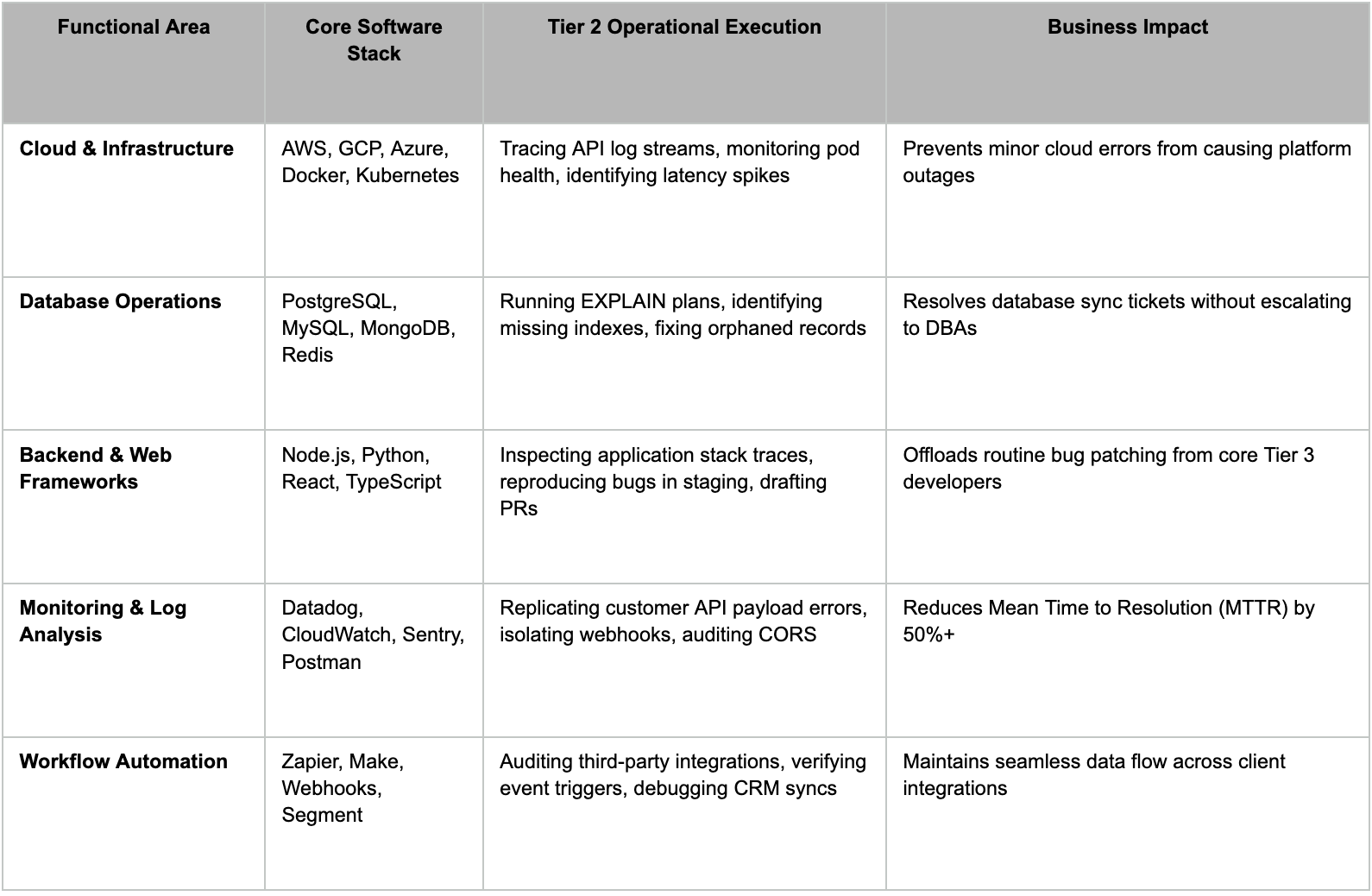
Technical Skill Matrix: What LATAM Tier 2 Support Engineers Bring to Your Stack
When you leverage a specialized LATAM Tech Talent Network, you acquire true software engineering talent capable of operating directly within your production and staging environments.
Nearshore Tier 2 Technical Competency Matrix
Analyzing the Cost Advantages of Latin American Talent Hiring
Comparing Direct Salary Savings:
Scaling a specialized Tier 2 technical support desk locally drains startup capital quickly. Sourcing engineers domestically puts significant pressure on your burn rate, especially when support roles require full-stack debugging and cloud environment skills.
Latin American software specialists provide high-level technical execution at a fraction of North American compensation rates. Hiring LATAM talent yields potential cost savings up to 66 percent over equivalent US roles, according to Hire With Near.
Mid-level software engineers across LATAM command annual salary ranges between $35,000 and $65,000, according to ParallelStaff. In contrast, the median annual salary for software developers in the United States reached $133,080, according to the U.S. Bureau of Labor Statistics.
These direct baseline savings let you expand your support desk capacity without doubling your engineering budget. You can easily bring on two or three experienced nearshore support engineers for the financial investment of a single domestic hire.
Factoring in Reduced Employer Burden:
Base salary metrics only tell part of the financial story. Domestic employment requires additional capital for payroll taxes, health insurance packages, 401(k) matching, legal overhead, and local compliance costs.
In the US, total employee burden typically adds 1.25 to 1.4 times the baseline salary to your annual expenditures. The median weekly earnings for US full-time workers with a bachelor's degree sit at $1,754, according to the U.S. Bureau of Labor Statistics. When factoring in regional benefits and mandatory contributions, keeping support fully onshore grows increasingly inefficient for scaling software companies.
Partnering with nearshore talent networks removes the weight of local administrative and operational overhead.
Nearshore platform fees and complete talent placement packages for senior LATAM engineers range between $65,000 and $130,000 annually, compared to over $200,000 in total compensation for equivalent US engineering roles, according to ParallelStaff.
Reinvesting Saved Capital into Core Growth:
Cost reduction should never be viewed simply as a defensive metric. Strategic founders treat support desk efficiency as a capital reallocation lever to extend runway and accelerate product development.
Lowering your Tier 2 support expenses keeps your core development team hyper-focused on long-term architecture rather than routine bug fixes.
- Saved capital shifts directly into R&D, customer acquisition, or expanded marketing channels.
- Tier 2 support desks run at full operational capacity across US business hours without eating into product engineering budgets.
- Unit economics improve substantially, helping SaaS startups hit critical profitability milestones faster.
Reallocating these funds accelerates product launches, improves overall platform stability, and ensures high-touch customer retention during crucial scaling phases.
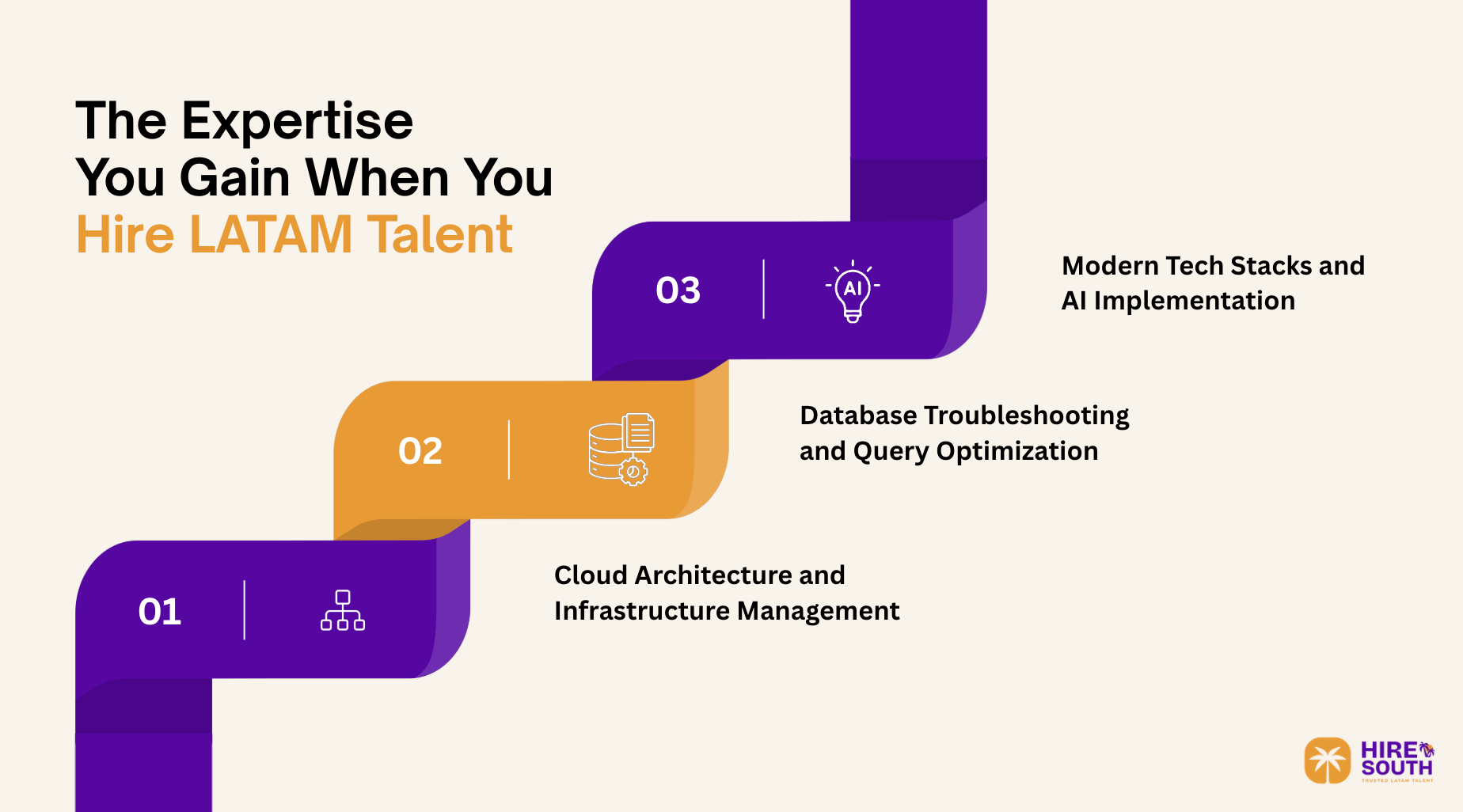
The Expertise You Gain When You Hire LATAM Talent
1. Cloud Architecture and Infrastructure Management
Tier 2 support calls for hands-on experience navigating production backends safely. When a customer encounters persistent latency or permission errors, your support engineers must inspect server logs, trace application calls, and manage cloud resources without breaking live systems.
Latin American software engineers bring extensive expertise in major cloud platforms, including, Microsoft Azure, and Google Cloud Platform.
LATAM software developers display high proficiency in modern backend environments, with JavaScript, TypeScript, Python, and SQL topping the list of most widely used technologies across regional software projects, according to Stack Overflow.
Your nearshore agents can comfortably trace API call failures, inspect container health in Docker or Kubernetes, and patch minor environment misconfigurations. Handing these backend tasks to Tier 2 support protects your core Tier 3 engineering squad from constant operational interruptions.
2. Database Troubleshooting and Query Optimization
Data syncing failures and degraded query performance drive a large percentage of escalated SaaS support tickets. Diagnosing these errors requires specialists who understand relational schemas, indexing strategies, and database isolation levels.
Engineers in Latin America undergo rigorous computer science training that prioritizes relational databases and backend system design.
- Nearshore support agents can safely run complex plans to identify missing indexes causing database bottlenecks.
- Engineers pinpoint orphaned records, reconcile data integrity bugs, and safely test migration scripts in staging environments.
- Support teams isolate client-side data errors before escalating issues to senior database administrators.
Having engineers who safely manipulate staging data environments guarantees customer data remains secure during active troubleshooting. Your Tier 2 support desk acts as a functional filter, resolving complex database tickets on the spot.
3. Modern Tech Stacks and AI Implementation
The software ecosystem evolves at a rapid pace. Modern SaaS products rely on decoupled architectures, microservices, and AI-assisted workflows that demand versatile, tech-forward support talent.
Tech hubs throughout Latin America rapidly adapt to new frameworks, open-source libraries, and emerging developer tooling. Over 80 percent of professional software developers use AI coding assistants to streamline workflows and debug code faster, according to the 2026 LATAM Tech Talent & Cost Benchmark Report.
This widespread adoption of modern tools helps nearshore Tier 2 agents digest complex codebases quickly. They easily analyze automated log streams, leverage diagnostic scripts, and adapt to custom internal tooling.
Your support desk stays fully aligned with your latest stack updates, ensuring high-tier clients receive knowledgeable, expert guidance regardless of how fast your core product features change.
How To Build Your Strategic LATAM Tech Talent Network
1. Sourcing from Established Markets in Brazil and Mexico
Building a strategic talent network starts by tapping into Latin America's largest established technology hubs. Brazil and Mexico anchor the region's software ecosystem, combining deep engineering pools with robust digital infrastructure.
Brazil boasts over 750,000 active software developers, according to Dev.to. The country's primary tech center, São Paulo, hosts significant enterprise operations for global giants like Google, Microsoft, and Amazon.
This dense concentration of enterprise experience means Brazilian developers easily adapt to scalable cloud architectures, complex data engineering, and enterprise security standards.
Mexico presents an equally compelling market, particularly for US companies prioritizing real-time operational sync.
- Mexico hosts over 560,000 software development professionals, according to Dev.to.
- Major Mexican hubs like Guadalajara and Mexico City graduate over 160,000 technical students annually, according to Dev.to.
- Shares direct land borders and identical Central and Mountain time zones with the US, streamlining daily standups.
2. Exploring High-Value Hubs in Colombia and Argentina
Looking beyond the largest regional markets opens access to highly specialized, cost-effective engineering talent. Colombia and Argentina have emerged as premier destinations for sourcing high-tier support engineers.
Colombia has transformed cities like Medellín and Bogotá into vibrant technology centers. The country maintains a growing pool of over 85,000 developers who offer full business-day overlap with Eastern Standard Time.
Argentina stands out for its deep software architecture expertise and strong language capabilities.
Argentine engineers bring exceptional problem-solving skills to complex system debugging. Engaging mid-to-senior LATAM software engineers across these emerging markets typically runs between $55,000 and $105,000 in base salary, according to Revelo. This price range delivers massive savings compared to equivalent US roles while keeping talent retention high.
3. Navigating Legal Compliance and Employer of Record Platforms
Direct international hiring introduces legal risks around foreign tax withholding, local labor laws, and contractor misclassification. Failing to establish compliant legal agreements can lead to severe regulatory penalties.
Using an Employer of Record (EOR) or structured talent network platform simplifies global payroll and legal management.
- The EOR acts as the lawful local employer, issuing contracts that satisfy country-specific labor statutes.
- Platforms manage local benefits administration, mandatory severance funds, and local currency distributions.
- IP assignment agreements remain fully protected under compliant cross-border contracts.
Modern nearshore sourcing networks handle the operational legwork end-to-end. You maintain direct daily management over your Tier 2 support agents, while your partner platform secures legal compliance, manages international benefits, and streamlines global payroll operations.
Frequently Asked Questions About LATAM Tier 2 SaaS Support
Why should tech founders hire LATAM talent for Tier 2 SaaS support instead of offshore talent?
Tech founders hire LATAM talent for Tier 2 support because Latin American engineers operate with 100% US timezone overlap (EST/CST/PST), possess fluent C1/C2 English skills, and deliver real-time synchronous bug resolution, eliminating the 10-to-12-hour communication delays typical of Asian offshore outsourcing.
What technical skills should a Tier 2 LATAM support engineer possess?
A qualified Tier 2 nearshore support engineer should possess hands-on experience in SQL database querying, cloud log analysis (AWS, Datadog, Sentry), REST API debugging, and core programming languages (Node.js, Python, React), allowing them to resolve complex software bugs without escalating to core developers.
How much can a SaaS company save by hiring nearshore LATAM technical support talent?
SaaS companies save between 50% and 65% in payroll overhead by sourcing Tier 2 support engineers in Latin America compared to localized US hires. A US-based Tier 2 support engineer costs $95,000–$130,000 annually, whereas an equivalent senior LATAM engineer through HireSouth costs $42,000–$58,000.
How does HireSouth streamline Latin American talent hiring for tech companies?
HireSouth manages the entire nearshore hiring lifecycle, including technical candidate sourcing, 4-stage technical vetting, transparent salary negotiation, cross-border legal compliance, and global USD payroll - delivering pre-vetted candidate shortlists within 72 hours with zero upfront fees.
Scale and Hire Tier 2 SaaS Support with Hire South
Scaling a Tier 2 SaaS support desk with local hires can drain your runway quickly, while traditional offshore setups introduce friction through overnight delays and communication gaps. Nearshoring bridges this gap by offering high-performing tech talent, complete time zone alignment, and substantial operational savings.
Stop burning out your core product developers on routine support tickets and stop risking customer churn with overnight offshore delays. Partner with Hire South to build a pre-vetted, synchronous Tier 2 technical support squad in Latin America.
- 72-Hour Candidate Shortlist: Receive 2 to 3 pre-vetted, bilingual technical support engineers ready to interview.
- 50% to 65% Cost Savings: Senior technical support expertise at a fraction of localized US salaries.
- 100% US Timezone Alignment: Real-time synchronous standups during EST, CST, and PST working hours.
- Zero Upfront Risk: Backed by our 90-day risk-free replacement guarantee.
👉 Book a free strategy call or explore our talent profiles today!