


Despite the back-to-the-office overload, the days of having no choice but being chained to a cubicle are officially a relic of the past. You have likely heard about remote contract work as yet another option, but what does it actually mean for your career or business's bottom line?
According to the Bureau of Labor Statistics, the US telework rate stabilized at approximately 23% by early 2025, a figure five times higher than pre-pandemic levels. This stability proves that flexible, contract-based arrangements are no longer an emergency measure; they are a standard competitive advantage.
In this guide, you will discover the nuances of the remote work definition and how it differs from traditional employment. We will walk you through the logistics of becoming a remote contractor, from managing your 1099 taxes to finding high-paying roles in a crowded digital market. Whether you are a mid-career professional seeking more autonomy or a business leader looking to tap into global talent, this article provides the roadmap you need to succeed in the modern, distributed economy.
What Is Remote Contract Work?
Remote contract work is a professional arrangement where you provide specific services to a company from a location of your choice, typically your home or a co-working space, without being a permanent employee. Unlike a traditional 9-to-5, this model is defined by a contractual agreement rather than an open-ended employment contract. You are hired to complete a project or fulfill a role for a set period, usually as an independent contractor or "1099" worker.
This setup removes the geographic barriers that used to dictate your career. You aren't just working from home; you are operating as a service provider. According to a 2024 report by MBO Partners, 72% of independent professionals say that being able to work from anywhere is a top priority, a trend that has fundamentally decoupled high-level expertise from physical office addresses.
Why Businesses Hire Remote Contractors
Companies use remote contract work to stay agile. It allows them to "rent" high-level expertise for a specific launch or technical hurdle without the long-term overhead of a full-time hire. This creates a massive opportunity for you to command higher rates if you possess a specialized skill set.
Data from Statista indicates that the number of freelance workers in the US. is expected to reach 90.1 million by 2028, according to their 2024 labor market projections. This growth is driven by businesses shifting toward a "fractional" talent model, where they hire experts for 10 hours a week rather than one generalist for 40.
The Key Aspects of Remote Contract Work
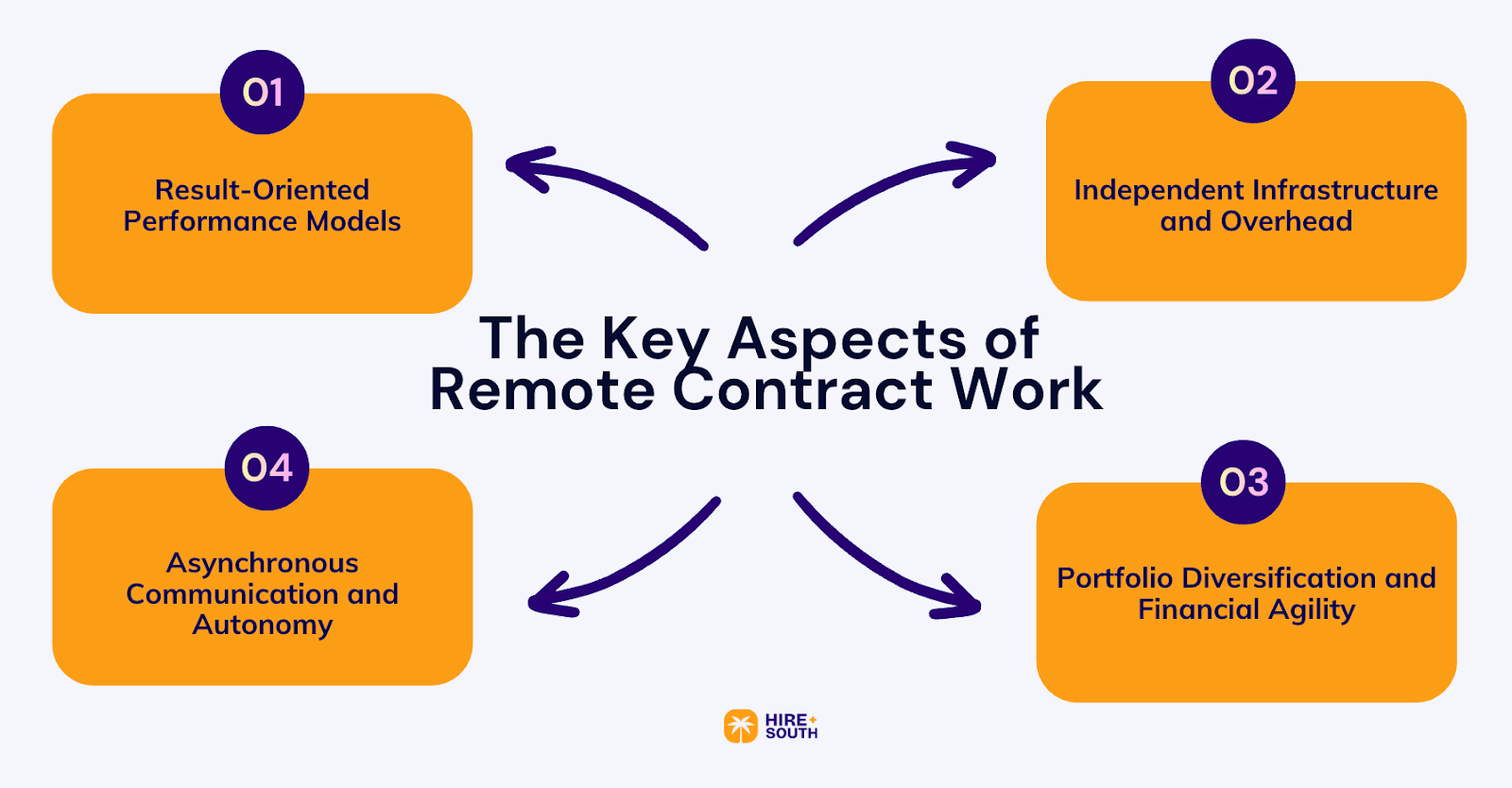
Remote contract work is defined by several core pillars that distinguish it from standard employment. If you are transitioning into this space, understanding these elements is essential for setting your rates and protecting your time. Unlike a salaried role where your presence is often a metric of success, contract work is strictly about defined outputs and self-managed operations.
Result-Oriented Performance Models:
In a remote contract, the "butts-in-seats" mentality is irrelevant. You are judged by your deliverables, not the hours you spend at a desk. According to 2026 workforce data from Splashtop, modern businesses are rapidly replacing traditional time-tracking with outcome-based performance models that prioritize quality and business impact over mere activity.
This shift allows you to work during your peak productivity hours. If you can finish a project in four hours that takes others eight, you reap the reward of extra time without a reduction in pay, provided you aren't billing on a strictly hourly basis.
Independent Infrastructure and Overhead:
One of the most critical aspects of being a remote contractor is that you are the Chief Technology Officer of your own career. You are responsible for providing all necessary equipment, from high-speed internet to specialized software. This is a standard requirement for maintaining your legal status as a contractor rather than an employee.
This responsibility carries a financial weight. According to data from StrongDM, most companies do not reimburse remote contractors for work-related expenses like hardware or utilities. When setting your contract fees, you must account for these overhead costs to ensure your net take-home pay remains competitive.
Asynchronous Communication and Autonomy:
Success in remote contracts often depends on your ability to work async. You will frequently collaborate with teams across different time zones, meaning you won't always have a manager available for immediate questions. According to 2026 trends from HR Oasis, high-performing distributed teams now default to "async-first" practices, relying on recorded updates and threaded discussions rather than live meetings.
This level of autonomy requires high emotional intelligence and self-discipline. You are expected to navigate roadblocks independently, making you a partner to the business rather than a subordinate who needs constant direction.
Portfolio Diversification and Financial Agility:
A major aspect of the contract model is the ability to work for multiple clients simultaneously, a practice often called "polyworking." According to 2025 research from Pumble, approximately 28% of remote professionals admitted to holding additional contract roles or side hustles to diversify their income.
This agility protects you from the "single point of failure" risk associated with traditional employment. If one contract ends, you still have other revenue streams active. However, this requires meticulous time management to ensure that the "Scope of Work" for one client never bleeds into the time dedicated to another.
The Pros and Cons of the Remote Contract Model
Choosing a remote contract career is a high-stakes trade-off. You gain unparalleled professional freedom, but you lose the safety net of traditional employment. Navigating this model successfully requires you to be as much an entrepreneur as you are a specialist. Below are the critical advantages and risks you must weigh to determine if this path aligns with your long-term goals.
1. The Freedom of Absolute Geographic and Schedule Autonomy
The most cited benefit of the remote contract model is the ability to design your life around your work, rather than the other way around. You aren't just saving time on a commute; you are reclaiming a massive portion of your life. According to 2026 data from Remotive, remote workers save an average of 72 minutes per day globally on commuting, time that is often reinvested into personal wellness or family.
Furthermore, 79% of remote professionals reported lower stress levels in 2025, according to Neat, largely due to this increased control over their environment. This autonomy allows you to work during your most productive hours, whether that is at 5:00 AM or midnight, without the artificial constraints of a physical office's operating hours.
2. The Profit Potential of Specialized Skill Arbitrage
As a contractor, your earning ceiling is often much higher than that of a salaried employee. You can work for multiple clients simultaneously, effectively decoupling your income from a single employer’s budget. According to Upwork’s 2025 data, 75% of freelancers earn as much as, or more than, they did when working full-time within just two years of making the switch.
This "pay premium" exists because companies are willing to pay higher hourly rates for specialized talent on demand rather than bear the long-term cost of a full-time salary and benefits package. For high-demand roles like AI specialists or data scientists, this can lead to annual earnings exceeding $200,000 for top-tier independent professionals.
3. The Financial Burden of Benefits and Tax Self-Management
The "con" side of the ledger is dominated by financial complexity. As the employer, you pay both halves of the Social Security and Medicare taxes, known as the self-employment tax. You also lose access to subsidized health insurance, 401(k) matching, and paid leave.
The weight of these missing perks is significant. According to a 2026 report from WifiTalents, 54% of contractors express deep concern over the lack of employer-provided benefits, and 33% specifically struggle with the rising costs of private health insurance. To remain profitable, you must calculate these costs into your "true" hourly rate, often needing to charge 30% to 50% more than an equivalent salaried rate just to break even.
4. Income Volatility and the "Hustle" for Consistency
The biggest psychological hurdle for many is the "feast or famine" cycle. Unlike a salary that hits your bank account every two weeks, contract income can be erratic. According to 2025 research from DemandSage, 66% of contractors cite "finding enough work" as their primary challenge.
Even when work is plentiful, you face the risk of non-payment or late payment. Data shows that 40% of freelancers have experienced non-payment at least once in their career, according to WifiTalents. This necessitates a robust "emergency fund" and a constant marketing effort, even when you are currently busy, to ensure your pipeline doesn't run dry.
How to Find and Secure Remote Contract Roles
Finding a high-quality remote contract isn't just about scouring job boards; it is about positioning yourself where the hidden market lives. In 2026, the strategy has shifted from high-volume applications to precision targeting. Companies now prioritize verified expertise over generalist resumes, seeking professionals who can hit the ground running without an office orientation.
Leveraging Niche and Vetted Talent Marketplaces.
The "post-and-pray" method on massive job boards is becoming a relic. Instead, successful remote contractors are turning to vetted marketplaces that do the pre-screening for the employer. According to 2026 data from FlexJobs, remote job postings in specialized fields like project management, sales, and medical services increased by 30% in late 2025, signaling a move toward domain-specific hiring.
Platforms like Toptal and Wellfound cater specifically to high-growth startups and elite firms. These sites often require skills-based assessments before you can even see the listings. While the barrier to entry is higher, the competition is significantly lower, and the pay scales often reflect a global standard rather than a local one.
Optimizing Your Digital Presence for AI-Driven Recruiting.
If your LinkedIn profile or portfolio isn't optimized for 2026 search standards, you are likely invisible to recruiters. Hiring managers are increasingly using AI-powered tools to source "passive" contract talent. According to Robert Half’s 2026 Demand for Skilled Talent report, 61% of technology leaders are increasing their reliance on contract talent to support critical AI and security initiatives, often sourcing these experts directly through keyword-heavy professional networks.
To rank in these searches, focus your profile on specific outcomes. Use data-backed phrases like "reduced churn by 15% using [Tool]" rather than generic descriptions like "experienced in customer retention." This type of transparency builds immediate trust with AI algorithms and human recruiters alike.
Tapping Into the Unlisted "Hidden" Contract Market.
Many of the most lucrative remote contracts never make it to a public job board. Instead, they are filled through professional referrals and nearshore networking. According to a 2025 study by MBO Partners, nearly 50% of independent professionals find their next project through their existing network or word-of-mouth.
Engaging in digital communities, such as Slack groups for developers, Discord servers for designers, or LinkedIn groups for project managers, is now a core part of the search process. By contributing value to these discussions, you position yourself as an authority before a role even opens. When a company experiences "hybrid creep" or a sudden talent gap, they look to these familiar experts first.
Mastering the Skill of "Fractional" Pitching.
In the current economy, you aren't just looking for a "job," you are offering a solution. A major trend in 2026 is the rise of the "fractional" professional, someone who handles a specific executive or technical function for multiple companies at 10 to 20 hours per week.
According to research from TalentGenics, companies are moving away from full-time headcount in favor of these high-impact, part-time roles to maintain agility. When you pitch yourself, don't ask for employment. Instead, offer a specific "Scope of Work" that solves an immediate pain point, such as "setting up an AI-driven lead gen pipeline" or "managing a 3-month cloud migration." This shifts the conversation from a hiring cost to a strategic investment.
Ready to Get Started With Remote Contract Work?
Remote contract work has evolved from a temporary crisis response into a permanent pillar of the global economy. As you navigate this landscape, success depends on your ability to treat your skills as a scalable business rather than just a remote job. With the US telework rate holding steady at approximately 23% in early 2026, according to the Bureau of Labor Statistics, the competition for top-tier roles is now global, requiring a more strategic approach to how you source and secure projects.
At Hire South, we specialize in bridging the gap between ambitious professionals and the companies that need their expertise. We understand that the "hustle" of finding consistent, high-quality contracts can be the most draining part of the independent model. Our services are designed to eliminate that friction by connecting you with pre-vetted opportunities that value your time and output.
Whether you are looking to diversify your client base or transition into a full-time "fractional" career, we provide the infrastructure and network to help you scale. By partnering with us, you aren't just finding work; you are joining a curated ecosystem built for the future of professional autonomy. Contact us to get started today!


.jpg)