


The days of the standard nine-to-five in a local office are fading, especially if you’re looking at the talent-rich landscape of Latin America. Whether you are a mid-career professional aiming for a US-dollar salary or a business leader looking to scale a distributed team, the "nearshore" boom is officially here.
This shift isn't just a trend, it’s a structural change in how the world works. According to Forbes, the proportion of remote workers in the LATAM region reached 30% by 2023, and that momentum has only accelerated as we head into 2026.
In this guide, you’ll discover the most in-demand career paths that allow you to work from anywhere, from high-level software engineering to the rising field of remote legal support. You’ll also get a breakdown of which countries, like Mexico, Colombia, and Argentina, are currently leading the pack for specific industries.
Ready to see where the best opportunities are hiding? Let’s dive into the top LATAM careers for remote work.
What Things Make a Career Suitable For Remote Work
Not every job translates well to a home office. To find a career that actually works in a distributed model, you need to look for specific structural traits. Careers suitable for remote work generally center on "knowledge capital", tasks that live on a screen rather than in a physical space.
According to Coursera, roles involving writing, data analytics, and digital research are the most natural fits because they don't require specialized onsite equipment. If your daily output is measured by digital deliverables rather than physical presence, you're in the right zone.
1. Independence and Asynchronous Potential
A remote-friendly career allows you to perform high-value tasks without a manager looking over your shoulder. According to Crossover, 96% of employers now prioritize "critical thinking" as the top skill for remote success because it allows professionals to make strong decisions without constant hand-holding.
If a role requires real-time, in-person collaboration (such as surgery or heavy manufacturing), it isn't remote-capable. However, if the collaboration can be managed through a project management tool, it’s a prime candidate. According to the Bureau of Labor Statistics, there is a direct positive relationship between remote work and "total factor productivity" across 61 private-sector industries, largely because independent workers often face fewer office-based distractions.
2. Digital-First Deliverables and Output Metrics
The best remote careers are those where "performance" is easy to track through data. Companies are moving away from "butts-in-seats" metrics. According to Splashtop, a major trend for 2026 is the rise of outcome-based performance models.
In these careers, your value is proven by the code you ship, the leads you generate, or the tickets you close. This transparency protects you; as long as the data shows you’re hitting your KPIs, it doesn’t matter if you’re working from a cafe in Medellín or a home office in Buenos Aires.
3. Low Dependency on Onsite Infrastructure
You can't be a remote lab technician if the 2-million-dollar microscope is bolted to a floor in Chicago. A career is truly remote-suitable when the only "infrastructure" you need is a high-speed internet connection and a laptop.
According to StrongDM, remote jobs now make up more than 15% of all U.S. opportunities, a 3x increase since 2020. This growth is driven by the realization that most professional services, legal, finance, and marketing, can function perfectly using cloud-based security and collaboration frameworks. If your tools are 100% SaaS (Software as a Service), your career is 100% portable.
4. High Demand for Specialized Digital Skills
The more specialized your digital skill set, the more likely a company will offer you remote flexibility to secure your talent. According to Vena Solutions, approximately 34.6 million people in the U.S. teleworked as of late 2025, but this was heavily skewed toward those with advanced degrees.
Specifically, workers with advanced degrees have a telework rate of about 41.2%. If your career requires continuous upskilling in areas like AI integration, cybersecurity, or cloud architecture, you have the leverage to demand a remote or hybrid arrangement.
The Best LATAM Careers For Remote Work
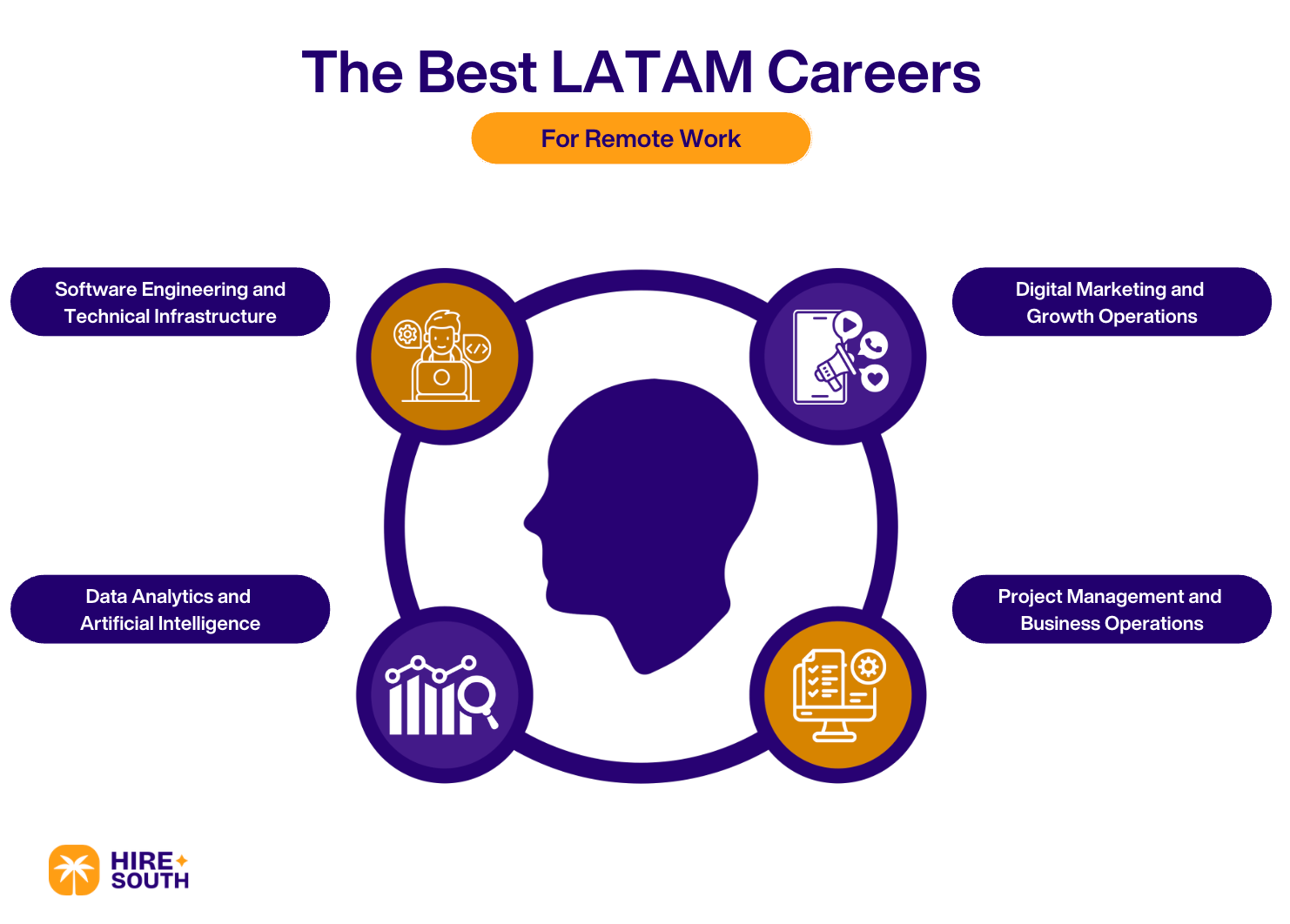
Identifying the right career path in the Latin American market requires a look at where global demand meets regional talent density. In 2026, the "best" roles aren't just about high pay; they are defined by long-term stability and the ability to command a "global" salary while living in a local economy.
According to FlexJobs, IT and computer science, project management, and marketing remain the top three career areas for work-from-anywhere opportunities as of early 2026. If you are looking to pivot or level up, these sectors offer the most frictionless transition to a fully remote lifestyle.
1. Software Engineering and Technical Infrastructure
Technology remains the undisputed heavyweight of remote work. Companies in the U.S. and Europe are aggressively hiring LATAM developers to bridge the talent gap while maintaining real-time collaboration. According to Howdy, the average base salary for a mid-level software engineer in Latin America now ranges between $35,000 and $48,000 USD annually, while senior-level roles involving DevOps or AI can reach up to $80,000 USD.
You don't just need to know how to code; you need to specialize. According to Mismo, developers proficient in "new era" languages like Rust and Go (Golang) are seeing the highest earnings in 2026, averaging around $52,300 USD across the region. This is significantly higher than ubiquitous languages like JavaScript, which have a larger, more competitive talent pool.
2. Data Analytics and Artificial Intelligence
The explosion of generative AI has turned data into the most valuable currency for remote professionals. According to Remote Rocketship, the average salary for a remote data analyst in Latin America has stabilized at approximately $55,887 USD per year as of March 2026.
These roles are highly suited for remote work because the primary tools, SQL, Python, and Power BI, are entirely cloud-based. According to Terminal.io, data scientists and DevOps engineers are currently the highest-paid remote professionals in Mexico, Chile, and Colombia, reflecting a massive regional investment in technical infrastructure.
3. Digital Marketing and Growth Operations
Marketing is no longer just about "branding"; it’s about data-driven growth. For those with a creative yet analytical mind, this is one of the most accessible, high-paying remote paths.
The demand is particularly high for specialized sub-sectors. According to Remote Rocketship, growth marketing managers in LATAM, who combine SEO, A/B testing, and lead generation, are commanding an average of $70,814 USD in 2026. This role is a favorite for remote-first startups that need bilingual experts to manage international campaigns across different time zones.
4. Project Management and Business Operations
As distributed teams grow more complex, the need for "organizational glue" has never been higher. According to several sources, the average salary for a remote Project Manager globally is roughly $82,878 USD, and LATAM professionals are capturing a significant slice of this market due to their cultural alignment with Western business practices.
Operations roles, including HR and recruiting, have also seen a massive surge. According to FlexJobs, remote job postings in administrative and sales categories nearly doubled in the last year. This is a perfect entry point if you have a background in management but want to move away from a technical or coding-heavy career path.
Future Trends: What’s Next for Remote Work in Latin America?
The landscape of LATAM careers for remote work is shifting from a "cost-saving" model to a "strategic-talent" model. By 2026, the region is no longer just an alternative for North American companies; it will have become a primary hub for innovation. As you look toward the end of the decade, several key trends will define whether you thrive or struggle in this borderless market.
The Convergence of Human Talent and AI Augmentation:
The biggest trend for 2026 isn't AI replacing workers, but AI making LATAM talent more competitive than ever. According to Resorsi, a single remote professional in Latin America using advanced AI tools can now produce the same output that previously required two to three U.S.-based employees. This "AI-Augmented" model is driving a massive ROI for companies that pair nearshore talent with automation workflows.
According to a study by the World Bank and the International Labour Organization, between 26% and 38% of jobs in the region are now "exposed" to generative AI. However, only 2% to 5% are at risk of full automation. For the vast majority, AI is an "augmentation" tool. If you can demonstrate "AI fluency", the ability to use tools like Claude, ChatGPT, and GitHub Copilot to accelerate your work, you are positioned for the highest-paying roles in the market.
The Rise of "Value-Based" and Flexible Compensation:
The era of receiving a lower salary just because of your zip code is ending. According to Latam Business School, there is a significant shift toward "Value-Based Compensation" in 2026. Top-tier professionals are moving away from standardized pay scales and toward flexible packages that include USD-pegged salaries, international health insurance, and "modular" benefits like continuous education subsidies.
According to the Mercer 2026 Benefit Strategies Report, companies that offer these flexible, personalized compensation models have seen an 18% reduction in voluntary turnover. For you, this means more leverage. If you have specialized skills in DevOps, Cybersecurity, or Growth Marketing, you can now demand "Global Market Rates" rather than "Local Market Rates."
Nearshoring 2.0: From Outsourcing to Integrated Teams:
We have moved past the "classic" outsourcing, where tasks were sent to a black box. According to Aditi Consulting, the 2026 trend is toward "Integrated Nearshore Teams." Companies are no longer hiring one-off contractors; they are building entire departments in Mexico, Colombia, and Argentina that operate as core parts of their internal structure.
This shift is fueled by what experts call "Friendshoring", the prioritization of hiring in politically and economically allied countries to strengthen supply chains. According to Mismo, the Inter-American Development Bank estimates that this nearshoring acceleration could boost the region’s exports by a staggering $78 billion USD annually by the end of 2026.
Specialization in "Green" and Sustainable Tech Roles:
Sustainability is becoming a core requirement for international investment in the region. According to International Banker, investment capital in 2026 is concentrating heavily on the energy and agroindustry sectors. This is creating a niche for remote professionals who specialize in ESG (Environmental, Social, and Governance) reporting, sustainable supply chain management, and "Green" software engineering.
According to GSMA, there will be over 1.3 billion IoT connections in Latin America by the end of 2025, many dedicated to smart-city and sustainable manufacturing programs. If your career intersects with data and sustainability, you are entering one of the fastest-growing sub-sectors of the LATAM remote job market.
Ready for Nearshoring?
The shift toward Latin American talent is no longer a temporary experiment, it is a foundational pillar of the modern global economy. As companies move away from fragmented outsourcing toward deeply integrated nearshore teams, the demand for high-tier professionals in time-zone-aligned hubs like Colombia, Mexico, and Argentina continues to hit record highs. This creates a massive window of opportunity for both businesses looking to scale and professionals seeking premium remote roles.
At Hire South, we understand that navigating international payroll, cultural nuances, and technical vetting requires more than just a job board. Our team provides the infrastructure you need to build stable, high-performing teams without the administrative headaches. Whether you are looking to hire specialized DevOps engineers or seeking to place your career in front of top-tier U.S. firms, we have the regional experience to make it happen. Contact us to get started!


.jpg)