


You have a vision for your product, but finding the right people to build it shouldn't feel like a hunt for a needle in a haystack. While the domestic talent scramble keeps salaries skyrocketing, more and more technical leaders are looking south. The tech talent in Latin America is no longer a hidden gem but a fully operational powerhouse. From the bustling hubs of Medellín to the high-rise offices of São Paulo, Latin America is producing world-class engineers who work in your time zone and speak your language.
The growth is impossible to ignore. The Latin American IT market is projected to reach $27.5 billion by 2026, according to Revelo. This isn't just about finding cheaper labor. It’s about accessing a massive, highly skilled workforce that integrates seamlessly into your existing workflows.
This article breaks down exactly why you should hire tech talent from the region. We will explore the massive cost savings, the cultural alignment that prevents project friction, and the specific countries leading the charge in software innovation.
Ready to scale without the burnout? Let’s dive into the strategic advantages of building your team in Latin America.
The Latin American Tech Ecosystem
The Latin American tech scene has evolved far beyond its early reputation as a simple outsourcing hub. Today, it is a sophisticated network of innovation driven by massive capital inflows and a maturing startup culture. If you are looking for a region that combines rapid growth with technical stability, this is your primary destination.
Rapid Recovery and Investment Resilience:
While global markets faced a correction in recent years, the Latin American startup ecosystem showed remarkable grit. By 2025, venture capital funding in the region rebounded to $4.1 billion across 681 rounds, representing a 13.8% year-over-year increase, according to Cuantico VP.
This momentum has carried into 2026. In just the first quarter of 2026, startups raised $1.03 billion, marking a 12% surge compared to the previous year, according to Crunchbase data. For you, this means a more stable environment where tech companies are not just surviving, they are scaling.
A Hub for Unicorns and Global Leaders:
The region is currently home to 39 unicorn startups, with valuations exceeding $1 billion, according to Failory. These companies aren't just local players; they are global entities like:
- Nubank (Brazil): A titan in digital banking.
- Rappi (Colombia): A delivery "super-app" valued at $5.25 billion, according to Failory.
- Kavak (Mexico): Revolutionizing the used car market with a $2.2 billion valuation, according to Failory.
The presence of these giants creates a "flywheel effect." They train thousands of engineers in high-scale, high-stakes environments. When you hire from this pool, you are getting talent that has already been battle-tested by some of the most successful startups in the world.
Dominant Sectors Driving Innovation:
If your business operates in specialized fields, the LATAM ecosystem likely has a concentrated pocket of expertise for you. Fintech remains the undisputed heavyweight, capturing 61% of all venture funding in the region, according to the Latin America VC Report 2026.
However, other sectors are catching up fast:
- SaaS: Accounts for 13% of deals, according to Cuantico VP, with companies like Omie leading the charge.
- Artificial Intelligence: AI-related job postings skyrocketed in mid-2025 to 7% of all vacancies, according to the Inter-American Development Bank.
- Digital Infrastructure: Investment in South American AI data centers is projected to reach $1.24 billion in 2026, according to Aerodoc.
Strategic Economic Stability:
The broader economic indicators support this tech-first shift. The region's economy is projected to grow by 2.1% in 2026, according to the Inter-American Development Bank. Governments in countries like Chile, Uruguay, and Colombia have actively prioritized "digitalization" as a core pillar of their GDP growth. This top-down support ensures that the infrastructure, from high-speed fiber optics to favorable tax laws for tech exports, remains a priority for the foreseeable future.
What Differentiates LATAM Tech Talent From Other Places
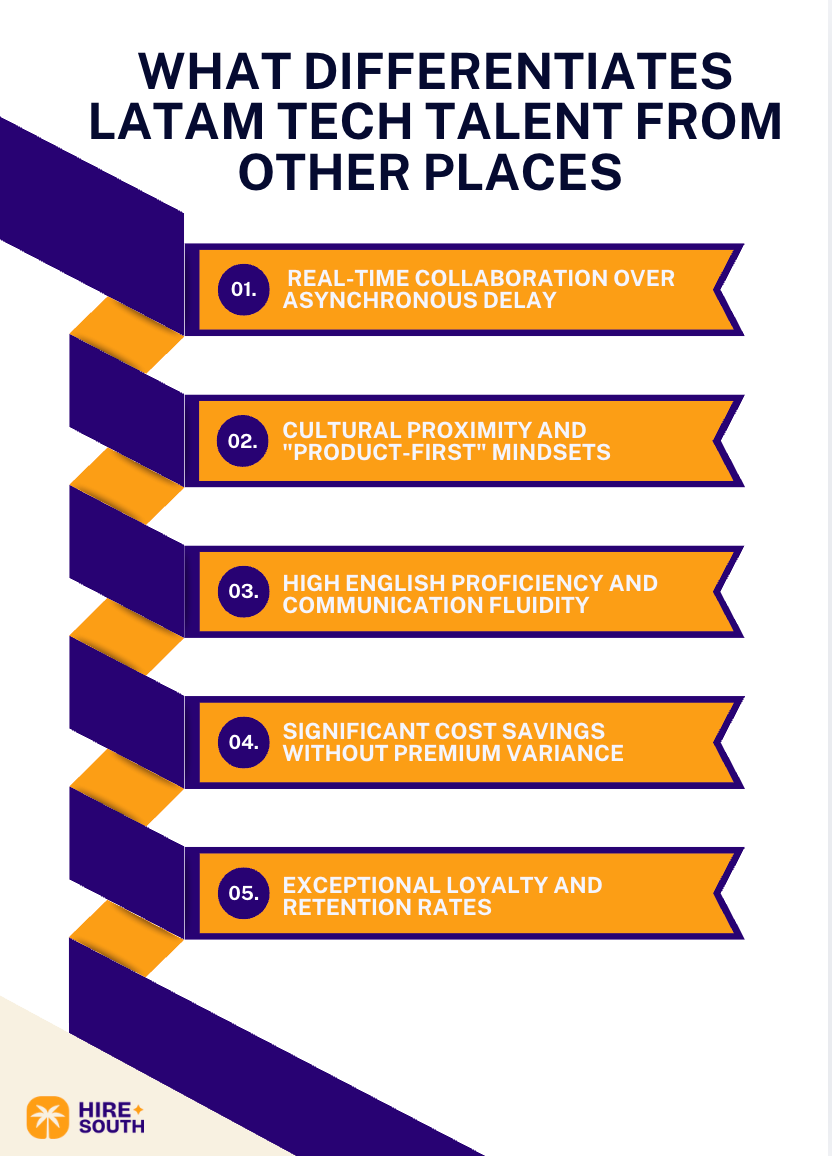
Understanding the nuances of the global labor market is the key to a successful hiring strategy. While Asia has historically dominated for high-volume tasks and Eastern Europe for deep-system engineering, LATAM tech talent is carving out a unique identity centered on high-touch collaboration and product ownership.
1. Real-Time Collaboration Over Asynchronous Delay
The most immediate differentiator you will notice is the lack of "communication lag." Unlike teams in India or the Philippines, where your morning is their midnight, LATAM offers 6 to 8 hours of daily overlap with US business hours. This enables synchronous work, meaning you can have a "quick huddle" without waiting 12 hours for a response. In fact, companies hiring through specialized LATAM agencies can reduce their recruitment cycle to just 3 to 7 days, according to There Is Talent.
2. Cultural Proximity and "Product-First" Mindsets
Developers in Latin America are frequently cited for their "Western" business mindset. While some offshore regions favor a "task-centric" approach, waiting for detailed documentation before starting, LATAM engineers typically lean toward a "product-centric" approach. This means they focus on the end-user experience and rapid iterations. This collaborative spirit is essential for Agile teams where daily brainstorming is the norm.
3. High English Proficiency and Communication Fluidity
Language is more than just vocabulary; it is about context. In Mexico, 92% of HR leaders report that English proficiency is now a standard requirement for global competitiveness, according to the 2026 TOEIC Global English Skills Report. In Brazil, that number is 88%, according to the same source. This high level of bilingualism reduces the friction of complex technical discussions, ensuring your vision isn't lost in translation.
4. Significant Cost Savings Without Premium Variance
While Asia remains the lowest-cost option at $18 to $50 per hour, Latin America offers a superior balance of price and proximity. Hiring senior engineers in LATAM can save you approximately 60% compared to equivalent US-based hires, according to the Nexton 2026 Tech Salary Report. For leadership roles like Engineering Managers, those savings can climb as high as 78%, according to the same report. Unlike Eastern Europe, where senior premiums vary wildly by country, LATAM provides more consistent scaling costs across its primary hubs.
5. Exceptional Loyalty and Retention Rates
High turnover is a silent killer for tech projects. While US voluntary turnover remains high, LATAM talent often demonstrates higher long-term engagement. Outsourcing to the region is linked to 20–21% better retention outcomes, according to Emapta. This stability allows you to build institutional knowledge within your remote team, rather than constantly retraining new hires.
Best Practices to Successfully Hire Tech Talent in the Region
1. Prioritize Compliance and Local Labor Laws
Hiring in LATAM involves a patchwork of different legal systems. In countries like Brazil or Argentina, labor laws are strictly protective of employees. If you hire directly without a local entity, you face significant "permanent establishment" risks.
Using an Employer of Record (EOR) is the standard workaround for international firms. This allows you to hire legally in minutes rather than months. Remember, 73% of companies expanding internationally cite navigating local regulations as their biggest hurdle. Ensuring your contracts include mandatory local benefits, such as the "13th-month" salary common in many LATAM countries, is non-negotiable for building trust.
2. Optimize Your Selection Process for Speed
The competition for LATAM tech talent is fierce. Top-tier engineers often juggle multiple offers simultaneously. If your interview process drags on for four weeks, you will lose the best candidates to more agile competitors.
Aim for a streamlined pipeline:
- Initial screening: Focus on cultural fit and English fluency.
- Technical assessment: Use a short, relevant take-home test or a live coding session.
- Final interview: Connect them with leadership to sell the vision.
Data shows that a "Time to Hire" under 15 days significantly increases your offer acceptance rate in competitive hubs like Medellín or Mexico City.
3. Focus on Long-Term Retention and Career Growth
Retaining talent is just as important as hiring it. While competitive salaries are a baseline, Latin American professionals highly value career development and stability. Investing in your team pays off. Companies that prioritize employee development see a 34% higher retention rate, according to LinkedIn’s 2024 Workplace Learning Report.
Since you are likely managing a remote or hybrid team, you must bridge the distance gap. Offer stipends for co-working spaces, provide high-end hardware, and integrate them into your core team meetings. Treat them as integral stakeholders, not just "remote help."
4. Leverage Data-Driven Salary Benchmarking
Don't guess when it comes to compensation. While you will save money compared to US Silicon Valley rates, underpaying leads to high turnover and poor quality. Salaries vary significantly by city and tech stack. For instance, a Senior DevOps engineer in São Paulo might command a different premium than one in Santiago.
Use real-time data to stay competitive. In 2026, mid-to-senior-level developers in the region expect transparency. Providing a clear salary range in your job description can increase application quality by 30%, according to Greenhouse.
5. Evaluate Cultural and Communication Nuances
While technical skills are measurable, "soft skills" are what keep a project moving. When you hire tech talent in Latin America, look for candidates who exhibit a high degree of "ownership."
Assess their ability to communicate complex ideas in English during the interview. According to the 2026 TOEIC Report, professional-level English proficiency is the single greatest predictor of success for remote LATAM engineers working with US-based firms. Ask behavioral questions that reveal how they handle ambiguity or project pivots.
Conclusion
The strategic shift toward Latin America has become a fundamental pivot in how global companies maintain their competitive edge. With the LATAM IT market projected to reach $27.5 billion by the end of 2026, according to Revelo, the infrastructure for high-scale, remote engineering is more robust than ever before. Building a distributed team requires more than just a job posting. It demands local expertise, legal precision, and a deep understanding of the regional talent landscape.
This is where we, at Hire South, step in. We specialize in connecting forward-thinking businesses with the top 3% of tech professionals across Latin America. So whether you need to bridge a 12-hour communication gap or reduce your development overhead, our team handles the heavy lifting of sourcing, vetting, and compliance. Reach out to us today to start building your high-performance nearshore team!