


Building a high-performing team shouldn't feel like a high-stakes gamble, yet here you are, staring at a mounting backlog and a talent gap that won't close itself. You need more hands on deck. The real question is whether you want to own the deck or just rent the expertise.
Deciding between direct hiring and staff augmentation is the fork in the road for your operational budget. One path offers the deep roots of company culture and long-term loyalty. The other provides the surgical precision of an expert who can start tomorrow and leave the moment the job is done. It is a choice between permanent overhead and agile scaling.
The stakes are higher than you might think. According to Glassdoor, the average employer in the United States spends about $4,000 and 24 days to hire a new worker. When you factor in benefits and training, that "direct hire" investment adds up fast.
This guide breaks down everything you need to know to make the right call. You will explore the mechanics of the staff augmentation model, the long-term ROI of direct hiring, and a side-by-side comparison of costs and security. Whether you are a startup founder or a seasoned corporate executive, you’ll find the roadmap to choose the model that actually fits your timeline.
What is the Direct Hiring Model?
The direct hiring model is the traditional approach to recruitment, where your company brings an individual onto the payroll as a permanent, full-time employee. Unlike temporary setups, you are looking for a "forever" fit. This means the person works directly for you, reports to your internal management, and receives a salary and benefits package directly from your organization.
You take full ownership of the entire lifecycle of the employee. From the initial interview to their fifth work anniversary, the relationship is between your brand and the individual. No middlemen or third-party agencies are managing their day-to-day tasks.
Full Control Over Company Culture and Integration:
When you choose a direct hire, you are investing in someone who will live and breathe your company's mission. They aren't just finishing a sprint; they are building the marathon. This model allows you to mold an employee's professional development to match your specific internal processes.
Because they are permanent, these team members tend to have a higher level of "buy-in." They participate in team-building, understand the nuances of your office politics, and contribute to the long-term institutional memory of the company.
The Financial Reality of the Direct Hiring Model:
Direct hiring is often viewed as a long-term cost-saving measure, even if the upfront investment is steep. You avoid the hourly markups typically charged by staffing agencies. However, the "sticker price" of a salary is only part of the story.
According to the U.S. Bureau of Labor Statistics, benefit costs for private industry workers averaged 29.5% of total compensation in late 2023. This means if you hire a developer for $100,000, you are likely actually spending closer to $130,000 when you factor in health insurance, retirement plans, and paid leave.
Long-Term Accountability and Security:
In this model, your sensitive data and proprietary intellectual property stay within your walls. While legal contracts protect you in any hiring scenario, a direct employee has a vested interest in the company’s stability.
You also gain the advantage of consistent availability. There is no risk of a consultant being pulled off your project because their agency reassigned them. The expertise stays in-house, ensuring that when a system breaks three years from now, the person who built it is still sitting at their desk.
Identifying the Administrative Commitment:
Direct hiring requires a robust HR infrastructure. You are responsible for:
- Withholding payroll taxes and filing government paperwork.
- Conducting annual performance reviews and managing career paths.
- Providing the physical hardware, software licenses, and office space.
- Navigating local labor laws and potential termination legalities.
According to the Society for Human Resource Management (SHRM), the average cost per hire is nearly $4,700, but many employers report that the total cost can be three to four times the position's salary when including soft costs like manager time and lost productivity during the search.
The Mechanics of the Staff Augmentation Model
Staff augmentation functions as an agile extension of your existing team. Instead of outsourcing an entire project to an external vendor, you "borrow" specific talent to work under your direct supervision. You maintain total control over the project's direction while a third-party provider handles the heavy lifting of employment logistics.
Think of it as plugging a high-powered battery into your current machine. The person joins your Slack channels, attends your daily stand-ups, and follows your coding standards. However, they remain employees of the staffing agency, not your company.
Rapid Integration and Onboarding Efficiency:
One of the most powerful mechanics of this model is speed. Traditional hiring is slow. In contrast, staff augmentation providers maintain "bench" talent or vast networks of pre-vetted professionals ready to deploy.
You skip the months of job board postings and technical screening. Because these professionals are used to jumping into different environments, their "time-to-productivity" is significantly shorter than that of a standard hire. They are specialized tools brought in for a specific purpose, whether that is a cloud migration or a front-end overhaul.
Outsourcing the Administrative Burden:
While the augmented staffer works for you, they aren't on your payroll. This distinction is vital for your HR and accounting departments. The staffing provider is the "employer of record," meaning they handle:
- Local and international tax compliance.
- Monthly payroll and specialized benefits.
- Unemployment insurance and workers' compensation.
- Provisioning of certain HR perks.
According to Deloitte’s Global Outsourcing Survey, 57% of organizations use external talent to focus on core business functions by offloading these peripheral administrative tasks. You get the output without the paperwork.
Elastic Scalability: The "Burst" Capacity:
The staff augmentation model operates on a flexible contract basis. This allows you to scale your team size up or down based on your current roadmap. If you have a product launch in six months, you can add five engineers today and roll them off the project once the peak workload subsides.
This elasticity protects your company from the "hire and fire" cycle. According to NerdWallet, the true cost of an employee is often 1.25 to 1.4 times their salary. By using augmentation, you avoid the long-term financial "drag" of a permanent salary once a specific project phase is completed.
Direct Management and Workflow Integration:
Unlike project outsourcing, where you hand over a brief and wait for a finished product, staff augmentation keeps you in the driver's seat. You manage the augmented worker exactly like your full-time staff.
You assign their daily tasks, review their code, and set their priorities. This mechanic ensures there is no "black box" where work is happening without your oversight. It bridges the gap between the need for extra capacity and the desire for total transparency.
Staff Augmentation vs. Direct Contracting: A Comparative Analysis

When you need to fill a seat, the technicality of the contract matters just as much as the talent's resume. While "staff augmentation" and "direct contracting" (hiring an independent 1099 freelancer) might look identical on a daily Zoom call, their legal and operational DNA are worlds apart. Choosing the wrong one can lead to administrative headaches or even legal audits.
1. Liability and Co-Employment Risks
In a staff augmentation setup, the agency acts as a shield. They are the employer of record, meaning they take on the legal risks associated with labor laws. If an augmented worker files a claim, the agency typically handles it.
Direct contracting, however, puts the spotlight on you. You must ensure the contractor meets the strict criteria for "independent" status. According to the Internal Revenue Service (IRS), misclassifying an employee as an independent contractor can result in significant penalties and the payment of back taxes for unpaid Social Security, Medicare, and unemployment insurance.
2. The Speed of Sourcing vs. The Burden of Vetting
With staff augmentation, you are essentially buying a pre-vetted solution. The agency has already conducted the background checks, technical assessments, and reference calls. You just interview the top two or three candidates.
Direct contracting requires you to do the heavy lifting. You write the job post, sift through hundreds of applications on platforms like Upwork or LinkedIn, and run your own technical tests. While you might save on agency markups, you pay for it in "opportunity cost", the time your managers spend recruiting instead of building.
3. Cost Structure: Markups vs. Flat Rates
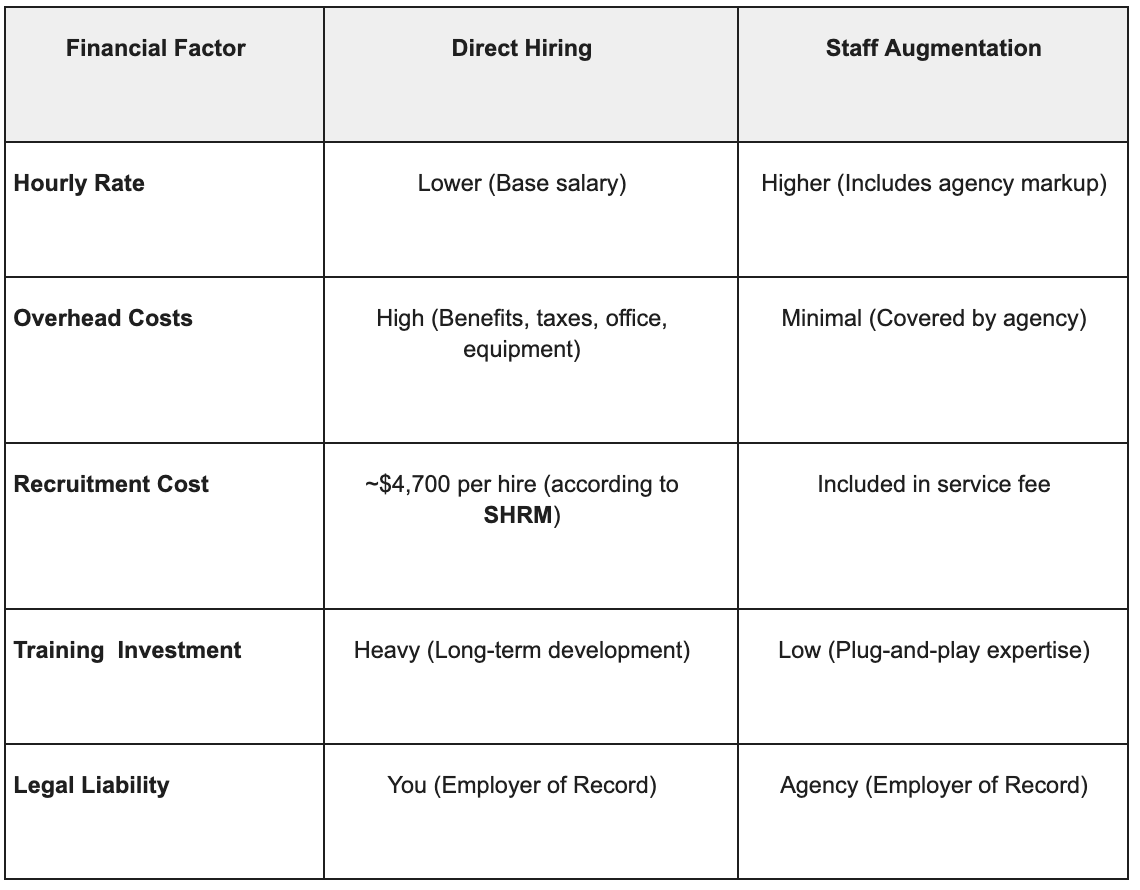
You will notice a price difference immediately. Staff augmentation agencies charge a markup, often 20% to 75% above the worker's take-home pay, to cover their overhead, benefits, and profit.
Direct contractors usually charge a flat hourly or project-based rate. On the surface, this looks cheaper. However, you must factor in the "fragility" of a direct contract. If an independent contractor gets sick or leaves, you are back at square one. A staff augmentation agency is often contractually obligated to provide a replacement within a set timeframe, protecting your project timeline.
4. Intellectual Property and Security Protocols
How do you protect your "secret sauce"? Staff augmentation agreements usually include robust, corporate-level IP transfer clauses and non-disclosure agreements (NDAs) backed by the agency’s professional liability insurance.
When you contract directly with an individual, your protection is only as strong as that single person's ability to pay if things go wrong. According to the Ponemon Institute, the average cost of an insider-related data breach has risen to $16.2 million. Managing security protocols across a dozen independent contractors is a manual, high-risk process compared to the centralized compliance offered by an augmentation partner.
5. Management Overhead and Relationship Longevity
Direct contractors often juggle multiple clients. You are one of many priorities. This can lead to "context switching" that slows down your project.
Augmented staff are typically dedicated 100% to your team for the duration of the contract. This creates a deeper integration into your workflow. While you still manage the "what" and "how" of the work in both models, the augmented professional is structurally positioned to function as a temporary teammate rather than an external service provider.
Which Model Is Best For You?
Choosing between staff augmentation and direct hiring isn't about finding the "superior" method; it’s about matching a model to your current business phase. You have to look at your roadmap, your bank account, and your long-term vision. If you need a specialized skill for a six-month push, a permanent hire is often overkill. If you are building the foundation of your company's proprietary IP, a temporary fix might be a liability.
1. Analyze Your Project Duration and Urgency
Speed is the most common reason you might lean toward one side. In 2026, the hiring landscape is more competitive than ever. According to industry benchmarks from Curriculo ATS, the average time-to-fill for engineering roles is roughly 45 days, while executive-level tech positions can balloon to 120 days.
If your deadline is next month, you don't have 45 days to wait. Staff augmentation allows you to bypass the traditional recruitment lag. However, if your project is open-ended and central to your business, the time spent finding a direct hire pays dividends in the form of consistency and cultural alignment.
2. Calculate the Total Cost of Engagement (TCE)
Don't just look at the hourly rate. You need to consider the "Total Cost of Engagement." According to eSparkBiz, organizations can reduce total hiring costs by 20% to 35% using flexible staffing models compared to full-time hiring when you factor in taxes, office space, and specialized perks.
Direct hiring wins on ROI when the employee stays for years, amortizing the $4,700 average recruitment cost over a long period. But if there is a high risk of turnover, those upfront costs become a sunk loss. Ask yourself: Is this a "keep" or a "lease" situation?
3. Evaluate the Level of Specialized vs. General Knowledge
Are you looking for a "Swiss Army Knife" or a "Laser"?
- Direct Hiring is best for generalists who will grow with the company, learn the nuances of your customer base, and take on multiple roles over time.
- Staff Augmentation is designed for high-end specialists. If you need someone who specifically knows how to migrate a legacy COBOL system to a modern AI-driven cloud environment, you likely only need that person until the migration is finished.
4. Assess Your Management Capacity
You must be honest about how much time you can spend managing people. Direct hiring requires you to handle career development, annual reviews, and conflict resolution. Staff augmentation offloads the "human" administrative side to the agency.
According to Deloitte, 57% of organizations use external talent specifically to focus on core business functions by offloading these peripheral HR tasks. If your management team is already stretched thin, adding five new direct reports might break your internal processes. Augmentation allows you to add "output" without adding "HR overhead."
5. Consider the Future Scalability and Hybrid Options
Many modern leaders no longer choose just one. A hybrid strategy, maintaining a core team of direct hires for "institutional soul" and using staff augmentation for "tactical muscle", is becoming the gold standard.
According to Gallup, as of early 2026, 52% of remote-capable employees work in hybrid environments. This flexibility shouldn't just apply to where people work, but also to how you hire them. You can use augmentation to "test drive" a role before committing to a permanent headcount, giving you a safety net in an unpredictable economy.
Ready to Hire LATAM Talent?
Whether you are expanding your footprint or filling a critical skill gap, the decision between direct hiring and staff augmentation ultimately defines your company’s ability to pivot in a volatile market. As we move through 2026, the data shows that agility is no longer a luxury; according to Gartner, 73% of CIOs now cite talent availability as the primary barrier to adopting the very technologies, like AI and cloud automation, that drive competitive advantage.
At Hire South, we recognize that modern business professionals need more than just extra hands. You need high-impact talent that integrates seamlessly without the traditional friction of local recruitment. Our nearshore solutions bridge the gap by providing access to a pre-vetted network of Latin American professionals who offer full timezone alignment and high English proficiency. By leveraging our expertise, you can secure senior-level talent at up to 40% lower costs than traditional in-house hiring, allowing you to scale your operations while we handle the complexities of payroll, benefits, and international compliance.
Ready to see how the right talent strategy can transform your bottom line? Let us help you build a team that doesn't just fill a role but drives your vision forward.
.jpg)