


The United States faces an acute deficit of over 500,000 cybersecurity professionals, creating severe compliance bottlenecks for SOC 2, ISO 27001, HIPAA, and PCI-DSS audits. Hiring vetted LATAM compliance auditors solves the US cyber shortage by providing audit-ready, C1-fluent security specialists who operate with 100% US timezone overlap (EST/CST/PST) at 40% to 70% lower compensation costs than domestic hires.
We get it, though. Finding qualified compliance talent locally feels like hunting for a needle in a haystack. Unfilled security roles leave your systems vulnerable, and your existing team burned out. You do not have to compete in endless domestic bidding wars to protect your business. Tapping into nearshore talent gives you access to deeply skilled, audit-ready professionals working right in your timezone.
This guide breaks down how nearshore hiring works, why compliance auditors from Latin America are a game-changer, and how you can seamlessly integrate them into your security operations.
Why There’s a Cyber Shortage in the US
Finding qualified cybersecurity compliance talent in the United States has reached a breaking point. Unfilled information security roles leave critical cloud infrastructure exposed to vulnerabilities, while internal engineering teams burn out trying to manually manage audit evidence collection.
According to the latest ISC2 Cybersecurity Workforce Study, the US alone faces a critical deficit of over 522,000 cybersecurity professionals. This acute shortage has created a hyper-competitive domestic market where recruitment timelines for specialized auditors routinely stretch past 90 days, and localized base salaries for senior SOC 2 or ISO compliance leads exceed $180,000 to $220,000 annually.
Attempting to solve this domestic deficit through traditional hiring channels leads to three major bottlenecks:
- Inflated Domestic Compensation: Bidding wars against enterprise tech giants drain security budgets that could otherwise fund advanced endpoint detection and automated monitoring tools.
- Severe Engineer Burnout: Forcing core DevOps and software engineers to handle grueling compliance workflows alongside product development drives voluntary employee attrition rates past 30%.
- Audit Preparation Delays: Unstaffed compliance pipelines result in missed enterprise sales deals, delayed SOC 2 Type II attestations, and increased exposure to regulatory non-compliance penalties.
Why Companies Could Need Vetted LATAM Compliance Auditors
1. Closing the Severe US Cybersecurity Skill Gap
Finding qualified auditors locally has become a losing battle for many organizations. The domestic talent pool simply cannot keep pace with the sheer volume of cyber threats, regulatory changes, and compliance requirements hitting businesses today.
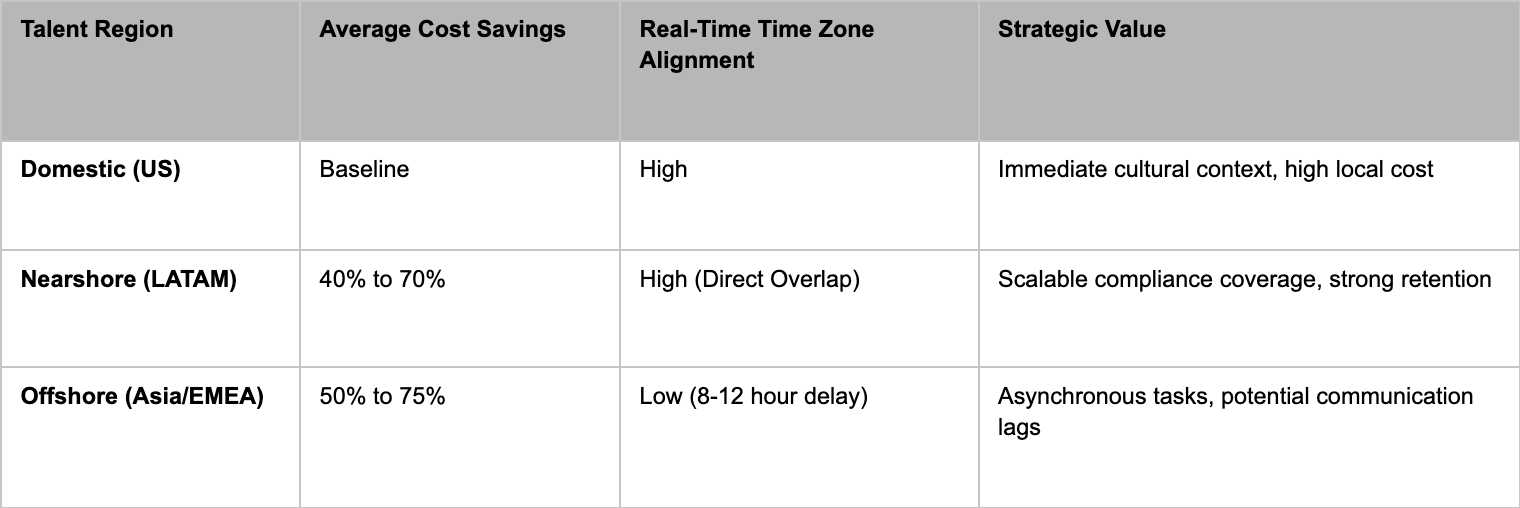
You face an active deficit of roughly 522,000 cybersecurity professionals across the US, according to the ISC2 Cybersecurity Workforce Study. This acute shortage drives up recruitment timelines and inflates localized compensation packages. Turning to nearshore talent allows you to bypass these local hiring bottlenecks entirely.
2. Unlocking Real-Time Collaboration Across Shared Time Zones
Offshore hiring traditionally meant dealing with a twelve-hour time difference that stalled critical projects. When an urgent audit bottleneck occurs, or a data protection emergency flares up, waiting overnight for a response from halfway around the world creates major operational risks.
LATAM compliance professionals operate within standard US time zones. Your team works alongside your auditors during normal operating hours, enabling immediate communication, real-time Slack updates, and frictionless daily standups.
3. Achieving Significant Savings Without Quality Trade-offs
Budget constraints force security teams to stretch every dollar. Attempting to hire senior-level compliance talent in major US metros often drains financial resources that could otherwise fund advanced security infrastructure.
Hiring nearshore remote talent from Latin America can reduce payroll costs by 40% to 70% compared to domestic hires, according to Mismo. You gain high-caliber compliance expertise while freeing up budget for other critical security investments.
4. Maintaining Rapid Readiness for SOC 2, ISO, and HIPAA Audits
Preparing for complex frameworks like SOC 2 Type II, ISO 27001, PCI-DSS, or HIPAA requires relentless oversight, documentation, and technical evidence collection. Internal teams often lack the bandwidth to manage these continuous tasks while keeping core systems running.
Vetted LATAM auditors bring extensive hands-on experience with international security frameworks. They can quickly jump in to design internal controls, conduct mock audits, organize evidence, and resolve compliance gaps well before external auditors arrive.
5. Scaling Security Infrastructure Without Increasing Employee Turnover
Burnout is driving skilled domestic security professionals out of the industry at alarming rates. Forcing your existing engineers to manage grueling compliance tasks alongside their primary responsibilities ruins morale and increases turnover risks.
Remote work options reduce employee quit rates by a full one-third compared to fully on-site arrangements, according to research published in the journal Nature. Bringing in dedicated, nearshore compliance specialists offloads tedious audit workloads, preserves your team's sanity, and creates a much more stable security posture overall.
Why Nearshore LATAM Compliance Staffing Outperforms Domestic & Offshore Models
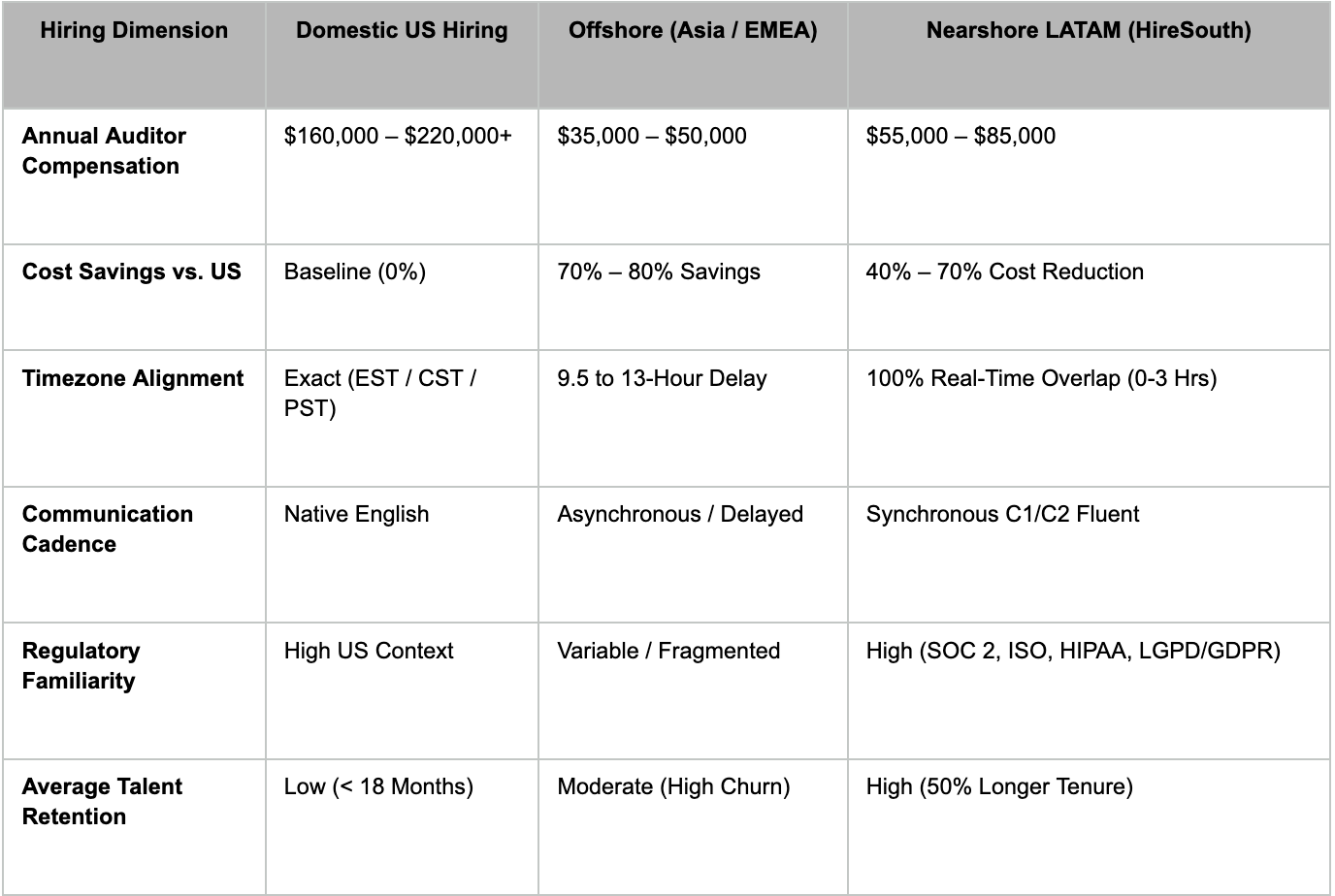
To bypass the domestic talent deficit without taking on the operational friction of traditional offshore outsourcing, forward-thinking CISOs and engineering leaders are leveraging nearshore LATAM cybersecurity staffing.
Nearshore vs. Offshore vs. Domestic Compliance Staffing
Compliance Frameworks Mastered by LATAM Auditors
1. Delivering Rigorous SOC 2 Type I and Type II Audits
Maintaining continuous SOC 2 readiness is essential if you want to close enterprise software deals and assure corporate clients that their data stays secure. Nearshore auditors possess extensive hands-on experience evaluating Trust Services Criteria, including security, availability, processing integrity, confidentiality, and privacy.
Vetted LATAM professionals specialize in setting up automated control monitoring systems, gathering technical evidence, and writing remediation plans. They handle the operational workload of SOC 2 compliance so your lead engineers can focus on product development rather than audit preparation.
2. Operationalizing ISO/IEC 27001 Standards for Global Operations
Achieving and maintaining ISO/IEC 27001 certification signals world-class Information Security Management System (ISMS) hygiene to international partners. Global adoption of ISO 27001 certifications has scaled rapidly, with ISO/IEC 27001 certifications nearly doubling globally to reach 96,709 valid certificates, led by strong regional adoption in Latin America, according to Nearshore Business Solutions.
LATAM compliance specialists excel at building ISMS frameworks tailored to your tech stack. They lead internal risk assessments, draft security policies, conduct gap analyses, and guide your teams through external Stage 1 and Stage 2 certification audits.
3. Protecting Sensitive Health Records Under HIPAA and HITECH
Healthcare providers and healthtech platforms subject to US regulations must enforce stringent administrative, physical, and technical safeguards. A single oversight regarding protected health information (PHI) can result in massive regulatory fines and severe reputational damage.
Nearshore auditors understand the nuances of the HIPAA Security Rule and Privacy Rule. They review Business Associate Agreements (BAAs), evaluate end-to-end encryption protocols across cloud databases, conduct access log reviews, and verify that your systems meet strict US federal data standards.
4. Securing Cardholder Data for PCI-DSS Compliance
Processing credit card payments requires unwavering adherence to Payment Card Industry Data Security Standards (PCI-DSS). LATAM auditors bring deep expertise in mapping data flows, identifying cardholder data environments (CDE), and establishing strict segmented networks.
They help design continuous vulnerability scan schedules, manage external penetration testing logs, and verify that your system architecture satisfies the latest PCI-DSS requirements. This proactive approach keeps your payment gateways active and fully compliant without unexpected operational hiccups.
5. Harmonizing Cross-Border Privacy Frameworks (GDPR, CCPA, and LGPD)
Navigating multiple data privacy laws can get messy when your customer base spans across borders. Nearshore auditors provide specialized value because Latin America’s local regulatory environment closely mirrors international privacy legislation.
Argentina and Uruguay hold official EU Adequacy Status, the European Commission's highest data protection recognition, while Brazil's LGPD aligns directly with GDPR standards, according to Nearshore Business Solutions. Auditors trained in these mature regional frameworks easily adapt to US state regulations like California's CCPA, assisting you with Data Protection Impact Assessments (DPIAs), mapping user consent data, and establishing solid data retention rules.
Steps to Successfully Include LATAM Compliance Auditors Into Your Workflows
1. Defining Clear Governance and Scope During Onboarding
Smooth integration starts well before a remote auditor accesses your compliance management dashboard. You need to establish precise boundaries regarding system permissions, data access thresholds, and project milestones right from day one.
Draft explicit standard operating procedures (SOPs) for continuous monitoring, evidence collection, and vulnerability reporting. Organizations with a structured onboarding process experience up to an 82% improvement in employee retention and significantly higher long-term output, according to research from the Brandon Hall Group. Documenting expected communication cadence early on eliminates ambiguity and keeps your team aligned.
2. Granting Secure Role-Based Access Controls (RBAC)
Security teams cannot compromise on data privacy when adding third-party or nearshore auditors to internal systems. Implementing the Principle of Least Privilege (PoLP) ensures that auditors receive only the access necessary to review logs and verify controls.
Set up dedicated, isolated credentials through your Identity and Access Management (IAM) infrastructure. Use Multi-Factor Authentication (MFA) enforcement, configure conditional access rules, and log all session activity within your Security Information and Event Management (SIEM) dashboard. This keeps your internal network fully secure while empowering auditors to perform thorough reviews.
3. Establishing Real-Time Asynchronous and Synchronous Syncs
Because nearshore LATAM talent shares direct time-zone overlap with US teams, you can integrate auditors into existing daily standups without awkward scheduling gymnastics. Combining regular live meetings with strong asynchronous tools prevents project delays.
Use platforms like Slack or Microsoft Teams for fast daily touchpoints and Jira or Asana for tracking audit ticket status. Assigning clear owners to specific control tasks gives auditors direct channels to request technical evidence from system admins, preventing communication bottlenecks before major audit windows.
4. Aligning Local Compliance Processes with Global Standards
While nearshore compliance auditors bring deep familiarity with international frameworks, internal security cultures vary from company to company. You must align their technical expertise with your specific internal risk tolerance and reporting formats.
Provide comprehensive documentation on your custom tech stack, cloud architecture diagrams, and current policy frameworks during the first two weeks. Fully remote professionals who undergo targeted, structured initial training demonstrate markedly higher productivity and lower attrition rates over time, according to research from Stanford University.
5. Conducting Periodic Performance Reviews and Knowledge Sharing
Integrating remote compliance talent should not be a "set it and forget it" process. Scheduling structured monthly or quarterly feedback loops helps refine operational workflows and identify potential process optimizations.
Encourage ongoing knowledge transfer between your nearshore compliance auditors and domestic engineering teams. Auditors can host internal workshops on upcoming regulatory changes, while engineers can brief auditors on planned code deployments. This bi-directional communication builds long-term operational resilience across your entire organization.
The 5-Stage Onboarding Framework for LATAM Compliance Auditors
Integrating remote nearshore compliance specialists into your security operations requires a structured governance framework. Following a standardized 5-stage onboarding playbook maximizes productivity while maintaining strict data security.
- Stage 1: Scope & SOP Definition: Establish explicit Standard Operating Procedures (SOPs) before granting dashboard access. Research by the Brandon Hall Group demonstrates that structured onboarding improves long-term talent retention by 82%.
- Stage 2: Enforce Role-Based Access Controls (RBAC): Apply the Principle of Least Privilege (PoLP). Issue dedicated, isolated credentials via Okta or Google Workspace, enforce hardware-backed MFA, and restrict cloud console access to read-only auditor roles.
- Stage 3: Establish Synchronous & Asynchronous Communication: Include nearshore auditors in daily 15-minute engineering standups via Zoom and other tools for asynchronous evidence requests and control remediation tracking.
- Stage 4: Align Tech Stack & Architecture Context: Share cloud infrastructure diagrams, network segmentation maps, and CI/CD documentation during weeks 1 and 2 to accelerate contextual understanding.
- Stage 5: Execute Quarterly Reviews & Knowledge Sharing: Conduct quarterly reviews to evaluate audit readiness metrics and host bi-directional workshops where auditors brief developers on upcoming regulatory shifts.
Frequently Asked Questions About Hiring Vetted LATAM Compliance Auditors
How does hiring a LATAM compliance auditor solve the US cyber shortage?
When you hire LATAM compliance auditors, you bypass the 522,000-person US cyber skill deficit by gaining immediate access to C1-fluent, audit-ready security talent in Latin America. LATAM auditors work in standard US time zones (EST/CST/PST) and reduce payroll costs by 40% to 70% without sacrificing quality.
What cloud compliance automation platforms do LATAM auditors support?
LATAM compliance auditors possess extensive experience operating modern compliance automation platforms, including Vanta, Drata, Secureframe, as well as native cloud security tools in AWS, Google Cloud, and Microsoft Azure.
How do companies maintain data security when working with remote nearshore auditors?
Companies maintain security by enforcing the Principle of Least Privilege (PoLP), deploying Role-Based Access Control (RBAC), requiring Multi-Factor Authentication (MFA), issuing encrypted company laptops via global device management, and restricting auditor permissions to read-only access within cloud environments.
What is the average time-to-hire for a LATAM compliance auditor through HireSouth?
Through HireSouth’s specialized LATAM cybersecurity staffing pipeline, companies can review a curated shortlist of pre-vetted, bilingual compliance auditors within 72 hours to 5 business days, completing the entire hiring loop in under 14 days.
Hire Vetted LATAM Compliance Auditors And Secure Your Pipeline
Bridging the US cybersecurity workforce deficit requires thinking beyond traditional domestic hiring models. Sourcing nearshore compliance specialists protects your bottom line while keeping your security framework audit-ready and operating in real-time.
At Hire South, we connect US businesses with fully vetted, bilingual compliance auditors and IT specialists across Latin America. Our founder-led, transparent placement process matches you with top nearshore talent in as little as 10 days, cutting operational overhead by up to 40% to 70% compared to domestic hires, all backed by a 90-day replacement guarantee.
Ready to secure your compliance pipeline with zero hiring headaches? Book a call with our team at Hire South today to receive your curated candidate shortlist!