


Managing nearshore teams across Latin America offers a massive strategic advantage: six to eight hours of direct daily time-zone overlap with North American business hours. However, enterprise leaders often struggle to balance output-driven performance tracking with employee trust.
According to remote work performance research by Stanford University, companies that transition from invasive micromanagement to clear, output-focused workflows experience up to a 13% increase in employee productivity. This comprehensive guide breaks down the essential management frameworks, modern tracking stacks, cultural integration tactics, and long-term retention strategies needed to maximize LATAM team performance in 2026.
Whether you are scaling a dedicated software development squad or managing a remote operations team, the right operational playbook transforms distributed talent into your company's greatest growth engine. Read on to discover how smart U.S. businesses manage and track remote LATAM professionals while fostering a culture of high trust and peak output.
What Does Productivity Mean in a Remote Team?
1. Outcome-Based Execution Over Active Screen Time
Productivity in a distributed environment centers strictly on tangible business results, not the number of hours someone sits at a desk. Tracking mouse clicks or activity indicators gives you a false sense of security while actively frustrating high-performing employees. According to remote work research by Stanford University economist Nicholas Bloom, companies that prioritize autonomous, output-focused workflows experience a 13% performance increase compared to traditional office environments. You measure success by code deployed, tickets closed, campaigns launched, and revenue generated, ensuring your Latin American talent focuses on high-value business outcomes.
2. Asynchronous Velocity and Direct Time Zone Overlap
True remote productivity means your team advances projects continuously without hitting approval bottlenecks. Working with Latin American teams gives you six to eight hours of direct daily overlap across U.S. Eastern, Central, and Pacific time zones. This geographic proximity allows your engineers and operations leads to resolve blockers in real time during shared working hours, eliminating the 24-hour review-and-rework loops typical of traditional offshore models in Asia or Eastern Europe.
3. High-Quality Documentation and SOP Clarity
In a remote setup, clarity directly drives speed. A productive LATAM team operates with accessible standard operating procedures, well-maintained internal wikis, and clear sprint goals. When human subject-matter experts thoroughly evaluate candidates during recruitment, they leverage this documentation to execute complex initiatives with high autonomy, according to Hire South. Clear processes empower team members to make confident decisions independently, keeping projects moving forward without constant managerial oversight.
4. Operational Alignment and Team Retention
Productivity relies on team stability and low turnover. Replacing a developer or revenue operations manager every six months destroys momentum and forces your team into continuous onboarding cycles. According to internal data, hiring Latin American professionals for permanent roles and paying above local market rates drives industry-leading team retention. When your remote team feels valued, integrated, and aligned with your long-term mission, their daily output and focus remain consistently high.
Best Practices to Manage Remote Workers' Productivity
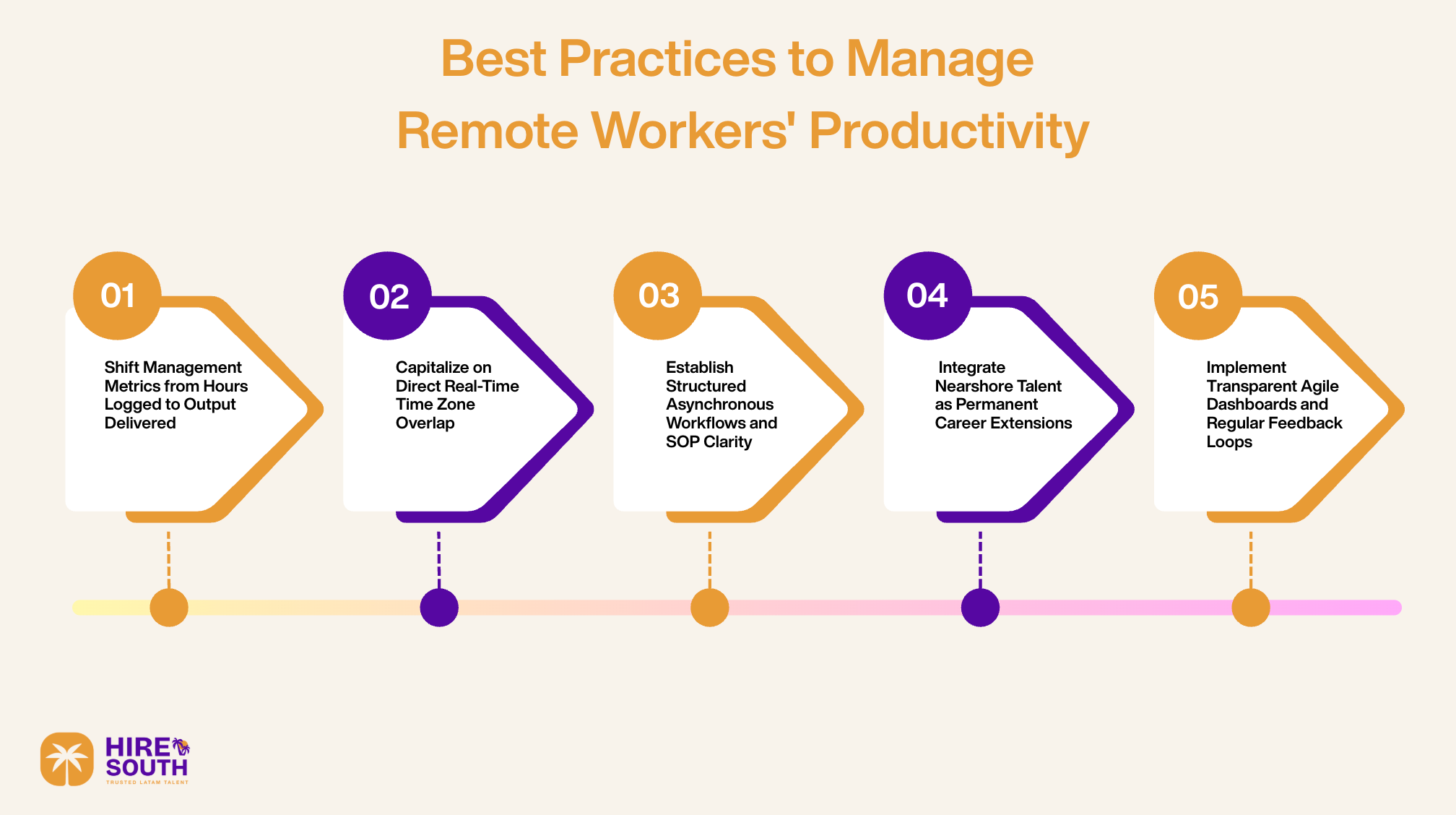
1. Shift Management Metrics from Hours Logged to Output Delivered
Invasive surveillance software, keystroke loggers, and active-screen monitors destroy trust and drive away senior-level talent. According to remote work productivity research published by RescueTime, knowledge workers in deep focus environments achieve 29% more uninterrupted focus time compared to traditional office settings.
You should measure performance using concrete deliverables, code commits, completed tickets, or revenue milestones rather than active desk hours. Aligning expectations around output gives your Latin American team the autonomy required to execute high-impact work consistently.
2. Capitalize on Direct Real-Time Time Zone Overlap
The single greatest operational advantage of nearshoring to Latin America is geographic proximity. Staffing teams across Central and South America gives your U.S. business six to eight hours of direct daily time-zone overlap across Eastern, Central, and Pacific schedules.
According to data compiled by Consultadd, real-time working overlap eliminates the 24-hour review-and-rework loops common in traditional Asian or European offshore arrangements. You can conduct daily agile stand-ups, resolve blockers during shared working hours, and maintain rapid feedback loops that keep sprint velocity high.
3. Establish Structured Asynchronous Workflows and SOP Clarity
While real-time overlap handles active collaboration, structured asynchronous workflows protect deep work. Equip your distributed team with comprehensive standard operating procedures (SOPs), centralized documentation in tools like Notion or Confluence, and detailed task briefs.
Research from GitHub on distributed engineering teams shows that structured documentation reduces daily workplace interruptions by over 48%, directly increasing sprint completion rates. Clear SOPs empower bilingual LATAM professionals to execute tasks autonomously without constantly waiting for real-time approvals.
4. Integrate Nearshore Talent as Permanent Career Extensions
Transactional freelancer models result in high churn, lost institutional knowledge, and declining team morale. According to multi-year workplace retention data published by Great Place to Work, companies that support structured remote team integrations achieve 42% higher sustained productivity levels than typical U.S. workplaces.
By hiring professionals for permanent career placements and compensating them above local market averages, U.S. businesses secure lower labor costs while achieving elite retention rates. Treating LATAM professionals as core members of your enterprise fosters long-term dedication, higher discretionary effort, and superior work quality.
5. Implement Transparent Agile Dashboards and Regular Feedback Loops
Managing remote teams effectively requires operational visibility without hovering. Set up shared Kanban boards or project management dashboards where every team member's sprint progress remains visible in real time.
Pair these transparent systems with weekly 1-on-1 check-ins focused on professional development, resource needs, and strategic alignment. Clear visual metrics combined with predictable feedback channels ensure complete operational alignment across border lines.
How to Track Remote Workers Without Micromanaging
Leverage Shared Task Management Tools for Transparent Workload Visibility:
You do not need to hover over your distributed employees to understand what they accomplish daily. Utilizing task management software like Jira, Asana, or ClickUp provides real-time visibility into project status, ticket ownership, and potential operational bottlenecks.
According to workforce analytics studies by Deel, organizing work through centralized, asynchronous task boards eliminates administrative friction and gives management complete transparency without constant status meetings.
Implement Asynchronous Stand-ups and Weekly Self-Reporting Cadences:
Daily synchronous status calls interrupt focus states and consume valuable deep-work hours. Establish daily asynchronous check-ins where team members post three simple updates via Slack or Teams: what they completed yesterday, what they plan to achieve today, and any current blockers.
Pairing these daily async updates with a weekly self-reporting summary empowers your nearshore Latin American talent to take complete ownership of their schedules while giving leadership an objective audit trail of output.
Build Permanent Careers to Secure High Retention and Sustained Velocity:
Constant employee churn forces your organization into continuous recruitment and onboarding loops, drastically reducing overall operational velocity. According to industry data, sourcing talent for long-term career placements and compensating them above local market rates results in industry-leading retention rates and team stability.
When your remote LATAM professionals feel valued as permanent extensions of your enterprise, they deliver consistently high productivity without requiring intrusive oversight.
Key Metrics To Evaluate Remote Workers' Productivity
1. Feature Velocity and Sprint Ticket Throughput
Evaluating technical output requires tracking feature velocity and ticket completion rates across structured agile sprints. Focus on the total story points or tickets closed per sprint using project management platforms.
Tracking sprint velocity over three-month intervals reveals individual output trends and highlights workflow blockers early. When you hire bilingual Latin American talent through a 100% human-vetted screening process, candidate shortlists are pre-evaluated for technical execution, ensuring higher sprint completion rates from week one.
2. Code Quality, Rework Ratios, and Pull Request Cycle Time
Measuring raw volume without analyzing code quality creates technical debt. Track key software engineering metrics including pull request (PR) cycle times, code review turnaround, and post-release defect rates.
According to research published by Consultadd, nearshoring to Latin America provides six to eight hours of direct daily time-zone overlap across EST, CST, and PST schedules. This real-time alignment reduces PR review loops from 24 hours down to standard working hours, drastically lowering code rework ratios compared to Asian or European offshore models.
3. SLA Adherence and First-Contact Resolution (FCR)
For operations, revenue ops, and Tier-2 support roles, evaluate performance through response times and Service Level Agreement (SLA) compliance rates. Track first-contact resolution rates, average handle times, and customer satisfaction (CSAT) scores.
Measuring SLA adherence provides an objective view of operational throughput without requiring invasive keystroke loggers. High-performing nearshore teams operating in your time zone resolve customer tickets during peak U.S. business hours, elevating CSAT scores across your user base.
4. Asynchronous Communication Velocity and Documentation Contributions
Productivity in a distributed model relies heavily on self-sufficiency and documentation clarity. Evaluate how effectively your remote talent documents standard operating procedures (SOPs), updates internal wikis, and posts concise async stand-up updates in Slack or Teams.
Tracking whether team members independently clear roadblocks using documented workflows prevents project stalls and ensures smooth asynchronous execution across cross-border teams.
5. Team Retention Rates and Long-Term Tenure Benchmarks
High employee turnover destroys operational productivity by forcing teams into perpetual recruitment and onboarding loops. According to multi-year nearshore hiring data from Hire South, placing talent in permanent career roles and compensating them above local market rates yields industry-leading retention rates.
Tracking team retention as a primary productivity metric ensures your organization builds compounding institutional knowledge while maintaining lower total labor costs compared to U.S. domestic hiring.
Looking to Build Productive Remote LATAM Teams For a Lower cost?
Navigating nearshore talent acquisition requires balancing cost efficiency, cultural alignment, and operational oversight. Finding the ideal talent partner demands clarity regarding technical vetting standards, financial risk mitigation, and long-term retention frameworks.
At Hire South, we eliminate the friction of nearshore recruitment by operating as a founder-led boutique staffing partner. We skip automated AI parsers in favor of 100% human-conducted technical interviews, providing access to bilingual Latin American talent with zero upfront fees and a 90-day replacement guarantee. Operating within real-time U.S. time zones (EST/CST) delivers six to eight hours of direct daily overlap, eliminating the 24-hour review-and-rework loops common in traditional offshore arrangements. Whether you need a senior software engineer, a dedicated revenue operations lead, or a full Tier-2 support team, our founders Jared and Sol personally curate candidate shortlists to guarantee strategic alignment.
Ready to scale your team with top 1% Latin American talent without the risk of upfront retainers? Book a free 30-minute strategy call to review your hiring brief, analyze salary benchmarks, and receive a custom candidate shortlist within 48 hours!

.jpg)