


US enterprises lose millions annually to bad hires, intellectual property theft, and compliance breaches when scaling remote teams without proper due diligence. When executed correctly, nearshore staff augmentation provides unparalleled access to elite IT, Finance, and Operations talent at a fraction of domestic costs.
However, conducting compliant background checks in Latin America requires navigating a highly fragmented landscape of regional labor laws, strict data privacy regulations, and decentralized public records. Treating a hire in Bogotá exactly like a hire in Austin is a fast track to regulatory fines and operational delays.
This guide provides the definitive, enterprise-grade blueprint for screening LATAM talent securely, legally, and efficiently in 2027 and beyond. Keep reading to learn more!
Navigating Country-Specific Legal Frameworks for Compliance
What are the legal requirements for background checks in Latin America?
To legally conduct background checks in Latin America, employers must obtain explicit, documented consent from the candidate and strictly adhere to localized data protection laws (such as Habeas Data or the LGPD). Processing personal data without this localized consent exposes US companies to severe regulatory fines and labor disputes under regional equivalents to the GDPR.
Latin America is not a regulatory monolith. A comprehensive background check requires boots-on-the-ground understanding of jurisdictional nuances. Each nation enforces unique frameworks governing what information can be requested, how it must be handled, and how it must be destroyed.
Brazil (LGPD):
Governed by the Lei Geral de Proteção de Dados (General Data Protection Law), Brazil possesses one of the strictest privacy frameworks in the Americas. Background checks must have a clear legal basis. Employers must prove that the data collected is strictly necessary for the specific role. Mishandling this data can result in fines of up to 2% of a company's revenue.
Colombia (Habeas Data):
Governed by Statutory Law 1581, candidates have the constitutional right to know, update, and rectify their data. Background checks, including screening national police records (such as the Procuraduría and Contraloría), require explicit, prior written authorization.
Mexico (LFPDPPP):
Regulated by the Federal Law on the Protection of Personal Data. Employers must provide candidates with a highly specific Privacy Notice (Aviso de Privacidad) detailing exactly how their data will be processed. Furthermore, criminal checks are highly restricted to prevent workplace discrimination and are typically only permissible if the law strictly requires it for the specific profession.
Argentina (PDPL):
Under the Personal Data Protection Law, sensitive data (including criminal records and health information) is heavily protected. Criminal background checks are generally only justifiable if strictly necessary for the role, such as handling sensitive financial data under US GAAP standards.
Costa Rica (Law 8968):
Known for its burgeoning tech sector, Costa Rica strictly enforces the Protection of the Person regarding the Processing of their Personal Data. Employers must ensure data is collected fairly, legally, and with the "informed and express consent" of the applicant.
Essential Types of Background Checks and Their Regional Application
What types of background checks are standard in Latin America?
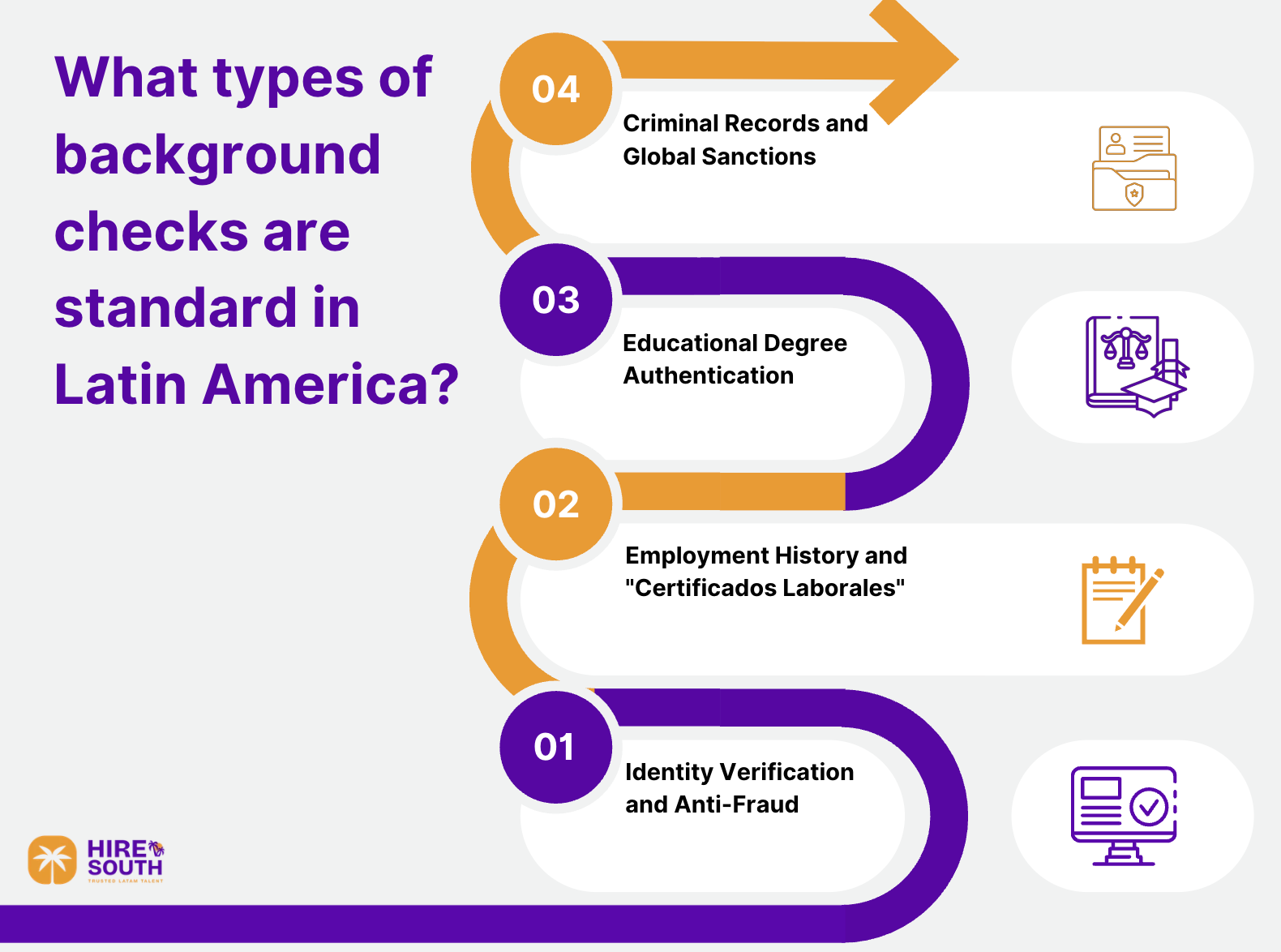
Standard background checks in Latin America include rigorous identity verification via national databases, employment history validation through localized labor certificates, educational degree authentication directly with universities, and localized criminal record screening. Depending on the role, financial probity checks may also be conducted if strictly relevant to the position.
To maintain enterprise-grade security, comprehensive B2B Staffing requires a multi-layered screening approach that goes far beyond a simple Google search or LinkedIn review.
1. Identity Verification and Anti-Fraud
The foundational step of any LATAM background check is validating the candidate’s government-issued ID. This prevents synthetic identity fraud. Screening partners must cross-reference national registry databases to validate documents like the Cédula de Ciudadanía (CC) in Colombia, the INE or CURP in Mexico, or the DNI in Argentina and Peru.
2. Employment History and "Certificados Laborales"
Unlike the US, where a quick call to an HR department often suffices, LATAM employment verification relies heavily on certificados laborales (official work certificates). These documents state the dates of employment, the role held, and sometimes the salary. However, because these can be forged, an elite vetting process involves directly contacting the issuing HR departments to authenticate the document, cross-referencing tax IDs of the previous employers to ensure they are legitimate, active businesses.
3. Educational Degree Authentication
With the rise of sophisticated diploma mills, validating educational credentials is non-negotiable, particularly for specialized engineering and finance roles. This requires direct outreach to the university’s office in the respective country. Furthermore, professional licenses (such as a Tarjeta Profesional for engineers or accountants in Colombia) must be verified against national professional council databases to ensure the candidate is legally permitted to practice their trade.
4. Criminal Records and Global Sanctions
Navigating criminal checks is notoriously complex in LATAM. In many countries, third-party agencies cannot simply "pull" a criminal record. Instead, the candidate must request their own official certificates from local government or police portals and provide them to the employer. A robust check will also run the candidate's identity against global watchlists, including OFAC (Office of Foreign Assets Control), Interpol, and international anti-money laundering (AML) databases.
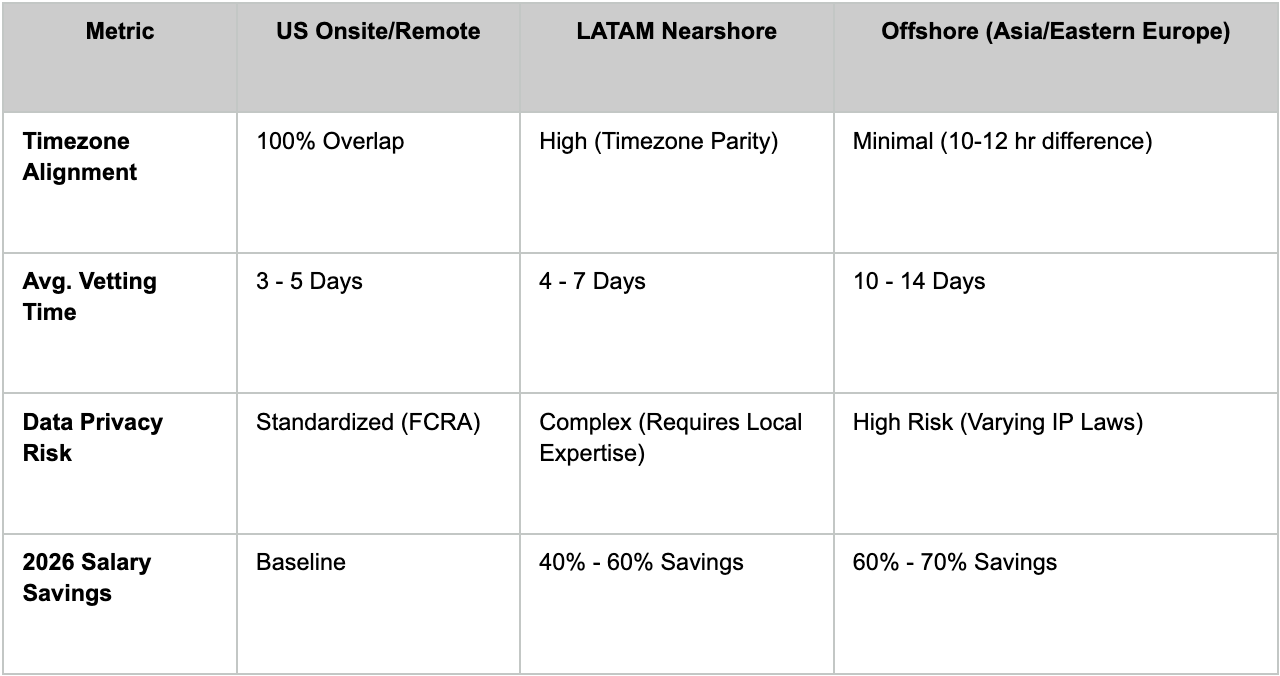
2026 Data Matrix: US vs. LATAM Hiring Dynamics
Understanding the intersection of vetting timelines, costs, and operational overlap is critical for executive hiring planning.
Industry-Specific Considerations in LATAM Background Screening
How do background checks in LATAM vary by industry?
Industry-specific background checks in Latin America scale in intensity based on the role's inherent risk profile. IT roles demand stringent intellectual property (IP) and data security screenings, Finance roles necessitate deep credit history checks and AML compliance, while Operations roles focus heavily on employment continuity and cultural integration.
A blanket approach to background checks inevitably leaves security gaps. Elite vetting must be tailored to the specific vertical.
IT & Software Development:
When hiring senior engineers, DevOps architects, or cybersecurity analysts who will handle proprietary code and access sensitive databases, the focus shifts to robust IP protection and data security. If your US enterprise is SOC 2 or ISO 27001 certified, your nearshore team must meet those same rigorous compliance standards. Screening includes deep reference checks for past NDA adherence, strict verification of technical certifications (AWS, Microsoft, CISSP), and assessing past involvement in data breaches.
Finance & Accounting:
For roles requiring adherence to US GAAP, such as financial controllers, FP&A analysts, and corporate accountants, vetting must be exhaustive. Because these individuals manage sensitive corporate funds, screening must include financial probity checks, credit history analysis (where legally permitted, such as for fiduciary roles), and rigorous cross-referencing with international sanction lists to comply with US AML and KYE (Know Your Employee) regulations.
Marketing & Operations:
Screening for growth marketers, digital project managers, and operations leads focuses heavily on portfolio authenticity. It is common for candidates to claim outsized roles in successful campaigns. Deep reference checking is required to validate their actual contribution, alongside cultural fit assessments to ensure seamless, frictionless integration with your US-based core teams.
Overcoming Common Challenges: Best Practices for Enterprise Vetting
How can US companies overcome background check challenges in Latin America?
US companies can overcome LATAM background check challenges by partnering with localized legal and staffing experts, leveraging regional screening technology, avoiding blanket financial checks that violate anti-discrimination laws, and ensuring every step of the vetting process is documented immutably.
Attempting to navigate Latin American bureaucratic systems independently often leads to disrupted hiring pipelines, lost top-tier candidates, and severe compliance violations. Implement these best practices to protect your enterprise:
Challenge 1: Decentralized and Outdated Databases
Unlike the US, where comprehensive background check APIs exist, LATAM data is highly decentralized. A clean record at the federal level does not guarantee a clean record at the municipal or state level.
- Best Practice: Do not rely on automated, single-source global background check tools. They frequently return false negatives in LATAM. Utilize localized screening partners who manually verify records across multiple, disparate governmental tiers.
Challenge 2: The Language and Cultural Barrier
Translating a criminal charge or a labor dispute from localized legal Spanish (or Portuguese) to English is not a 1:1 process. Nuances are frequently lost, leading employers to either panic over minor civil infractions or overlook serious red flags.
- Best Practice: Ensure your screening team consists of native speakers who understand the local legal nomenclature and can contextualize the findings for US-based HR directors.
Challenge 3: Navigating Anti-Discrimination Laws
In an effort to emulate US hiring practices, many companies illegally mandate credit checks for all LATAM applicants. In countries like Mexico and Colombia, using a candidate's credit history to deny employment for a non-financial role (like a graphic designer) can immediately trigger a discrimination lawsuit.
- Best Practice: Keep the scope of the background check strictly job-relevant. Only request financial or deep criminal data if the specific duties of the role legally justify the invasion of privacy.
Defeating AI-Driven Identity Fraud in the 2026 Remote Hiring Landscape
How do companies prevent AI identity fraud during LATAM background checks?
To combat synthetic identity fraud, proxy interviewing, and deepfakes during the vetting process, enterprises must deploy biometric liveness detection and cross-reference digital footprints with physical government IDs. Relying solely on standard video interviews and unverified PDF document submissions is no longer sufficient to guarantee candidate authenticity in 2026.
As remote work infrastructure has matured, so have the tactics of bad actors. A growing threat in the global remote hiring space, including Latin America, is the use of generative AI to circumvent standard background checks and technical assessments. This ranges from candidates using real-time AI teleprompters during interviews to full-scale Proxy Interviewing, where a highly skilled individual passes the technical vetting, but a different, underqualified person actually shows up for onboarding.
To secure your enterprise against next-generation fraud, background screening must evolve from static document review to dynamic identity verification:
- Biometric KYC (Know Your Customer) Protocols: Elite vetting now requires banking-grade identity verification. Candidates must complete live, biometric facial scans that are algorithmically matched against the micro-features of their physical, government-issued IDs (like a Colombian Cédula or Mexican INE) in real-time.
- IP and Geolocation Auditing: Background checks must verify that the candidate's digital footprint aligns with their stated physical address. If a candidate claims to be based in Buenos Aires, but their network packets consistently route through non-LATAM VPNs during the vetting process, this triggers an immediate security review.
- Live-Environment Technical Vetting: For IT and engineering roles, asynchronous coding tests are easily bypassed by AI agents. Secure background vetting now requires proctored, live-coding environments where identity is continuously verified throughout the assessment.
By partnering with an elite agency like Hire South, US enterprises inherit a zero-trust vetting architecture. We utilize proprietary anti-fraud measures to ensure the candidate you interview is the exact, legally verified professional who logs into your servers on day one.
The Enterprise Shift from Point-in-Time Vetting to Continuous Workforce Screening
What is continuous workforce screening for nearshore teams?
Continuous workforce screening involves periodically re-verifying a LATAM employee’s legal, criminal, and financial status throughout their tenure, rather than relying on a single pre-employment check. This proactive approach ensures ongoing enterprise compliance with strict US regulatory frameworks, including SOC 2, ISO 27001, and SEC guidelines.
A traditional background check is merely a historical snapshot. A candidate who clears a rigorous criminal and financial background check on their hiring date could, hypothetically, face legal or financial charges a year later. For US enterprises managing highly sensitive data or operating in heavily regulated sectors like FinTech or Healthcare, a "Day 1" background check leaves a massive compliance blind spot by "Day 400."
However, implementing Continuous Screening in Latin America requires navigating a legal minefield. Because of strict localized privacy laws like Brazil’s LGPD and Argentina’s PDPL, a company cannot unilaterally run background checks on existing employees without cause.
To implement continuous vetting legally, enterprises must structure their nearshore operations carefully:
- Rolling Consent Clauses: Employment contracts or independent contractor agreements must include explicit, legally localized clauses where the professional grants ongoing consent for periodic compliance audits throughout their employment lifecycle.
- Trigger-Based Re-Screening: Rather than arbitrary monthly checks, continuous screening should be tied to specific triggers, such as an employee being promoted to a role with higher database access privileges or transitioning to a project involving sensitive US financial data.
- Managing the Compliance Overhead: Monitoring changing privacy laws across multiple LATAM jurisdictions while conducting continuous audits is a massive drain on US HR departments.
This is where the LATAM Nearshore Staff Augmentation model proves invaluable. When you partner with Hire South, the ongoing compliance and continuous vetting of the workforce are fully managed by our localized legal teams. We ensure your distributed workforce remains 100% compliant with both LATAM labor laws and your internal US security audits year-round.
Frequently Asked Questions (FAQ)
Can US companies directly access criminal records in Latin America?
No. In most Latin American countries, US companies cannot directly pull criminal records via third-party databases like they do under the FCRA in the United States. Due to strict privacy laws, candidates typically must request their own official criminal certificates from local government, judicial, or police portals and voluntarily submit them to the employer.
Does a standard US NDA protect my intellectual property when hiring in LATAM?
A standard US Non-Disclosure Agreement (NDA) is rarely fully enforceable in Latin American jurisdictions. To ensure true IP protection and legal recourse in the event of a breach, employment contracts, NDAs, and IP assignment agreements must be explicitly localized and translated to align with the specific labor and intellectual property laws of the candidate’s home country.
How long does a standard, compliant background check take in Latin America?
A comprehensive, legally compliant background check in Latin America typically takes between 4 to 7 business days. This extended timeframe (compared to the US) accounts for the manual authentication of educational degrees, the retrieval of government documents by the candidate, and the response times of previous employers providing official certificados laborales.
Are credit checks legal for job applicants in Latin America?
Credit checks are highly restricted in most of LATAM and are only legally permissible if the financial history is strictly relevant to the job function (e.g., senior finance roles, corporate treasurers, or banking developers). In countries like Mexico, Colombia, and Argentina, using credit history to deny employment for non-financial roles violates privacy laws and can result in severe discrimination claims.
The Takeaway: Secure Elite Nearshore Talent with Hire South
Thorough Background Checks in Latin America are non-negotiable for enterprise security, IP protection, and operational continuity. However, the friction of navigating disparate legal systems, securing proper localized consent, and verifying complex international records shouldn't be a bottleneck to your company's growth.
At Hire South, we engineer risk entirely out of the equation. As a premier nearshore staffing agency, we connect US companies with elite, pre-vetted LATAM talent across IT, Finance, Marketing, and Operations. We do not just source resumes; we deliver fully compliant, enterprise-ready professionals. Every candidate we present has already cleared a rigorous, locally compliant background, identity, and reference check conducted by our localized compliance teams, ensuring you get top-tier talent without the legal friction or administrative overhead. Contact us to get started today!