


You have likely been there. A critical project is underway, a deadline is looming, and your key contractor suddenly stops replying to emails. Just like that, your timeline is in tatters.
This is not just bad luck, it is a structural epidemic. Professional ghosting has transitioned from a minor frustration to a full-blown corporate headache, with 76% of recruiters reporting that candidates have completely vanished during the hiring process, according to a talent acquisition report by HiredAI.
When you source talent from open, unvetted marketplaces, you are essentially gambling with your project delivery dates.
This article explores why independent talent is struggling to stay afloat, why open-market platforms are failing your business, and how shifting to a curated, pre-vetted remote talent model can permanently protect your pipeline. Let’s dive in.
The Freelancers' Struggles in 2026
If you hire or manage independent professionals, you need to understand that the open marketplace is undergoing a quiet crisis. The self-employed lifestyle is no longer just about managing client demands and setting schedules. Today, it is a high-stress battle against rapid technological shifts, administrative bottlenecks, and extreme market saturation.
Understanding these internal pressures helps explain why so many talented professionals suddenly go out of touch, miss deadlines, or exit the market entirely.
Managing Unstable Project Pipelines and Client Dry Spells:
The classic "feast or famine" cycle of freelancing has turned particularly brutal. Freelancers are fighting a daily war against unpredictable income. In fact, approximately 53% of independent contractors point to income instability as their single most significant professional roadblock, according to data from Accio.
When you work with open-market contractors, you are dealing with individuals who are constantly hunting for their next paycheck. To keep their heads above water, they often overbook themselves, hoping that at least one project will stick.
This survival tactic routinely backfires. The moment multiple projects hit simultaneously, your contractor becomes overloaded, leading to delayed deliverables or a sudden drop in communication.
The Mental Toll of Administrative Overload and False Self-Employment:
Many professionals go freelance to focus on their craft, only to realize they have inherited a second, unpaid job as a full-time administrator. The typical independent worker spends roughly 21 hours per week on non-billable administrative tasks like drafting proposals, chasing late invoices, and managing accounting, according to a time-tracking report published by Rudys.AI.
This administrative burden is compounded by growing regulatory scrutiny surrounding contractor misclassification, forcing freelancers to navigate complex tax and compliance laws just to keep working.
By the time these professionals sit down to work on your project, they are already mentally exhausted. The compounding fatigue of running a micro-business with zero back-office support leads to burnout, which is the leading cause of sudden freelancer dropouts.
How Algorithmic Shifts and Platform Fee Changes Eat Into Margins:
The digital platforms that once served as reliable launchpads for independent talent have steadily become high-friction environments. Heavy platform commissions, which regularly range from 10% to 20% of total contract values, eat directly into a worker's bottom line.
Simultaneously, unexpected algorithmic changes on major freelance networks can instantly bury a seasoned professional’s profile, cutting off their main source of inbound inquiries overnight.
To compensate for these shrinking profit margins and unpredictable platform visibility, freelancers are forced to raise their rates or cut corners on the time they dedicate to your projects.
The Struggle to Stay Ahead of the AI Upskilling Curve:
Artificial intelligence is rapidly splitting the freelance economy into two distinct camps: those who orchestrate complex AI workflows and those whose basic skills are being automated out of existence. Simple creative production and basic generative AI writing contracts have seen their average per-contract earnings decline by 13% year-over-year, according to the Upwork Future Workforce Index.
Meanwhile, the demand for complex, AI-augmented roles has jumped by 72%. This rapid shift places immense pressure on freelancers to constantly upskill, retrain, and master new automation tools just to justify their rates.
The preparation gap is widening rapidly. While most freelancers use AI tools, only 39% feel truly prepared to navigate these technological shifts, according to a global trends report by Freelancermap. Freelancers who fail to transition to high-value, complex work find themselves working longer hours for less money, leaving them with little to no bandwidth to focus on their business goals.
Vetted Talent vs. Freelancer: What is the Real Difference?
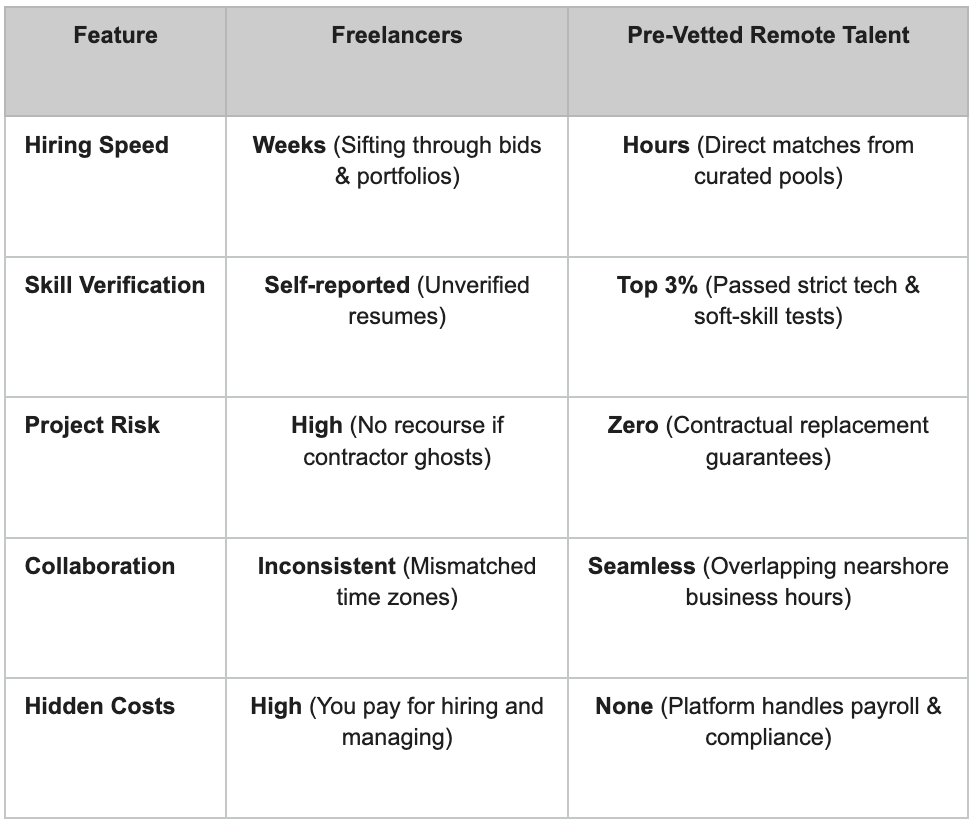
When you need to scale your team or patch a critical skill gap, you face a strategic crossroads. On one side stands the traditional open-marketplace freelancer; on the other, the pre-vetted remote specialist.
While both operate outside your standard payroll, they exist in completely different operational universes. Understanding the structural division between these two models is the key to preventing project delays and protecting your bottom line.
Defining the Open Marketplace Freelancer Model.
The traditional freelance model is built on volume and self-reporting. On major open bidding platforms, anyone can create a profile, list their skills, and start bidding on projects.
This creates a massive discovery burden for your business. Because these platforms do not verify technical capabilities, you are forced to act as the primary recruiter, portfolio checker, and quality control manager.
The statistics highlight the sheer scale of this administrative hurdle. When you post a project on a traditional freelance network, listings receive an average of 41 bids within the first five minutes.
Sorting through this sea of proposals to find a qualified partner takes an average of three business days for simple tasks, and can stretch into weeks for highly specialized technical roles. Essentially, you are trading upfront recruiting labor for a lower hourly rate, while carrying all the performance risk yourself.
Understanding the Premium Vetted Talent Infrastructure.
Pre-vetted talent networks remove the gamble from the hiring process by reversing the vetting dynamic. Instead of asking you to filter out unqualified applicants, these platforms handle the entire screening process before a professional ever speaks to a client.
The barrier to entry in these curated networks is exceptionally high. Elite vetted platforms famously accept only the top 3% of technical and creative applicants who apply to their networks.
This process involves multi-stage technical testing, live coding assessments, soft-skills evaluations, and background checks.
Because the platform has already verified the capabilities, communication skills, and reliability of the professional, your time-to-hire drops from weeks to hours. You are no longer buying a raw application; you are purchasing a pre-qualified solution.
The Crucial Shift from Active Sourcing to Curation.
The core difference between these two paths comes down to how your company spends its time. Relying on traditional freelancers requires active sourcing, which means you are constantly writing job descriptions, interviewing candidates, and managing individual contractor risk.
When you transition to a vetted model, you move to curated matching.
A vetted talent platform analyzes your specific project requirements, matches you with a pre-screened expert, and often provides a replacement guarantee if the match does not work out.
This shift saves significant management overhead. Companies utilizing integrated, vetted talent networks report a 60% reduction in the hours spent coordinating and managing external workers, according to operational data published by Averi AI.
Instead of managing a fragmented web of individual contractors, you gain an organized, accountable extension of your internal team.
Key Vetted Talent Benefits for Growing Enterprises
When you run a growing business, your operational speed is your greatest competitive advantage. Traditional hiring and unverified freelancing models slow you down with vetting administrative work and high-friction onboarding.
Shifting to a structured, pre-vetted talent model removes this friction, offering major benefits that directly impact your company’s agility and productivity.
1. Immediate Access to Niche and Specialized Modern Skillsets
Finding specialized professionals in the open market is a massive bottleneck. High-growth enterprises often struggle to secure highly specific technical skills, such as advanced data engineering or specialized AI architecture, with 76% of hiring managers reporting severe talent shortages in these areas, according to recruitment data published by CanX Global.
When you source through a premium vetting framework, the platform has already done the heavy lifting. The screening process filters out thousands of resume-padders, leaving only high-caliber specialists with proven track records.
Instead of waiting months to recruit locally or gambling on a self-reported resume, you gain immediate, on-demand access to elite talent that is fully equipped to handle highly technical, specialized project requirements.
2. Elastic Scalability to Match Fluctuating Project Demands
Modern business demands flexibility. You may need to scale up a software development team to meet a critical product launch deadline, only to scale it back down once the product goes live.
Traditional hiring locks you into fixed, long-term overhead costs.
Vetted remote networks give you elastic scalability, allowing you to quickly add or subtract experts without the legal and financial burdens of permanent employment contracts.
This model lets you match your talent spend directly to your active project pipelines. You keep your core team lean while drawing from a flexible, high-performing roster of specialists exactly when your workload spikes.
3. Built-In Replacement and Quality Guarantees
In the traditional freelance world, if a contractor abruptly disappears or fails to perform, your project stalls, and your upfront investment is lost. You are stuck starting the recruitment process all over again from scratch.
Vetted networks eliminate this systemic risk through contractual quality guarantees.
Because these platforms actively monitor developer output, they provide structured safeguards. If a matched specialist does not meet your specific standards or has an emergency, the platform quickly steps in.
They will replace the resource, handle the transitional onboarding, and ensure your development pipeline keeps moving with zero additional recruitment fees or scheduling delays.
The Strategic Impact of Remote Vetted Talent
When you build a distributed workforce, your focus must shift from simply reducing payroll costs to maximizing operational resilience. Sourcing premium remote professionals who have already passed rigorous quality, technical, and communication filters completely changes how your team operates.
Rather than dealing with the standard headaches of managing unverified offshore freelancers, integrating high-performing remote vetted talent directly enhances your speed to market, execution quality, and engineering velocity.
1. Unlocking Borderless Sourcing Without Quality Degradation
Limiting your recruitment efforts to a local talent pool drastically restricts your access to specialized skills. When you transition to a global remote framework, you gain immediate access to top-tier expertise, but doing this through unvetted freelance platforms often results in inconsistent deliverables.
Curated remote talent networks solve this quality gap. Because these networks systematically filter out underperforming candidates before they ever reach your inbox, you can scale your operations globally with complete confidence.
Expanding your geographical search parameters directly impacts your bottom line. Organizations can achieve an average cost reduction of 40% to 60% on total compensation by leveraging a remote staff augmentation model compared to hiring comparable, full-time onsite professionals in high-cost cities, according to compensation research by Coders.dev.
This approach allows you to optimize your budget while keeping quality high. You bypass regional talent shortages and secure elite, business-critical professionals who are ready to hit the ground running.
2. Leveraging Nearshore Time Zone Alignment for Real-Time Collaboration
A major drawback of traditional offshore hiring is the painful lag in communication. When your development team is asleep while your internal product managers are awake, a simple question can stall a project for an entire business day.
Working with remote vetted talent in nearshore locations fixes this bottleneck. Sourcing specialists who share overlapping business hours with your core team allows for natural, real-time collaboration.
This overlapping schedule means your team can run daily standups, conduct instant code reviews, and pair-program without anyone working odd night shifts.
By eliminating communication delays, you build a highly cohesive, hybrid environment where remote and in-house teams collaborate fluidly, speeding up feedback loops and keeping projects on track.
3. How Distributed Teams Achieve 24/7 Continuity
While nearshore alignment is perfect for close, collaborative product design, a strategically distributed team allows you to build a continuous, round-the-clock development cycle.
Using pre-vetted specialists in different time zones creates a seamless handoff system. As your local office winds down for the evening, your remote engineers in other parts of the world pick up the work, run testing protocols, and push updates.
This model accelerates your time-to-market. Additionally, remote work environments are proven to drive individual performance. Remote workers show a 13% performance increase compared to traditional office workers, according to a landmark randomized controlled trial conducted by Stanford University.
By structuring a distributed team of highly motivated, pre-screened professionals, you get the combined benefits of higher individual output and continuous development, helping your business ship products faster than your competitors.
Hire Vetted Talent in Latin America With Hire South
Building a high-performing remote team should not feel like a gamble. When you move past the administrative chaos of open freelancing marketplaces, you protect your product roadmap, stabilize your delivery pipelines, and gain a massive competitive advantage.
At Hire South, we are dedicated to helping you scale faster by hiring vetted Latin American talent through nearshore outsourcing, all at up to a 40% reduction in staffing costs compared to local hires. Our hands-on nearshoring service connects your company with senior-level bilingual professionals who operate in your exact time zone, eliminating communication delays and allowing for true, real-time collaboration.
We take complete ownership of the sourcing, screening, and multi-stage vetting process to present you with only the top candidates. Because we handle all payroll, local benefits, and compliance, you can focus on driving your business forward while we manage the operational details. We are so confident in our matching process that we offer a 90-day replacement guarantee at no additional cost if a match does not work out, and you pay absolutely nothing until you make a hire.