


Building a high-performing engineering team is expensive. When you look at local US salaries, a single senior developer can easily blow through your budget. But expanding your search southward changes the financial math completely. In fact, hiring a five-person remote team in Latin America can save you up to 57% on annual costs compared to the San Francisco Bay Area, according to a 2026 report by EliteCoders.
You get the same technical expertise. You keep your standard business hours. You just pay a fraction of the fully loaded domestic rate.
This guide breaks down exactly what you can expect to spend when sourcing senior tech talent across the region. It walks through country-by-country salary benchmarks, hidden compliance fees, and the practical differences between direct hires and contractor models.
Keep reading to learn how to scale your engineering team without sacrificing quality!
What is the Real LATAM cost to hire vs the United States?
Looking at base compensation alone rarely gives you the full financial picture. Compare fully loaded expenses to understand the true budget impact.
Base Salary Comparisons for Top Tech Talent:
The gap in raw compensation remains massive across borders. In the US, a senior software engineer currently earns a median total compensation of $252,000 annually, according to 2026 data from Levels.fyi.
When you source that same level of experience in Latin America, the financial requirements drop significantly. Senior medians in the region hover between 18% and 25% of the US benchmark. If you prefer contract work, senior developers in LATAM typically bill between $50 and $80 an hour. Compare that to the US market, where senior freelance rates easily range from $100 to well over $150 an hour.
The Hidden Costs of Taxes and Corporate Benefits:
Domestic hiring comes with heavy compliance baggage. US employment taxes automatically add roughly 15% to 20% on top of a worker's base salary. You then have to factor in standard corporate benefits like healthcare premiums, retirement matching, and paid time off. These standard perks can inflate the final price tag by another 30%.
Nearshore hiring bypasses the bulk of this domestic overhead. Bringing someone on as an international contractor eliminates US payroll taxes. Even if you use an Employer of Record to offer localized health benefits, the mandatory social contributions are calculated against a much lower base salary. Your total liability shrinks drastically.
Why a Local Hire Could Cost Over 60 Percent More:
Adding up base pay, equipment, and taxes reveals undeniable savings. Hiring a senior engineer in Latin America costs 40% to 60% less than bringing on an equivalent US or Canadian developer, according to a 2026 report by Lapieza.
This dynamic is driven by geographical arbitrage rather than a drop in quality. A salary of $80,000 USD provides an exceptional standard of living in cities like Buenos Aires or Bogotá. You get to pay top-of-market rates to attract elite regional talent, and your finance department still effectively cuts the engineering budget in half.
What Costs Are Involved When Hiring a Senior Developer in Latin America
1. Navigating Recruiting and Headhunting Fees
Finding elite engineering talent requires an upfront investment before a single line of code gets written. Standard tech recruiting agencies in the region typically charge between 15% and 25% of the candidate's first-year salary, according to LaPieza. For a senior developer earning $60,000 a year, you should expect to pay a placement fee ranging from $9,000 to $15,000.
Some firms offer an alternative pricing model to bypass percentage-based hurdles. You can find specialized networks that charge a flat fee of around $3,500 per successful placement, according to HireLATAM. These flat-fee structures usually include candidate sourcing, initial screening, and standard replacement guarantees of about 90 days.
2. Employer of Record and Compliance Overheads
Once you select your ideal candidate, you have to legally employ them. If you don't have a corporate entity in countries like Mexico or Argentina, using an Employer of Record (EOR) becomes the standard route. EOR platforms handle local payroll, taxes, and labor law compliance. This service generally costs around $600 per month, adding $7,200 to your annual budget, according to BEON.tech.
Beyond the administrative fee, you must fund the mandatory local benefits and social security contributions. Depending on the country, these social charges and bonuses add approximately 30% on top of the base compensation. For a developer earning a $60,000 base, you need to set aside roughly $18,000 annually for these required local benefits, according to BEON.tech.
3. Budgeting for Remote Equipment and Logistics
Remote engineers need high-performance hardware to compile code and run local testing environments efficiently. Shipping laptops internationally involves hefty import taxes and customs delays. Instead, most companies provide a direct equipment stipend.
You should budget approximately $4,000 for year-one equipment and logistical setups, according to BEON.tech. This covers a modern workstation, an external monitor, and ergonomic home-office accessories. Providing this stipend upfront ensures your new hire has reliable tools on day one, avoiding technical roadblocks during the onboarding phase.
4. The Financial Impact of Time-to-Fill and Lost Productivity
A vacant senior engineering seat quietly drains corporate resources. The longer a specialized position stays open, the more your product roadmap gets delayed. Leaving a senior tech role unfilled for three months can cost your business between $30,000 and $60,000 in lost productivity, according to LaPieza.
Speed matters when expanding your team internationally. Partnering with nearshore agencies often accelerates the hiring cycle significantly compared to traditional domestic recruiting. While you pay a premium for agency services, closing a hire in three to four weeks prevents massive technical debt and gets your features shipped faster.
The Real Cost To Hire Senior Developers in LATAM
Pricing out a senior engineering hire requires looking past broad regional averages. The final number on your balance sheet depends heavily on the engagement model you choose, the specific country you target, and the technical stack required to build your product.
1. Average Annual Salaries for Direct Hires
When you decide to hire a developer directly as a full-time equivalent, base compensation remains highly competitive. Average senior developer salaries across Latin America range from $53,000 to $63,000 USD per year, according to a massive payroll dataset from Howdy.
Geography plays a direct role in these baseline numbers. Mexico currently leads the region for senior compensation, with a median total pay of $63,324, according to 2026 data from Levels.fyi. Argentina follows closely, offering average salaries of $63,163 for senior roles, according to Howdy. These hubs command top dollar because they offer unmatched talent density and deep experience working directly with United States tech companies.
2. Hourly Rates for Senior Freelance Contractors
Many companies prefer to bypass direct employment entirely by bringing on senior engineers as independent contractors. This model shifts the burden of taxes and insurance onto the developer, which naturally inflates the hourly rate but simplifies your corporate accounting.
You can generally expect to pay a senior contractor between $35 and $55 an hour for standard web development roles. However, if you require highly specialized senior talent to scale complex systems, those hourly rates can easily climb toward $80 an hour. You essentially trade a higher monthly invoice for total flexibility and zero long-term payroll commitments.
3. Premium Costs for High Demand Tech Stacks
Your technology stack dictates your financial baseline just as much as geography. Standard frontend or backend developers using Java, Node, or Python typically fall neatly into the average salary bands. But when you need engineers to build specialized infrastructure, the cost to hire automatically increases.
Artificial Intelligence and Machine Learning engineers represent the most expensive talent pool in the region. Senior AI specialists currently command between $68,000 and $84,600 annually, according to a 2025 industry report by Next Idea Tech. Cloud architects also demand a significant premium, with average salaries hitting $61,200, according to more information from Next Idea Tech.
4. Total Employer Cost vs Domestic Equivalents
To calculate the true return on investment of a nearshore hire, you have to look at the fully loaded total employer cost. This metric bundles base salary, compliance fees, equipment stipends, and mandatory local benefits into a single figure.
Bringing on a fully loaded senior domestic engineer in the US costs roughly $160,000 a year at the absolute minimum, according to Howdy. In contrast, the total employer cost for an equivalent senior developer in Latin America tops out at approximately $65,000, according to Howdy. You capture a 60 percent reduction in overhead while maintaining full time zone alignment and senior-level execution.
How Staffing Agencies Can Help You Reduce The Cost To Hire
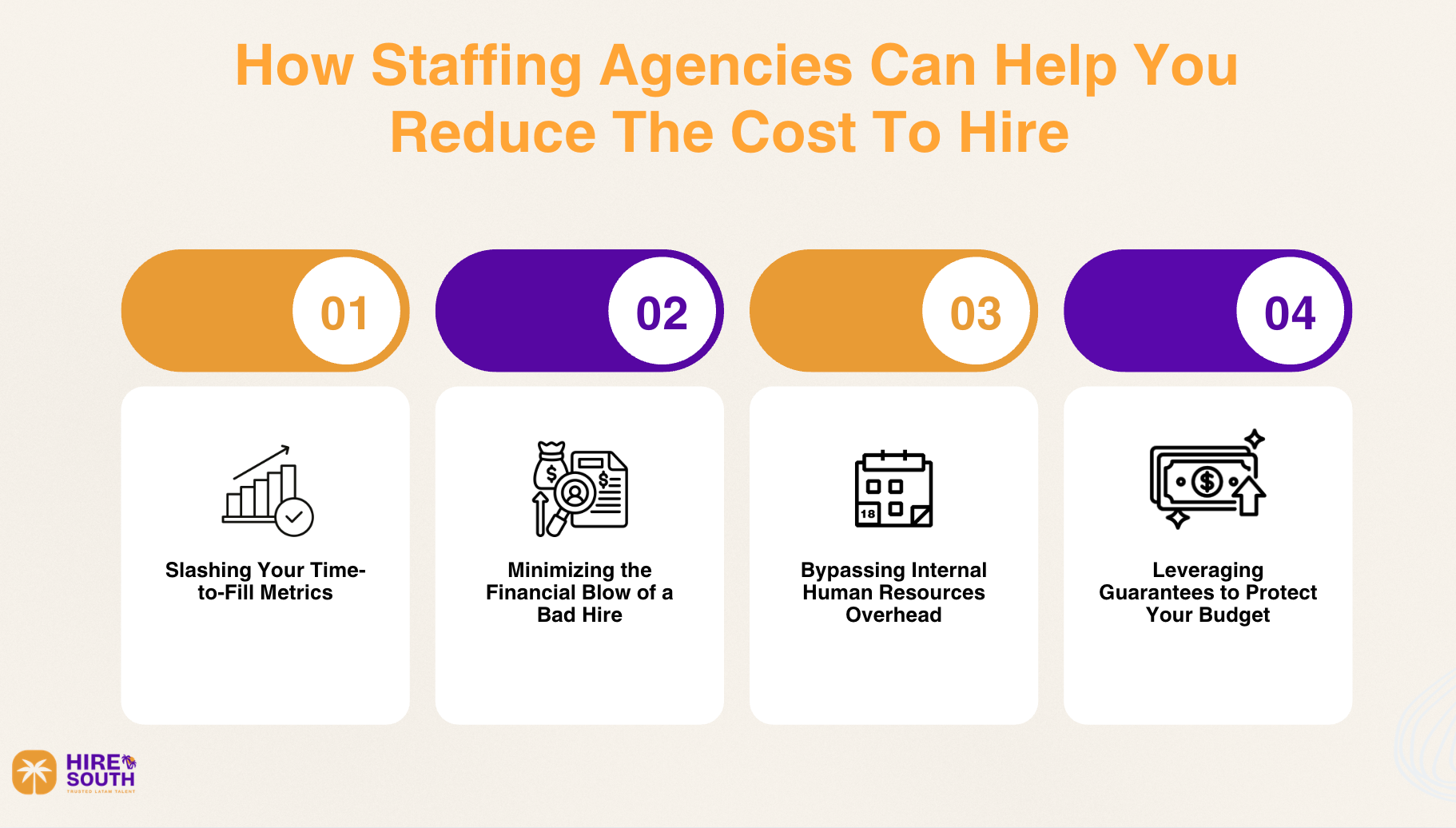
Slashing Your Time-to-Fill Metrics:
Every day an engineering seat sits empty, your product roadmap stalls. An in-house recruitment team usually takes 45 to 62 days to finalize a technical hire. Staffing agencies maintain active, pre-vetted talent pools in Latin America. They can typically place a qualified developer in just one to two weeks. By cutting your vacancy timeline by a month or more, you preserve operational momentum and avoid bleeding thousands of dollars in lost feature delivery.
Minimizing the Financial Blow of a Bad Hire:
Bringing on the wrong developer does more than waste a monthly paycheck. It drains management capacity and creates technical debt for the rest of your team. Replacing a mid-level technical employee actually costs between 100% and 150% of their annual salary when you factor in onboarding drag and lost productivity, according to SHRM. Specialized tech agencies mitigate this risk through rigorous upfront screening. They handle the specialized coding tests and architecture interviews, ensuring you only spend time evaluating candidates who already meet your technical bar.
Bypassing Internal Human Resources Overhead:
Scaling an internal recruiting department requires a heavy financial commitment. The average direct cost to hire a non-executive employee runs around $5,475 in recruiter time, job board fees, and administrative overhead, according to a 2025 SHRM benchmark. When you partner with a specialized agency, you outsource that entire operational layer. Your existing HR team stays lean and focused on culture and retention rather than sifting through hundreds of mismatched resumes from generic job boards.
Leveraging Guarantees to Protect Your Budget:
Directly hiring a developer carries significant financial risk if the candidate quits early. You lose the training investment and immediately restart the expensive search process from scratch. Most reputable staffing agencies offer built-in placement guarantees to protect your capital. If a candidate resigns or fails to meet performance expectations within the first 90 days, the agency replaces them at no additional cost. This contractual safety net prevents you from paying premium recruitment expenses twice for a single engineering seat.
Ready to Hire Senior Developers in Latin America?
Expanding your engineering capacity doesn't require burning through 60% more of your budget on domestic overhead and local compliance fees. Sourcing senior developers in Latin America gives your team the same technical execution at a fraction of the fully loaded US cost.
At Hire South, we handle the entire sourcing and compliance lifecycle so your internal teams can focus on shipping products rather than reviewing resumes. We maintain an active, pre-vetted network of elite nearshore talent, allowing you to bypass the standard 45-day corporate recruiting cycle and onboard fully compliant senior developers in under two weeks. When you partner with us, you secure top-tier code quality, complete time zone alignment, and a straightforward flat-fee structure that actively protects your corporate runway.