


Finding top talent in Latin America shouldn't feel like a high-stakes gamble, yet for mid-market companies, the wrong recruitment partner can derail entire product roadmaps. In fact, a single bad hire can cost your organization up to 30% of that employee's first-year salary, according to data from the U.S. Department of Labor.
When you need to scale your team without burning through capital, deciding between specialized boutique nearshore agencies and sprawling global staffing networks gets tricky. Each model offers distinct advantages in speed, cultural fit, compliance, and cost, but only one truly fits your specific growth phase.
This guide breaks down the core operational differences between boutique providers and massive recruitment networks. You will discover key cost drivers, retention impacts, and a clear decision framework to help you choose the right partner for your organization.
The Mid-Market Talent Dilemma: Scaling Speed vs. Cultural Alignment
Mid-market leaders face a constant tug-of-war. Your board demands rapid expansion to hit revenue milestones, but rushing candidate searches often backfires. Accelerating your hiring velocity without an airtight vetting process leads directly to misaligned hires, fractured team dynamics, and skyrocketing churn.
The High Financial Cost of Rushed Hiring:
Speed matters, but reckless speed carries a steep price tag. When you rush to fill open seats, candidate quality usually drops, and the financial consequences hit mid-market bottom lines immediately. Replacing a departed team member costs between 1.5 and 2 times their annual salary, according to research from Gallup. On top of that, up to 40% of new hires quit within 18 months due to poor cultural fit, according to data from DevsData. Re-opening a search resets project timelines, pushing critical software releases or operational rollouts back by months. For enterprise giants, losing an employee is a rounding error. For mid-sized firms, a single bad hire in a key engineering or product role stalls entire departments.
Why Cultural Alignment Matters as Much as Hard Skills:
Technical competence gets candidates past the initial resume screen, but shared values determine whether they stay three years or three months. Mid-market organizations depend on close collaboration across lean teams. When you bring in individuals who struggle to communicate synchronously or adapt to your operating style, productivity slumps across the entire group.
Achieving a balance between swift recruitment and long-term retention requires vetting candidates for critical soft skills like proactive communication in real-time standups, problem-solving autonomy, and comfort with shifting business priorities in high-growth environments. Solving this dilemma requires moving away from transactional headcount filling toward targeted candidate curation that protects your team culture while keeping growth on schedule.
Boutique vs Big Recruitment Firms: A Direct Operational Comparison
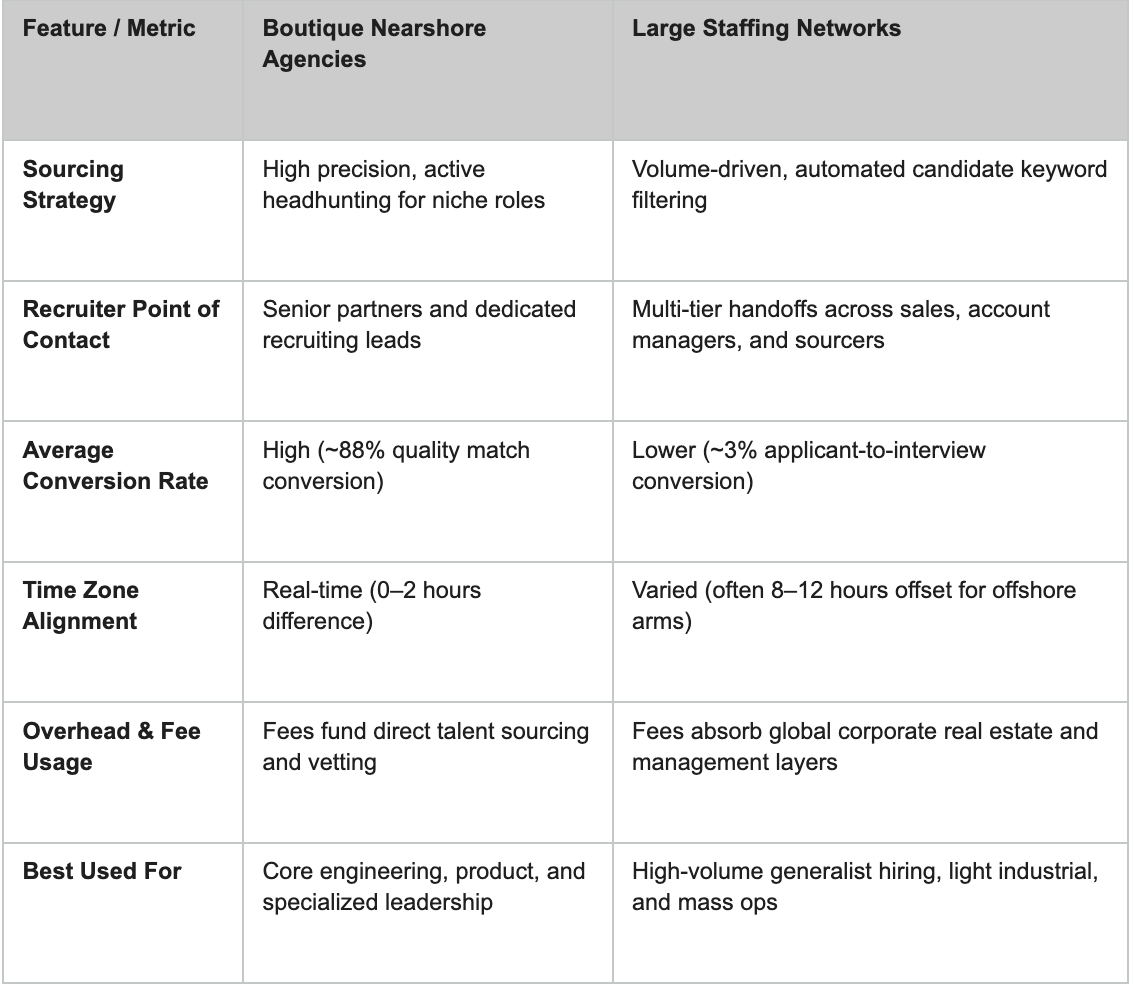
Pitting a specialized nearshore partner against a global staffing machine highlights fundamental differences in how work gets done. While both models aim to connect your business with qualified professionals, their internal incentives, operational workflows, and delivery methods diverge sharply. Examining these structural differences helps you anticipate the day-to-day experience of working with each type of firm.
Account Management vs. Multi-Tier Handoffs: Who Actually Handles Your Search?
In large staffing networks, the individual who sells you the service rarely participates in candidate sourcing. Enterprise firms operate on an assembly-line structure where business development managers secure contracts, account managers handle client communications, and junior sourcers run candidate outreach. Critical context about your engineering culture or technical requirements frequently gets lost across these internal handoffs.
Boutique agencies operate on a flat organizational structure. The senior partner or lead recruiter who conducts your initial discovery call handles candidate screening directly. Because the same professional manages both client expectations and candidate interviews, there is zero communication lag. Feedback from hiring managers immediately refines the active search without passing through multiple administrative layers.
Quality vs. Volume: Sourcing Precision against Candidate Flood
Large staffing firms rely on volume-driven metrics. Account managers inside big agencies are often evaluated on candidate submission speed and resume output, which can lead to high-volume resume dumps that pass the screening burden onto your internal hiring team. Standard recruitment funnels at high-volume firms yield an applicant-to-interview rate of roughly 3%, meaning 97 out of 100 applicants fail to meet basic requirements, according to benchmarking data from CareerPlug.
Boutique firms invert this model by prioritizing precision over raw candidate numbers. Instead of sending twenty unvetted profiles, a specialized nearshore agency typically presents three to five carefully curated candidates who match both technical needs and cultural requirements. This targeted strategy delivers measurable operational efficiency. In specialized and temporary talent placement scenarios, boutique recruiting approaches achieve up to an 88% conversion rate for quality solutions, according to reporting by Boutique Recruiting.
Pricing Models, Transparency, and Hidden Administrative Overhead
At first glance, markup percentages and placement fee structures may appear similar between boutique providers and global vendors. However, a look into fee allocation reveals where your financial investment actually goes.
When you pay a large staffing network, a significant portion of your placement fee covers non-recruiting overhead, including corporate real estate, enterprise software licenses, executive management tiers, and global marketing budgets.
When you partner with a boutique nearshore agency, fees directly support dedicated recruitment labor, regional compensation packages, and thorough candidate vetting. Additionally, boutique agencies often offer flexible contract terms, adaptable statement of work (SOW) structures, and custom guarantee periods that reflect a true partnership rather than a rigid corporate contract.
Choosing Between Boutique Nearshore Agencies and Staffing Networks
Selecting the right partner requires balancing your growth trajectory against your team's operational needs. While both staffing models connect businesses with external talent, they serve entirely different strategic goals. Making the right choice comes down to assessing whether your business needs specialized, high-retention talent or rapid, high-volume capacity.
When to Partner with a Boutique Nearshore Agency:
Boutique nearshore agencies excel when your organization prioritizes placement quality, cultural cohesion, and specialized technical expertise over raw candidate volume. Partnering with a dedicated nearshore specialist makes sense under specific growth conditions.
You should consider this route if you are hiring core product developers, cloud architects, or specialized engineers where a bad hire can derail product roadmaps. A single mid-level bad hire can quietly cost a business between 1.5 and 3 times that employee's annual salary, according to data published by People Atlas HR.
This path is also ideal if your internal workflow relies on daily standups, spontaneous messaging, and active collaboration during standard North American business hours. You will benefit most if you need long-term team members who integrate deeply into your corporate culture, rather than short-term project contractors who rotate off after a few months. Additionally, choosing a boutique agency ensures you get direct access to seasoned recruiting partners managing your account directly, rather than having your requirements passed down through multiple internal corporate layers.
If your primary goal is building a cohesive, highly skilled engineering or operational unit that functions as a natural extension of your internal team, the boutique model delivers superior long-term ROI.
When Enterprise Staffing Networks Are the Superior Choice:
Global staffing networks remain the industry standard for large-scale operations requiring mass headcount, standardized corporate governance, and multi-region administrative support. Selecting a global vendor is the right move when your hiring needs meet specific enterprise criteria.
These major vendors are built for situations where you need to fill dozens or hundreds of standardized administrative, customer support, or light industrial positions across short timeframes. They fit seamlessly into environments where your corporate procurement strategy requires all vendor management to flow through a centralized Vendor Management System or Managed Services Provider.
Furthermore, if you are expanding operations into distant international regions concurrently, a global vendor provides a single point of contact with local legal entities. This approach also appeals to executive leadership teams that prefer working with legacy staffing vendors carrying massive balance sheets and standardized Master Service Agreements.
When sheer scale, rapid contract execution, and standardized compliance take priority over hyper-specialized talent matching, large networks offer the necessary global infrastructure.
Hybrid Sourcing Strategies for Mid-Market Scaling:
Growing mid-market companies do not always have to choose between models exclusively. Many high-growth organizations deploy a dual-track strategy to optimize their recruitment spend and operational efficiency.
Under a hybrid approach, companies leverage large staffing networks for high-volume operational staffing, basic payrolling, and generalist contract labor. Concurrently, they partner with boutique nearshore agencies to recruit core engineering leads, product managers, and specialized technical teams. This dual strategy ensures enterprise-grade scale for routine operations while protecting team culture and technical execution where performance matters most.
Ready to Hire LATAM Talent With a Dedicated Nearshore Agency?
Finding the ideal staffing partner is about far more than just filling open seats; it directly impacts your team's execution speed, retention rates, and long-term operating costs. When you weigh the precision of boutique agencies against the sheer volume of global networks, the right choice ultimately depends on whether your priority is generic headcount or dedicated, highly aligned talent.
At Hire South, we bring the best of both worlds to growing mid-market companies. We deliver specialized nearshore staffing across Latin America, connecting you with pre-vetted, bilingual professionals who work directly in your time zone. By screening thousands of candidates down to the top 1%, our team helps businesses cut payroll overhead by up to 40% while maintaining the high performance, cultural alignment, and retention required to scale with confidence. Ready to start hiring? Contact us to book a discovery call today!

.jpg)