
.jpg)

Building a modern engineering or revenue team no longer requires battling local domestic wage inflation or managing transactional freelancers on gig platforms. US companies cut operating expenses by 50% to 70% when hiring senior engineers, marketers, and operations staff in Latin America.
However, cost savings are only half the equation. The platform model you choose determines whether you gain a dedicated, long-term operational team or an endless cycle of contractor churn and administrative overhead.
This guide evaluates Hire South vs. Upwork to help founders, CTOs, and HR leaders choose the optimal talent acquisition strategy. It breaks down the true total cost of ownership, technical vetting rigor, cross-border compliance, and the best Upwork alternatives for scaling LATAM hires. Keep reading to start building a true global team!
Why Companies Got Used to Hiring Talent From Upwork
The modern trend of hiring remote talent largely traces back to open online marketplaces. Millions of business leaders got their first taste of global hiring through platforms built for speed and low initial overhead. Understanding why companies default to these platforms helps explain why so many eventually search for alternatives as their teams mature.
1. The Frictionless Onboarding of Global Talent
Setting up an account takes less than five minutes. You do not need to navigate local labor laws, negotiate employment contracts, or establish overseas business entities.
The immediate convenience is hard to ignore. Over 784,000 active clients regularly post jobs on Upwork, according to Upwork's 2026 platform earnings disclosures. The ability to post a job description at night and wake up to twenty proposals from across the globe created a brand new paradigm for business speed.
2. Access To an Unmatched Pool of Specialized Workers
Marketplaces offer an incredible breadth of skills under a single search bar. You can find a niche database administrator, a video editor, or a voiceover artist without leaving the platform interface.
Upwork hosts over 18 million registered freelancers across more than 180 countries, according to DemandSage's 2026 Global Data Report. This massive inventory provides on-demand capacity, allowing companies to tap specialized skills for micro-tasks lasting as little as two hours. Job posters filter candidates directly by hourly rate, job success score, verified earnings, and location.
This global reach made talent sourcing feel as simple as ordering e-commerce products online.
3. A Low-risk Environment for Small Budget Experiments
Testing new project ideas requires speed and financial safety. Early-stage businesses and small teams rarely have the capital to commit to full-time hires for unproven concepts. Escrow payment protections lower the risk of hiring strangers across borders. Funds sit safely in escrow until you verify that the work meets your quality standards.
If a trial project fails, you simply close the contract, pay for the logged hours, and move on. That low financial barrier to entry made project-based hiring the default starting point for digital businesses everywhere.
Why Companies Should Look for Dedicated Nearshore Alternatives
Despite their convenience, relying indefinitely on transactional freelance platforms creates hidden friction for growing businesses. What works for a quick design fix rarely scales into a stable operational framework. As project complexity increases, companies run into structural limits that slow down execution and drain internal resources.
1. The High Cost of Continuous Talent Churn
Managing a revolving door of contractors drains momentum. Freelancers often rotate off projects suddenly when higher-paying gigs pop up or personal client capacity shifts.
Replacing an employee costs between 50% and 200% of their annual salary, according to Gallup research. While replacing a freelancer seems faster on paper, the repetitive cycle of posting jobs, reviewing proposals, and conducting technical evaluations burns valuable executive bandwidth.
Contractor churn forces your core team into an endless cycle of re-boarding and context-setting rather than focusing on core strategic initiatives.
2. Overcoming The Context Switching Penalty
Freelancers naturally split their focus across multiple client accounts simultaneously. This fragmented attention creates subtle bottlenecks across your entire organization.
Asynchronous message gaps stall urgent daily decisions. Institutional knowledge leaves the moment a project milestone closes. External contractors rarely absorb your internal operating principles or long-term vision.
Dedicated nearshore hires work exclusively within your ecosystem. They attend your daily standups, adapt to your communication channels, and build lasting organizational memory.
3. Solving Compliance and Payroll Complications
Scaling a team across international borders introduces severe legal and financial landmines. Treating permanent workers as independent contractors can trigger severe misclassification penalties from tax authorities.
Boutique nearshore staffing partners act as legal employers of record or supply compliant hiring frameworks tailored to local labor laws in countries like Colombia, Brazil, and Mexico. They handle local payroll taxes, statutory benefits, and legally binding IP assignment agreements.
This infrastructure lets you scale globally without establishing costly foreign legal entities or risking unexpected regulatory audits.
Hire South vs Upwork Comparative Analysis
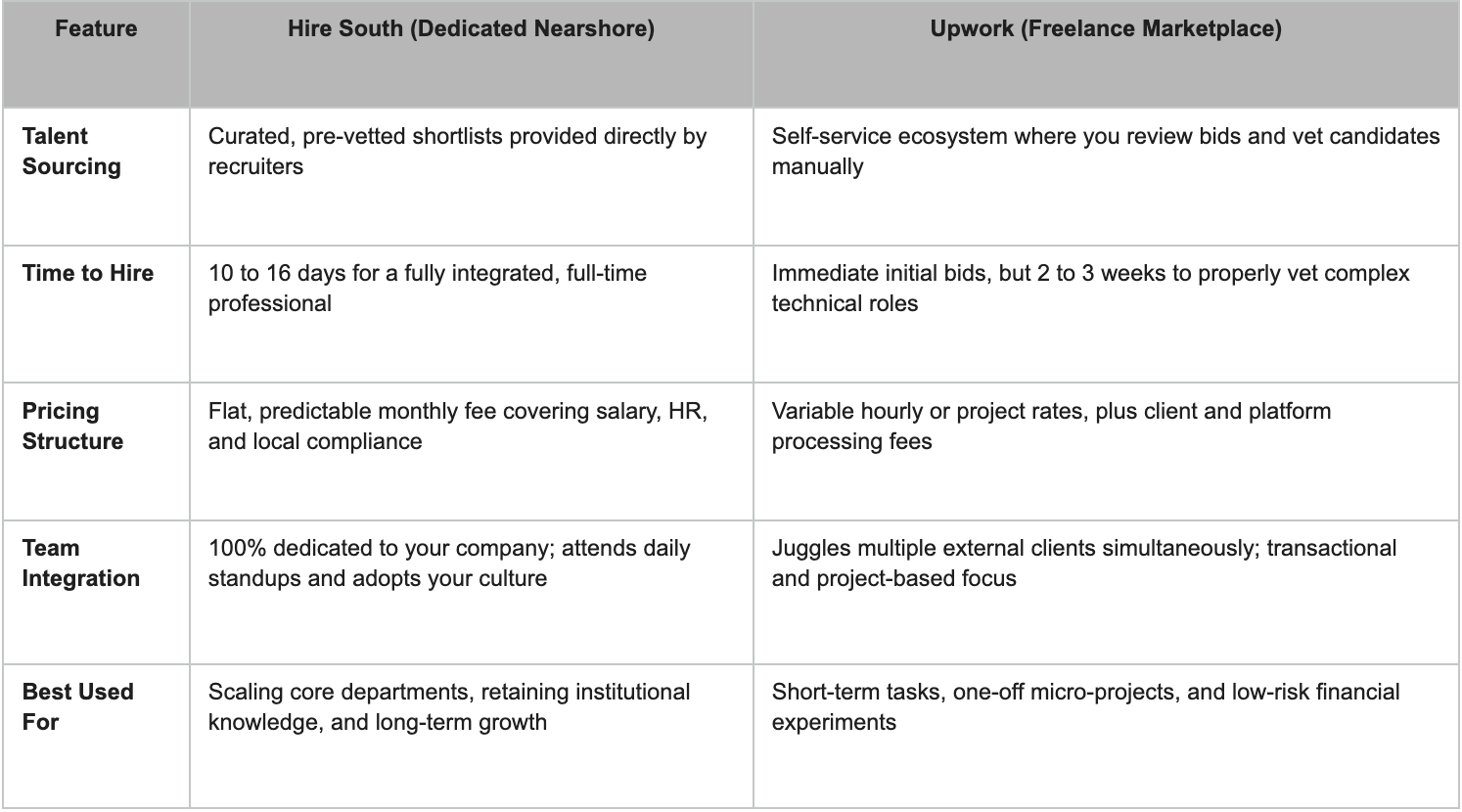
Choosing between a dedicated nearshore staffing agency and a global freelance marketplace comes down to your core hiring objectives. While both models connect US companies with skilled remote professionals, their delivery mechanisms, financial structures, and long-term operating outcomes diverge significantly.
Evaluating these structural differences helps identify which platform aligns with your immediate project requirements and broader growth strategy.
Talent Quality and Sourcing Methodologies:
Marketplaces rely on a self-service, open-bidding ecosystem. Platform algorithms and client reviews flag high-performing freelancers, but initial talent discovery remains an unassisted manual process.
Upwork processes thousands of bids daily across millions of active freelancer profiles. This model creates a vast, highly diverse talent pool, but it places the entire burden of technical screening, identity verification, and cultural assessment on the employer.
Boutique nearshore agencies operate as curated recruitment partners. Organizations like Hire South utilize localized recruitment networks to source, interview, and pre-vet candidates across specific operational verticals. Candidate pools are filtered down to senior-level bilingual professionals, cutting initial shortlisting down to a few pre-screened options.
Sourcing Efficiency and Delivery Timelines:
Speed to hire varies depending on whether you need temporary labor or a permanent team member. Posting a project on a gig marketplace can yield initial proposals within hours. The timeline to screen candidates, run code tests, verify portfolios, and execute contracts typically averages two to three weeks for complex or specialized technical roles.
Nearshore recruitment firms streamline candidate matching through pre-vetted databases. Placement cycles for full-time nearshore staff generally take between 10 to 16 days from initial intake to final candidate onboarding, eliminating internal recruiting overhead.
Cost Structures and Administrative Margins:
Financial obligations extend beyond baseline hourly compensation on both platform types.
Marketplaces generate revenue by applying client payment processing fees and charging service fees directly to contractors. While starting hourly rates on open marketplaces often appear low, administrative costs grow over time through hidden management overhead, project scope creep, and context-switching penalties.
Dedicated nearshore models offer flat, predictable pricing schedules. The monthly fee covers the candidate's direct compensation, cross-border payroll logistics, local compliance, and ongoing HR support. US businesses saving up to 70% compared to domestic hires gain additional cost stability by avoiding transactional bidding spikes and client platform markups.
Engagement Models and Retention Rates:
The structural difference in worker commitment directly dictates how candidates integrate into daily operations.
Freelancers on gig platforms naturally manage multiple clients simultaneously to maximize personal revenue. This fragmented focus frequently leads to variable project delivery schedules and elevated turnover once a specific contract milestone concludes.
Dedicated nearshore staff work exclusively for your organization. They log standard company hours, adopt internal software stacks, participate in regular team meetings, and align with corporate culture. This single-client alignment increases long-term retention and allows companies to build lasting institutional knowledge within their remote LATAM workforce.
How To Know When To Move From Upwork to Dedicated Remote Hiring
Freelance marketplaces serve a distinct purpose during the early stages of business growth. However, there comes a specific point where the flexibility of the gig economy starts working against your long-term goals. Identifying that transition period ensures you do not waste resources managing temporary workers when you actually need a permanent team.
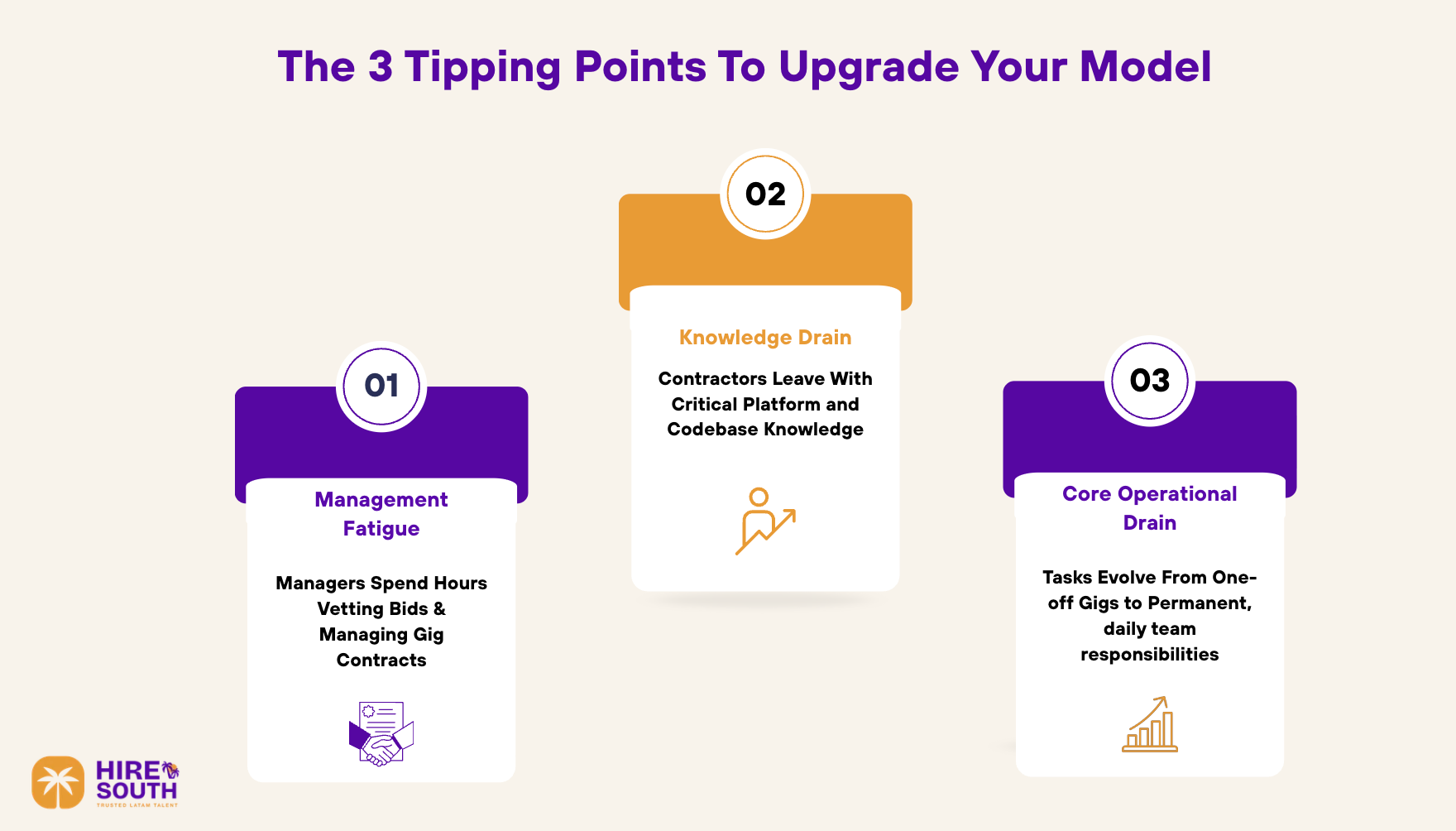
The Tipping Point of Management Fatigue.
Your middle managers should focus on strategic growth rather than acting as full-time project coordinators. When leaders spend more hours assigning tasks, reviewing gig work, and processing multiple freelance invoices than they do on actual product development, the marketplace model has broken down.
Constantly onboarding new contractors creates severe operational drag. Replacing a professional in a technical role costs approximately 80% of their salary in lost productivity and training time, according to Gallup's workplace turnover research. Every time a freelancer leaves a project, your internal team absorbs that hidden cost through wasted administrative hours and workflow bottlenecks.
When Institutional Knowledge Becomes a Liability
Short-term contractors build temporary solutions without understanding the historical context of your business. As your operations become more complex, relying on individuals who do not retain institutional knowledge introduces massive risk.
Marketplace workers take their learnings with them when they log off. If a critical piece of custom software breaks or a long-term marketing strategy stalls, you cannot rely on a freelancer who has already moved on to another client's project. Dedicated nearshore professionals document processes, understand your specific client nuances, and ensure that valuable company data stays securely inside your organization.
Transitioning from Project Execution to Core Operations.
The clearest signal that it is time to upgrade your hiring model is the nature of the work itself. Marketplaces excel at isolated deliverables like a one-off website redesign or a single promotional video.
Once those isolated tasks evolve into ongoing operational needs, the freelance model fails. You cannot build a reliable customer success department or a stable software engineering pod using workers who bid on weekly hourly contracts. When you require predictable daily capacity, synchronous collaboration, and unwavering alignment with your company goals, transitioning to a dedicated LATAM talent partner becomes the only logical step forward.
The Transition Framework: Moving from Upwork to Dedicated Nearshore Pods
Step 1: Conduct a Workforce Audit
Catalog your active contractors across platforms like Upwork and Fiverr. Identify roles that have logged more than 20 hours per week for over three consecutive months. These are no longer temporary projects but permanent operational roles with long-term ROI.
Step 2: Define Core vs. Fractional Needs
Reserve freelance marketplaces for isolated, low-risk deliverables (such as a 2-hour video edit or annual audit). Transition core software engineering, customer support, and growth marketing positions to dedicated nearshore placements.
Step 3: Partner with a Specialized Nearshore Recruiter
Collaborate with a nearshore partner like Hire South to build clear candidate profiles, establish local benchmark compensation, and initiate headhunting across regional LATAM hubs.
Frequently Asked Questions About Upwork Alternatives
Is Upwork suitable for full-time hiring?
While Upwork permits full-time hourly contracts, its ecosystem is built around transactional, project-based freelancing. Freelancers often manage multiple clients, leading to variable retention rates compared to dedicated nearshore staffing models.
How does Hire South handle cross-border compliance and IP protection?
Hire South manages cross-border legal contracts, IP assignment agreements enforced under US law, and localized payroll taxes in compliance with regional LATAM labor regulations (e.g., in Mexico, Colombia, Argentina, and Brazil).
What are the main cost differences between Hire South and Upwork?
Upwork charges hourly/project fees plus a 3%–5% client processing fee, with project costs that can vary over time. Hire South utilizes flat, transparent monthly pricing that covers full-time candidate salaries, compliance, cross-border payroll, and ongoing account support, saving US companies up to 70% compared to domestic hires.
How fast can Hire South place a remote LATAM professional?
Most recruitment searches at Hire South present pre-vetted candidate shortlists within 5 to 7 days, with selected professionals fully onboarded and integrated into your team within 10 to 16 business days.
Ready to Upgrade Your LATAM Talent Strategy Today?
Relying on temporary gig marketplaces to build core business operations introduces unnecessary friction, context loss, and manager fatigue.
At Hire South, we replace endless bidding with a curated recruitment framework. We connect growing US companies directly with the top 1% of pre-vetted LATAM professionals who work in your time zone, adopt your internal workflows, and integrate into your company culture.
Every placement is backed by flat monthly pricing, full legal compliance, cross-border payroll logistics, and a 90-day replacement guarantee. Ready to build a dedicated LATAM team? Book a 30-Minute Strategy Call to outline your hiring needs and review exact salary benchmarks for your next key hire!