


Running a medical practice often feels like you are drowning in paperwork instead of actually treating patients. The administrative load keeps growing, but local hiring costs can quickly drain your budget. That is where nearshore talent comes in to save your operations.
Up to 78% in administrative staffing costs can be saved by integrating virtual medical support into your workflow, according to VA Masters. Nearshore assistants give your clinic room to breathe without sacrificing patient care quality.
This guide breaks down everything you need to know about scaling your practice with Latin American talent. You will learn how top agencies like MedVA operate, how to guarantee strict HIPAA compliance, and why LATAM time zones make daily collaboration seamless. Read on to see how you can streamline operations, protect your bottom line, and give your clinical team their time back.
What a HIPAA-compliant Virtual Assistant Does
Navigating administrative overload can drain your practice's resources fast. Physicians spend nearly 28 hours every week on administrative tasks, according to a survey conducted by The Harris Poll. A HIPAA compliant virtual assistant absorbs this backend friction without exposing your practice to regulatory risk. Operating under strict privacy frameworks, these remote specialists keep sensitive electronic Protected Health Information (ePHI) secure while giving your core team room to focus on direct patient care.
Core Operational Responsibilities of a Medical Virtual Assistant:
Modern medical virtual assistants cover a wide range of administrative, revenue cycle, and patient coordination duties. Their daily work targets the manual bottlenecks that slow down patient throughput and delay payments.
Insurance verification and patient intake represent a primary focus area. Assistants cross-reference coverage details, confirm copays, and process digital registration forms before patients arrive for their appointments.
Managing prior authorizations takes up substantial office time when handled in-house. Remote assistants step in to initiate, track, and log payer approvals so treatments, diagnostic tests, and specialty prescriptions clear without triggering unexpected claim denials.
Live scribing and EHR chart maintenance keep clinical records up to date. During patient encounters, virtual scribes document chart notes directly into primary systems such as Epic or Cerner, freeing doctors from hours of after-hours paperwork.
Billing, coding, and claims follow-up keep your cash flow predictable. Assistants review charts for proper coding, flag documentation gaps, and systematically work unpaid claims to resolve rejections.
Patient outreach and recall coordination keep your schedules full. Assistants run recall lists, respond to portal messages, and confirm upcoming appointments, which reduces no-shows and stabilizes practice revenue.
Technical and Physical HIPAA Security Safeguards:
A virtual assistant maintains HIPAA compliance through strict protocols governing every tool, device, and network connection they use. Data protection is built directly into their physical environment and computer setup.
Workstations access clinical systems using encrypted Virtual Private Networks (VPNs) paired with multi-factor authentication (MFA). Laptops run full-disk AES-256-bit encryption, and access controls limit visibility strictly to the patient records required for specific tasks. Automatic system timeouts lock inactive screens, and automated session logs create clear audit trails for compliance checks.
Physical environment rules are equally strict. Virtual assistants work from dedicated, private home offices with closed doors to prevent unauthorized viewing. Screen privacy filters prevent shoulder surfing, while clean-desk policies strictly prohibit downloading local files, photographing personal phones, or printing ePHI on paper.
Legal Compliance and the Business Associate Agreement:
Before any assistant handles patient records, a Business Associate Agreement (BAA) must be fully executed. Under federal privacy regulations, any third-party vendor or remote contractor with access to ePHI operates as a legal Business Associate.
Covered entities must sign a formal Business Associate Agreement before granting remote contractors access to protected health information, according to the U.S. Department of Health and Human Services.
The BAA defines permitted uses of ePHI, details mandatory security safeguards, and requires immediate reporting if a potential security incident occurs. Established agencies also have assistants sign individual non-disclosure agreements, adding another layer of legal protection for your practice.
Cost Benefits of Outsourcing Them to Latin America
Managing operational overhead is an ongoing struggle for medical practices. Administrative expenses account for roughly 25% of total U.S. healthcare spending, according to a report published in JAMA. Sourcing qualified support from Latin America offers an effective way to lower these operational burdens without reducing service levels.
1. Direct Hourly Salary Savings and Pay Structure Comparisons
Traditional U.S. hiring comes with high base wage expectations. Medical assistants in the United States earn a median wage of $21.25 per hour, according to the U.S. Bureau of Labor Statistics. In high-cost metro regions, that rate regularly rises to $28 or more per hour.
Nearshore virtual medical assistants in Latin America earn competitive local rates that typically translate to $900 to $1,500 USD per month. Converting this monthly pay to hourly rates puts nearshore compensation around $6 to $10 per hour. Practices save substantially on core wage expenses while providing strong, high-tier compensation within LATAM local job markets.
2. Elimination of Payroll Taxes, Benefits, and Capital Expenditures
Base compensation represents only part of total local staffing expenses. U.S. employers pay extra overhead on every full-time employee, covering mandatory items such as employer-side taxes, health insurance, paid leave, and retirement contributions.
Working with nearshore staffing agencies turns variable administrative overhead into a single, predictable line item. The agency manages worker benefits, localized tax withholdings, and hardware allocation. You avoid capital expenditures for dedicated office computers, desk space, and extra software licenses.
3. Increasing Revenue Through Higher Patient Throughput
Cost reduction is only half of the financial benefit. Offloading routine desk tasks to remote staff directly boosts your practice's revenue potential.
When remote assistants handle check-ins, insurance verifications, and prior authorizations, your on-site medical staff can focus entirely on clinical workflows. Physicians spend less time entering chart data, letting them see additional patients each day. Uncovering and resolving unpaid claims faster prevents missed billing deadlines and decreases overall claim rejection rates, stabilizing monthly revenue collections.
Why LATAM Outperforms Other Regions
Selecting a remote workforce involves looking beyond base salaries. While offshore destinations like the Philippines or India have historically dominated administrative staffing, Latin America has emerged as the preferred hub for healthcare operations. LATAM combines geographic proximity, cultural alignment, and strong educational pipelines to deliver a seamless extension of your medical team.
1. Real-Time Collaboration via Time Zone Alignment
Operating across massive time zone gaps creates friction in clinical environments. When assistants work 9 to 12 hours ahead, urgent prior authorizations, last-minute schedule changes, and real-time patient inquiries stall until the next business day.
Latin American countries operate within Central Standard Time (CST), Eastern Standard Time (EST), and Mountain Standard Time (MST). Working in parallel with your physical clinic hours means virtual assistants field inbound calls, verify insurance, and chart visits during live patient care. Real-time communication eliminates morning inbox backlogs and resolves patient questions on the spot.
2. Superior English Fluency and Neutral Accents
Clear communication is mandatory when handling sensitive health details and patient billing questions. Misunderstandings lead to medical errors, dropped calls, and frustrated callers.
Latin America continuously improves its language skills, with countries like Argentina and Costa Rica leading the region in high-to-moderate proficiency bands, according to the EF English Proficiency Index. Nearshore medical VAs typically possess C1 or C2 level English fluency. They speak with clear, neutral accents that put elderly or stressed callers at ease during routine phone check-ins and intake assessments.
3. Cultural Affinity and Patient Care Empathy
Healthcare relies heavily on emotional intelligence and soft skills. Latin American culture shares strong societal and cultural ties with North America, translating into natural empathy during patient interactions.
Virtual assistants trained in LATAM demonstrate high levels of patience and warm interpersonal communication. Whether dealing with an anxious patient seeking test results or navigating a difficult insurance agent, nearshore assistants handle complex conversations with composure, protecting your practice's local reputation.
4. The Bilingual Advantage for a Diverse Patient Base
Serving Spanish-speaking patients presents an ongoing challenge for many U.S. clinics. Nearly 14% of the U.S. population speaks Spanish at home, according to data from the U.S. Census Bureau.
Hiring a bilingual virtual assistant based in Latin America gives your practice native Spanish capabilities alongside fluent English skills. Assistants switch between languages effortlessly to intake non-English-speaking patients, explain post-care instructions, and manage bilingual consent documentation, helping your practice expand its reach without paying premium local rates for bilingual staff.
How HIPAA-compliant Virtual Medical Assistants Recruitment Works
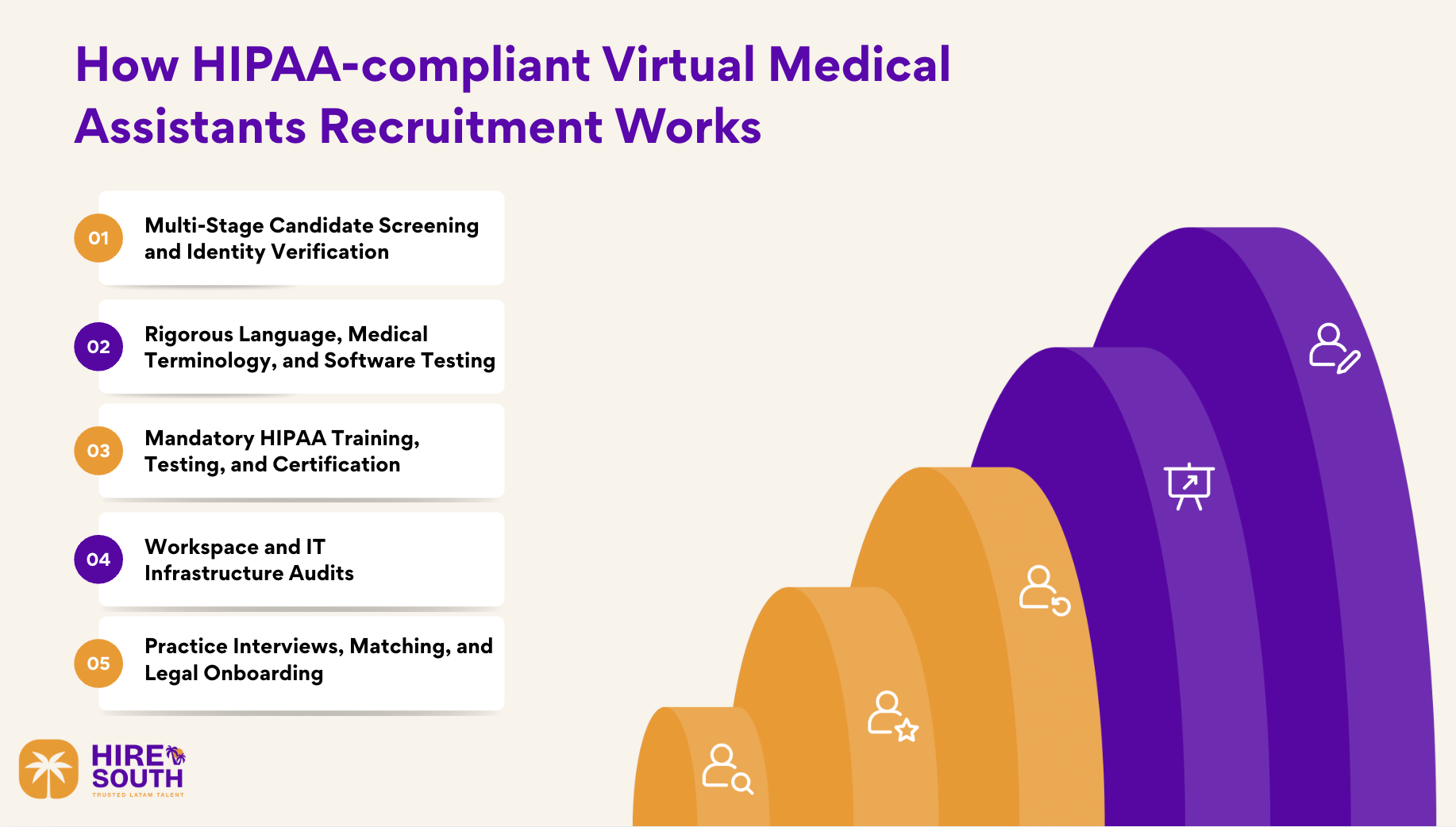
Sourcing qualified remote healthcare staff requires a disciplined hiring pipeline. You cannot rely on standard remote job boards when handling sensitive patient data. Healthcare data breaches cost an average of $6.64 million per incident, according to the IBM Cost of a Data Breach Report. Partnering with specialised placement agencies or running a strict internal recruitment strategy ensures candidates possess verified clinical skills, strong technical infrastructure, and rigorous compliance habits.
Multi-Stage Candidate Screening and Identity Verification:
The recruitment process begins by filtering out unqualified applicants through multi-tiered assessments. Agencies evaluate hundreds of resumes to isolate candidates with genuine medical administration backgrounds, nursing credentials, or prior healthcare experience.
Identity verification is the first critical security checkpoint. Candidates submit government-issued identification, tax numbers, and proof of address. Agencies cross-reference national police registries in the candidate's home country to run comprehensive background checks, ensuring zero history of financial crime, identity theft, or data privacy infractions.
Rigorous Language, Medical Terminology, and Software Testing:
Once basic background checks clear, candidates undergo practical testing designed to reflect live clinic scenarios. Written and spoken English assessments evaluate real-time communication, ensuring zero misunderstandings during patient interactions.
Technical evaluations test candidate familiarity with major Electronic Health Record (EHR) platforms like AthenaHealth, and eClinicalWorks. Candidates complete timed exercises covering medical coding terminology, intake processing, and prior authorization workflows to confirm immediate job readiness.
Mandatory HIPAA Training, Testing, and Certification:
Before any candidate meets your practice for an interview, they complete specialized HIPAA and cybersecurity training modules. This step goes beyond theoretical knowledge; candidates must demonstrate practical understanding of privacy rules, security standards, and breach notification steps.
Agencies administer formal certification exams, requiring high passing scores, typically 90% or higher, before adding candidates to their active hiring pool. Candidates sign individual confidentiality and non-disclosure agreements (NDAs) that legally bind them to maintain privacy standards throughout their engagement.
Workspace and IT Infrastructure Audits:
Technical readiness is evaluated before a final placement offer is extended. Agency IT specialists perform remote security audits on the candidate's physical workspace and computer equipment.
The audit confirms the candidate uses a high-performance computer running supported operating systems with full-disk encryption. Inspectors check internet speed stability, require backup connection sources, and verify the presence of an Uninterruptible Power Supply (UPS) to prevent sudden dropouts. Software checks ensure endpoint protection, enterprise antivirus programs, and secure VPN connections are active before granting access to client systems.
Practice Interviews, Matching, and Legal Onboarding:
The final recruitment phase brings shortlisted candidates directly to your clinical leadership for interviews. You receive two or three pre-screened profiles complete with skill assessment scores, interview recordings, and background check confirmations.
After selecting your preferred assistant, legal documentation is finalized. You sign a formal Business Associate Agreement (BAA) with the staffing agency. The agency manages localized payroll, human resources, and ongoing compliance monitoring, allowing your new virtual team member to integrate seamlessly into your daily clinical operations.
Ready to Hire Virtual Medical Assistants in Latin America?
Integrating nearshore talent into your medical practice transforms backend operations while keeping administrative overhead under control. Partnering with a dedicated nearshore agency bridges the gap between top-tier Latin American talent and rigid U.S. compliance standards, letting your clinical team step back from paperwork and focus entirely on patient outcomes.
At Hire South, we connect medical practices with pre-vetted, bilingual nearshore virtual assistants operating directly in your time zone. Our full-service sourcing and vetting model lowers labor expenses by up to 53% compared to local hiring without sacrificing quality, technical security, or HIPAA compliance safeguards. Book a free discovery call today to build your dedicated nearshore team in 21 days or less!
.jpg)