
.jpg)

Building a top-tier remote customer support team in Latin America has quickly shifted from an outsourcing secret to a core business strategy. The regional talent pool is massive, highly educated, and culturally aligned with North American markets. According to data from the Inter-American Development Bank, Latin America boasts an active, tech-savvy labor force of over 300 million people, offering an incredible deep well of bilingual professionals ready to handle your front lines.
This guide breaks down everything you need to know to build, manage, and scale a high-performing nearshore team. You will discover how to source the best regional talent, navigate local compensation expectations, and set up a cloud-based infrastructure that keeps your remote agents secure and productive. Here is your roadmap to building a world-class support presence in LATAM.
Why You Should Build Remote Teams in Latin America for Customer Support
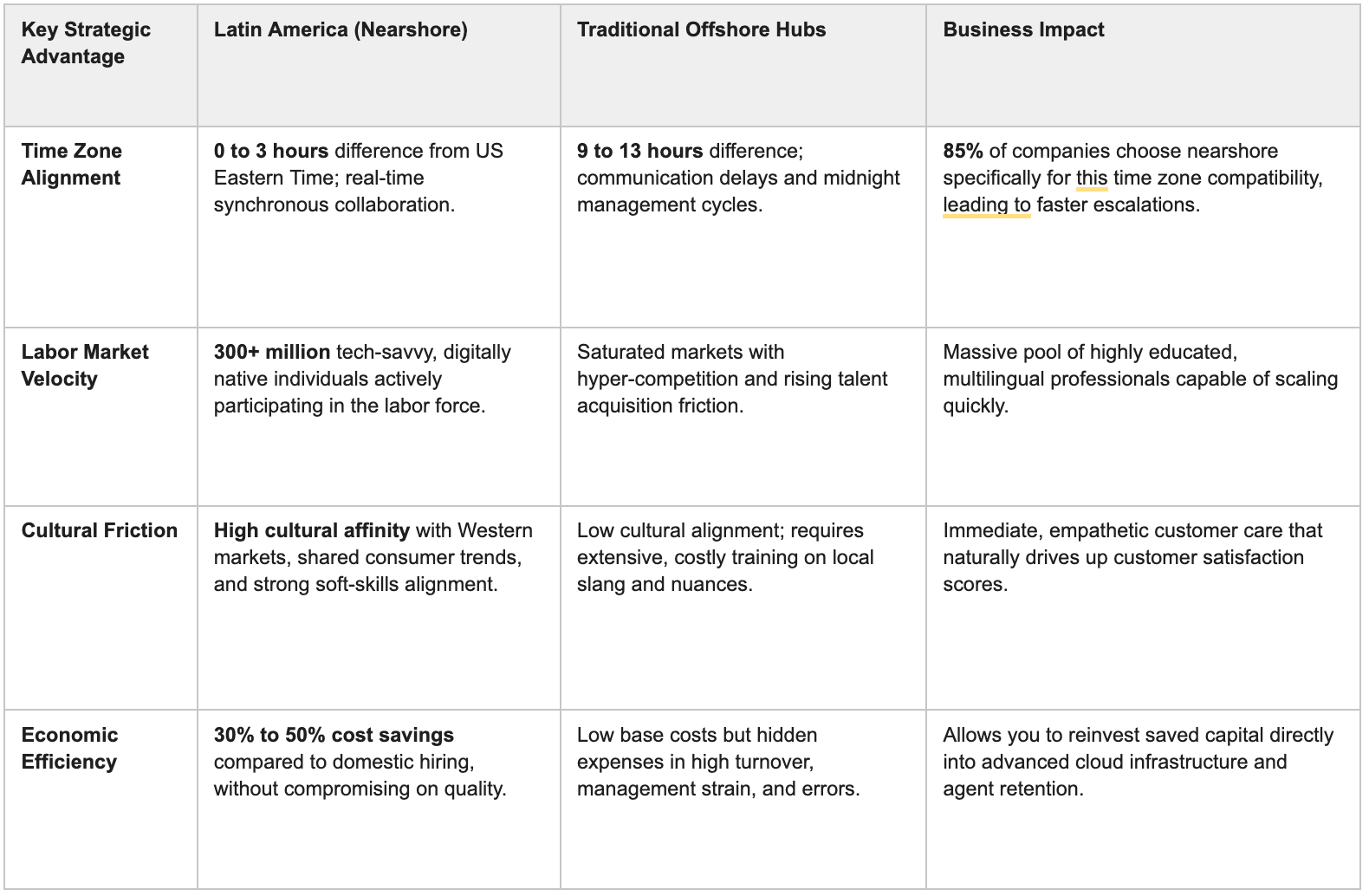
Shifting your support operations to Latin America is no longer just a trend, it is a calculated business move that resolves the structural headaches of traditional offshoring. When you build a customer support team in this region, you bridge the gap between cost efficiency and high-caliber customer experience.
Leveraging Nearshore Proximity for Real-Time Synchronous Support:
Time zone friction can silently drain your management resources. Traditional offshore locations often require managers to log on at midnight or wait 12 hours for a simple email reply. By utilizing a nearshore model, your remote customer support team operates in real time alongside your domestic headquarters. According to research published by ScaleupAlly, 85% of companies choose nearshore outsourcing specifically for its time zone compatibility, which allows for immediate feedback loops and seamless daily collaboration.
This synchronous workflow completely changes how you handle urgent customer escalations. Your agents are active when your customers are active, leading to faster response times and significantly higher customer satisfaction scores.
Accessing an Expansive, Highly Educated Regional Talent Pool:
The workforce throughout Latin America is highly educated, digitally native, and increasingly specialized in customer success. Governments across major regional hubs have invested heavily in technical education and bilingual training programs over the last decade. According to the World Economic Forum's Future of Jobs Report, 84% of employers in Latin America and the Caribbean are actively upskilling their workforce to meet the skyrocketing global demand for advanced digital and technical roles.
Furthermore, cultural alignment with North American and European markets reduces the need for extensive soft-skills training. Your agents understand the nuances of consumer behavior, slang, and corporate expectations, allowing them to deliver empathetic support right out of the gate.
Unlocking Cost Efficiencies Without Sacrificing Service Quality:
Managing a budget requires maximizing the return on every dollar spent. Building remote teams in Latin America offers an ideal balance by lowering operational costs while maintaining exceptional quality metrics. According to data from the Inter-American Development Bank, nearshore outsourcing is projected to contribute an additional $78 billion to Latin American and Caribbean export industries, driven heavily by companies looking for premium alternatives to traditional offshore hubs.
By expanding your customer support team-building efforts into this region, you benefit from a lower cost of living that translates into competitive base salaries for top talent. These savings allow you to reinvest in advanced support tools, comprehensive training, and robust retention strategies, keeping your customer support sharp, reliable, and highly scalable.
Planning Your Strategy for Building a Remote Customer Support Team
Launching a distributed operations framework requires more than just picking a country and posting job openings. A successful strategy demands a structural blueprint that aligns your business goals with the unique operational landscape of Latin America. Setting up this framework correctly from day one prevents communication bottlenecks, minimizes cross-border friction, and ensures a predictable cost structure.
1. Defining Omnichannel Service Standards and Performance Metrics
Before hiring your first regional representative, you need to lock down exactly how your support channels will function. Customers expect immediate, low-effort resolutions regardless of whether they reach out via chat, email, or a messaging app. According to data published by Unthread, companies that implement strong omnichannel strategies retain 89% of their customers, compared to a mere 33% retention rate for organizations with fragmented, weak strategies.
Your operational strategy must explicitly define key performance indicators like first contact resolution, customer effort score, and average handle time. For example, because every 1% improvement in first contact resolution yields a direct 1% increase in overall customer satisfaction according to SQM Group research, your workflow should empower regional agents to resolve tickets autonomously without transferring the user. Defining these target metrics early gives your nearshore team clear benchmarks to hit right from their first login.
2. Mapping Out the Ideal Team Structure for Distributed Operations
Determining how your nearshore team integrates with your domestic workforce is a critical structural decision. Will your Latin American team operate as an independent tier-one filter, or will they work side-by-side with your local tier-two and tier-three specialists? A hybrid structure often yields the best operational balance, blending local technical oversight with scalable nearshore support.
This layout maximizes both regional capability and budget efficiency. According to workforce analytics from Unthread, companies save an average of $11,000 per remote employee annually on real estate, utilities, and office overhead. By reinvesting these saved funds into specialized technical leads and regional managers within Latin America, you build a self-governing hierarchy that handles high ticket volumes without constantly leaning on your home office for supervision.
3. Aligning Corporate Culture Across Cross-Border Hubs
A remote team without a unified culture quickly defaults to feeling like a transactional vendor rather than an extension of your brand. True cultural alignment requires conscious planning and deliberate communication structures. This means you must explicitly loop your Latin American agents into company-wide town halls, product roadmap updates, and digital team-building spaces.
To make this alignment stick, integrate your remote support team into daily conversational workflows using platforms like Slack or Microsoft Teams. When nearshore agents share the same digital workspaces, social channels, and peer-recognition programs as your onshore staff, the geographical distance fades. Building this shared identity fosters a sense of ownership, motivates agents to champion your brand voice, and ultimately drives better interactions with your customers.
Best Practices for Managing a Dynamic Customer Support Team
Once your nearshore operations are up and running, your primary objective shifts from recruitment to sustainable management. Managing a distributed network of professionals across multiple time zones requires clear structures that prevent burnout, drive accountability, and maintain service consistency.
1. Establishing Clear Communication Cadences and Accountability Rhythms
Managing a remote team means you cannot rely on informal office interactions to gauge performance or morale. Instead, you must build intentional touchpoints into the weekly schedule. A lack of structure leads to operational drift, where agents lose touch with core company updates and process changes. According to a large-scale work activity study by WebWork Tracker, remote workers split their days almost equally between production and coordination, spending roughly 34% of their active time inside asynchronous communication tools.
To maximize this coordination time, set up short, 15-minute daily syncs every morning. Use these huddles to address immediate ticket backlogs, share product updates, and unblock any difficult customer issues. Follow this up with bi-weekly one-on-one sessions focused entirely on the agent’s professional development, performance metrics, and general well-being. This balance of daily operational alignment and personal feedback keeps your team organized without overwhelming them with unnecessary meetings.
2. Tracking Shared Metrics and Utilizing Transparent Live Dashboards
Data should drive every management decision you make. When operating across international borders, utilizing centralized dashboards ensures that your domestic leadership and your nearshore agents see the same numbers in real time. This shared visibility eliminates ambiguity and sets a clear standard for performance.
Focus your team on key metrics that directly impact your customer retention. For instance, according to data published by Enjo AI, 85% of customer experience leaders report that consumers will abandon a brand over an unresolved issue, even during the very first contact. To stay ahead of this friction, push your live help desk data to shared channels. When everyone can see real-time metrics, like first response times and current queue lengths, your remote agents can adjust their workflows autonomously to handle sudden ticket surges.
3. Fostering Inclusivity to Combat Remote Isolation and Boost Retention
The customer support industry is notorious for high burnout rates, making agent retention a massive bottom-line lever for your business. Keeping your Latin American staff engaged requires a deliberate effort to make them feel like core team members rather than an isolated, distant back-office unit. According to call center data published by Insignia Resources, the industry faces an average annual turnover rate of 41% to 46%, but virtual or remote centers consistently show lower attrition rates, hovering between 26% and 34%.
You can capitalize on this inherent remote stability by actively investing in digital community building. According to virtual workplace data published by Speakwise, organizations that implement comprehensive remote engagement programs report up to an 87% reduction in employee turnover. Budget for regular virtual team-building events, set up dedicated watercooler channels in Slack for casual non-work conversations, and establish peer-recognition programs. When your nearshore agents feel valued, heard, and structurally integrated into your corporate culture, they stay with your company longer and deliver better service to your customers.
Ready to Hire LATAM Talent?
Building a resilient, high-performing remote customer support team in Latin America is one of the most effective ways to scale your business operations while protecting your bottom line. Transitioning to a nearshore model ensures that your brand maintains uninterrupted, real-time engagement with your customer base without the steep overhead costs of domestic hiring.
At Hire South, we specialize in helping businesses bridge this geographic gap by connecting you directly with the top 1% of bilingual support professionals across Latin America. According to internal placements and regional market data from Hire South, companies that build their remote teams through our nearshore staffing solutions consistently realize operational cost savings of 30% to 50% compared to traditional in-house hiring.
We take the friction out of cross-border expansion by handling the entire talent pipeline for you. Our team manages advertising, rigorous multi-stage screening, English proficiency testing, compliance, and ongoing payroll logistics. You only interview pre-vetted, elite candidates who are fully aligned with your specific tools and time zone. Let us handle the complexities of regional recruitment so you can focus on driving your business forward. Visit us today to schedule a consultation and review your first candidate shortlist!

.jpg)