


Finding top-tier remote talent shouldn't feel like rolling the dice on a massive marketplace.
You need skilled professionals who hit the ground running, communicate seamlessly, and fit your company culture. Yet, many growing businesses end up spending tens of thousands of dollars on algorithmic platforms, only to micromanage short-term freelancers across competing time zones.
That is why most founders and hiring managers are shifting toward a tailored, nearshore model. According to recent performance metrics, businesses can cut total staffing overhead by up to 40% while securing full-time, bilingual team members in standard US time zones.
In this complete Toptal and Hire South comparison, you will discover operational differences, hidden platform costs, and why boutique hiring agencies are better suited to scale your business for long-term success. Let's break down which model gives your company the ultimate strategic edge before you hire LATAM talent!
Exploring the Toptal Freelance Marketplace Model
How the Top 3 Percent Claim Actually Works:
The central pitch of the massive platform model rests heavily on extreme selectivity.
Toptal prominently markets that it accepts only the top 3 percent of global applicants into its freelance network. This multi-stage vetting framework evaluates candidates across language proficiency, personality traits, domain-specific technical challenges, live problem-solving sessions, and simulated test projects.
According to published platform data breakdown studies, roughly 26 percent of applicants pass the initial communication test, while less than 4 percent survive the subsequent live technical screening.
For your company, this initial filter offers a baseline assurance of raw technical skill and spoken English fluency. However, it is essential to recognize that this selectivity evaluates individual contributors in isolation. The process screens for standard technical competence and algorithmic problem-solving rather than how effectively a candidate adapts to your specific team dynamics, workflow habits, or long-term product roadmap.
Algorithmic Matching Versus Human Curation:
High-volume freelance platforms rely heavily on software and keyword-matching systems to pair open job requisitions with available talent.
When you submit a project brief, internal matchmakers utilize platform databases to filter candidate profiles based on listed skill sets, historical project tags, and reported hourly availability. This framework prioritizes speed and volume.
This reliance on database query logic introduces noticeable operational gaps:
- Keyword Overlap Over Practical Experience: Software parameters match listed technologies like React, Node.js, or AWS without evaluating how deeply a candidate applied those tools within an actual team architecture.
- Disconnection from Company Culture: An algorithm cannot interpret soft skills, organizational pace, or communication styles unique to your core engineering team.
- Transaction-Oriented Pairings: Matchmakers focus on filling immediate short-term availability rather than planning for multi-year retention or long-term operational continuity.
While automated keyword filtering helps parse thousands of applicants quickly, it frequently lacks the nuanced human oversight required to build cohesive, high-performing engineering units.
Limitations of a Highly Automated Talent Funnel:
Treating talent acquisition as an automated assembly line creates distinct structural risks for growing organizations.
When project specs shift, or a placed freelancer struggles with real-world execution, automated systems offer minimal recourse beyond initiating a new automated talent search.
High-volume platforms generally operate under a project-based freelance model. Freelancers frequently balance multiple client contracts simultaneously to optimize their own billable hours. According to third-party pricing breakdowns, clients utilizing top-tier global platforms routinely pay between $60 and $200 per hour for specialized technical talent.
At these elevated premium rates, divided attention from a contractor balancing parallel workloads leads to fragmented communication, missed standups, and unpredictable delivery timelines. When issues arise, you are left to manage individual accountability, performance tracking, and day-to-day integration on your own.
Why Companies Are Rethinking Their Hiring Strategies
1. The Friction of Asynchronous Time Zone Gaps
Managing engineering projects across opposite sides of the globe creates severe operational drag. When your primary developers work in time zones with an 8 to 12 hour difference, every daily interaction turns into a multi-step delay. A simple pull request review or a clarifying question about an API spec takes 24 hours to resolve.
According to workplace research from Haystack Analytics, 74 percent of software engineers report experiencing burnout symptoms. A massive contributor is the endless cycle of fragmented, late-night Slack messages and delayed feedback loops.
This forced reliance on purely asynchronous communication breaks project momentum in several ways. Simple bug fixes that should take two hours end up stretching across three full workdays due to handoff waiting periods. US-based product managers wake up to overnight questions, spend their mornings writing long explanations, and lose focused blocks of deep work time. Without real-time, verbal alignment on morning standups, remote developers risk building features against outdated design specifications.
Shrinking the geographic gap by building nearshore teams eliminates this lag, allowing engineering leaders to run fast, synchronous daily iterations during normal business hours.
2. Shift from Short-Term Gig Contractors to Full-Time Teams
Building complex software requires long-term continuity, deep domain expertise, and institutional knowledge. Many organizations initially lean on broad freelance platforms to fill immediate technical skill gaps. However, they quickly hit a ceiling when treating core product development as a series of isolated, transactional tasks.
Constantly cycling through project-based freelancers destabilizes team infrastructure. According to general industry workplace data from Gallup, employee turnover costs companies up to two times an individual worker's annual salary when factoring in lost productivity, recruitment costs, and continuous onboarding delays.
When a freelancer exits a project after a few months, they take critical architectural knowledge with them. Growing companies are stepping away from gig networks in favor of dedicated, salaried professionals. Placing full-time remote engineers into your existing infrastructure ensures that team members invest in your product roadmap, contribute to your long-term code quality, and remain accountable to overall business milestones.
3. Rising Management Overhead on Fragmented Freelance Platforms
Sourcing talent from self-service global marketplaces shifts an immense administrative burden back onto your internal team. While these marketplaces give you access to thousands of candidate profiles, they leave you entirely responsible for day-to-day integration, performance monitoring, localized payroll compliance, and retention management.
This unbundled approach quietly drains your executive and engineering resources. Technical leads end up spending dozens of hours configuring local environments, access permissions, and repo rights for contractors who may only stick around for a few weeks. Managing currency exchanges, localized tax withholdings, and international wire fees across multiple independent contractors adds massive operational complexity.
If an independent freelancer suddenly drops off a project or fails to deliver code up to standard, you carry the financial burden of re-hiring and starting from scratch. Companies are actively moving toward specialized staffing partners that handle localized legal compliance, onboarding workflows, and ongoing account support, freeing engineering managers to focus purely on building product.
Unpacking Hire South and the Boutique Nearshore Strategy
1. A Focus on Dedicated Latin American Talent
The boutique nearshore model takes a targeted geographic approach, connecting growing businesses directly with elite professionals in South and Central America. Instead of pulling contractors from completely disparate international time zones, this strategy focuses on sourcing bilingual remote specialists who operate within standard US business hours.
Every professional brought into your organization through Hire South is evaluated for technical execution, domain expertise, and high-level English fluency. Talent pools across countries like Argentina, Colombia, and Brazil bring deep familiarity with Western business culture, enabling fast onboarding and natural collaboration. Rather than hiring short-term contractors who split their time among multiple clients, you gain full-time, dedicated team members who align directly with your internal goals and operational cadence.
2. The Power of Founder-Led Placements
Massive global marketplaces often route your open roles through automated software and rotating account managers. The boutique approach replaces that mechanical process with direct human relationship building.
At Hire South, your hiring journey starts with a personalized 20-minute intake call led directly by the agency's founders, according to the official website. During this strategy session, the founders dive deep into your company structure, team culture, technical requirements, and long-term product vision.
This hands-on, founder-led framework removes the noise of unvetted applicant stacks. Instead of reviewing dozens of surface-level resumes, you receive a curated shortlist of top candidates who match both the technical demands of the role and the specific interpersonal dynamic of your team. The founders remain involved through candidate interviews, offer negotiations, and initial onboarding reviews to ensure alignment every step of the way.
3. Ensuring Perfect Time Zone and Cultural Alignment
Geographic proximity plays a huge role in daily software execution and operational momentum. By hiring nearshore professionals in Latin America, your team operates in real time across matching time zones.
This shared daily schedule delivers distinct operational benefits:
Synchronous daily standups happen naturally during standard business hours without forcing anyone to join late-night or early-morning calls.
Engineering questions, pull requests, and code reviews get resolved in real time, preventing the multi-day delays common in offshore arrangements.
Shared work hours build genuine team cohesion, allowing your nearshore hires to participate actively in daily strategy discussions, impromptu problem-solving sessions, and team meetings.
Nearshoring eliminates the communication barriers and fragmented handoffs typical of traditional offshore outsourcing. You get a fully integrated team that works alongside you every single day.
The Ultimate Toptal and Hire South Comparison
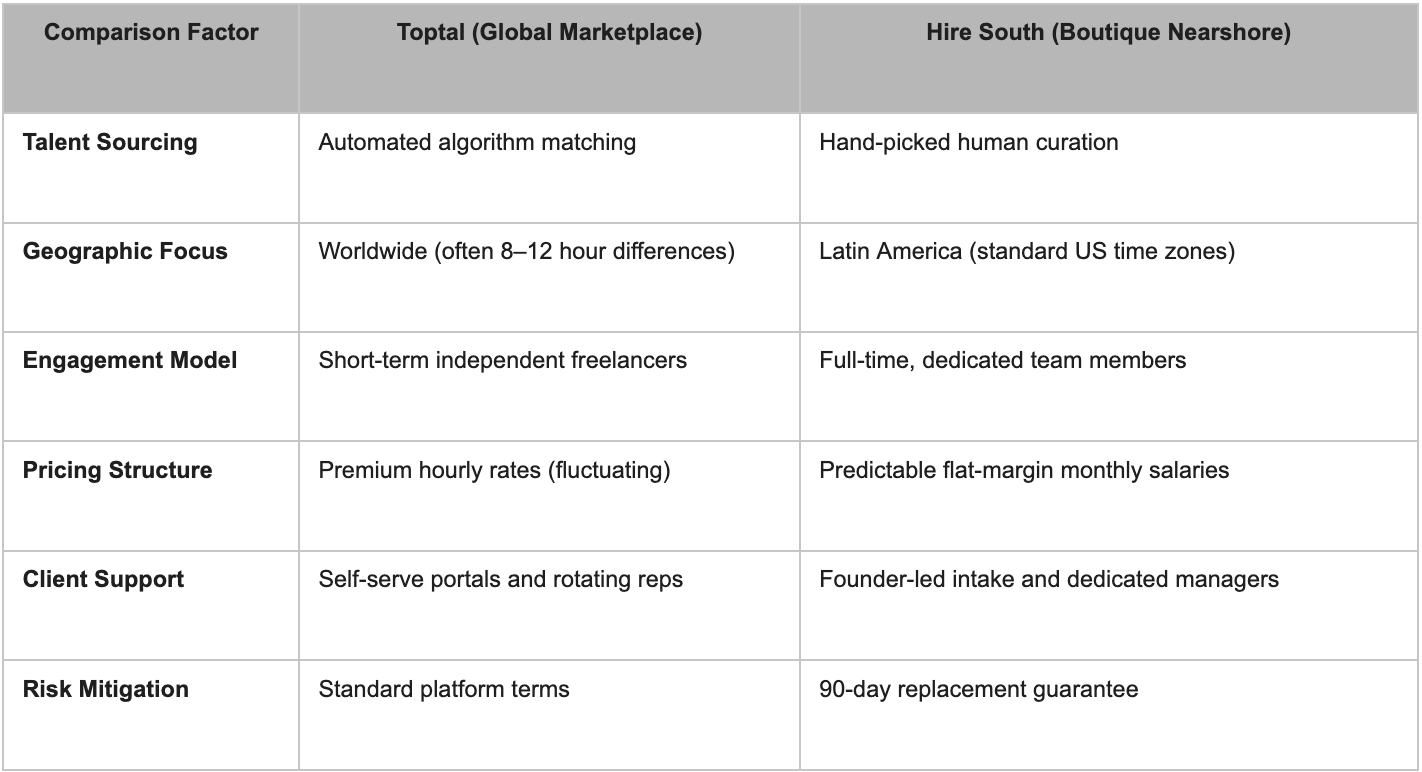
1. Talent Sourcing and Vetting Methodologies
When evaluating technical talent, both platforms utilize distinct screening frameworks that fundamentally change the type of professional you receive. Toptal relies on a globally recognized automated pipeline. The platform famously accepts only the top 3 percent of applicants through a rigorous sequence of automated coding tests, live problem-solving sessions, and communication evaluations, according to 2026 Industry Benchmarks. This massive scale ensures a baseline of high technical proficiency, but it relies heavily on algorithmic keyword matching to pair you with available freelancers.
Hire South takes a curated, human-centric approach focused entirely on the Latin American market. Rather than using an automated applicant tracking system to filter millions of global applications, this boutique agency utilizes specialized recruiters to source bilingual talent. They evaluate candidates not just for technical frameworks, but for specific cultural alignment and proactive communication skills required in agile US workflows. This means your candidate shortlist is hand-picked by humans who understand your specific team dynamics, completely bypassing the algorithmic matching process.
2. Time Zone Alignment and Daily Collaboration
The geographic location of your remote team drastically impacts your daily operational momentum. Toptal operates as a borderless global network, meaning you might match with an elite developer in Eastern Europe or Southeast Asia. While the talent quality is undeniably high, working across an 8 to 12 hour time difference frequently forces your internal managers to rely on delayed, asynchronous communication, completely stalling fast-moving development sprints.
Hire South operates strictly as a nearshore staffing partner, providing bilingual professionals based exclusively in Latin America. Because these countries share standard US time zones, your remote hires can seamlessly attend daily morning standups, participate in live code reviews, and resolve complex API issues in real time. This localized geographic focus completely eliminates the frustrating overnight delays associated with traditional offshore freelance marketplaces.
3. Pricing Models, Billing, and Hidden Platform Costs
Financial predictability is a major dividing line between high-volume freelance networks and boutique nearshore agencies. Toptal caters to highly specialized tech roles, according to industry resources, and functions on a premium freelance billing model. You pay elevated hourly rates that can fluctuate based on the specific contractor, and managing multiple independent freelancers across different countries leaves you responsible for complex international wire fees and varying compliance risks.
Hire South utilizes a completely transparent flat margin pricing structure that is fully disclosed at signing, according to their official website. You agree on a set monthly salary for your dedicated, full-time professional, and the agency handles all localized payroll, legal compliance, and benefits. By bypassing massive platform fees and targeting the Latin American talent pool, businesses secure elite remote talent while lowering total overhead costs by up to 40 percent, according to internal Hire South performance metrics. Both you and the candidate know the exact numbers, ensuring nobody is surprised by hidden markup fees.
4. Onboarding Speed, Guarantees, and Long-Term Retention
Getting a new hire up to speed quickly is critical, but securing their long-term commitment is what actually scales your business. On global platforms like Toptal, the focus leans heavily toward rapid project-based matchmaking. You can often find a highly specialized freelancer within 24 hours, according to 2026 tech reports, making it ideal for isolated, mission-critical tasks. However, these independent contractors frequently juggle multiple clients and are prone to moving on once a short-term project wraps up.
Hire South optimizes for long-term retention and deep team integration. The boutique agency manages the entire sourcing and technical screening process, successfully closing most full-time placements in just 10 days, according to published Hire South timelines. Because you are hiring dedicated professionals who view this as a long-term career rather than a temporary gig, retention rates soar.
5. Account Management and Founder-Led Support
The level of support you receive after signing a contract varies wildly between the two models. High-volume marketplaces generally process your requirements through self-serve portals or rotating account managers. Once the freelancer is placed, you are largely left to manage their daily integration, performance tracking, and workload on your own.
The boutique experience is designed to feel like an extension of your internal human resources department. At Hire South, every client engagement begins with a 20-minute intake call directly with a company founder, according to their website. The founders remain personally involved from the initial project brief to your new hire's first performance reviews. This continuous, dedicated account management ensures that any onboarding friction is resolved immediately, providing a level of white-glove service that massive automated platforms simply cannot match.
Ready to Hire LATAM Talent Smarter?
Choosing between a massive freelance marketplace and a dedicated nearshore agency comes down to whether you need short-term project help or true long-term team integration. While automated platforms suit brief, isolated tasks, growing companies need real-time collaboration in matching time zones to scale effectively.
At Hire South, we eliminate the operational friction of international hiring by connecting your business directly with elite, bilingual talent across Latin America. Our founder-led sourcing model delivers hand-picked full-time professionals in an average of just 10 days, backed by a transparent flat-margin pricing structure that cuts your total staffing overhead by up to 40 percent.
We take full ownership of localized compliance, payroll, and initial onboarding so your engineering and operational leaders can focus on building products. Every contract includes a strict 90-day replacement guarantee, ensuring complete peace of mind and long-term retention for your core team.
Ready to build a remote team that works synchronously alongside you every single day? Schedule a 20-minute intake call with our founders today, and we’ll source the ideal nearshore professional for your business!
.jpg)