


Hiring remote engineers isn’t just about verifying who writes clean Python or designs resilient cloud architecture. You also need to know who actually communicates well when a release breaks at 4 p.m.
With over 2.8 million tech professionals in Latin America and the region’s tech market surging toward $67 billion by 2030, according to data from Alcor, nearshore sourcing is busier than ever. But seamless time zone alignment only matters if your new hire can clearly explain their trade-offs, voice concerns early, and keep async projects moving forward.
This guide walks you through how to evaluate LATAM tech talent for real-world collaboration, navigate subtle cultural nuances, and structure your interview process so you land top-tier engineers who code and communicate.
Why Evaluating Communication in LATAM Tech Talent Matters as Much as Code
High-performing engineering teams rarely break down because of syntax errors or bad database schemas. Projects stumble when people stop sharing context, misinterpret user stories, or stay silent when deadlines slip.
According to research from the Project Management Institute, ineffective communication acts as a primary driver in 56% of failed projects, directly risking up to $75 million for every $135 million lost on troubled initiatives.
When you hire nearshore talent, technical chops get candidates through the door, but communication determines whether your software actually ships on time.
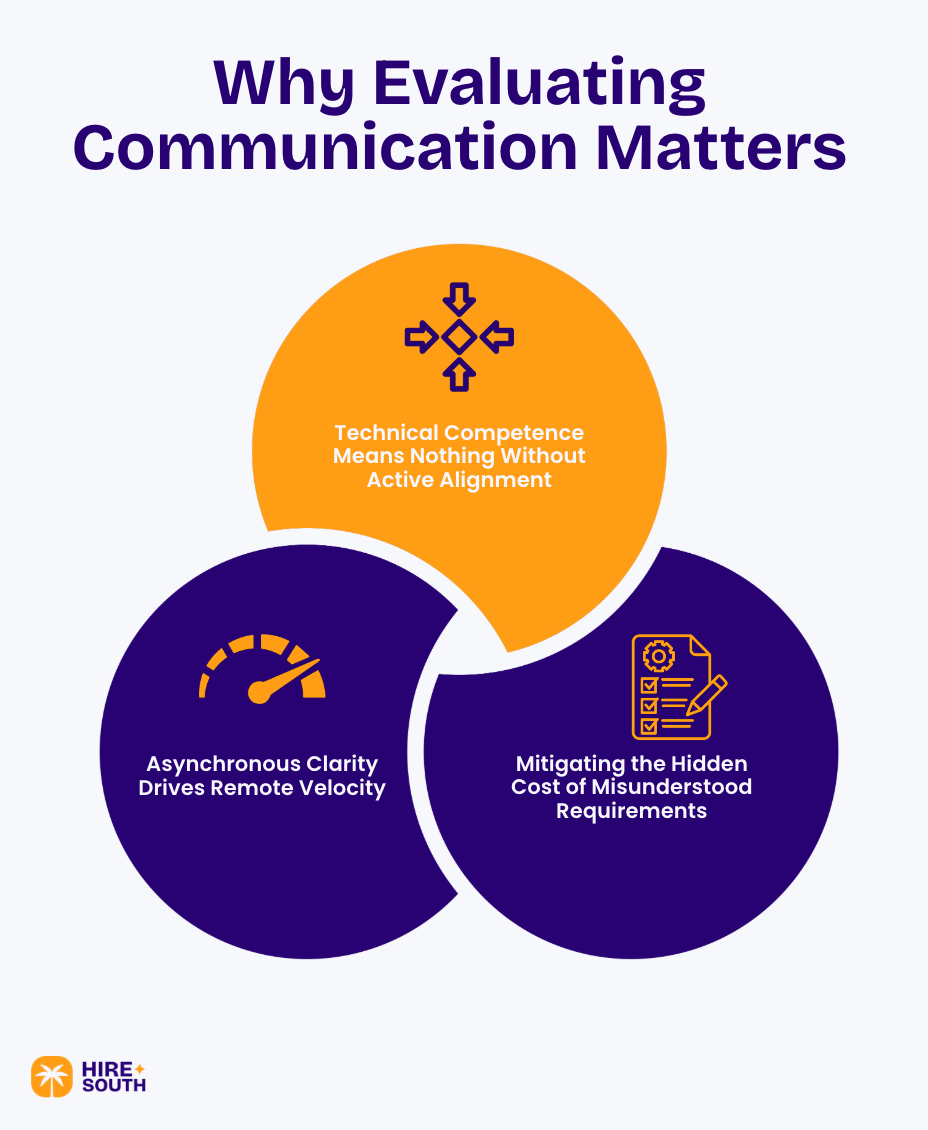
Technical Competence Means Nothing Without Active Alignment.
You can source a senior developer who writes flawless algorithms, but if they build a feature based on flawed assumptions, that code becomes instant technical debt. Real-time collaboration requires engineers to actively ask clarifying questions, challenge vague specs, and explain trade-offs before writing a single line of code.
Evaluating communication early gives you direct visibility into how a candidate handles ambiguity. Engineers who proactively flag blockers during standups keep sprint cycles moving, while passive coders often create hidden bottlenecks that surface days later.
Asynchronous Clarity Drives Remote Velocity.
Distributed teams run on written documentation, pull request reviews, and concise messaging. According to a project analysis by STG Consulting, communication breakdowns cause frequent rework and missed requirements across more than half of struggling software initiatives.
If a candidate cannot summarize a technical decision clearly in Slack or document an API endpoint layout cleanly, your existing team wastes hours untangling confusion. Testing written precision during the interview ensures your nearshore hires add momentum rather than friction to your asynchronous workflows.
Mitigating the Hidden Cost of Misunderstood Requirements.
Rework is the most expensive byproduct of poor communication in software development. When developers hesitate to confirm requirements or downplay scope changes, delivery timelines expand rapidly.
Focusing on communication during interviews allows you to gauge a candidate's willingness to push back, seek feedback, and align with business objectives. This shift turns standard technical hires into reliable strategic partners who take full ownership of product outcomes.
Structural Frameworks for Effective LATAM Talent Interviewing
Ad-hoc interviews lead to gut-feeling hiring, which fails consistently when evaluating remote candidates. Unstructured conversations often let charismatic speakers hide technical weaknesses, while exceptional engineers who communicate plainly get overlooked.
According to foundational research published by the American Psychological Association, structured interviews achieve a predictive validity score of 0.63 for job performance, matching work sample tests and vastly outperforming unstructured chats.
Designing a repeatable framework gives your team actionable data on technical clarity and collaboration skills.
1. Multi-Stage Interview Pipelines Built for Signal
A noisy interview pipeline wastes team hours and burns out strong candidates. You need distinct stages that isolate specific competencies without overlapping.
- Initial Recruiter Screen (30 Mins): Focus on basic alignment, salary expectations, time zone compatibility, and verbal English clarity.
- Async Technical Exercise (2–3 Hours Max): Evaluate written documentation, code structure, and self-directed problem-solving.
- Live Pair Programming & Architecture Review (60 Mins): Test real-time verbal reasoning, receptivity to feedback, and collaborative troubleshooting.
- Culture & Values Alignment (45 Mins): Assess cross-functional communication, handling of past project failures, and ownership mindset.
Separating these assessments ensures every team member evaluates a candidate against dedicated criteria rather than general impressions.
2. Objective Rubrics for Soft Skills Assessment
Soft skills feel subjective until you map them to explicit behaviors. To grade communication objectively, give interviewers clear scorecards that define what good looks like.
Skill Dimension
Needs Improvement (1-2)
Meets Bar (3-4)
Exceeds Expectations (5)
Technical Clarity
Uses dense jargon without explaining context; struggles to summarize ideas.
Explains trade-offs simply; checks if the interviewer understands.
Translates complex ideas effortlessly for technical and non-technical audiences.
Active Listening
Interrupts frequently; answers a different question than what was asked.
Listens fully before responding; asks relevant clarifying questions.
Summarizes requirements back to the interviewer to confirm alignment before coding.
Receptivity to Feedback
Becomes defensive when challenged on architectural choices.
Accepts feedback neutrally and adjusts approach when prompted.
Actively invites critique and uses hints to co-create a better solution live.
Using explicit scorecards removes interviewer bias and ensures candidate discussions stay grounded in observable behavior.
3. Pre-Interview Transparency Decreases Candidate Anxiety
Interview performance drops when candidates face unexpected environments or unclear prompts. According to a meta-analysis published in the Journal of Applied Psychology, high interview anxiety directly correlates with lower performance scores, regardless of actual job competence.
Sending a candidate prep guide 48 hours before the interview levels the playing field. Outline the tools you will use, the structure of the technical challenge, and whether they can consult external documentation.
This transparency reduces artificial stress, giving you an accurate look at how the engineer actually solves problems on a normal workday.
Post-Interview Evaluation: Decision Frameworks for Hiring Exceptional LATAM Tech Talent
Evaluating candidates after the final interview loop requires balancing hard technical data with interpersonal signal. Missteps at this stage often lead to costly bad hires or lost opportunities in a competitive talent market.
A landmark study by Leadership IQ tracking 20,000 new hires revealed that 89% of hiring failures stem from attitudinal factors like coachability and emotional intelligence, while technical skill deficiencies account for only 11%.
Creating an objective post-interview decision framework prevents your hiring team from overlooking soft-skill red flags in favor of raw coding ability.
Calibrating Interpersonal Signals Against Technical Output:
Decisive debriefs require structured weighting rather than unstructured vote casting. You need a scoring matrix that balances technical execution against daily communication capabilities.
During debrief sessions, enforce a simple rule: every claim about a candidate's communication must cite a specific behavior from the interview. If an interviewer labels a candidate "hard to follow," they must point to a specific system architecture explanation that lacked structure.
Identifying Red Flags in Candidate Communication Patterns:
Technical missteps during an interview can be coached, but behavioral warning signs rarely disappear after an offer is extended. The Leadership IQ study noted that 82% of hiring managers admitted seeing subtle warning signs during the interview process that they chose to ignore.
Watch for these specific communication red flags during your team's debrief:
- Defensiveness Under Critique: The candidate argues aggressively when an interviewer offers an alternative approach during pair programming.
- Vague Failure Narratives: When asked about past project failures, the candidate shifts 100% of the blame to former teammates or management without acknowledging personal ownership.
- Monologuing Without Alignment: The candidate speaks continuously for minutes without pausing to check if the interviewer follows their line of reasoning.
- Reluctance to Seek Clarification: The candidate makes blind assumptions on vague prompts instead of asking probing questions to define scope.
When these patterns surface, treat them as hard performance limits rather than minor quirks.
Formulating Competitive Offers with Clear Role Expectations:
Top engineering talent in Latin America often receives multiple nearshore offers simultaneously. According to research from Gartner, misaligned job expectations act as a primary driver of candidate drop-off and early attrition across technical hires.
Speed and clarity win candidates. Deliver offer letters that explicitly detail the operational expectations discussed during the interview loop:
- Core Working Hours: Define exact time zone overlap requirements for live collaboration.
- Async Communication Tools: Outline the team's primary documentation stack, such as Slack and Notion.
- Feedback Loops: Highlight how quarterly performance reviews and weekly 1-on-1s operate.
Presenting a transparent, structured offer proves your organization values clear communication from day one, helping you secure top-tier LATAM engineers before competing firms do.
Conclusion
Evaluating communication alongside code is the single most effective way to turn nearshore technical hires into long-term product engines. When you build a structured interview process focused on real-time problem-solving and asynchronous clarity, you eliminate costly miscommunication and accelerate project velocity.
At Hire South, we eliminate the guesswork of nearshore hiring. We source, screen, and vet senior Latin American tech talent for exceptional technical skill, time zone alignment, and fluent communication before they ever reach your calendar. Whether you need full-stack engineers, system architects, or specialized developers, our team delivers pre-vetted, interview-ready candidates in as little as two weeks, saving you up to 40% on recruitment and payroll costs.
Ready to scale your engineering team with talent that codes and communicates seamlessly? Schedule a consultation with Hire South today to meet your next key hire.
.jpg)