


Struggling to align your marketing department's structure with your actual revenue goals? You are not alone. Marketing job titles signal seniority, scope, and specialty, and candidates use them as the first filter before they even read your posting. A misaligned title can attract the wrong skill set, inflating your payroll while starving your pipeline.
To scale effectively, you need to understand the precise hierarchy and functional differences between every role, from a junior coordinator to a specialized product marketing manager. Getting this structure right is the first step to building a high-performance demand generation engine.
Whether you are expanding an in-house team or leveraging nearshore talent to control costs, this guide breaks down the complete B2B marketing organizational chart. You will discover how the modern title hierarchy works, compare average compensation levels, and learn how to source elite marketing professionals capable of driving your business forward.
A Quick Look at Marketing Job Titles
Understanding the baseline structure of marketing roles helps clarify how different levels and functions interact. The hierarchy generally starts with hands-on execution and scales up to multi-function leadership and portfolio planning.
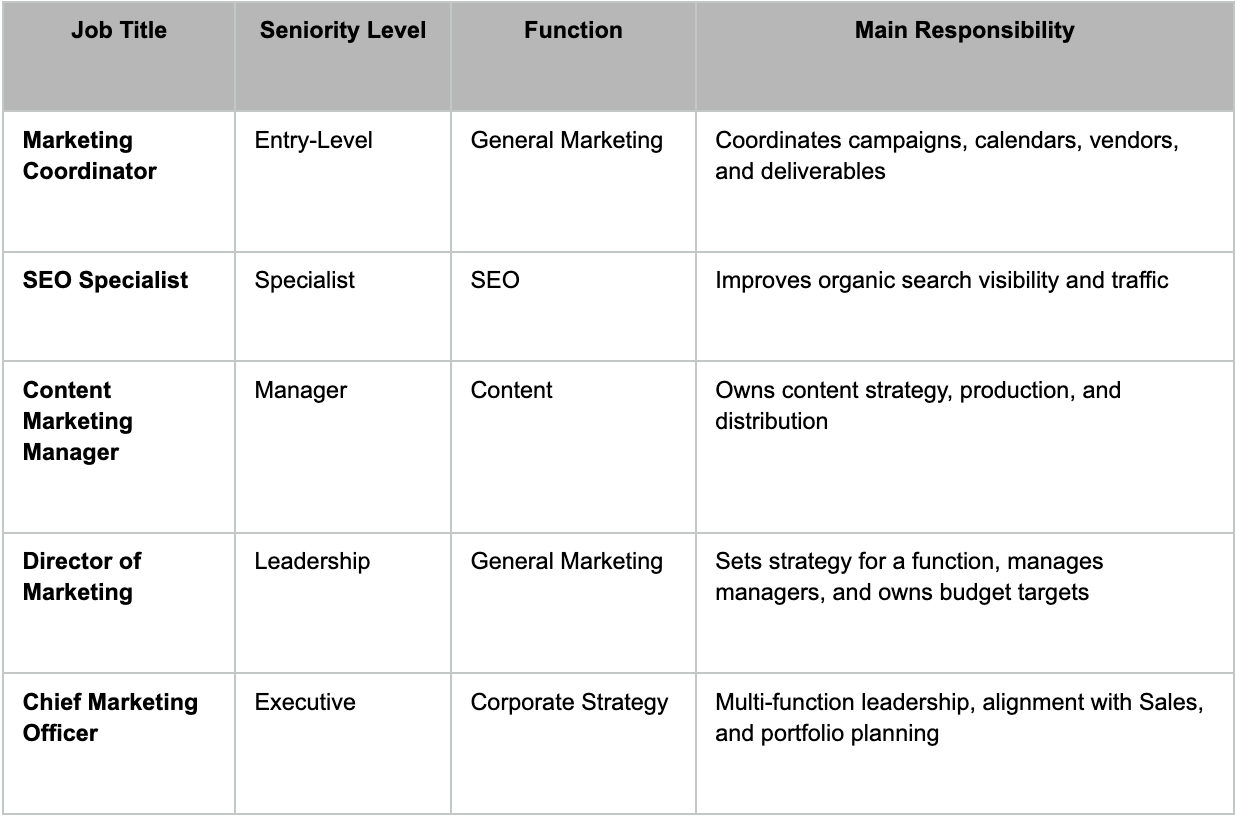
The Traditional Marketing Job Title Hierarchy
The progression of marketing titles establishes clear career paths and operational accountability. The standard ladder runs from coordinator or assistant, to specialist or associate, then up to manager, senior manager, director or head of, vice president, and finally CMO.
Entry-level roles focus heavily on hands-on execution, reporting, asset production, and campaign support. As professionals move into specialist roles, they typically own or support a defined area of marketing while working across several activities. Mid-level managers take ownership of entire channels or programs end-to-end, planning the strategy and reporting directly on performance outcomes. Senior leaders and directors step away from daily execution to oversee multiple campaigns, raise quality, set departmental strategies, and align marketing efforts directly with sales and product teams.
Categorizing Marketing Roles by Core Function
Modern marketing departments require dedicated teams to handle distinct disciplines. The exact structure will vary by company size, but a larger organization often separates its staff into specialized functions such as SEO, content, product marketing, demand generation, paid acquisition, and marketing operations.
Search marketing roles focus intensely on site health, keyword strategy, and technical SEO. Content and communications roles revolve around storytelling, media relations, and brand narrative. Product marketing functions center on positioning, messaging, competitive intelligence, and sales enablement. Marketing analytics and operations roles are strictly data-driven, managing the tech stack, automation workflows, dashboards, and attribution models.
Top 20 Marketing Job Titles and Their Responsibilities
Defining exact roles and responsibilities eliminates operational overlap, clarifies accountability, and ensures your marketing engine scales efficiently. Web content visitors rarely read dense walls of text sequentially; they scan for specific answers. Structuring complex role hierarchies into clear functional categories and scannable reference tables makes the information easily readable for decision-makers and machine-readable for AI search engines.
1. Executive & Strategic Leadership
Director of Marketing
Oversees the overarching marketing vision, budget distribution, and cross-channel strategy. They align marketing initiatives with company revenue targets, manage team leads, and report campaign ROI directly to executive leadership.
Product Marketing Manager (PMM)
Bridges the gap between product development, sales, and marketing. PMMs develop buyer personas, craft value propositions, execute product launch plans, and create sales enablement assets to drive product adoption.
Brand Manager
Guards the organization’s visual identity, messaging architecture, and market position. They ensure brand consistency across every customer touchpoint and run campaigns designed to increase brand equity and recall.
Communications Manager
Owns public relations (PR), corporate messaging, media outreach, and crisis mitigation. They build relationships with journalists, coordinate press releases, and maintain corporate reputational integrity.
2. Acquisition, Growth & Performance Marketing
Growth Marketer
Focuses on rapid, data-driven experimentation across the full customer funnel. They test new acquisition channels, referral programs, and product-led growth (PLG) loops to minimize Customer Acquisition Cost (CAC).
Demand Generation Specialist
Engineers multi-channel strategies to build a measurable sales pipeline. They run targeted campaigns across paid search, syndication, and content offers specifically designed to generate marketing-qualified leads (MQLs).
Digital Marketing Manager
Manages online acquisition architecture, combining search engine optimization (SEO), performance marketing, and conversion rate optimization (CRO) to scale organic and paid digital presence.
Paid Social Specialist
Focuses exclusively on paid social channels (LinkedIn, Meta, TikTok). They manage media budgets, build target audience lookalikes, execute A/B creative testing, and optimize Return on Ad Spend (ROAS).
3. Content, Creative & Community Engagement
Content Marketing Manager
Owns the editorial roadmap across blogs, whitepapers, case studies, and video channels. They oversee writers and subject-matter experts to publish SEO-optimized assets that establish industry authority and capture search traffic.
Copywriter
Crafts persuasive, conversion-focused messaging across landing pages, ad copy, email sequences, and sales collateral. They translate complex product features into customer-centric benefits.
Social Media Manager
Builds organic community presence across major social platforms. They establish the brand's conversational voice, publish daily content, monitor brand mentions, and drive audience engagement.
Event Marketing Specialist
Plans and executes field events, trade shows, proprietary conferences, and virtual webinars. They manage event logistics, booth positioning, vendor contracts, and post-event lead capture workflows.
4. Operations, CRM & Data Analytics
Marketing Operations Manager (MOps)
Architects and maintains the marketing tech stack (HubSpot, Salesforce). They configure lead scoring models, optimize attribution systems, and ensure clean data flow between marketing and sales operations.
CRM Marketing Specialist
Manages the customer database structure and lifecycle segmentation. They design targeted messaging campaigns based on customer behavior to boost retention and reduce churn.
Lifecycle Marketing Manager
Maps out end-to-end customer journeys from initial onboarding through expansion and renewal. They build automated nurture workflows and trigger campaigns to maximize Customer Lifetime Value (LTV).
Email Marketing Specialist
Builds, tests, and deploys marketing emails, newsletters, and promotional broadcasts. They maintain list hygiene, manage IP sender reputation, and optimize email deliverability.
Marketing Data Analyst
Transforms raw campaign metrics into business intelligence. They build real-time dashboards, run multi-touch attribution models, and deliver predictive analysis to guide marketing spend decisions.
Market Research Analyst
Studies consumer behavior, industry trends, and competitor positioning. They gather quantitative and qualitative market intelligence to evaluate new product expansion opportunities.
5. Execution & Campaign Management
Marketing Specialist
Executes tactical marketing initiatives across assigned channels (such as managing a specific monthly newsletter or promotional push). They blend execution with performance tracking to keep campaigns on schedule.
Marketing Coordinator
Provides essential operational and administrative support. They manage project schedules, coordinate creative deliverables between internal teams, update editorial calendars, and assemble baseline performance reports.
The Evolution: Traditional vs. Modern Marketing Roles
Marketing titles have shifted dramatically as the industry has digitized. Traditional roles like Media Planner and Media Buyer focused heavily on offline advertising, negotiating ad placements, and owning delivery against a set budget.
Today's landscape has introduced highly specialized digital variants. Roles like Lifecycle Marketing Manager, Account-Based Marketing (ABM) Manager, and Influencer Marketing Manager did not exist in traditional corporate structures. Furthermore, the rise of complex software has birthed entire departments dedicated to Marketing Operations and Revenue Operations (RevOps), where analysts focus purely on tech stack alignment, routing, and clean data rather than creative execution.
How AI is Reshaping Marketing Roles in 2026
The rapid integration of generative AI has fundamentally altered the marketing org chart, creating entirely new job categories that did not exist three years ago. Marketing departments are no longer just hiring traditional copywriters or data analysts; they are recruiting AI Content Managers, Prompt Engineering Specialists, and Marketing Automation Architects. These professionals are tasked with managing large language models, automating programmatic SEO at scale, and training internal AI systems on the company’s specific brand voice.
As these technical marketing roles become standard, the demand for candidates who possess both creative intuition and technical systems architecture has skyrocketed. US companies frequently struggle to fill these hybrid positions domestically without paying massive premiums. Sourcing these advanced roles in Latin America allows forward-thinking businesses to tap into tech hubs in Buenos Aires and São Paulo, where marketing professionals are already deeply integrated with the latest AI marketing stacks and machine learning workflows.
The Trap of Title Inflation: Why Premature Promotions Stall Organizational Growth
Startups and mid-market companies frequently fall into the trap of title inflation, awarding "Director" or "Vice President" titles to mid-level individual contributors as a substitute for competitive compensation. While this might secure a candidate in the short term, it creates severe structural friction as the company scales. When an organization actually needs a true executive to manage a multi-million-dollar budget and lead cross-functional departments, the inflated titles of existing employees create internal bottlenecks, reporting conflicts, and damaged morale.
Aligning your job titles with actual operational reality preserves your organizational hierarchy. Instead of artificially inflating titles to mask a limited domestic budget, high-growth companies are leveraging nearshore B2B staffing. By partnering with an agency like Hire South, you can afford to hire a true, seasoned Director of Marketing in Colombia or Argentina for the same cost as a mid-level domestic manager, ensuring your org chart remains structurally sound and ready for enterprise scale.
Strategies for Selecting the Perfect Marketing Title
Choosing the right title is about matching your operational needs to candidate strengths. If your goal is to generate organic traffic, you need an SEO Specialist, while a company focusing heavily on customer retention should target an Email Marketing Specialist or Lifecycle Marketer.
You must align the title with the daily work. If the role requires writing and storytelling, titles related to Content, Product Marketing, or Communications are appropriate. If the role demands left-brain metrics and systems management, titles in Analytics, Operations, or PPC are the right fit. Never inflate a title; calling a junior employee a Director will distort your internal hierarchy and create misaligned expectations regarding strategic output.
2026 Salary Benchmarks for Marketing Roles
Domestic salaries for specialized marketing professionals have surged, making it difficult for scaling businesses to maintain healthy profit margins. Leveraging nearshore B2B staffing models allows US companies to secure elite, bilingual marketers in Latin America at a fraction of the domestic cost.
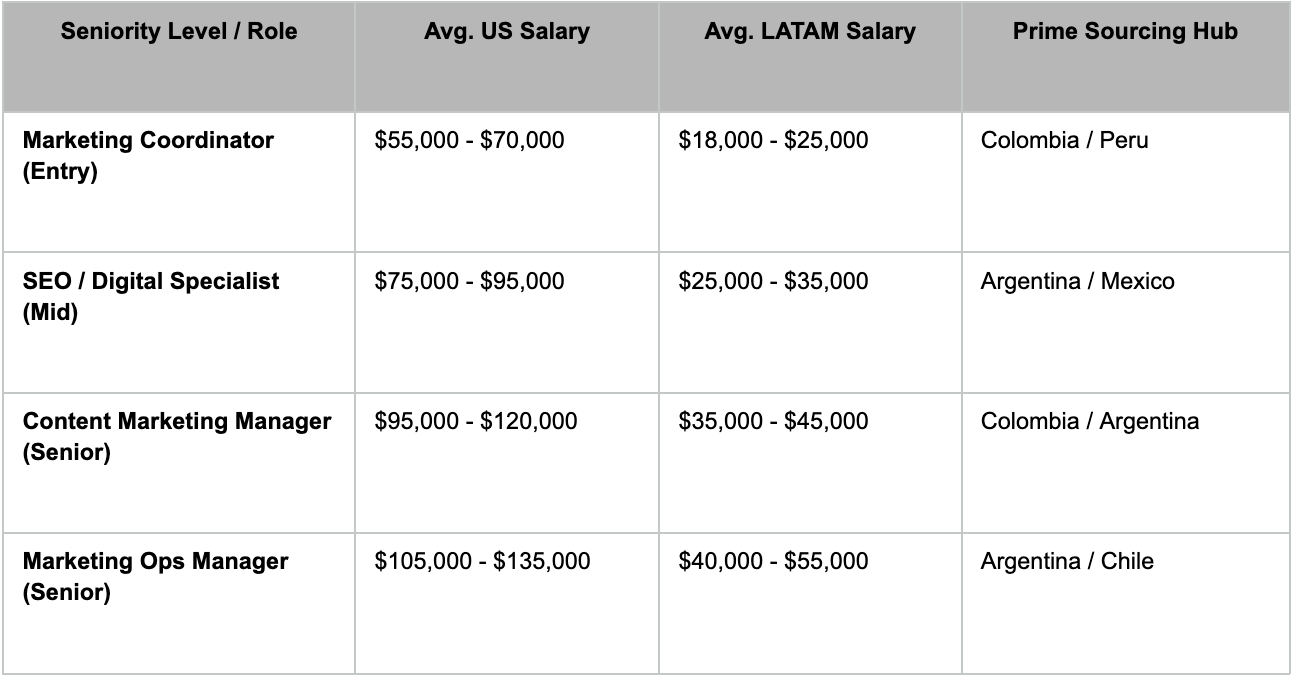
Hiring Marketing Talent in Latin America
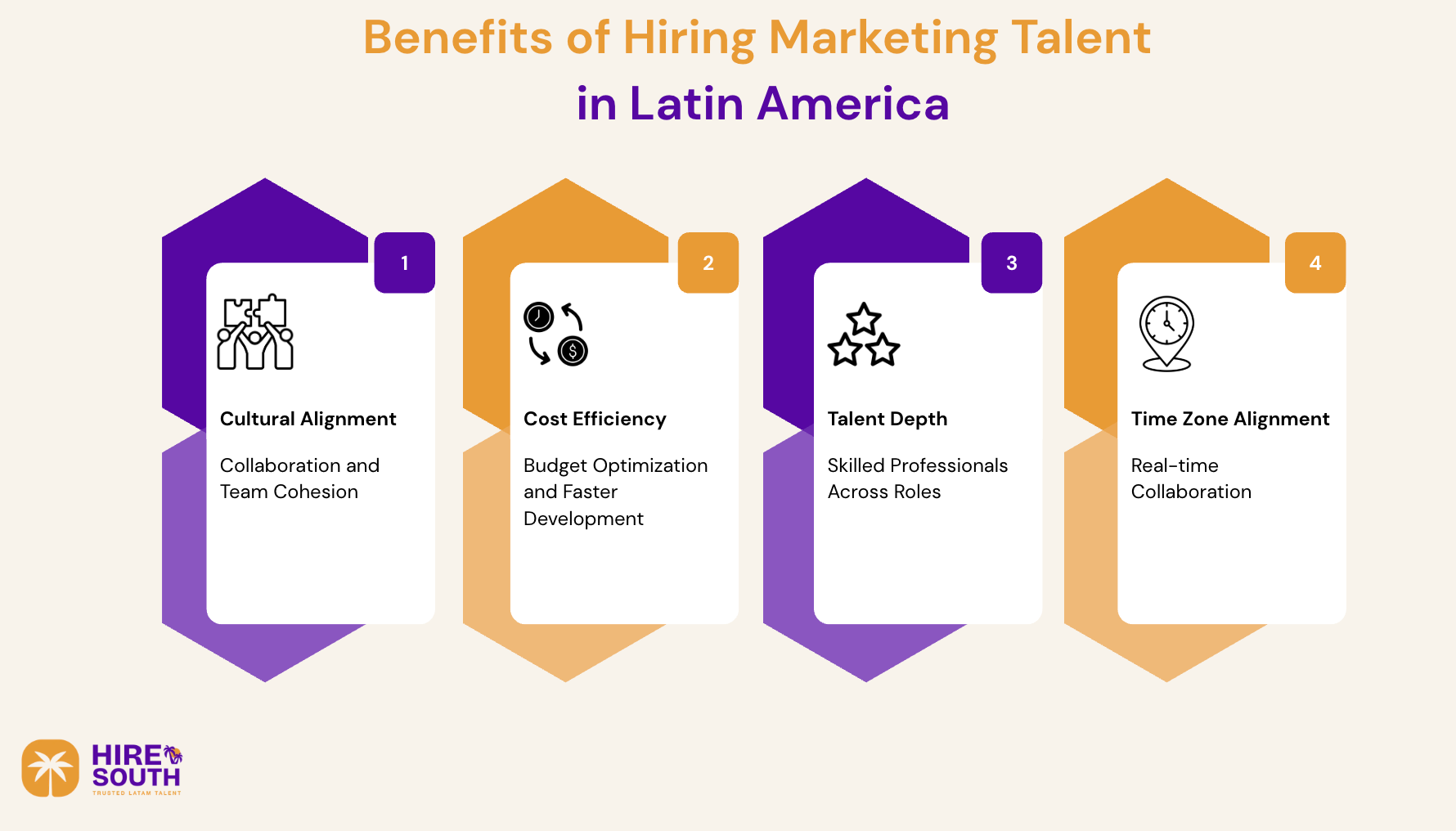
US businesses are rapidly shifting away from traditional offshore hubs due to severe communication delays. Offshoring to distant time zones creates massive friction for marketing teams that require agile responses to trending topics and daily campaign optimizations.
Nearshoring to Latin America guarantees Timezone Parity. Because LATAM professionals operate in EST, CST, and PST time zones, your marketing department can conduct synchronous daily standups, live creative reviews, and immediate campaign troubleshooting. Furthermore, professionals in hubs like Colombia, Argentina, and Mexico possess profound English fluency and a deep cultural understanding of the US Digital ecosystem, ensuring your brand messaging never gets lost in translation.
Frequently Asked Questions About Hiring LATAM Marketers
What is the difference between a Marketing Coordinator and a Marketing Specialist?
A Marketing Coordinator is generally an entry-level role focused on cross-channel support, updating calendars, and preparing reports. A Marketing Specialist usually owns or supports a defined area of marketing, executing specific campaigns within a channel like email or social media.
Why are titles less standardized at the senior leadership level?
As professionals move into leadership roles, the scope of their work depends heavily on company size. A Head of Marketing at a 40-person startup may have broader, hands-on responsibilities than a VP of Marketing at an enterprise company with several highly specialized departments.
How does nearshoring marketing talent improve campaign velocity?
Traditional offshoring introduces 10-to-12-hour time zone differences, creating severe bottlenecks. Nearshoring to LATAM provides Timezone Parity, allowing for real-time collaboration, instant feedback on creative assets, and live optimization of paid media campaigns during standard US business hours.
Can LATAM marketers handle complex US Marketing Operations (RevOps)?
Absolutely. Tech hubs in Argentina and Chile boast advanced technical literacy and deep experience with enterprise marketing automation platforms. These professionals excel at managing complex tech stacks, data routing, attribution modeling, and maintaining clean CRM data for US organizations.
Build Your LATAM Marketing Team With Hire South
Scaling a high-performance marketing department requires a strategic partner capable of delivering elite talent without inflating your administrative overhead. By consolidating sourcing, vetting, compliance, and ongoing payroll into a single, predictable monthly invoice, Hire South empowers your leadership to focus on generating revenue rather than managing international red tape.
At Hire South, we execute airtight Contractor and IP Assignment agreements governed strictly by US law, guaranteeing that your marketing assets, CRM data, and brand secrets remain fully protected. Take the guesswork out of your hiring strategy. Use Hire South’s 2026 US vs. LATAM Salary Calculator today to map out your exact cost savings, and then book a free discovery call to review a curated shortlist of top-tier marketing professionals perfectly matched to your strategic requirements. Ready to build your elite LATAM team? Book a free discovery call today!
.jpg)