

Hiring software engineers and tech talent across Latin America gives you a massive edge in speed, cost, and time-zone alignment. But bridging the gap between US compliance rules and international contractor workflows isn’t always simple.
A single slip in endpoint security or mismanaged data access can derail your operations quickly. According to the IBM Cost of a Data Breach Report, the global average cost of a data breach sits at $4.44 million, with US-based breaches costing even more. When your developers work across borders, keeping customer data locked down isn't optional, it's existential.
Protecting your business doesn't mean drowning in red tape or micromanaging your developers. This guide walks you through zero-trust access, rock-solid contractor agreements, regional tax compliance, and seamless device management. You will learn how to build an airtight, compliant nearshore operation that keeps your intellectual property safe without slowing down your team's velocity.
Navigating US Remote Work Rules for International Tech Teams.
US federal and state privacy statutes apply directly to the handling of sensitive consumer data, regardless of where the developer processing that data sits physically.
If your company handles health records, financial transactions, or personal identifying information, your LATAM team must follow strict statutory frameworks:
SOC 2 Type II requires continuous auditing of system controls covering security, availability, and privacy. LATAM developers accessing your cloud environments must operate strictly inside scoped, monitored sessions to avoid invalidating your attestation.
HIPAA does not prohibit using offshore talent. However, the law requires every contractor with access to Protected Health Information to operate under a signed Business Associate Agreement alongside strict physical and administrative safeguards.
CCPA and CPRA govern how California residents' data is processed. Giving offshore software engineers unencrypted or unrestricted access to production databases containing CCPA-regulated consumer data exposes your firm to significant statutory fines.
Bridging the Regulatory Gap Between Latin American Data Laws and US Standards.
Latin American nations maintain their own data protection rules that mirror European standards more closely than US federal frameworks.
Brazil enforces the Lei Geral de Proteção de Dados, while Argentina operates under Law No. 25,326, and Mexico enforces its Federal Law on Protection of Personal Data.
These regional laws often dictate how local citizens' data is stored and processed, but they also influence how local contractors handle foreign data.
To bridge this regulatory gap, your remote work contracts must establish that US data security protocols take precedence over local default practices whenever your developers interact with your core systems.
Why Cross-Border Data Transfers Require Strict Compliance Frameworks.
Allowing offshore contractors to download customer records or codebase repositories to unmanaged laptops creates an uncontrolled cross-border data transfer.
According to research published by the World Economic Forum, 76% of Chief Information Security Officers report that regulatory fragmentation across international jurisdictions directly undermines their compliance efforts.
To maintain continuous audit trails for US regulators, implement strict cross-border operational frameworks:
Zero Local Storage restrictions keep code cloning and data downloads strictly inside secure cloud environments or virtual desktops.
Role-Based Access Control limits visibility so contractors see only the data necessary for their specific job functions.
Audit Logging maintains detailed records of all API calls, database queries, and remote access sessions across international borders.
How to Make Sure Your Remote LATAM Team Follows US Security Rules
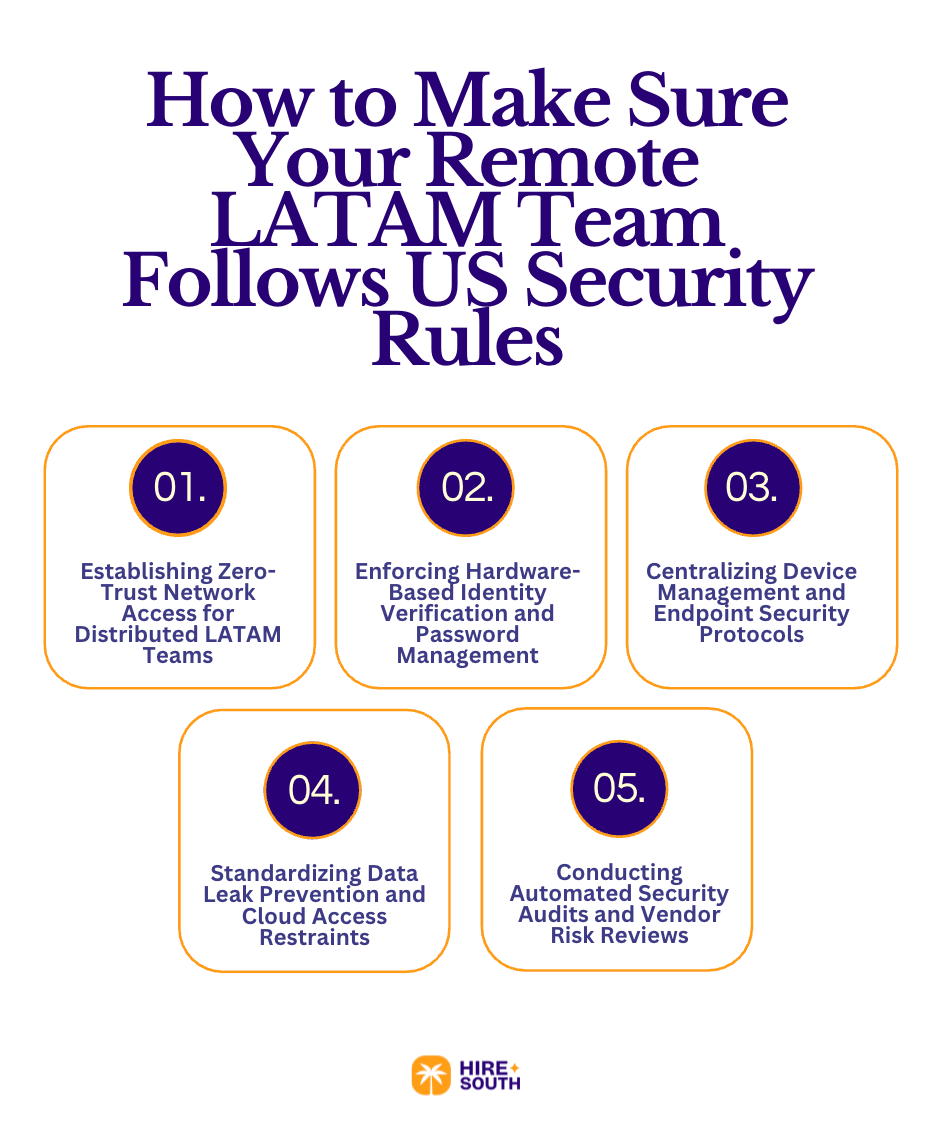
1. Establishing Zero-Trust Network Access for Distributed LATAM Teams
A traditional virtual private network leaves significant blind spots when managing remote developers across Latin America. When you grant network-level VPN access to an overseas contractor, a compromised endpoint can expose your entire internal ecosystem.
Zero-Trust Network Access operates under a strict principle: never trust, always verify. Access is granted at the individual application level rather than the network level.
A developer in São Paulo or Bogotá receives precise access to specific code repositories, ticketing tools, or database staging environments required for their active sprint. Every session request requires explicit identity verification, device health checks, and continuous context checks.
According to research from SecurityScorecard, roughly 29% of all cyber breaches stem from third-party attack vectors. Implementing Zero-Trust policies isolates your primary servers so an infected contractor laptop cannot trigger a lateral network intrusion.
2. Enforcing Hardware-Based Identity Verification and Password Management
Passwords remain the primary entry point for credential harvesting campaigns targeting remote tech talent. According to the Verizon Data Breach Investigations Report, 62% of corporate security breaches involve the human element, including phishing lures and compromised credentials.
Relying on SMS-based two-factor authentication or basic authenticator apps leaves your team vulnerable to SIM-swapping attacks and sophisticated man-in-the-middle phishing kits. Your remote work security rules must mandate phishing-resistant multi-factor authentication.
Deploy physical security keys that rely on Fast Identity Online standards for every software engineer accessing production infrastructure. Combine hardware tokens with enterprise-managed password platforms.
Enforce strict password generation rules, master-password complexity standards, and automated credential rotation for all shared cloud services.
3. Centralizing Device Management and Endpoint Security Protocols
Permitting contractors to build code or handle sensitive user data on personal, unmanaged hardware creates severe compliance risks under US data privacy frameworks.
Centralized Mobile Device Management software gives your security engineers direct visibility into every laptop used by your remote LATAM talent.
Deploy endpoint protection platforms across every authorized device to maintain system compliance:
System-level disk encryption prevents unauthorized data extraction if a physical device is lost or stolen.
Automated patch management installs critical security updates for operating systems and developer tools without requiring manual intervention from remote workers.
Endpoint Detection and Response continuously monitors device behavior for anomalous activity, unapproved software installations, or unauthorized peripheral connections.
Remote wipe capabilities allow your IT department to clear all proprietary data immediately if a contractor leaves the company or misplaces their laptop.
4. Standardizing Data Leak Prevention and Cloud Access Restraints
Preventing unauthorized data exfiltration requires strict technical controls over cloud storage environments, APIs, and code hosting platforms.
Developers often move fast and might copy production data into local environments or AI tools to troubleshoot code faster. According to more data published in the Verizon Data Breach Investigations Report, uploading source code to unauthorized external AI models has grown into a leading cause of non-malicious insider policy violations.
Configure your cloud infrastructure with strict Data Leak Prevention rules. Restrict raw data downloads from cloud databases, block USB mass storage drives on managed endpoints, and disable local clipboard sharing within virtualized desktop environments.
Limit access to production cloud resources using static IP address whitelisting, geographically scoped access policies, and strict Role-Based Access Control parameters.
5. Conducting Automated Security Audits and Vendor Risk Reviews
Securing a remote international team requires continuous verification through automated auditing systems rather than manual checklists.
Integrate continuous risk assessment software that monitors contractor accounts for credential leaks on dark web marketplaces. Schedule automated scans across your code repositories to flag hardcoded secrets, API keys, or unencrypted database credentials before they reach production branches.
Run quarterly access reviews to prune inactive contractor accounts and downgrade access rights for developers who switch projects. Maintaining an auditable trail of access reviews ensures your remote LATAM operations align directly with SOC 2, HIPAA, and CCPA standards.
Steps For Building Infrastructure for a Secure Remote Team in the US and LATAM
1. Provisioning Hardware with Native Endpoint Security Tools
Relying on contractors to use their own personal computers introduces immediate compliance and operational security vulnerabilities. Unmanaged personal devices often lack critical system updates, carry hidden malware, or connect to unencrypted local networks.
Distributing pre-configured corporate laptops directly to developers in Argentina, Colombia, or Mexico creates a uniform baseline of control.
To maintain total system integrity, your IT team must lock down hardware before it ever ships:
Enable full-disk encryption like BitLocker or FileVault at the hardware level so stolen hard drives remain completely unreadable.
Disable administrative rights on local contractor user accounts to prevent unauthorized software downloads or rogue browser extensions.
Pre-install Mobile Device Management agents to push software patches and enforce security profiles remotely.
For scenarios where shipping hardware across international borders presents extreme customs hurdles, deploy dedicated Virtual Desktop Infrastructure (VDI) environments. Virtual desktops ensure all proprietary code, development tools, and data processing remain hosted on secure US cloud servers rather than on local Latin American hardware.
2. Deploying Continuous Network Monitoring and Shadow IT Defense Systems
Distributed engineering teams rely heavily on cloud applications to collaborate, but unvetted cloud software introduces severe operational risks. When developers upload proprietary code into unapproved SaaS utilities or external AI conversion platforms, you lose control over your company's intellectual property.
Implementing Cloud Access Security Brokers (CASB) gives you direct visibility into the applications running across your distributed infrastructure. According to findings from the Verizon Data Breach Investigations Report, third-party and supply-chain vulnerabilities now account for 30% of all confirmed enterprise breaches.
Using automated monitoring software allows you to enforce strict cloud safety parameters:
Track and automatically block unapproved file-sharing sites, unauthorized AI coding assistants, and unencrypted cloud storage endpoints.
Monitor file movement in real time to trigger automatic access revocations if a developer attempts to download large repositories of sensitive data.
Set up continuous risk scoring for every connected SaaS integration to detect abnormal access patterns or unexpected geographic logins instantly.
3. Restricting Cloud Infrastructure Access by Geographic Region and IP Address
Exposing your primary staging servers and production cloud environments to open global access invites relentless automated credential-stuffing attacks. Implementing strict perimeter restrictions ensures that only authorized connections reach your critical assets.
Configure your cloud infrastructure providers, such as Google Cloud, or Azure, with precise access control barriers:
Create static IP whitelists so developers can only access sensitive databases through approved, encrypted access gateways or dedicated virtual private networks.
Implement geo-blocking policies inside your Web Application Firewalls (WAF) to restrict administrative portal logins strictly to the specific cities or countries where your LATAM team members actually operate.
Deploy conditional access rules that evaluate connection context, blocking login attempts coming from anonymized proxies, TOR nodes, or high-risk geographic locations.
4. Implementing Phishing-Resistant Identity Verification Protocols
Human error remains a primary entry point for adversary campaigns targeting remote tech talent across borders.
Relying on legacy two-factor authentication methods like SMS texts or push notifications leaves your distributed workforce vulnerable to SIM-swapping schemes and real-time adversary-in-the-middle phishing platforms.
Safeguard your authentication workflows by enforcing modern identity protocols:
Distribute physical FIDO2 hardware security keys to every software developer to ensure login credentials cannot be intercepted by cloned phishing sites.
Enforce single sign-on (SSO) controls across all internal developer tools, enabling instant, centralized credential revocation if a team member parts ways with your firm.
Require context-aware identity checks that analyze time-of-day access patterns, device posture health, and physical location before granting access to critical repositories.
Ready to Hire a Remote LATAM Team?
Securing a distributed engineering team across Latin America is not an operational burden; it is a critical business enabler. Organizations that combine strict endpoint protocols, zero-trust network access, and continuous compliance monitoring minimize cross-border security risks while maintaining execution speed.
At Hire South, we eliminate the friction of expanding your technical workforce into Latin America. We connect growing US companies with pre-vetted, bilingual tech talent working in your time zone at up to 30% to 50% lower costs than domestic hires. Beyond matching you with top-tier talent, we manage the entire recruitment, HR, payroll, and compliance framework, ensuring every new hire aligns seamlessly with your operational and security requirements. Let us help you scale your engineering capabilities safely and efficiently.