


México has long emerged as one of the most attractive talent hubs in Latin America when it comes to hiring remote talent, with a clear shift toward flexible and hybrid work models among technology professionals. In fact, 68.7% of tech professionals in México favor at least some form of remote or hybrid work, a strong indicator of how much talent you’ll be able to find ready to work for global companies.
In this article, you’ll learn exactly how to tap into México’s remote talent pool. The guide covers the current remote-work landscape, what makes México an appealing nearshore option, how to locate and vet candidates, legal and payroll considerations, and the best practices for onboarding and managing remote teams. Whether you’re building a new remote team or expanding an existing one, this article gives you a clear, actionable roadmap to hire remote talent in México without guesswork.
Why Hire Remote Talent in México
1. Cost Efficiency Without Sacrificing Quality
Hiring remote talent in México gives you meaningful cost advantages without lowering the bar on skill. Many companies report 40–60 % savings compared to equivalent U.S. roles, according to Interfell. Those savings let you scale faster, extend budgets, or assign more resources to high-impact areas, all while working with experienced professionals who deliver reliably.
2. Time-Zone and Geographic Alignment with North America
Because most of México operates on Central Standard Time, your team works in near-real time with U.S. and Canadian teams. This makes daily standups simple, allows same-day iteration cycles, and reduces the frustration that often comes with offshore time gaps. You get responsive collaboration without having to restructure your workflow.
3. Large, Skilled, and Bilingual Talent Pool
Mexico’s remote workforce brings strong English proficiency, solid technical training, and real experience with global teams. Many professionals are fully bilingual, which reduces communication friction and improves project velocity.
Remote work is also widely accepted. A recent survey found that 42.1 % of tech professionals prefer fully remote roles and 26.6 % prefer hybrid setups, totaling 68.7 % who want remote-friendly work, according to CodersLink. That means you’ll find more candidates who are already prepared and motivated to work effectively in distributed environments.
4. Access to Talent Beyond Major Cities
Remote hiring removes the usual geographic barriers. Instead of limiting your search to Mexico City, Monterrey, or Guadalajara, you can reach skilled professionals in smaller cities and emerging tech regions. This approach opens up access to overlooked talent and often shortens hiring cycles.
It also supports cost efficiency because salaries and competition vary meaningfully between regions. Companies expanding beyond major urban hubs consistently report faster placements and better role–fit outcomes, according to Global Squirrels.
5. Mature Nearshore Ecosystem & Experience With International Clients
México has spent more than a decade strengthening its nearshore services sector. Many professionals already have experience working with U.S. clients, Agile workflows, and modern collaboration tools. Industry reports note increased adoption of international standards and remote-first practices across Mexican tech and service roles, according to Mexico Business News.
This reduces onboarding friction and accelerates time-to-value because teams don’t need heavy cultural or operational adjustment.
6. Flexibility for Scaling Teams and Managing Workloads
Remote hiring makes it easier to scale teams up or down without long-term commitments. As workloads shift, you can add specialized roles, expand support, or spin up project-specific pods quickly.
Because over two-thirds of Mexican tech professionals prefer remote or hybrid work, you benefit from a workforce already optimized for distributed collaboration, leading to smoother handoffs, more predictable output, and better retention.
7. Nearshore Benefits With Lower Operational Risks
Nearshoring to México offers a strong balance of cost, proximity, and talent quality. Cultural alignment, short flights, and similar business norms help minimize operational risk. U.S. companies consistently rank México among the most stable and convenient nearshore destinations for tech and back-office operations, according to Remote Team Solutions.
For North American businesses, México stands out as one of the most efficient and strategically aligned places to build or expand distributed teams.
What You Should Know About México’s Talent Pool
A Deep and Steadily Expanding Talent Pool.
México offers one of the fastest-growing professional workforces in Latin America. The country produces more than 130,000 engineering and technology graduates every year, according to UNESCO, giving you consistent access to fresh talent across multiple disciplines. This continuous inflow makes the market especially resilient during hiring surges or rapid scaling cycles.
The talent pool isn’t concentrated in a single metro area. Regions like Guadalajara, Monterrey, and Mexico City lead in tech specialization, but secondary cities such as Mérida, Tijuana, Puebla, and Querétaro are developing strong professional ecosystems of their own. This geographic distribution helps reduce competition for top performers and improves your ability to source specialized skill sets quickly.
Strong Bilingual Capabilities and Global Readiness.
English proficiency plays a major role in remote collaboration, and México performs well compared to regional peers. The EF English Proficiency Index places México above the Latin American average, with business professionals showing especially strong communication skills. That directly reduces friction in cross-border work and shortens onboarding cycles.
Many professionals also have real experience working with U.S. teams. The nearshore industry has matured for more than a decade, and México now has over 500,000 workers in export-oriented service roles, according to ProMéxico. That means more talent already understands Agile workflows, U.S. business norms, and global tooling.
A Workforce Aligned with Remote and Hybrid Models.
Remote-first culture is widely accepted. Survey data shows 68.7 % of Mexican tech professionals prefer remote or hybrid setups, according to CodersLink, which signals strong readiness for distributed teams. You gain access to talent that is already familiar with virtual communication, asynchronous workflows, and digital collaboration tools.
This level of adoption also means the country’s talent landscape supports both long-term remote roles and flexible, project-based resourcing. Whether you need specialized engineers, back-office support, or bilingual CX talent, you can find professionals who are comfortable operating independently in remote environments.
Growing Specialization Across High-Demand Disciplines.
México’s talent landscape covers far more than entry-level or generalist roles. The market includes strong clusters in software development, cloud engineering, cybersecurity, data analytics, and UX/UI design. Tech hubs like Guadalajara, often called the “Silicon Valley of Latin America”, according to the Jalisco Government, have expanded significantly in applied research, embedded systems, and advanced manufacturing software.
You also see growth in AI-related roles. Universities and private institutions continue adding AI, machine learning, and data science programs, contributing to a workforce that evolves with global job trends. This makes the market particularly attractive if you’re building future-focused teams.
Competitive Compensation and Talent Stability.
Talent in México offers competitive compensation benchmarks while maintaining strong retention rates. Wage inflation is lower than in many U.S. metropolitan areas, and tech salary growth has remained stable compared to double-digit spikes seen in other markets. That stability helps you plan long-term workforce strategies without constant renegotiation cycles.
Combined with the country’s cultural alignment, bilingualism, and expanding specialization, México’s talent landscape gives you both depth and predictability, two key factors when building high-performing remote teams at scale.
The Key Options To Hire Remote Talent in México
1. Direct Hiring Through a Local Entity
Setting up a legal entity in México allows you to hire remote workers directly, giving you full control over employment terms, benefits, and long-term workforce planning. This option is common for companies planning sustained team expansion.
Direct employment also ensures full compliance with Mexico’s Federal Labor Law, which governs vacation entitlements, profit-sharing, and social security contributions. Keep in mind that contributions to the IMSS (social security), INFONAVIT (housing), and payroll taxes typically add 25–35 percent on top of base salaries, according to SAT.
This route works best if you’re committed to building a long-term presence and can support ongoing administrative overhead.
2. Hiring Through an Employer of Record (EOR)
An Employer of Record lets you hire Mexican professionals without creating a local entity. The EOR becomes the legal employer on paper, managing contracts, payroll, and compliance while you manage day-to-day work.
This structure is frequently used for quick hiring and for companies that want to reduce regulatory risk. With Mexico ranking 63rd globally in ease of doing business, according to the World Bank, an EOR significantly simplifies setup costs and timing.
It’s a strong option when you want operational flexibility or expect headcount changes over time.
3. Staff Augmentation via Nearshore Providers
Staff augmentation firms in México allow you to scale engineering, CX, or operations teams quickly by tapping into pre-vetted remote professionals. This model provides speed, predictable monthly costs, and wide access to specialized roles.
Many companies lean on staff augmentation when building teams in regions like Guadalajara, Monterrey, or Mexico City’s tech corridors, where talent density is the highest. The sector’s growth shows solid maturity, nearshore IT services in México grew more than 9 percent year-over-year, according to the IDC, making it a stable staffing channel.
It’s especially useful for project-based work or when you need niche skills without long-term commitments.
4. Freelance Marketplaces and Independent Contractors
You can also hire Mexican professionals as independent contractors through global platforms or direct agreements. This option works for short-term projects, fractional roles, or exploratory hiring before committing to permanent positions.
However, you must be conscious of misclassification risks. Mexico’s labor authority enforces strict definitions of employment, and long-term “contractor” arrangements that resemble full employment may be challenged. Penalties can apply, especially around retroactive benefits and employer obligations.
Freelancing can still be effective when properly structured, but it requires well-defined scopes, deliverables, and timeframes.
5. University Pipelines and Early-Talent Programs
If your long-term strategy includes building junior or entry-level teams, you can partner with Mexican universities. Schools such as UNAM and Tecnológico de Monterrey rank among the top engineering institutions in Latin America, according to QS Latin America Rankings.
Early-talent programs can help you secure skilled candidates before they enter highly competitive hiring cycles. This option is particularly relevant in México due to the large volume of annual STEM graduates and strong regional academic ecosystems.
How To Hire Remote Talent in México Step By Step-by-Step
1. Define the Role and Skill Requirements Clearly
Start by outlining the exact responsibilities, required technical skills, and seniority level. México has a large pool of remote professionals, and clarity helps you target the right segment. The country produces over 130,000 STEM graduates per year, according to OBS Business School, so precise criteria streamline sourcing and reduce mismatches.
Include time-zone expectations, compliance needs, and whether the role will require English proficiency. Roughly 57 percent of Mexican tech workers rate their English level as intermediate or higher, according to the EF English Proficiency Index, making it important to specify communication requirements upfront.
2. Choose the Hiring Model That Fits Your Structure
Select whether you’ll hire through a local entity, an Employer of Record, staff augmentation providers, or contractors. Each model affects onboarding, benefits, and compliance.
If you plan to scale quickly or avoid administrative overhead, an EOR or staff augmentation model may be the most efficient. If long-term expansion is the priority, direct hiring through your own Mexican entity provides more control.
3. Source Talent Through the Right Channels
Use platforms and ecosystems that are active among Mexican professionals. Local job boards, nearshore recruitment partners, and LinkedIn communities focused on engineering roles are common sourcing hubs.
Tech hubs like Guadalajara, Monterrey, and Mexico City provide the highest candidate density. Guadalajara alone accounts for nearly one quarter of Mexico’s tech workforce, making it a strategic starting point when sourcing remote talent.
4. Assess Technical and Soft Skills Thoroughly
Prioritize structured evaluations. Coding assessments, take-home projects, and scenario-based questions reveal how candidates approach real-world tasks.
Soft-skill evaluation is equally important. Remote work across borders requires strong communication, reliability, and self-management. Since 68.7 percent of Mexican tech employees prefer remote or hybrid work formats, experienced remote operators are not hard to find, but a structured assessment helps ensure quality.
5. Verify Employment History and Compliance Details
Run background checks, reference calls, and identity validation. This step is essential when hiring across borders, especially if you’re working directly with contractors.
Confirm that contractors have proper tax registrations. For employees, ensure compliance with mandatory benefits and contributions like IMSS and INFONAVIT if hiring through a legal entity.
6. Make a Competitive and Locally Aligned Offer
Compensation expectations vary across regions and specializations. Tech salaries in México tend to be lower than in the United States, but top-tier candidates still expect competitive packages and clear growth paths.
Use fresh market salary benchmarks to tailor your offers. Salary data from platforms like OCC and LinkedIn show consistent demand for roles in software development, QA, and cloud engineering, driving higher compensation bands.
7. Handle Contracts, Onboarding, and First-Month Setup
Draft compliant employment agreements or contractor contracts that reflect Mexican labor regulations. Include clear terms around confidentiality, IP ownership, working hours, and deliverables.
Once the offer is accepted, organize onboarding with structured access to tools, security protocols, team introductions, and clear expectations for the first 30 days. This matters because remote retention significantly increases when onboarding is organized and consistent.
The Best Practices When Hiring Remote Talent In México
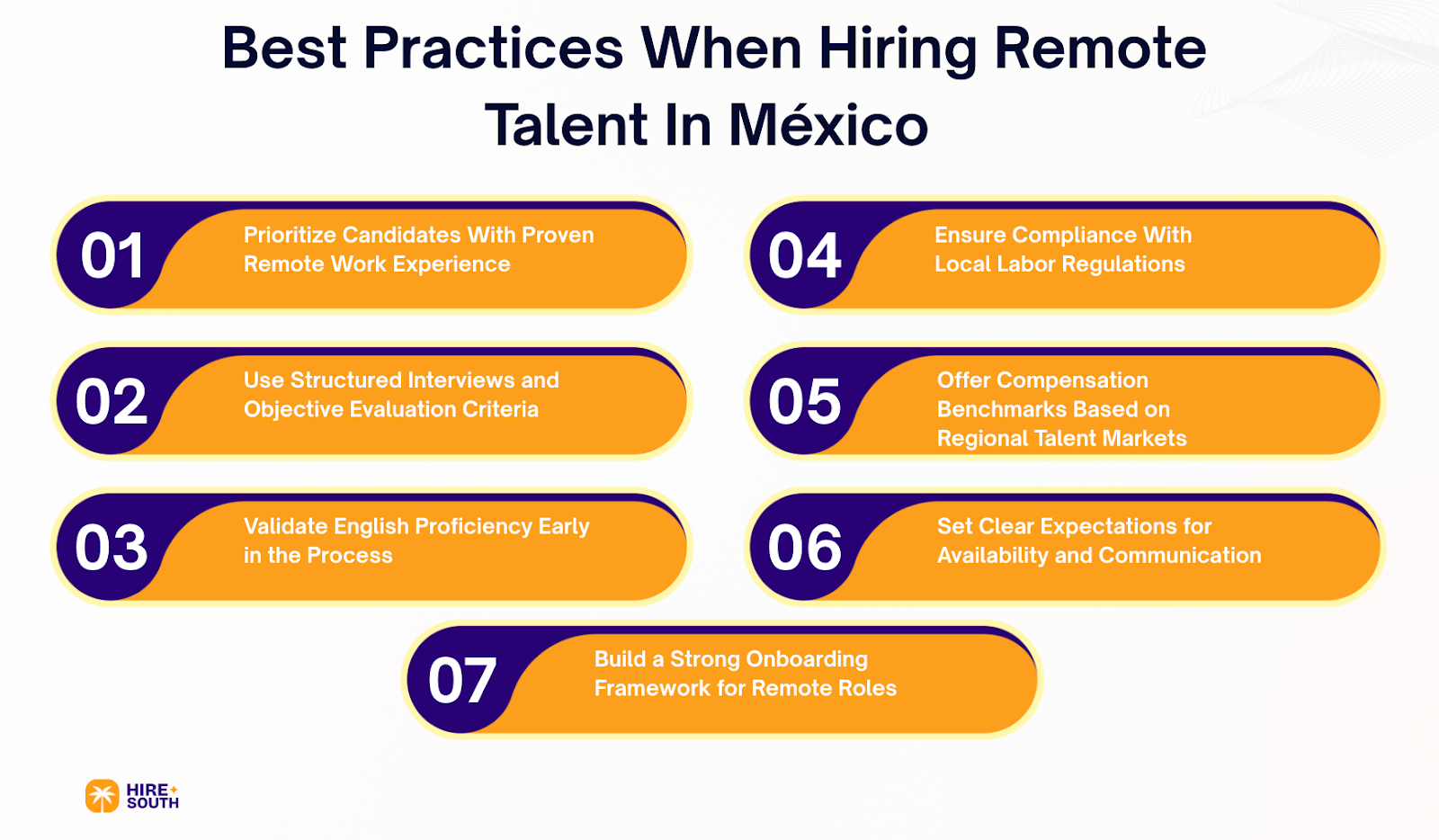
Prioritize Candidates With Proven Remote Work Experience:
Remote readiness matters. Look for candidates who have operated in distributed teams or global projects. México has a strong remote culture. That means you can reliably filter for people who already understand asynchronous workflows, communication norms, and self-management expectations.
Review past projects, collaboration tools used, and examples of independent problem-solving. Experience with Slack, GitHub, Jira, Notion, or similar tools is a good indicator of readiness.
Use Structured Interviews and Objective Evaluation Criteria:
Structured interviews help you compare candidates fairly and avoid subjective bias. Define technical, behavioral, and communication criteria before meeting candidates.
México’s tech workforce is diverse across regions and industries, so using the same rubric for each interview makes your process consistent. Add scenario-based questions to evaluate real decision-making rather than theoretical knowledge. Complement interviews with short work samples or time-bound assessments to validate execution quality.
Validate English Proficiency Early in the Process:
Language clarity is essential for remote operations. Several Mexican tech workers report intermediate or higher English proficiency, so verifying fluency at the start helps you avoid later communication issues.
Instead of generic questions, ask candidates to explain technical decisions, walk through past work, or summarize complex information. This gives you a better gauge of how they’ll operate in client-facing or cross-border teams.
Ensure Compliance With Local Labor Regulations:
If you hire full-time employees, you must comply with Mexican labor law. This includes mandatory benefits such as vacation days, public holiday compliance, profit sharing, and contributions to IMSS, INFONAVIT, and retirement funds.
For contractors, confirm that they hold an RFC (Registro Federal de Contribuyentes) and provide legally valid invoices. México takes compliance seriously, and clear documentation protects your organization from future liabilities.
Offer Compensation Benchmarks Based on Regional Talent Markets:
Compensation varies significantly between major tech hubs like Guadalajara, Monterrey, and Mexico City. Using market-aligned salary ranges helps you stay competitive while maintaining cost efficiency.
Local salary reports from LinkedIn show demand for cloud engineers, data analysts, QA automation specialists, and backend developers continuing to rise. Aligning your compensation with these benchmarks improves offer acceptance and long-term retention.
Set Clear Expectations for Availability and Communication:
México shares close time zones with the United States, which is a major advantage for remote teams. Even so, setting explicit guidelines around working hours, response times, and meeting cadence eliminates ambiguity.
Define your standards for async documentation, meeting frequency, sprint rituals, and tool usage. Remote teams in México adapt quickly when expectations are transparent and consistent.
Build a Strong Onboarding Framework for Remote Roles:
Structured onboarding reduces early turnover and accelerates productivity. Provide documentation, security protocols, milestone expectations, and a clear 30-, 60-, and 90-day roadmap.
Remote employees in México integrate faster when they understand the workflow from day one. Add shadowing opportunities or buddy systems whenever possible. A consistent onboarding process reinforces alignment and strengthens collaboration from the start.
Ready to Hire Talent in Mexico?
Building remote teams in México gives you access to a workforce that’s both highly skilled and operationally aligned with North American business needs. With the country’s tech sector growing at 8.5 percent annually, according to INEGI, the talent pool continues to expand in depth and specialization.
At Hire South, we help companies leverage this momentum with a transparent, data-driven hiring process built specifically for Latin America. Our team sources, screens, and validates remote professionals so you can scale confidently without navigating compliance or market complexities alone. If you're looking to hire remote talent in México or any country in Latin America, with accuracy, speed, and full operational clarity, we’re here to make every step measurable and reliable. Contact us to get started today!