
.jpg)

Building a distributed tech team used to mean keeping your talent pool within driving distance of your headquarters. Today, the brightest engineering minds might be sitting in Medellín, São Paulo, or Buenos Aires. According to global workforce studies, Latin America has surged to the forefront of the remote hiring market, boasting an incredible 156% growth in international placements.
But hiring cross-border talent isn’t as simple as sending a laptop and a wire transfer.
Navigating foreign tax laws, mandatory 13th-month bonuses, and strict local labor courts can quickly turn your expansion plans into a legal headache. This guide breaks down exactly how a LATAM Employer of Record (EOR) solves these hurdles. We will explore how an EOR protects your company from contractor misclassification risks, manages localized payroll, and streamlines your nearshore operations, helping you decide whether to outsource your global compliance or build a local entity from scratch.
What Is an EOR and How Does It Work?
An Employer of Record, commonly known as an EOR, is a third-party organization that legally employs personnel on your behalf in a foreign country. When you find the perfect software engineer in Brazil or a product manager in Mexico, you cannot simply add them to your domestic payroll. Doing so violates local tax and labor laws.
Instead, the EOR steps in as the official employer. They handle the legal framework, navigate municipal tax codes, and assume all statutory liabilities.
The mechanics of the relationship operate through a tripartite structure. Your company signs a service agreement with the EOR provider, the provider signs a local employment contract with the talent, and you retain complete control over the worker's daily tasks, deliverables, and performance management. The worker feels like a core part of your team, while the administrative burden lives entirely with the partner.
According to data tracking by the global compliance platform Deel, companies using an EOR save an average of 85% in upfront setup costs compared to establishing a foreign subsidiary, making it a highly efficient vehicle for agile scaling.
The Legal and Compliance Framework of an EOR:
When you hire through an EOR, the provider takes on a massive checklist of compliance duties. They register with local social security offices, manage mandatory severance funds, and ensure contracts strictly adhere to evolving regional labor laws.
If a legal dispute arises, the EOR is the entity responsible for defending the contract in local labor courts. This setup insulates your main business from compliance fines, unexpected tax audits, and the legal fallout of accidental contractor misclassification.
How Cross-Border Payroll and Benefits Function:
International payroll is notoriously complex. An EOR solves this by streamlining the entire payment cycle into a single, predictable monthly invoice.
You pay the provider in your home currency, such as US Dollars. The EOR then calculates the exact deductions, converts the funds, and distributes local currency to your talent.
They ensure perfect accuracy for mandatory benefits, which vary wildly across Latin America. According to the 2025 Global Benefits Index by Safeguard Global, statutory non-wage benefits in countries like Argentina and Colombia can add between 30% and 45% on top of an employee's base salary. The EOR automatically calculates these figures, including mandatory health insurance, pension contributions, and localized bonuses like the 13th-month salary.
What Kind of Companies Benefit From Utilizing EOR Latin America Services
Expanding your workforce internationally is no longer exclusive to Fortune 500 enterprises with massive legal budgets. Because the logistical barriers of cross-border employment have dissolved, a wide variety of business models now leverage global infrastructure to scale.
Understanding where your organization sits within this landscape helps determine if outsourcing your employment framework aligns with your operational goals.
1. Early-Stage Startups Validating Cross-Border Product Teams
When you are running a lean startup, speed and capital preservation are your two most critical metrics. Spending months of engineering runway on foreign corporate registrations simply does not make sense.
According to data published by Globalization Partners, roughly 60% of early-stage startups hiring one to five remote engineers choose an Employer of Record over direct entity incorporation. This allows founders to issue compliant offers to elite developers in hubs like Colombia or Argentina within days, completely bypassing the traditional structural friction.
2. Mid-Market Enterprises Testing New Regional Hubs
Mid-sized companies frequently use Latin America as a strategic testing ground before making a permanent capital commitment. If you want to pilot a new customer success hub in Mexico or a localized QA team in Brazil, an EOR provides the ultimate low-risk sandbox.
You can employ a small cohort of professionals, analyze their output, and evaluate the regional cultural fit. If the market underperforms, offboarding is handled legally and cleanly by your provider, saving you from the complex bankruptcy and liquidation laws that govern wholly owned foreign subsidiaries.
3. High-Growth Tech Firms Moving Away From Contractor Risk
Many scaling tech companies begin their nearshore journey by hiring developers as independent contractors. However, as headcount grows, this model creates massive compliance vulnerabilities.
According to the State of Global Hiring Report by Deel, Latin American hiring contracts grew by 161% year-over-year as companies actively migrated their international workforces away from high-risk contractor relationships and into fully compliant, full-time local employment structures. Utilizing an EOR allows these organizations to retain their top talent while completely erasing the threat of backdated tax penalties and worker misclassification lawsuits.
4. Industrial and Energy Corporations Managing Specialized Field Projects
Outside of software development, the energy, infrastructure, and industrial sectors heavily rely on localized employment partners. When a company secures a short-term infrastructure project or an offshore drilling contract, it must deploy specialized teams rapidly.
According to a global mobility analysis by NES Fircroft, industrial firms use EOR frameworks to manage temporary field workforces without having to navigate complex local corporate registrations. The provider handles the hyper-localized compliance requirements, union mandates, and safety-related tax contributions, allowing project managers to focus exclusively on execution.
Where to Deploy Employer of Record Services in LATAM
Selecting the right location for international expansion requires looking past general regional trends. Each Latin American market features a unique combination of developer availability, institutional tax rates, and distinct regulatory hurdles.
Deploying an Employer of Record allows you to target specialized tech hubs strategically, aligning your enterprise's specific talent needs with local market advantages.
Brazil: Navigating the Complexities of the Region's Largest Tech Ecosystem
Brazil remains the economic powerhouse of South America, making it an essential target for complex enterprise development and fintech scaling. According to data from the Brazilian Association of Software Companies, the country's IT market reached 117.8 billion dollars, positioning it as the tenth largest technology sector globally. The local talent pool is immense, fueled by elite public universities and a booming startup landscape.
However, hiring in Brazil requires a deep understanding of the local labor framework, known as the Consolidação das Leis do Trabalho. The regulatory system mandates strict protections, including a compulsory 13th-month bonus, one-third additional pay for annual vacations, and complex payroll tax contributions that can add significant overhead. Utilizing an EOR allows you to tap into the massive technical ecosystem of São Paulo and Belo Horizonte while transferring the burden of these complicated municipal regulations to a localized legal partner.
Mexico: Capitalizing on Perfect Nearshore Alignment and Scale
For North American corporations, Mexico offers unmatched operational benefits due to geographical proximity and closely aligned time zones. According to the CBRE Scoring Tech Talent Report, Mexico City's technical workforce surpassed 320,000 professionals, nearly doubling over five years to establish itself as the single largest tech market in Latin America. This scale makes it the ideal destination when your company needs to hire software developers rapidly or build out customer-facing engineering teams.
The legal landscape in Mexico has shifted heavily following aggressive governmental rollouts against traditional corporate outsourcing. Today, any enterprise utilizing external staffing must adhere to strict regulatory guidelines regarding profit sharing and mandatory social security contributions. An EOR acts as the direct legal entity, ensuring your contracts remain fully compliant with these updated federal frameworks while managing the standard statutory Christmas bonus, known locally as the Aguinaldo.
Colombia: Maximizing Efficiencies in Cloud and Infrastructure Engineering
Colombia has transformed into a premier digital hub, with cities like Bogotá and Medellín actively attracting global tech investments. According to research published by Alcor, Colombia represents one of the fastest-growing destinations for cloud infrastructure architecture and mobile application development, driven by a highly proactive business ecosystem and extensive government-backed digital transformation initiatives.
The financial structure of employment in Colombia features higher mandatory payroll contributions than some of its neighbors, with employer-side taxes and healthcare contributions often exceeding 30% of the base salary. Local regulations also enforce a unique statutory bonus structure divided into biannual payments, which is called the Prima de Servicios. Partnering with an EOR ensures your enterprise calculates these multi-layered compensation structures perfectly without triggering compliance investigations or local labor audits.
Argentina: Sourcing Elite Architecture and High English Proficiency
If your development lifecycle requires high-level software architects, advanced data scientists, or complex cybersecurity specialists, Argentina is a highly effective market. According to a global digital skills analysis by Randstad Digital, Argentina ranks at the top of Latin American tech hubs for English language proficiency and advanced software problem-solving. This high communication capability eliminates the primary collaboration friction often found in cross-border tech teams.
Operating payroll in Argentina, however, presents unique financial hurdles due to complex currency controls, fluctuating exchange rates, and persistent inflation pressures. Remote workers overwhelmingly prefer to receive their compensation in stable foreign currencies like US Dollars rather than the local peso. An EOR solves this logistical barrier entirely, absorbing the multi-currency accounting friction and ensuring your distributed team receives stable, legal payments that adhere perfectly to national financial regulations.
Is an EOR Right for Your Business? Making the Strategic Decision
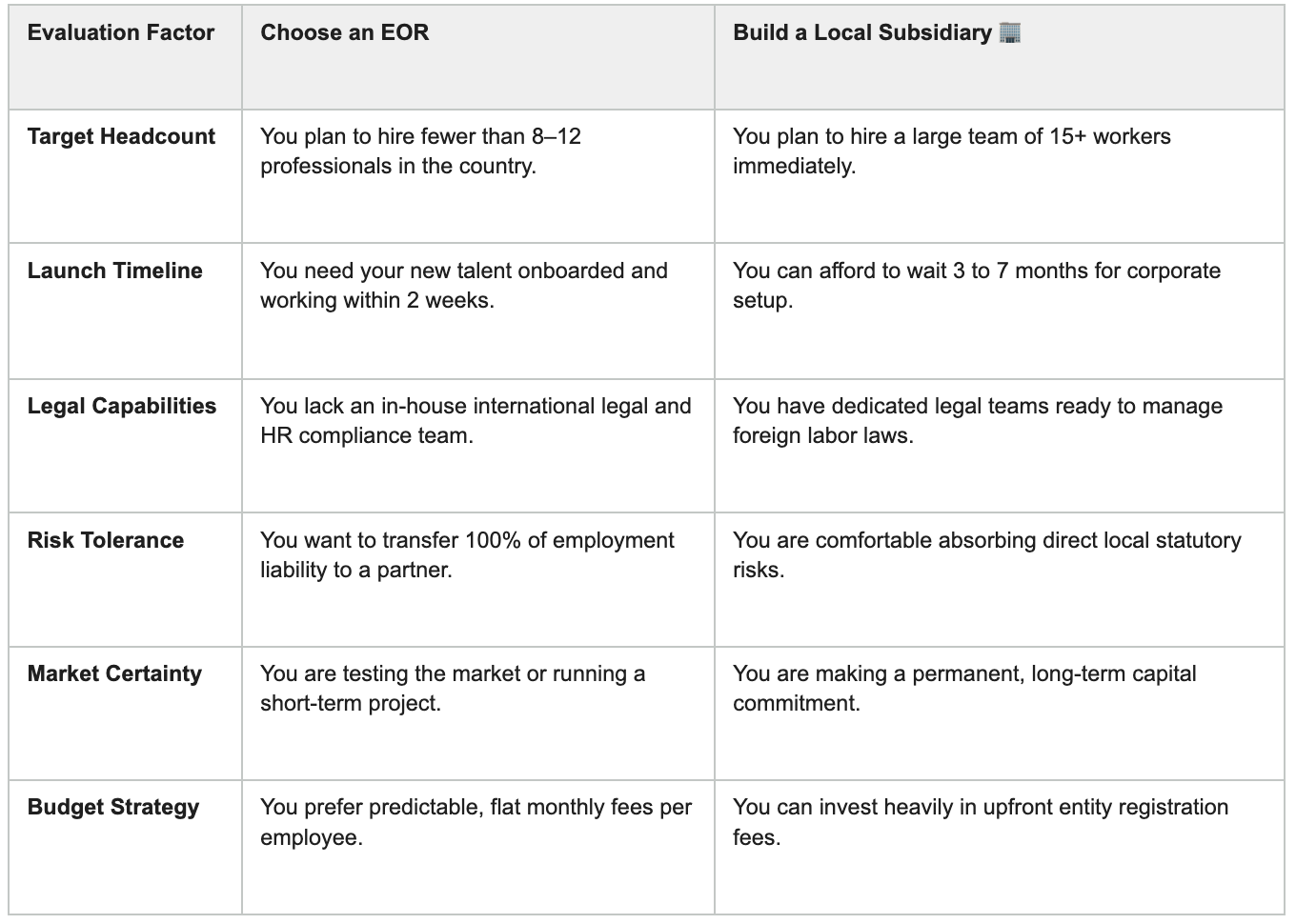
Deciding how to anchor your international hiring infrastructure requires balancing financial scaling against risk tolerance. You cannot look at global expansion through a single lens, meaning you must weigh immediate deployment speed against long-term operational overhead. Evaluating specific organizational metrics reveals whether an external employment framework makes sense for your current corporate lifecycle.
The Headcount Crossover: Calculating Your Break-Even Point
The decision to choose an Employer of Record over establishing a wholly owned local subsidiary typically comes down to a clear numerical tipping point. An EOR scales linearly, charging a predictable monthly fee per employee, which keeps your initial capital expenditures exceptionally low. A native entity requires a massive upfront investment but offers flat ongoing maintenance costs regardless of how large your team grows.
According to a 2026 global expansion report by Nearshore Business Solutions, the economic break-even point for most Latin American markets sits between 8 and 12 in-country hires. For organizations employing fewer than 8 professionals, an EOR remains the most cost-effective model, saving thousands in corporate overhead. Once your regional workforce expands past 12 full-time team members, the amortized cost of running your own local entity begins to offer better long-term financial efficiency.
Time-to-Market Analysis: Immediate Deployment Versus Corporate Setup
If your current product roadmap depends on immediate engineering output, timeline friction becomes a vital metric to analyze. Registering a corporate entity in Latin America involves navigating dense bureaucratic channels, local notary systems, and complex corporate banking approvals.
According to market tracking data published by the TMF Group, the median time required to fully incorporate a local business entity spans 45 to 90 days in Mexico and between 4 and 7 months in Brazil. If you utilize an EOR, the infrastructure is already fully built and compliant, allowing you to move from a signed job offer to a compliant first day of work in roughly 14 days.
Risk Allocation: Managing Constant Regulatory Changes
Every business leader must evaluate how much compliance risk their internal HR and legal departments can realistically handle. Latin American labor frameworks evolve rapidly, requiring constant contract updates, changes to social security contributions, and a deep understanding of local court precedents.
According to an analysis by Deel, maintaining international corporate compliance independently can cost up to 2.71 times more than utilizing a dedicated compliance partner due to hidden administrative errors, filing delays, and local statutory penalties. An EOR assumes this entire legal burden, meaning they absorb the liability for compliance failures, leaving your core organization completely insulated from cross-border legal penalties.
Ready to Hire LATAM Talent?
Deciding on the correct employment structure is only half the battle, the real competitive advantage comes from execution. Whether you are an early-stage startup looking to secure a core engineering asset or a scaling enterprise migrating away from independent contractor vulnerabilities, navigating the compliance landscape demands specialized regional oversight.
This is exactly where we, at Hire South, transform your international expansion strategy into a seamless reality. As a dedicated partner specializing in Latin American remote talent acquisition and nearshore infrastructure, we handle the complex legal, payroll, and statutory mechanics on your behalf. According to internal placement metrics, our comprehensive onboarding and vetting ecosystem helps businesses build fully compliant, high-performing nearshore teams in 21 days or less, completely removing the administrative friction from your growth roadmap. Let us manage the backend compliance and multi-currency payroll so you can focus entirely on driving your core business forward. Contact us to get started!

.jpg)