


Scaling a mid-market company into a massive enterprise requires flawless execution, aggressive revenue generation, and strict operational cost controls. As domestic U.S. payroll costs surge and talent shortages stall product roadmaps, ambitious executives are looking at how the absolute biggest players optimize their margins.
To reach the next tier of business success, you need to understand the precise metrics that define the top corporations in the United States. Getting this structural knowledge right is the first step to building a high-performance engine capable of dominating your market. Whether you are expanding an in-house engineering team or leveraging nearshore LATAM talent to radically reduce your operational expenditure, this guide breaks down the architecture of the world's elite businesses. You will discover exactly how the ranking system works, the revenue thresholds required, and how to apply Fortune 500 talent strategies to your own scaling organization.
A Fortune 500 company ranks among the 500 largest U.S. businesses based entirely on total annual revenue. Both public and private companies can qualify, provided they submit verifiable financial statements to a government agency. To emulate the operational efficiency of these giants, growing U.S. companies are increasingly bypassing inflated domestic salaries by hiring elite professionals in Latin America through B2B Staffing models, achieving massive cost savings while maintaining real-time collaboration.
Decoding the Fortune 500: What Defines the Ultimate Corporate Benchmark?
The Fortune 500 is an annual ranking compiled by Fortune magazine that lists the 500 largest eligible United States corporations by total fiscal revenue. A company's inclusion on this list is the ultimate indicator of its massive market share and economic footprint for a given year.
While the list naturally features globally recognized, publicly traded heavyweights, it also includes eligible private businesses, cooperatives, and mutual insurance companies. The defining characteristic is scale; these companies represent the bedrock of the U.S. economy, generating trillions of dollars in combined sales and employing millions of workers worldwide.
The Gates of Enterprise Scale: Strict Eligibility Requirements
Reaching this elite tier requires meeting strict geographical and regulatory conditions before a single dollar of revenue is even evaluated. According to the official methodology, a business must satisfy three primary prerequisites to be considered:
- U.S. Incorporation: The business must be legally incorporated within the United States.
- Domestic Operations: The company must maintain its primary operations and headquarters within the U.S.
- Financial Transparency: The organization must file official financial statements with a government agency.
If a massive enterprise meets the revenue threshold but refuses to release verifiable public filings, it is automatically disqualified from the list.
The Revenue Mandate: How the Top 500 Are Actually Ranked
Once a company passes the eligibility screen, Fortune researchers rank it from highest to lowest based strictly on the total revenue reported for its most recent fiscal year.
The organization with the highest revenue takes the #1 position, followed sequentially by the rest. Revenue is the sole deciding factor. Other critical financial health indicators, such as net profit margins, total market capitalization, stock price performance, and global employee headcount, may provide context on how a business operates, but they have absolutely zero impact on its final placement.
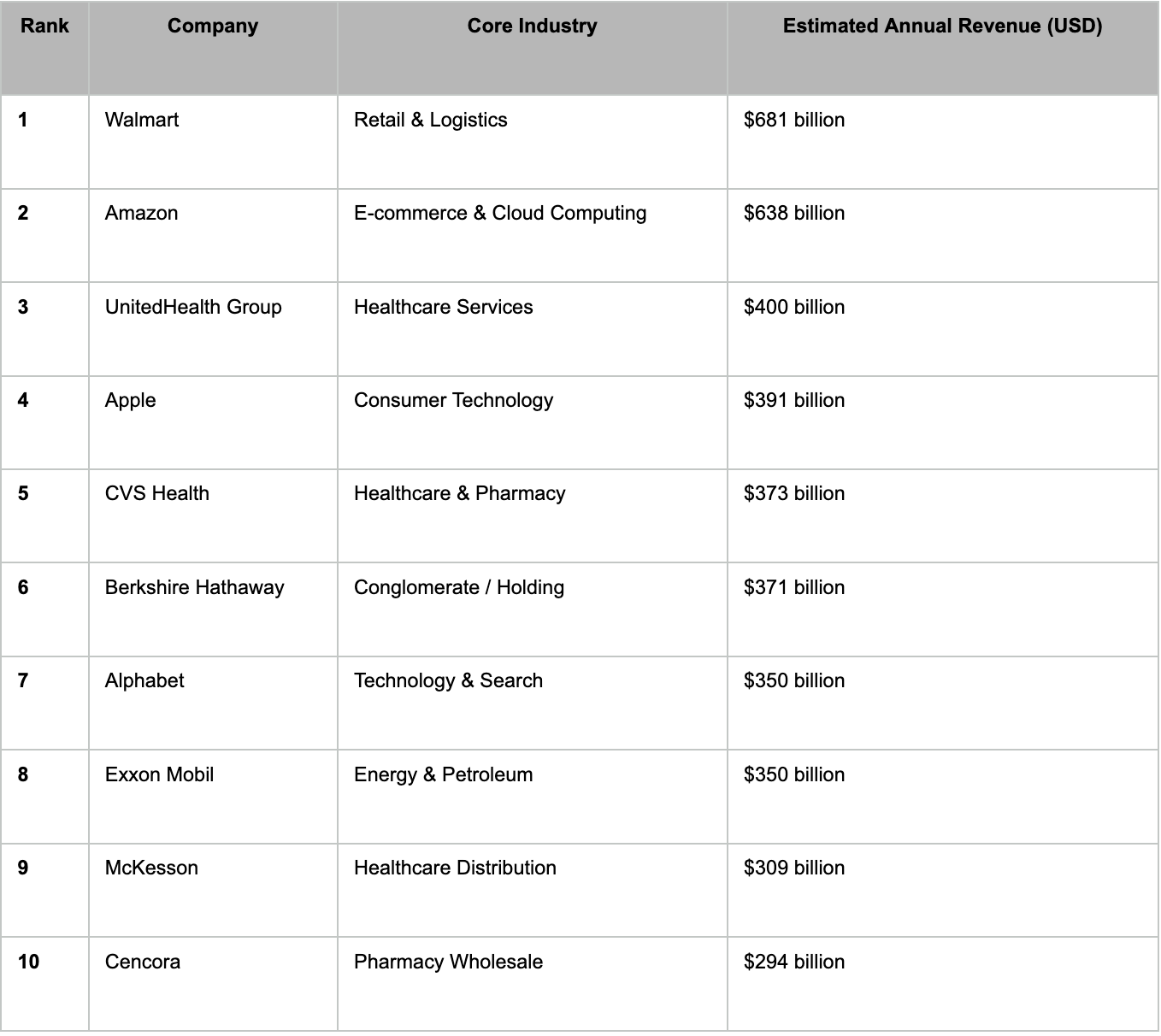
The 2026 Vanguard: A Look at the Top 10 Corporate Titans
The absolute largest enterprises in the country generate staggering amounts of capital, often exceeding the GDP of entire nations. These top 10 companies are masters of supply chain logistics, cloud computing infrastructure, and operational efficiency.
The Fortune 500 Churn Rate: Why Legacy Enterprises Fall Off the List
While reaching the Fortune 500 is a monumental achievement, staying on it requires relentless agility and aggressive cost management. Historically, less than 12% of the companies featured on the original 1955 list remain there today. This massive corporate churn rate is primarily driven by technological stagnation and bloated operational expenses that paralyze a company's ability to pivot during economic shifts.
To avoid falling off the list, modern enterprises refuse to carry unnecessary overhead. Legacy corporations often collapse under the weight of massive domestic payrolls and outdated tech debt. In contrast, businesses that sustain their Fortune 500 status continuously optimize their P&L by adopting flexible workforce models. By leveraging nearshore LATAM talent for their IT, Finance, and Marketing operations, these giants build high-performance, scalable departments that can adapt to market demands instantly, completely bypassing the friction of massive domestic severance liabilities.
The Infrastructure of Giants: Core Tech Stacks Driving Fortune 500 Growth
The fastest-growing Fortune 500 companies in 2026 operate fundamentally as technology companies, regardless of whether they sell retail goods, healthcare, or logistics. Sustaining hundreds of billions in revenue requires an elite, zero-latency infrastructure built on robust cloud architecture, generative AI automation, and real-time data pipelines.
Designing and maintaining these massive tech stacks requires armies of specialized engineers. Because domestic U.S. markets simply cannot produce enough senior-level cloud architects and data scientists to meet enterprise demand, Fortune 500 leaders secure their infrastructure by tapping into South America. By staffing highly specialized roles, such as AWS Solutions Architects, Full Stack Developers, and Machine Learning Engineers, out of advanced technical hubs in Argentina and Colombia, these mega-corporations maintain their technological dominance while keeping their R&D budgets exceptionally lean.
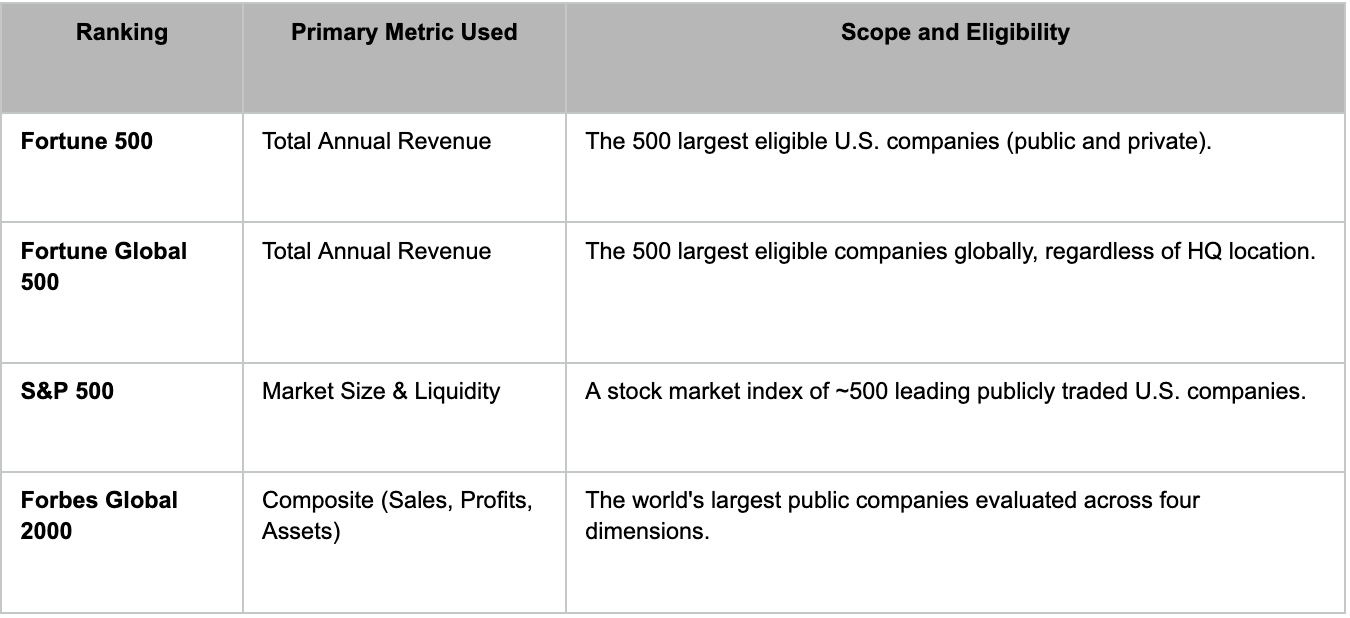
Market Indices Demystified: The Fortune 500 vs. S&P 500 and Beyond
The Fortune 500 is frequently grouped in conversation with other major financial indices, but each list evaluates a fundamentally different group of companies using distinct methodologies.
The Private Sector Exception: Can Non-Public Firms Make the Cut?
Yes. While the majority of the Fortune 500 consists of publicly traded corporations whose financials are broadcast to Wall Street, private companies are absolutely allowed if they comply with strict financial transparency rules.
A private business, cooperative, or mutual insurance organization must file its revenue and balance sheets with a government agency in a format that Fortune researchers can access and officially verify. Prominent private companies like State Farm Insurance frequently appear on the list because they meet these filing requirements.
The Financial Threshold: How Much Revenue Secures a Spot?
Breaking into this elite group requires immense, sustained scale. As corporate revenues grow globally, the barrier to entry rises consistently every cycle.
In recent years, the absolute minimum threshold to secure the #500 spot hovered around $7.5 billion in annual revenue. For mid-market companies and ambitious startups aiming to reach this list over the next decade, aggressively scaling topline sales while ruthlessly optimizing operational expenditure (OpEx) is mandatory.
Decades of Dominance: The Evolution of the Fortune 500 List
The concept of ranking America’s corporate titans began in 1955 when Fortune magazine published its inaugural list. Originally, the ranking was restricted entirely to companies in the manufacturing, mining, and energy sectors, accurately reflecting the industrial core of the mid-20th century American economy.
It wasn't until 1995 that Fortune modernized its methodology to include the service sector, allowing the massive retail, finance, healthcare, and software giants that dominate the modern landscape to take their rightful places at the top.
Beyond Vanity Metrics: The True Market Power of Fortune 500 Status
Earning a spot on the Fortune 500 provides unparalleled brand equity. It signals absolute market dominance, operational stability, and institutional trust to global investors, B2B partners, and prospective talent.
Inclusion on the list acts as a premier credential that significantly lowers the cost of borrowing capital and makes enterprise-level procurement negotiations infinitely smoother. Furthermore, elite candidates view these organizations as the pinnacle of career security, giving these companies immense leverage when recruiting top-tier executives.
The Smart Capital Arbitrage: Reinvesting Payroll Savings into Topline Growth
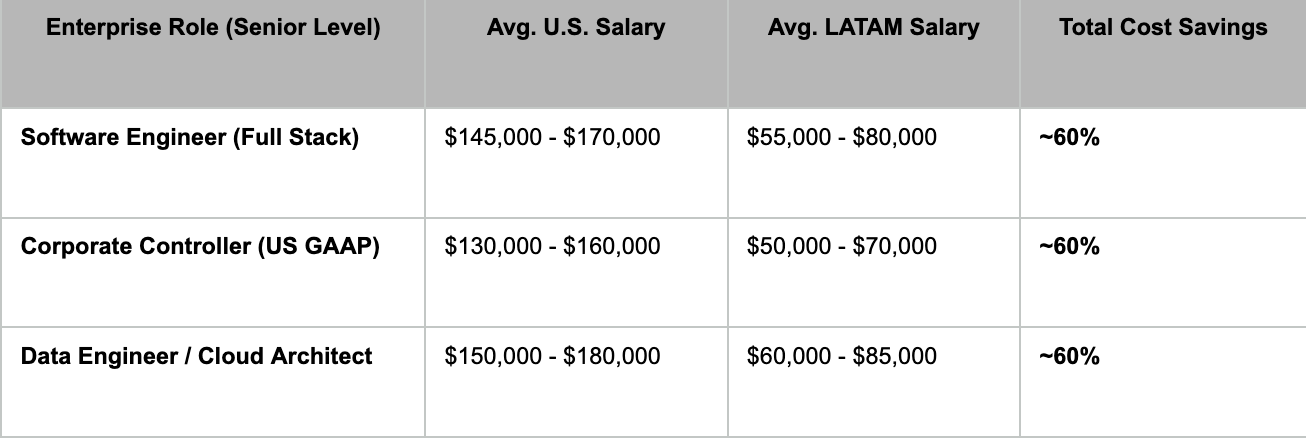
To scale from mid-market ($20M–$100M) to enterprise status ($7.5B+ threshold), corporate leaders cannot rely solely on revenue expansion; they must optimize revenue per employee. Domestic U.S. engineering and finance overhead consumes up to 65% of operating budgets. Enterprise leaders utilize geographical talent arbitrage to maintain high R&D velocity without expanding capital burn.
1. Revenue-per-Employee Benchmarking
Fortune 500 tech and service titans generate an average of $450,000 to $1.2M in revenue per employee. Scaling firms that rely exclusively on domestic hiring in high-cost tech hubs hit a margin ceiling. By building nearshore engineering and revenue pods in Latin America, companies preserve gross margins above 70%.
2. The OpEx Reinvestment Flywheel
Reducing full-time equivalent (FTE) costs by 56% to 59% across core functions (Engineering, RevOps, US GAAP Accounting) frees capital that is directly reallocated into:
- Paid Customer Acquisition: Accelerating top-of-funnel pipeline growth.
- Product R&D: Shipping enterprise features faster to win market share.
- M&A and Market Expansion: Capitalizing on strategic acquisition opportunities.
Enterprise Playbooks: Operational Strategies for Scaling Mid-Market Firms
The defining characteristic of an elite company is not just how much money it makes, but how efficiently it operates at scale. To maintain massive profitability, top U.S. corporations aggressively control their payroll and operational overhead.
Today, leading enterprises are rapidly abandoning traditional offshore hubs in Asia in favor of Nearshore Staff Augmentation in Latin America. This strategy significantly lowers expenditure while retaining highly skilled, bilingual professionals trained in U.S. corporate standards like US GAAP, agile software development, and modern RevOps frameworks.
The Power of Timezone Parity:
Unlike offshore operations in India or the Philippines that suffer from exhausting 12-hour communication delays, LATAM nearshoring guarantees Timezone Parity. When hiring in Eastern Standard Time hubs like Colombia, Peru, and Ecuador, U.S. companies experience 100% full-day overlap. This allows elite nearshore teams to integrate seamlessly with U.S. headquarters, executing daily standups and real-time incident resolution during standard business hours.
Leveraging Regional Hubs for Specialized Talent:
Enterprise leaders target specific regional hubs. Colombia is rapidly becoming the premium market for bilingual customer success and mid-level engineering. Argentina is the undisputed powerhouse for highly complex, senior-level talent, perfect for sourcing Data Scientists and US GAAP-certified Financial Controllers who exhibit incredibly low turnover. Mexico is the ultimate nearshore destination for massive IT deployments, operating under the strict data privacy frameworks of the USMCA.
Eliminating EOR and IP Compliance Risks:
Navigating international labor laws involves mandatory 13th-month bonuses and rigid severance packages. Top companies avoid these liabilities by partnering with enterprise-grade B2B staffing partners. Furthermore, to protect their massive valuations, they execute airtight Contractor and IP Assignment agreements governed strictly by U.S. law, guaranteeing that proprietary source code and trade secrets remain fully protected.
Fuel Your Next Growth Stage With Elite Nearshore Talent
Achieving and maintaining enterprise-level revenue requires flawless operational execution and a world-class team. Any scaling mid-market company can adopt the exact same geographical talent strategies used by the world's largest organizations to protect their margins.
Deploying elite LATAM professionals allows U.S. companies to reduce payroll overhead by up to 60% without sacrificing execution quality.
Frequently Asked Questions (FAQs) About Enterprise Growth
What does it mean to be a Fortune 500 company?
It means the business is ranked by Fortune magazine as one of the 500 largest eligible U.S. companies based entirely on total annual revenue. It is a widely recognized indicator of massive corporate scale and domestic market dominance.
Is every Fortune 500 company publicly traded on the stock market?
No, the list includes public companies as well as eligible private businesses, cooperatives, and mutual insurance companies. The primary requirement for a private company is that it must provide verifiable financial filings to a government agency.
What is the difference between the Fortune 500 and the Fortune Global 500?
The Fortune 500 focuses strictly on eligible companies that are incorporated and operating within the United States. The Fortune Global 500 ranks the world's largest companies by revenue, regardless of where they are headquartered internationally.
How does nearshoring help companies achieve enterprise-level growth?
Nearshoring to Latin America allows scaling U.S. companies to bypass expensive domestic talent shortages. By leveraging geographic arbitrage, companies can hire senior-level IT, Finance, and Marketing professionals in LATAM for 50-60% less than U.S. equivalents, reinvesting those massive payroll savings directly into revenue-generating growth initiatives.
Ready to Build Your Remote LATAM Team?
By consolidating your talent sourcing, EOR compliance, payroll administration, and replacement guarantees into a single, predictable flat-rate invoice, Hire South acts as a frictionless extension of your U.S. operations. We, at Hire south, deliver the vetted LATAM talent necessary to scale your IT, Finance, Marketing, and Operations departments instantly. Stop letting domestic talent shortages and complex global payroll systems bottleneck your growth.
Take the guesswork out of your Q4 scaling strategy. Validate your exact cost savings using Hire South’s 2026 US vs. LATAM Salary Calculator, the definitive benchmarking tool for Q4/2026 hiring planning. Once you map your budget, book a free consultation and discovery call to view a curated shortlist of top-tier professionals ready to accelerate your revenue.