


Hiring used to mean picking the best person within a thirty-mile radius of your office. That world is gone. Today, the "best" candidate might be sipping coffee in Buenos Aires while your headquarters is in Berlin.
Managing a borderless team is the ultimate competitive advantage, but it’s also a legal and logistical puzzle. If you get the structure wrong, you’re looking at tax nightmares or a fragmented company culture. If you get it right, you unlock a global engine of 24/7 productivity.
According to Buffer, 98% of workers want to work remotely at least some of the time for the rest of their careers. The talent is already there. You just need the right framework to catch them.
This guide breaks down the high-performing strategies used by modern HR leaders to scale across time zones. You’ll explore everything from the speed of Employer of Record (EOR) platforms to the stability of direct entities. Whether you’re a scrappy startup founder or an enterprise executive, here is how to rank and choose the best remote hiring models for your specific goals.
The 7 Most Popular Remote Hiring Models: A Comparative Guide
1. The Fully Distributed Entity (Direct Employment)
If you are playing the long game in a specific country, building a local legal entity is the gold standard. This model involves registering your business as a foreign corporation, setting up local bank accounts, and hiring staff directly on your own payroll. You own the entire relationship, from the "water cooler" culture to the intellectual property.
This approach offers the highest level of control, but it comes with a steep administrative price tag. You are responsible for navigating local tax codes, mandatory benefits, and labor laws that can change overnight. It’s often the preferred route for companies with more than 20 employees in a single high-growth region.
2. The Employer of Record (EOR) Model
Think of an EOR as a "bridge" between you and your international talent. When you use an EOR, the provider legally employs the person on your behalf. They handle the messy parts: localized contracts, tax withholdings, and mandatory social contributions. You still manage the employee's daily tasks, goals, and performance.
This is arguably the most popular remote hiring model for rapid scaling. You can hire someone in Japan on Monday and someone in Spain by Wednesday without ever talking to a foreign tax official. While EORs charge a monthly fee per employee, often between $200 and $600, the speed to market is unbeatable. According to The Starr Conspiracy, the EOR market has seen a 25% annual growth rate as companies prioritize speed over infrastructure.
3. The Independent Contractor & Freelance Model
The contractor model is the "lite" version of remote hiring. You aren't providing a 401k or health insurance; you are paying a gross amount for a specific set of deliverables. This provides immense flexibility for project-based work or testing out a new market before committing to a full-time hire.
However, the risk here is "misclassification." Governments are increasingly cracking down on companies that treat contractors like full-time employees without providing benefits. If your "contractor" has a company email, works set hours, and uses your equipment, you might be at risk. According to IPSE, approximately 1 in 10 freelancers globally could be at risk of being reclassified as employees under stricter "gig economy" laws.
4. Nearshore & Offshore Outsourcing Model
This model moves beyond individual hires and focuses on entire teams. Nearshoring involves hiring in countries with similar time zones (e.g., a US company hiring in Mexico), while offshoring targets lower-cost regions regardless of time (e.g., hiring in the Philippines).
The primary driver here is cost-to-value. You aren't just saving on salary; you’re saving on the "burdened cost" of employment, office space, hardware, and training. According to Statista, the global IT outsourcing market is projected to reach $512 billion by 2025, driven largely by the need for specialized technical talent that is scarce in Western markets.
5. The Hybrid "3-2" Framework
The hybrid model is the middle ground that has become the post-pandemic standard. It usually involves three days in a local hub or coworking space and two days at home. This isn't "fully remote," but it is a core hiring strategy for companies that believe face-to-face innovation can't be fully replicated on Slack.
While it offers a "best of both worlds" feel, it limits your talent pool to people within commuting distance of your hubs. You gain cultural cohesion but lose the ability to hire the best person in the world regardless of their zip code. According to Stanford economist Nicholas Bloom, hybrid work setups can reduce employee turnover by as much as 35% compared to fully in-office requirements.
6. The Talent Marketplace & AI-Matching Model
The newest entry into the ranking is the AI-driven marketplace. Instead of posting on LinkedIn and praying, you use platforms that use machine learning to vet candidates' code or portfolios before you ever see a resume. These models often operate on a "success fee" basis rather than a subscription.
This model is optimized for "Notability" and "Expertise" (E-E-A-T). You aren't just getting a body; you’re getting a pre-vetted specialist. According to Gartner, AI-enabled talent acquisition tools can increase hiring precision by 30%, significantly reducing the "bad hire" rate that plagues remote teams.
Comparing the Models: Speed, Risk, and Cost
Choosing the right model requires a cold look at your priorities. If you need a developer by tomorrow morning, the Contractor or Marketplace models are the winners. If you are building a 100-person engineering hub in Poland, the Direct Entity is your best bet for long-term IP protection.
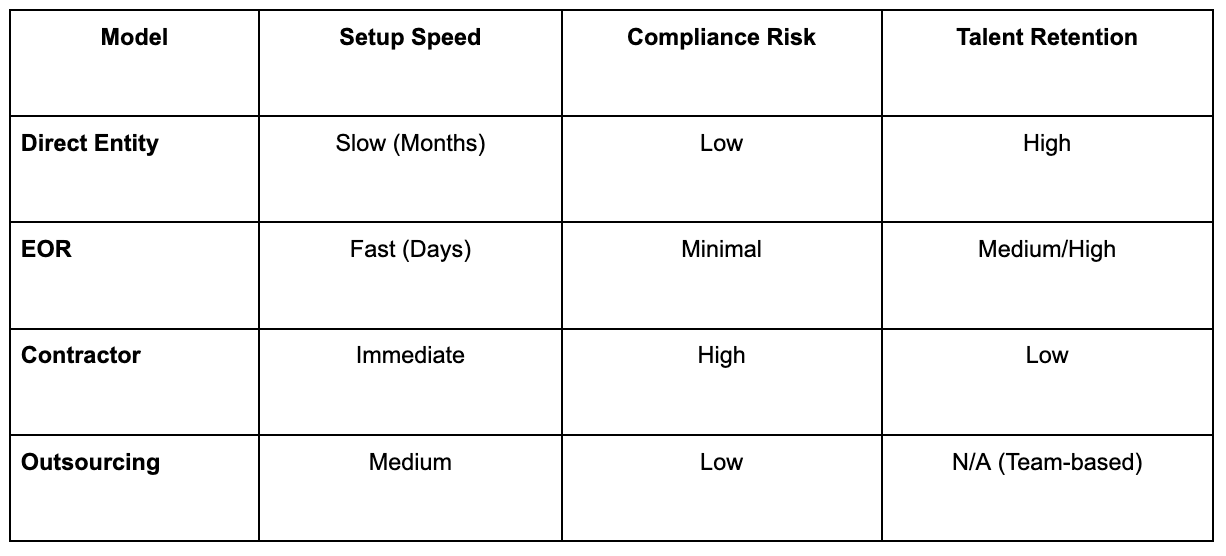
Which One Wins for Your Business?
If you are running a high-growth startup, speed is your primary currency. You likely don’t have six months to wait for a local business license in Estonia or Vietnam. For this stage, the Employer of Record (EOR) model usually wins because it allows you to issue a compliant offer letter in a matter of clicks.
Startups often prioritize "talent density" over long-term infrastructure. According to a 2025 State of Global Hiring Report by Deel, startups increased their international hiring by 25% year-over-year to fill specialized roles in AI and cybersecurity. By using an EOR, you bypass the $15,000+ setup costs associated with foreign entities while ensuring you aren't accidentally violating local labor laws.
Cost-to-Output Ratios: Ranking by ROI.
When you rank remote hiring models by financial efficiency, the Independent Contractor model initially appears to be the cheapest. You avoid payroll taxes, benefits, and insurance. However, the "true cost" often includes higher turnover and potential fines for legal reclassification.
For many businesses, the Nearshore Outsourcing model offers the best ROI. You get the benefit of a dedicated team in a similar time zone, like a New York firm hiring in Colombia, at a significantly lower labor cost. According to Korn Ferry, the global talent crunch could result in $8.5 trillion in unrealized annual revenues by 2030; nearshoring helps close that gap without the high price tag of Silicon Valley or London salaries.
The Future Outlook: Why Remote is Non-Negotiable.
The data is clear: the "office-first" era hasn't just paused; it has evolved. Future-proofing your business means adopting a model that can scale regardless of physical geography. You aren't just looking for a way to save on rent; you are looking for a way to access the 99% of the world's talent that doesn't live within driving distance of your headquarters.
According to Upwork, by 2026, an estimated 27% of the American workforce will be fully remote. This shift is mirrored globally, as digital nomad visas and remote-work legislation become the norm in over 50 countries. Choosing a model today isn't just about this year's headcount, it's about where your company will stand in the global marketplace five years from now.
Ready to Hire Remote Talent?
Choosing the right remote hiring model is no longer a matter of administrative convenience; it is a core strategy for staying competitive in a globalized market. As you’ve seen, the transition from local to borderless talent can reduce overhead significantly, but only if you align your structure with your long-term operational goals.
At Hire South, we specialize in making this transition seamless by bridging the gap between North American businesses and the top 1% of talent in Latin America. We know that 75% of U.S. employers currently struggle to find skilled workers domestically, according to WFTV. Our nearshore model solves this by providing pre-vetted, high-performing professionals in your own time zone, typically resulting in cost savings of 30% to 70% compared to U.S.-based hires, according to our internal placement data.
Whether you need a single specialist or a full-scale outsourced team, we handle the recruiting, vetting, and compliance so you can focus on scaling your business. With an average time-to-hire of just 16 days, we help you move faster without the typical risks of international expansion. Book a call to start hiring today!
.jpg)