


Leaving a technical seat empty might look like a simple line item saving you a salary, but the reality is much harsher. In fact, according to Deloitte's recruitment efficiency research, an unfilled technical role costs companies roughly $500 per day in lost productivity and project delays. Stretch that across a standard hiring timeline, and you are quietly bleeding tens of thousands of dollars long before a new engineer even signs an offer letter.
In this article, you will discover the true financial impact of tech vacancies, how open roles trigger team burnout, and why temporary savings actually hurt your bottom line. You will also get a practical formula to calculate your exact vacancy costs, alongside proven strategies to fill your critical engineering seats much faster.
What is the True Cost of an Unfilled Tech Role in Today’s Market?
Why an Unfilled Tech Role Costs More Than Saved Salary.
An empty desk on your engineering or IT team looks like a temporary cost reduction on a monthly spreadsheet. When a $130,000 developer role sits open, your ledger reflects roughly $10,800 in unspent monthly payroll. That apparent saving, however, is an illusion that conceals massive daily losses.
According to recruitment data from Deloitte, an unfilled technical role costs a company approximately $500 per day in lost productivity, delayed projects, and operational drag. Over a single month, that single open seat drains around $15,000.
The underlying issue stems from a fundamental misunderstanding of technical labor. Non-technical seats often perform routine operational work, whereas technical talent builds core products, automates costly manual tasks, and protects revenue infrastructure. Leaving a core developer position empty does not pause spending; it pauses output while your fixed operational costs remain constant.
Unfilled Tech Role Benchmarks: Time-to-Fill Metrics.
Filling technical positions takes significantly longer than standard corporate hires. Knowing how long these seats typically sit vacant helps you forecast the total hit to your budget.
According to Society for Human Resource Management (SHRM) benchmark reports, the average time to fill a non-executive position is roughly 44 to 54 days. Specialized technical roles, however, frequently remain vacant for much longer. According to findings from CCS Learning Academy, senior data science, cloud architecture, and specialized engineering roles take an average of 70.5 days to hire.
During that ten-week gap, the financial damage compounds steadily:
- Standard Software Engineer (44-day vacancy): Results in $22,000 in lost productivity.
- Senior Data Scientist or Architect (70-day vacancy): Generates over $35,000 in direct operational drag.
- Multiple Open Roles (Three engineering seats open for 44 days): Creates a vacancy loss exceeding $66,000 before adding a single recruiter invoice.
Tech talent scarcity explains why these timeframes remain so long. According to Robert Half's tech team research, 87% of technology leaders face severe challenges sourcing skilled talent. You are rarely hiring from an active pool of unemployed workers. Instead, you are competing to pull gainfully employed talent away from other firms.
Daily Revenue Loss and Project Slippage.
Product roadmaps depend on consistent technical execution. When a key developer seat goes unfilled, sprint velocity drops, forcing project managers to push back release dates.
A two-month delay on a customer-facing product update or software feature carries cascading financial consequences:
- Delayed Time-to-Market: Competitors release features first, capturing market share that requires significantly more marketing spend to regain later.
- Deferred ARR (Annual Recurring Revenue): Pushing back a product launch by 60 days means forfeiting two full months of new subscription revenue that can never be recovered.
- SLA Breach Penalties: Understaffed infrastructure and cybersecurity teams struggle to maintain system uptime, leading to Service Level Agreement (SLA) breaches and client refund payouts.
According to analysis from IDC, global IT skills shortages and open technical roles will result in $5.5 trillion in corporate losses due to product delays, missed execution, and operational inefficiencies.
True Cost of Open Roles Beyond HR Budgets.
When estimating vacancy costs, financial leaders often look only at direct recruitment spending. They tally candidate sourcing fees, job board subscriptions, and agency recruitment costs.
According to research from ScoutLogic, standard technical recruitment overhead runs between $6,200 and $8,000 per hire. That figure, however, represents only a fraction of your real total cost.
According to data confirmed by SHRM and the U.S. Small Business Administration, an employee's fully loaded cost is 1.25 to 1.4 times their base salary once payroll taxes, equipment, software licensing, and healthcare overhead are factored in. According to Mercer, health insurance alone adds an average of $17,496 annually per technical employee.
When you leave a seat open, you do not simply freeze that expenditure. Instead, you shift those hidden overhead costs onto existing engineering teams through overtime, expensive temporary fixes, or external contractors who charge two to three times standard internal rates. Evaluating the true expense of an open role requires measuring total product output lost, not just what HR pays to post a job listing.
The Human and Team Impact: The Cost of Open Roles on Workplace Culture
1. The Burnout Spiral of Overburdened Tech Teams
When a technical role stays open, the work does not vanish. It gets distributed among the engineers who remain. Team members quietly stretch their hours to cover extra sprint tickets, run late-night system deployments, and respond to off-hours monitoring alerts. What starts as a brief push to cross the finish line quickly morphs into an unsustainable baseline.
According to workplace research from Gallup, overextended employees are 63 percent more likely to take a sick day and half as likely to discuss performance goals with their manager. Chronic overload rapidly degrades focus and problem-solving abilities.
When senior developers burn out, they stop proactively refactoring code or mentoring junior staff. They pivot to survival mode, handling only immediate surface-level fixes while overall project momentum slows down.
2. Cascading Resignations and Secondary Turnover Costs
An unfilled role places a heavy strain on team stability. Exhausted developers who feel forced to handle two full workloads eventually start looking elsewhere. This triggers a destructive chain reaction: one open seat leads to a second exit, multiplying your recruitment costs and team disruption.
According to benchmark turnover data from Gallup, replacing a single specialized technical employee costs between 80 percent and 200 percent of their annual salary once lost productivity, onboarding, and recruiting expenses are calculated.
Losing a seasoned developer means losing institutional knowledge that cannot be recovered through a standard job posting. According to retention research from the Work Institute, 75 percent of voluntary employee exits are fully preventable. Leaving a position vacant for months signals to your team that their workload and well-being are secondary priorities.
3. Escalating Technical Debt and Declining Code Quality
Speed and thoroughness rarely mix well on understaffed tech teams. When forced to meet aggressive launch deadlines with fewer people, engineers naturally skip best practices to ship features on time.
This rushed execution creates immediate quality issues across your technical stack:
- Skipped Automated Testing: Developers bypass unit and integration tests to move code into production faster, raising bug rates.
- Architectural Shortcuts: Temporary patches are applied directly to live systems instead of building clean, scalable software frameworks.
- Outdated Documentation: Internal systems go undocumented because developers lack the bandwidth to write guidebooks, making future onboarding harder.
According to engineering analysis from Consortium for Information & Software Quality (CISQ), poor software quality and accumulated technical debt cost U.S. organizations over $2.41 trillion annually in operational defects, legacy system maintenance, and cybersecurity vulnerabilities.
4. Morale Erosion and Breakdown in Daily Collaboration
An understaffed engineering team changes the social and operational dynamics of your workplace. When people are constantly underwater, cross-functional collaboration suffers.
Engineers start skipping non-essential syncs, communication with product managers becomes abrupt, and friction builds between development and operations teams. Innovation dies in this type of environment. Employees stop proposing fresh architectural ideas or experimenting with new tools because they simply lack the cognitive bandwidth to handle anything beyond their daily workload.
Leaving a technical role open for an extended period creates a culture of daily firefighting. That continuous stress environment quietly drives away your best problem solvers long before you notice a slump in your quarterly output.
How to Eliminate Open Roles Costs and Fill Critical Tech Vacancies Faster
1. Optimizing Your Technical Interview Process
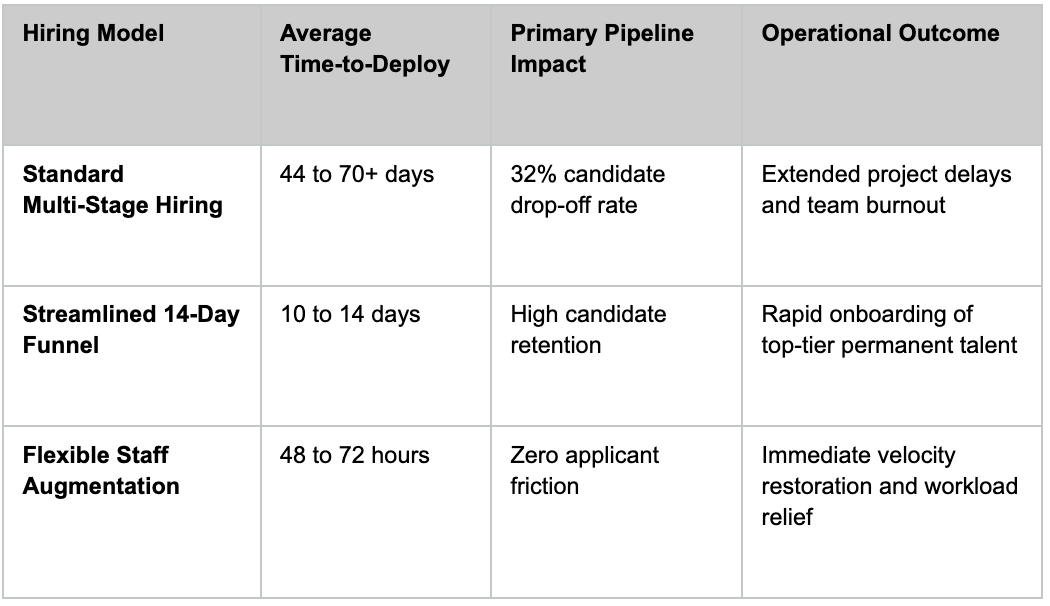
Multi-stage technical interviews often take too long, driving away qualified applicants. When your hiring process drags past three or four weeks, top candidates accept competing offers. According to industry benchmark data from Pin, the interview stage accounts for 32 percent of all candidate drop-off, making it the single largest leak in the recruiting funnel.
Streamlining your evaluation steps protects your candidate pipeline. First, eliminate unnecessary take-home projects that require 10 to 15 hours of unpaid labor, as these lead to immediate applicant abandonment. Next, consolidate panel rounds by combining system design reviews, team fit checks, and leadership conversations into a single, cohesive two-hour session. Finally, cap your total hiring timeline at 14 days. According to SelectSoftwareReviews data, top tech talent stays active on the job market for an average of just 10 days, so setting a tight two-week deadline from first contact to offer prevents candidate drop-off.
2. Leveraging Flexible Staff Augmentation Immediately
You do not need to wait for a permanent, full-time hire to keep crucial engineering projects on track. Flexible staff augmentation allows you to bring in specialized contract engineers to maintain development velocity while your internal recruiting team searches for a long-term fit.
Deploying external specialized talent functions as a circuit breaker for team fatigue. It brings average time-to-deploy down from months to a few days, shifting costs to a variable operational spend rather than a fixed payroll commitment. This approach halts product launch delays, prevents burnout among your core team, and gives you the leverage to hire for quality rather than rushing a permanent decision out of desperation.
3. Employer Branding That Attracts Passive Engineering Talent
Posting jobs on standard job boards rarely reaches senior technical talent. High-performing software architects and senior engineers are almost always gainfully employed and not actively browsing job listings. Winning their attention requires an attractive employer brand. Data from Glassdoor shows that 86 percent of job seekers research company reviews and employer ratings before applying for a role.
To stand out to passive tech talent, highlight the specific details developers care about most in your public profile. Start by providing total transparency into your tech stack, documenting the modern tools, languages, and cloud infrastructure your team uses every day. Next, showcase clear work-life boundaries by demonstrating how your organization actively prevents developer burnout, avoids mandatory weekend deployments, and handles on-call rotations fairly. Finally, publish an engineering blog or contribute to open-source projects, encouraging senior staff to write about how they solve complex architectural problems to attract ambitious problem-solvers.
4. Targeted Sourcing Channels to Shorten Time-to-Fill
Relying on incoming application volume often leads to a stack of underqualified resumes. Shortening your hiring timeline requires shifting from passive inbound recruiting to proactive, targeted sourcing. Data from CareerPlug reveals that only 6 percent of candidates who click an online job ad actually complete the application.
To build a stronger candidate pipeline faster, move your sourcing efforts directly to developer-centric communities like GitHub, Stack Overflow, or dedicated Slack groups focused on specific frameworks. Additionally, establish robust employee referral programs that offer competitive financial incentives to internal staff, as internal referrals consistently yield higher offer acceptance rates and stronger onboarding retention. Lastly, utilize data-driven direct outreach by personalizing initial recruiting messages around specific open-source contributions or technical accomplishments, as targeted communication earns significantly higher response rates than generic recruiter pitches.
Ready to Hire Tech Specialists in Latin America?
Leaving critical technical positions empty turns quiet productivity loss into direct financial damage. Between delayed product roadmaps, burning out your remaining engineers, and paying steep temporary contractor markups, every day an open role sits vacant actively hurts your bottom line. Waiting months to secure local candidates through traditional recruitment channels simply costs too much.
At Hire South, we eliminate the heavy financial burden of unfilled tech roles by connecting your business with top-tier, pre-vetted LATAM talent. By leveraging nearshore staff augmentation and direct sourcing across Latin America, we match you with senior-level engineers and IT professionals who work in your time zone, speak fluent English, and integrate directly into your team. Our end-to-end service reduces your time-to-hire down to an average of just 16 days while slashing overall hiring costs by up to 30% to 70% compared to US-based salaries.
Stop losing revenue to open seats and let our team help you build a scalable, high-performing tech team today! Ready to hire tech specialists in Latin America? Book a free discovery call today!